

The DOI matches its Crossref record; 87 of the 89 references it cites were found in a registry or an index.
Physician Emigration from Sub-Saharan Africa to the United States: Analysis of the 2011 AMA Physician Masterfile
Open accessAbstract
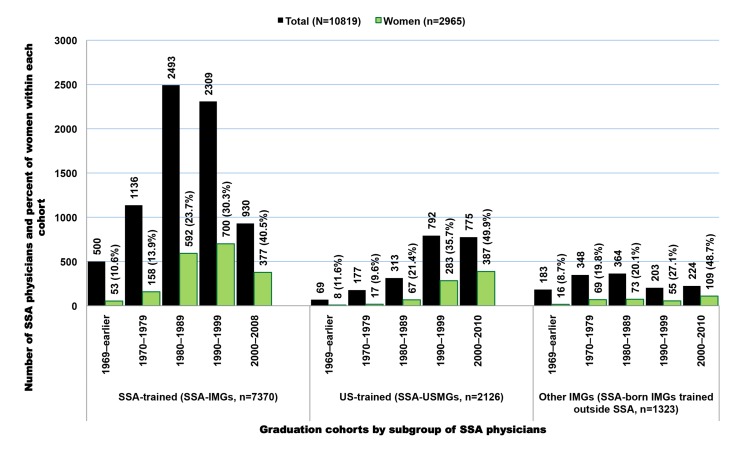
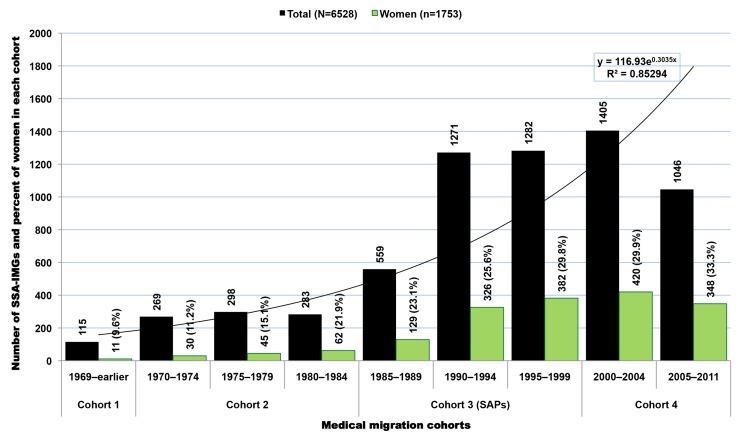
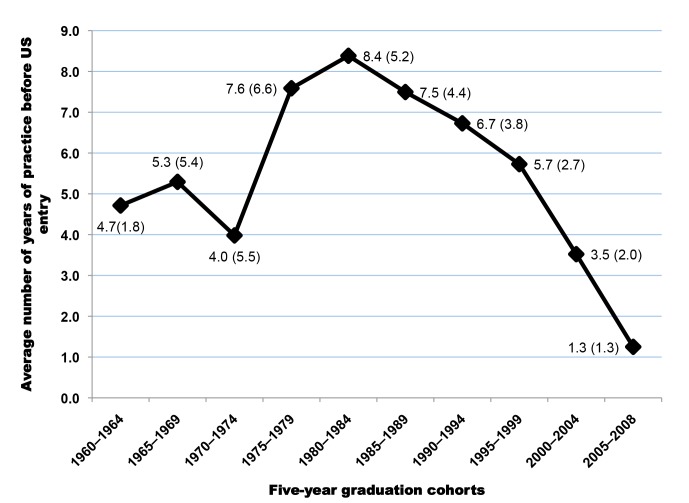
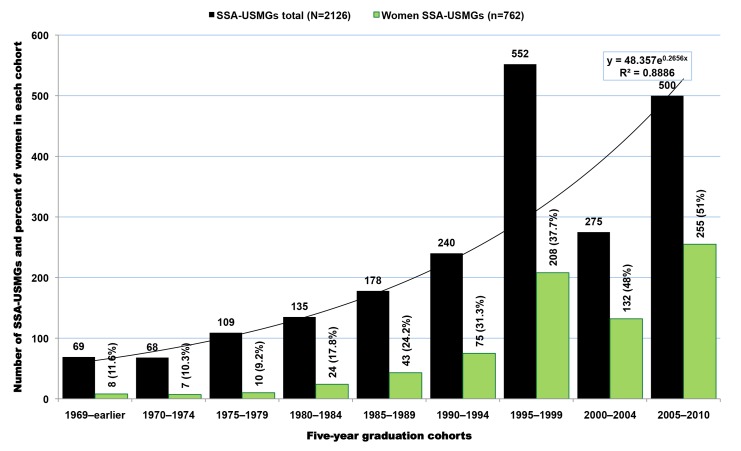
BACKGROUND: The large-scale emigration of physicians from sub-Saharan Africa (SSA) to high-income nations is a serious development concern. Our objective was to determine current emigration trends of SSA physicians found in the physician workforce of the United States. METHODS AND FINDINGS: We analyzed physician data from the World Health Organization (WHO) Global Health Workforce Statistics along with graduation and residency data from the 2011 American Medical Association Physician Masterfile (AMA-PM) on physicians trained or born in SSA countries who currently practice in the US. We estimated emigration proportions, year of US entry, years of practice before emigration, and length of time in the US. According to the 2011 AMA-PM, 10,819 physicians were born or trained in 28 SSA countries. Sixty-eight percent (n = 7,370) were SSA-trained, 20% (n = 2,126) were US-trained, and 12% (n = 1,323) were trained outside both SSA and the US. We estimated active physicians (age ≤ 70 years) to represent 96% (n = 10,377) of the total. Migration trends among SSA-trained physicians increased from 2002 to 2011 for all but one principal source country; the exception was South Africa whose physician migration to the US decreased by 8% (-156). The increase in last-decade migration was >50% in Nigeria (+1,113) and Ghana (+243), >100% in Ethiopia (+274), and >200% (+244) in Sudan. Liberia was the most affected by migration to the US with 77% (n = 175) of its estimated physicians in the 2011 AMA-PM. On average, SSA-trained physicians have been in the US for 18 years. They practiced for 6.5 years before US entry, and nearly half emigrated during the implementation years (1984-1999) of the structural adjustment programs. CONCLUSION: Physician emigration from SSA to the US is increasing for most SSA source countries. Unless far-reaching policies are implemented by the US and SSA countries, the current emigration trends will persist, and the US will remain a leading destination for SSA physicians emigrating from the continent of greatest need. Please see later in the article for the Editors' Summary.
Overview
The claims and statistics of this paper haven’t been checked yet.
Run the check — free, no account needed. It reads the open-access text and checks the sources it cites.
Integrity signals
Registry
Cites
Statistics
Figures
Verification
Claims the paper makes
The claims and statistics of this paper haven’t been checked yet.
Run the check — free, no account needed. It reads the open-access text and checks the sources it cites.
Claims other papers make about this one
Each is checked against this paper’s own text: does it say what the citing paper says it does?
The source backs part of the claim, not all of it — or backs it for a different population, condition or comparison.
In the citing paper
“Africa is a continent plagued by continuous and massive emigration of clinicians to technologically advanced and high income countries [29].”
From The dentist-scientist career pathway in Africa: opportunities and obstacles (2018) · cites this paper as [29]
Experimental — accuracy not yet measured
Self-check
Percentages, sums and reported differences re-computed from the paper’s own numbers.
The self-check needs the paper’s full text.
Citations
Cites
Murray, C. J. L., Vos, T., Lozano, R., Naghavi, M., Flaxman, A. D., Michaud, C., Ezzati, M., Shibuya, K., Salomon, J. A., Abdalla, S., et al. (2012) · The Lancet · doi:10.1016/s0140-6736(12)61689-4 · Cited by 8,888
The age of migration: international population movements in the modern world
(1994) · Choice Reviews Online · doi:10.5860/choice.32-0553 · Cited by 2,483
McNutt, M. K. (2017) · Human Rights Documents online · doi:10.1163/2210-7975_hrd-9978-20190011 · Cited by 1,183
Patient-Physician Racial Concordance and the Perceived Quality and Use of Health Care
Saha, S., Komaromy, M., Koepsell, T. D., & Bindman, A. B. (1999) · Archives of Internal Medicine · doi:10.1001/archinte.159.9.997 · Cited by 1,125
The Role of Black and Hispanic Physicians in Providing Health Care for Underserved Populations
Komaromy, M., Grumbach, K., Drake, M., Vranizan, K., Lurie, N., Keane, D., & Bindman, A. B. (1996) · New England Journal of Medicine · doi:10.1056/nejm199605163342006 · Cited by 915
Democracy and the “Washington consensus”
Williamson, J. (1993) · World Development · doi:10.1016/0305-750x(93)90046-c · Cited by 874
The Metrics of the Physician Brain Drain
Mullan, F. (2005) · New England Journal of Medicine · doi:10.1056/nejmsa050004 · Cited by 758
Health, United States, 2011: With Special feature on Socioeconomic Status and Health
(2012) · PsycEXTRA Dataset · doi:10.1037/e582072012-001 · Cited by 477
Physician Race and Care of Minority and Medically Indigent Patients
Moy, E. M. (1995) · JAMA · doi:10.1001/jama.1995.03520430051038 · Cited by 451
Hagopian, A., Thompson, M., Fordyce, M. A., Johnson, K. E., & Hart, L. G. (2004) · Human Resources for Health · doi:10.1186/1478-4491-2-17 · Cited by 425
Research works printed but not linked: 12
- Alkire S, Chen L (2005) Medical exceptionalism in international migration: should doctors and nurses be treated differently? Tamas K, Palme J, editors. Globalizing migration regimes: new challenges to transnational cooperation. Burlington: Ashgate Publishing Company. pp. 100–117.
- American Medical Association - How the data elements of the AMA physician Masterfile are collected, maintained, and verified. Available: http://www.ama-assn.org/ama1/pub/upload/mm/eProfiles/mm/primarysource.pdf. Accessed 14 February 2013.
- American Medical Association – More about AMA database licensing. Available: http://www.ama-assn.org/ama/pub/about-ama/physician-data-resources/ama-database-licensing/more-about-ama-database-licensing.page? Accessed 17 February 2013.
- P Curtis, 2005, GMC launches inquiries into private medical schools, The Guardian
- J West, 2005, NTLA orders ‘bogus’ St. Luke University closed, Liberian Observer
- The Structural Adjustment Participatory Review International Network (2004) Structural adjustment: The SAPRI report. The policy roots of economic crisis, poverty and inequality. London & New York: Zed Books. 242 p.
- Cornia AG, Jolly R, Stewart F (1987) Adjustment with a human face: country case studies. Oxford: Clarendon Press. 328 p.
- TL Friedman, 2010, Start-ups, not bailouts, The New York Times
- H Goodall, 2008, More foreign science and engineering grad students flock to U.S., new survey finds, Chron High Educ
- J Jacobson, 2003, Foreign-student enrollment stagnates, Chron High Educ
- E McCormack, 2005, Enrollment of foreign students fall for a 2nd year, Chron High Educ, A1
- S Brill, 2013, Bitter pill: why medical bills are killing us, Time Magazine
Cited by
Sorted by citations
The Lancet Nigeria Commission: investing in health and the future of the nation
Abubakar, I., Dalglish, S. L., Angell, B. J., Sanuade, O. A., Abímbọ́lá, Ṣ., Adamu, A. L., Adetifa, I., Colbourn, T., Ogunlesi, A. O., Onwujekwe, O. E., et al. (2022) · The Lancet · doi:10.1016/s0140-6736(21)02488-0 · Cited by 433
The global diabetes epidemic: what does it mean for infectious diseases in tropical countries?
van Crevel, R., van de Vijver, S. J. M., & Moore, D. (2016) · The Lancet Diabetes & Endocrinology · doi:10.1016/s2213-8587(16)30081-x · Cited by 160
HIV and Noncommunicable Disease Comorbidities in the Era of Antiretroviral Therapy
Narayan, K. M. V., Miotti, P., Anand, N. P., Kline, L., Harmston, C., Gulakowski, R., & Vermund, S. H. (2014) · JAIDS Journal of Acquired Immune Deficiency Syndromes · doi:10.1097/qai.0000000000000267 · Cited by 144
Self-citationOnah, C. K., Azuogu, B. N., Ochie, C. N., Akpa, C. O., Okeke, K. C., Okpunwa, A. O., Bello, H. M., & Ugwu, G. O. (2022) · Human Resources for Health · doi:10.1186/s12960-022-00788-z · Cited by 101
Dohlman, L., DiMeglio, M., Hajj, J., & Laudanski, K. (2019) · International Journal of Environmental Research and Public Health · doi:10.3390/ijerph16071182 · Cited by 100
Metadata
- Authors
- Tankwanchi, A. B. S., Özden, Ç., & Vermund, S. H.
- Affiliations
- Vanderbilt University (US)
- World Bank (US)
- Corresponding author
- Tankwanchi, Akhenaten Benjamin Siankam
- Venue
- PLoS Medicine
- Publisher
- Public Library of Science (PLoS)
- Published
- 2013-09-17
- Volume
- 10
- Issue
- 9
- Pages
- e1001513
- ISSN
- 1549-1277 (ISSN-L)
- 1549-1676
- PMC
- PMC3775724
- OpenAlex
- W2150437981
- Cited by
- 117
- References
- 89
- Citations by year
- 2026: 5 · 2025: 6 · 2024: 10 · 2023: 5 · 2022: 3 · 2021: 9 · 2020: 12 · 2019: 5 · 2018: 4 · 2017: 10 · 2016: 19 · 2015: 11 · 2014: 15 · 2013: 2
- FWCI
- 24.31
- Type
- journal article
- Language
- en
- Update notices
- correction (2013-12-16)
- Open access
- gold
- doi.org
- Locations
- PLoS Medicine (publishedVersion, cc-by)
- Europe PMC (PubMed Central) (publishedVersion, cc-by)
- PubMed Central (publishedVersion, cc-by)
- PubMed (publishedVersion)
- RePEc: Research Papers in Economics (publishedVersion)
- DOAJ (DOAJ: Directory of Open Access Journals) (submittedVersion, cc-by-sa)
- Figshare (submittedVersion, cc-by)
- Funders
- World Bank Group
- Vanderbilt University
- Topics
- Health Sciences › Medicine › Public Health, Environmental and Occupational Health › Global Health Workforce Issues
- Health Sciences › Medicine › Public Health, Environmental and Occupational Health › Global Health and Surgery
- Social Sciences › Sociology and Political Science › Migration and Labor Dynamics
- Keywords
- physician emigration, brain drain, sub-Saharan Africa, physician migration, structural adjustment programs, residency training, migration trends, Liberia, Nigeria, South Africa, Ghana, Ethiopia, Sudan, health workforce policy
- MeSH terms
- Adult, American Medical Association, Demography, Emigration and Immigration, Foreign Medical Graduates, Humans, Internship and Residency, Medicine, Middle Aged, Physicians, Schools, Medical, United States, Africa South of the Sahara, Internationality
About these checks
Registry, retraction, Cites and statistics results are computed, not judged, with one exception: a printed reference that no index lists is read once by a model before it counts as a citation error. Claims are extracted by a model and kept only when their quote appears verbatim in the text; each cited source is then checked, with a model’s help, for whether it says what the claim relies on. Those verdicts can be wrong — read the claim’s quote and the cited source before relying on one.
Statistics and arithmetic are recomputed, not judged.
Confidence bands are shown only for fields calibrated on our annotated test set. None is calibrated yet, so no band is shown.
What counts as a claim ›How we measure confidence ›How we check this ›
Are you an author, or do you see a problem with this page? Request a review
