

Trade challenges at the World Trade Organization to national noncommunicable disease prevention policies: A thematic document analysis of trade and health policy space
Open accessThe DOI matches its Crossref record; 42 of the 43 references it cites were found in a registry or an index, and 1 are not checked yet.
Abstract
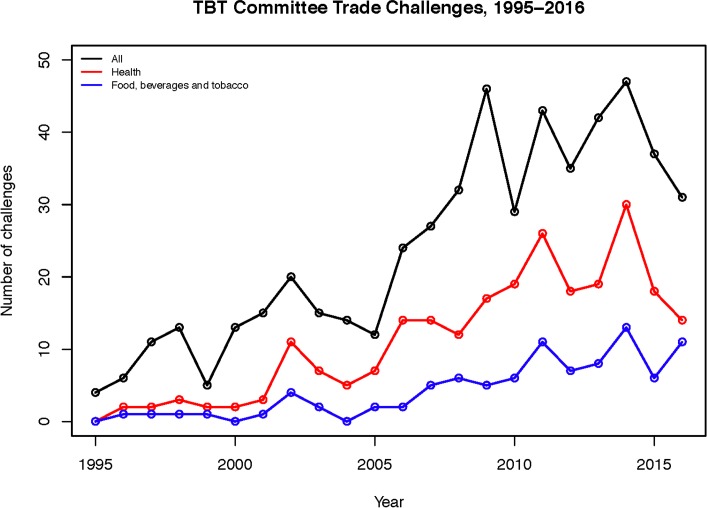
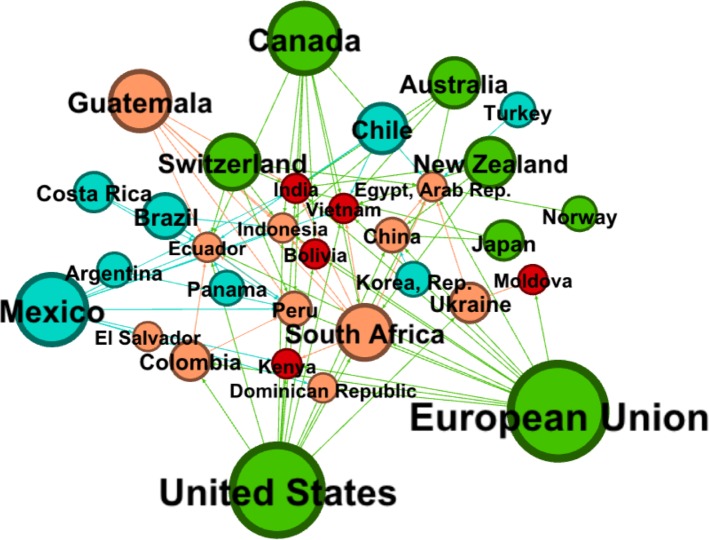
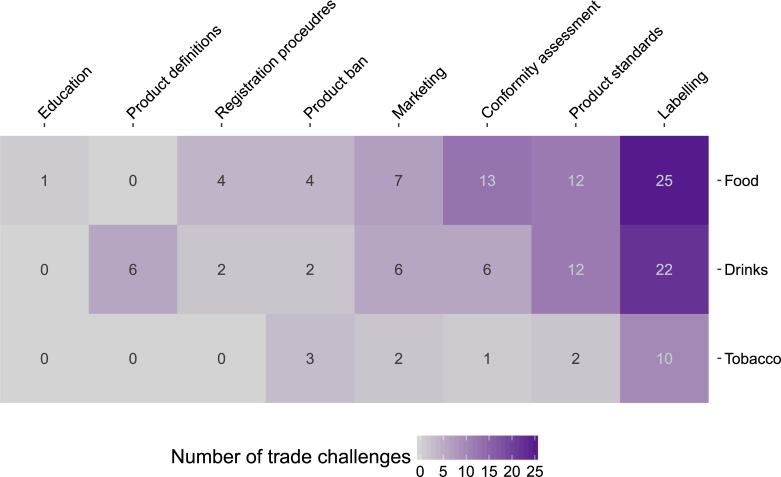
BACKGROUND: It has long been contested that trade rules and agreements are used to dispute regulations aimed at preventing noncommunicable diseases (NCDs). Yet most analyses of trade rules and agreements focus on trade disputes, potentially overlooking how a challenge to a regulation's consistency with trade rules may lead to 'policy or regulatory chill' effects whereby countries delay, alter, or repeal regulations in order to avoid the costs of a dispute. Systematic empirical analysis of this pathway to impact was previously prevented by a dearth of systematically coded data. METHODS AND FINDINGS: Here, we analyse a newly created dataset of trade challenges about food, beverage, and tobacco regulations among 122 World Trade Organization (WTO) members from January 1, 1995 to December 31, 2016. We thematically describe the scope and frequency of trade challenges, analyse economic asymmetries between countries raising and defending them, and summarise 4 cases of their possible influence. Between 1995 and 2016, 93 food, beverage, and tobacco regulations were challenged at the WTO. 'Unnecessary' trade costs were the focus of 16.4% of the challenges. Only one (1.1%) challenge remained unresolved and escalated to a trade dispute. Thirty-nine (41.9%) challenges focussed on labelling regulations, and 18 (19.4%) focussed on quality standards and restrictions on certain products like processed meats and cigarette flavourings. High-income countries raised 77.4% (n = 72) of all challenges raised against low- and lower-middle-income countries. We further identified 4 cases in Indonesia, Chile, Colombia, and Saudi Arabia in which challenges were associated with changes to food and beverage regulations. Data limitations precluded a comprehensive evaluation of policy impact and challenge validity. CONCLUSIONS: Policy makers appear to face significant pressure to design food, beverage, and tobacco regulations that other countries will deem consistent with trade rules. Trade-related influence on public health policy is likely to be understated by analyses limited to formal trade disputes.
Overview
The claims and statistics of this paper haven’t been checked yet.
Free: it reads the open-access text and checks the first 5 claims that cite a source we can check. Create a free account to check every claim.
Integrity signals
Registry
Cites
Statistics
Figures
Verification
Claims the paper makes
The claims and statistics of this paper haven’t been checked yet.
Free: it reads the open-access text and checks the first 5 claims that cite a source we can check. Create a free account to check every claim.
Claims other papers make about this one
Each is checked against this paper’s own text: does it say what the citing paper says it does?
In the citing paper
“At the international level, the Codex Alimentarius Commission, the UN food standardsetting body, has faced intensive lobbying as it often functions as the de-facto benchmark for food regulatory agencies in low and middle-income countries, as well as the reference standard used in WTO trade disputes 212 .”
From Ultra‐processed foods and the nutrition transition: global, regional and national trends, food systems transformations and political economy drivers (2020) · cites this paper as [212]
Self-check
Percentages, sums and reported differences re-computed from the paper’s own numbers.
The self-check needs the paper’s full text.
Citations
Cites
Transforming Our World: The 2030 Agenda for Sustainable Development
(2018) · A New Era in Global Health · doi:10.1891/9780826190123.ap02 · Cited by 19,351
Awais, A. (2015) · Data Archiving and Networked Services (DANS) · doi:10.17632/zcvgc6m58h.1 · Cited by 6,707
Democracy Barometer. Methodology. Version 4.
Merkel, W., Bochsler, D., Bousbah, K., Bühlmann, M., Giebler, H., Hänni, M., Heyne, L., Müller, L., Ruth, S., & Weßels, B. (2004) · Intellectum (Universidad de La Sabana) · doi:10.1007/s13398-014-0173-7.2 · Cited by 2,331
The Global Diffusion of Public Policies: Social Construction, Coercion, Competition, or Learning?
Dobbin, F., Simmons, B., & Garrett, G. (2007) · Annual Review of Sociology · doi:10.1146/annurev.soc.33.090106.142507 · Cited by 1,379
Bargaining, Enforcement, and International Cooperation
Fearon, J. D. (1998) · International Organization · doi:10.1162/002081898753162820 · Cited by 1,149 · cited 1×
“However, political economy analyses of conflict have observed that an emphasis on overt and formal conflicts, like formal WTO disputes, may obscure a substantially more significant ‘hidden hand’ of influence: how a challenge to a regulation’s consistency with trade rules raised in an intergovernmental committee may le…”
BackgroundThe design of international trade agreements: Introducing a new dataset
Dür, A., Baccini, L., & Elsig, M. (2013) · The Review of International Organizations · doi:10.1007/s11558-013-9179-8 · Cited by 889 · cited 1×
“In addition, WTO debates may provide an insight into the challenges that may be raised elsewhere because the clauses in many subsequent agreements built upon and expanded WTO rules [14,47,48].”
BackgroundGlobal strategy to reduce the harmful use of alcohol
Ray, R., & Anish, P. K. (2012) · The Indian Journal of Medical Research · Cited by 888
(2007) · Your Psychology Project: The Essential Guide · doi:10.4135/9781446213667.n18 · Cited by 807
The Design of International Trade Agreements: Introducing a New Dataset
Elsig, M., Dür, A., & Baccini, L. (2014) · doi:10.7892/boris.49460 · Cited by 745
The political origins of health inequity: prospects for change
Ottersen, O. P., Dasgupta, J., Blouin, C., Buss, P., Chongsuvivatwong, V., Frenk, J., Fukuda-Parr, S., Gawanas, B. P., Giacaman, R., Gyapong, J., et al. (2014) · The Lancet · doi:10.1016/s0140-6736(13)62407-1 · Cited by 683
Research works printed but not linked: 2
- UNSCN. Enhancing Coherence between Trade Policy and Nutrition Action: Implementing the Framework for Action of the Second International Conference on Nutrition. Geneva, Switzerland; 2015. Available from: https://www.unscn.org/files/ICN2_TPM/UNSCN_Discussion_Paper_1_Trade_and_Nutrition_2015rev_en.pdf [cited 26 September 2017].
- Shalhoub L. New tax doubles price of cigarettes, energy drinks in Saudi Arabia. In: Arab News. 2017 Available from: http://www.arabnews.com/node/1113771/saudi-arabia. [cited 20 Oct 2017].
Cited by
Baker, P., Machado, P., Santos, T., Sievert, K., Backholer, K., Hadjikakou, M., Russell, C., Huse, O., Bell, C., Scrinis, G., et al. (2020) · Obesity Reviews · doi:10.1111/obr.13126 · Cited by 1,194
“mechanisms to challenge food regulations adopted by other countries.(118,212) Furthermore, as suppliers of jobs and tax revenue, the food industry has gained ‘productivist power’ through its importance”
BackgroundCOVID-19 and the collapse of global trade: building an effective public health response
Barlow, P., van Schalkwyk, M. C., McKee, M., Labonté, R., & Stückler, D. (2021) · The Lancet Planetary Health · doi:10.1016/s2542-5196(20)30291-6 · Cited by 135
Self-citationEconomic globalization, nutrition and health: a review of quantitative evidence
Cuevas, S., Cornelsen, L., Smith, R., & Walls, H. (2019) · Globalization and Health · doi:10.1186/s12992-019-0456-z · Cited by 137
“This literature, however, does suggest that the impact of restrictions to the policy space, associated with trade liberalization processes, should not be underestimated, as it can curtail the capacity of governments to protect public health [42].”
BackgroundEvaluating the Impact of COVID-19 on Society, Environment, Economy, and Education
Kumar, V., Alshazly, H. A., Idris, S. A., & Bourouis, S. (2021) · Sustainability · doi:10.3390/su132413642 · Cited by 120
Milsom, P., Smith, R., Baker, P., & Walls, H. (2020) · Health Policy and Planning · doi:10.1093/heapol/czaa148 · Cited by 85
“The dogma that exporting risk commodity industries are essential for economic growth and job creation can also compel governments to pursue the interests of THCCs in trade agreement negotiations and at WTO (Curran and Eckhardt, 2017; Barlow et al., 2018).”
BackgroundInfluential
Metadata
- Authors
- Barlow, P., Labonte, R., McKee, M., & Stuckler, D.
- Affiliations
- University of Oxford (GB)
- London School of Hygiene & Tropical Medicine (GB)
- Corresponding author
- Barlow, Pepita
- Venue
- PLOS Medicine
- Publisher
- Public Library of Science (PLoS)
- Published
- 2018-06-26
- Volume
- 15
- Issue
- 6
- Pages
- e1002590
- ISSN
- 1549-1277 (ISSN-L)
- 1549-1676
- PMC
- PMC6019096
- OpenAlex
- W2811305117
- Cited by
- 58
- References
- 40
- Citations by year
- 2026: 2 · 2025: 1 · 2024: 2 · 2023: 7 · 2022: 9 · 2021: 17 · 2020: 13 · 2019: 6 · 2018: 1
- FWCI
- 15.29
- Type
- journal article
- Language
- en
- Open access
- gold
- doi.org
- Licence
- Locations
- PLoS Medicine (publishedVersion, cc-by)
- Europe PMC (PubMed Central) (publishedVersion, cc-by)
- PubMed Central (publishedVersion, cc-by)
- PubMed (publishedVersion)
- London School of Economics and Political Science Research Online (London School of Economics and Political Science) (acceptedVersion)
- London School of Economics and Political Science Theses Online (London School of Economics and Political Science) (acceptedVersion)
- LSHTM Research Online (London School of Hygiene and Tropical Medicine) (acceptedVersion)
- Archivio istituzionale della Ricerca - Bocconi (submittedVersion, cc-by)
- RePEc: Research Papers in Economics (submittedVersion)
- DOAJ (DOAJ: Directory of Open Access Journals) (submittedVersion, cc-by-sa)
- Figshare (submittedVersion, cc-by)
- Funders
- Wellcome Trust
- European Research Council (313590)
- Topics
- Health Sciences › Medicine › Public Health, Environmental and Occupational Health › Global Public Health Policies and Epidemiology
- Social Sciences › Political Science and International Relations › World Trade Organization Law
- Social Sciences › Economics, Econometrics and Finance › General Economics, Econometrics and Finance › Global trade and economics
- Keywords
- World Trade Organization, trade challenges, non-communicable disease prevention, food regulation, beverage regulation, tobacco regulation, regulatory chill, trade disputes, economic asymmetry, low- and middle-income countries, public health policy
- MeSH terms
- Noncommunicable Diseases, Economics, Health Policy, Humans, International Agencies, International Cooperation, Policy Making
About these checks
Registry, retraction, Cites and statistics results are computed, not judged, with one exception: a printed reference that no index lists is read once by a model before it counts as a citation error. Claims are extracted by a model and kept only when their quote appears verbatim in the text; each cited source is then checked, with a model’s help, for whether it says what the claim relies on. Those verdicts can be wrong — read the claim’s quote and the cited source before relying on one.
Statistics and arithmetic are recomputed, not judged.
Confidence bands are shown only for fields calibrated on our annotated test set. None is calibrated yet, so no band is shown.
What counts as a claim ›How we measure confidence ›How we check this ›
Are you an author, or do you see a problem with this page? Request a review
Data sources
Bibliographic data: Semantic Scholar, OpenAlex, Crossref.
Contains information from the Semantic Scholar Academic Graph Datasets, made available under the ODC Attribution License (ODC-BY 1.0).
Semantic Scholar’s data is described in: Kinney, R., et al. (2023). The Semantic Scholar Open Data Platform. arXiv:2301.10140.
