

The DOI matches its Crossref record; 44 of the 44 references it cites were found in a registry or an index.
Effectiveness of a primary care-based integrated mobile health intervention for stroke management in rural China (SINEMA): A cluster-randomized controlled trial
Open accessAbstract
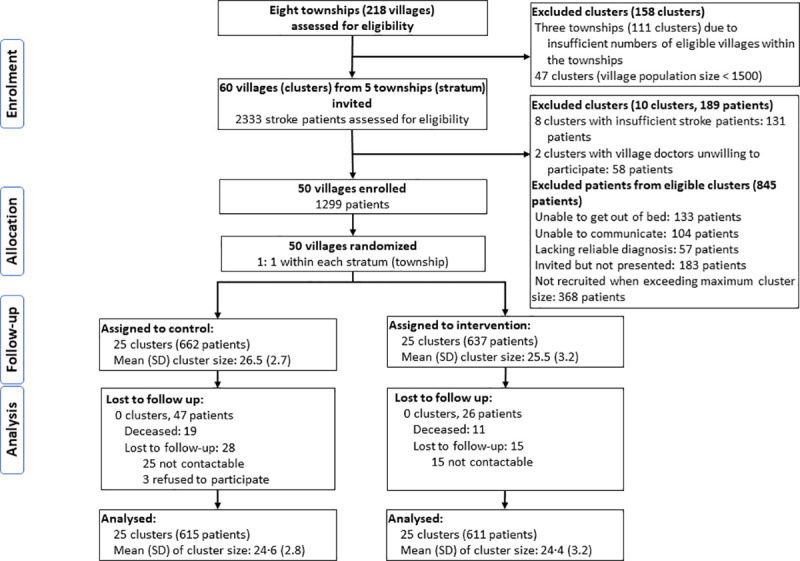
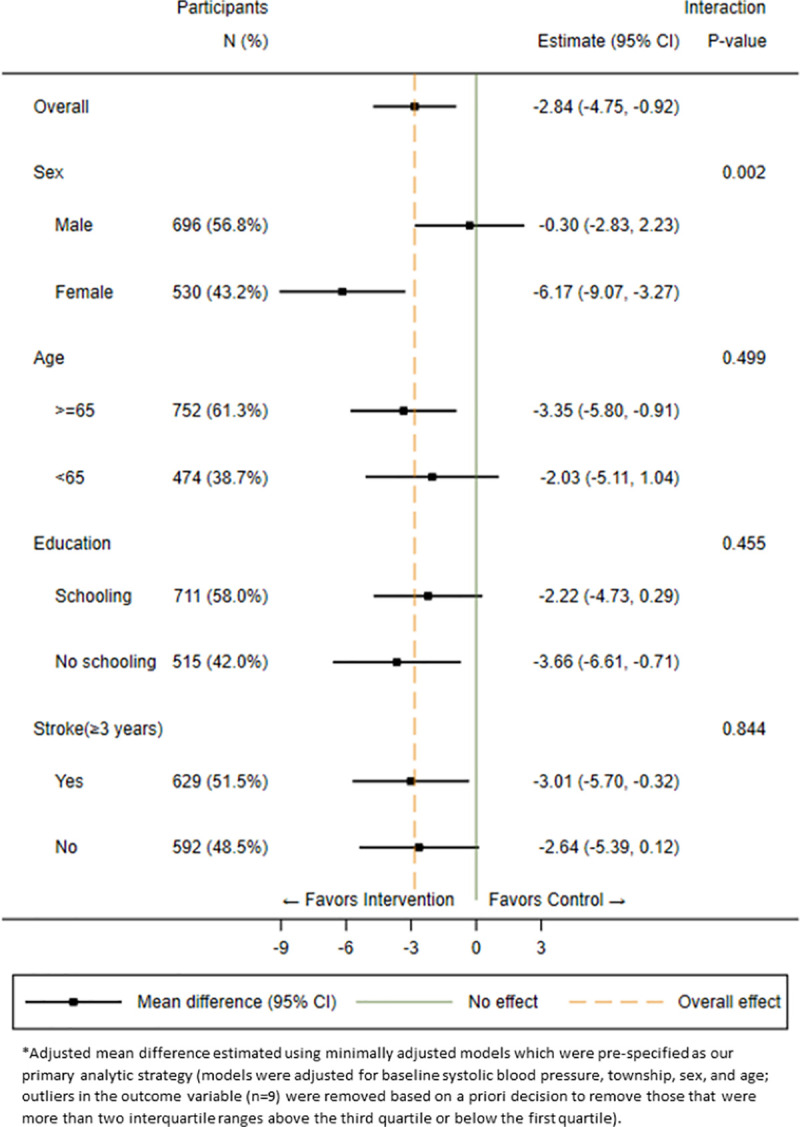
Background: Managing noncommunicable diseases through primary healthcare has been identified as the key strategy to achieve universal health coverage but is challenging in most low- and middle-income countries. Stroke is the leading cause of death and disability in rural China. This study aims to determine whether a primary care-based integrated mobile health intervention (SINEMA intervention) could improve stroke management in rural China. Methods and findings: Based on extensive barrier analyses, contextual research, and feasibility studies, we conducted a community-based, two-arm cluster-randomized controlled trial with blinded outcome assessment in Hebei Province, rural Northern China including 1,299 stroke patients (mean age: 65.7 [SD:8.2], 42.6% females, 71.2% received education below primary school) recruited from 50 villages between June 23 and July 21, 2017. Villages were randomly assigned (1:1) to either the intervention or control arm (usual care). In the intervention arm, village doctors who were government-sponsored primary healthcare providers received training, conducted monthly follow-up visits supported by an Android-based mobile application, and received performance-based payments. Participants received monthly doctor visits and automatically dispatched daily voice messages. The primary outcome was the 12-month change in systolic blood pressure (BP). Secondary outcomes were predefined, including diastolic BP, health-related quality of life, physical activity level, self-reported medication adherence (antiplatelet, statin, and antihypertensive), and performance in “timed up and go” test. Analyses were conducted in the intention-to-treat framework at the individual level with clusters and stratified design accounted for by following the prepublished statistical analysis plan. All villages completed the 12-month follow-up, and 611 (intervention) and 615 (control) patients were successfully followed (3.4% lost to follow-up among survivors). The program was implemented with high fidelity, and the annual program delivery cost per capita was US$24.3. There was a significant reduction in systolic BP in the intervention as compared with the control group with an adjusted mean difference: −2.8 mm Hg (95% CI −4.8, −0.9;p= 0.005). The intervention was significantly associated with improvements in 6 out of 7 secondary outcomes in diastolic BP reduction (p< 0.001), health-related quality of life (p= 0.008), physical activity level (p< 0.001), adherence in statin (p= 0.003) and antihypertensive medicines (p= 0.039), and performance in “timed up and go” test (p= 0.022). We observed reductions in all exploratory outcomes, including stroke recurrence (4.4% versus 9.3%; risk ratio [RR] = 0.46, 95% CI 0.32, 0.66; risk difference [RD] = 4.9 percentage points [pp]), hospitalization (4.4% versus 9.3%; RR = 0.45, 95% CI 0.32, 0.62; RD = 4.9 pp), disability (20.9% versus 30.2%; RR = 0.65, 95% CI 0.53, 0.79; RD = 9.3 pp), and death (1.8% versus 3.1%; RR = 0.52, 95% CI 0.28, 0.96; RD = 1.3 pp). Limitations include the relatively short study duration of only 1 year and the generalizability of our findings beyond the study setting. Conclusions: In this study, a primary care-based mobile health intervention integrating provider-centered and patient-facing technology was effective in reducing BP and improving stroke secondary prevention in a resource-limited rural setting in China. Trial registration: ClinicalTrials.gov NCT03185858.
Overview
The claims and statistics of this paper haven’t been checked yet.
Run the check — free, no account needed. It reads the open-access text and checks the sources it cites.
Integrity signals
Registry
Cites
Statistics
Figures
Verification
Claims the paper makes
The claims and statistics of this paper haven’t been checked yet.
Run the check — free, no account needed. It reads the open-access text and checks the sources it cites.
Claims other papers make about this one
Each is checked against this paper’s own text: does it say what the citing paper says it does?
In the citing paper
“Another highly considerable facilitator to digital health uptake is the integration with existing health systems or local service delivery models, as was mentioned in two of the included studies in China71,74, which was also recommended by a WHO policy brief90.”
From Digital health interventions for non-communicable disease management in primary health care in low-and middle-income countries (2023) · cites this paper as [74]
Self-check
Percentages, sums and reported differences re-computed from the paper’s own numbers.
The self-check needs the paper’s full text.
Citations
Cites
Fitting Linear Mixed-Effects Models Using lme4
Bates, D., Mächler, M., Bolker, B., & Walker, S. (2015) · Journal of Statistical Software · doi:10.18637/jss.v067.i01 · Cited by 86,835
Development and preliminary testing of the new five-level version of EQ-5D (EQ-5D-5L)
Herdman, M., Gudex, C., Lloyd, A., Janssen, M., Kind, P., Parkin, D., Bonsel, G., & Badia, X. (2011) · Quality of Life Research · doi:10.1007/s11136-011-9903-x · Cited by 9,795 · cited 1×
“There were 7 prespecified secondary outcomes: diastolic BP, mobility functioning measured by the “timed up and go” test [27], physical activity based on the short-form International Physical Activity Questionnaire [28], health-related quality of life assessed by the EuroQol-5 Dimension-5L [29], and self-reported medic…”
MethodRoth, G. A., Abate, D., Abate, K. H., Abay, S. M., Abbafati, C., Abbasi, N., Abbastabar, H., Abd-Allah, F., Abdela, J., Abdelalim, A., et al. (2018) · The Lancet · doi:10.1016/s0140-6736(18)32203-7 · Cited by 8,600
Concurrent and Predictive Validity of a Self-reported Measure of Medication Adherence
Morisky, D. E., Green, L. W., & Levine, D. M. (1986) · Medical Care · doi:10.1097/00005650-198601000-00007 · Cited by 5,399
Naghavi, M., Abajobir, A. A., Abbafati, C., Abbas, K. M., Abd-Allah, F., Abera, S. F., Aboyans, V., Adetokunboh, O., Afshin, A., Agrawal, A., et al. (2017) · The Lancet · doi:10.1016/s0140-6736(17)32152-9 · Cited by 4,821
Ettehad, D., Emdin, C. A., Kiran, A., Anderson, S. G., Callender, T., Emberson, J., Chalmers, J., Rodgers, A., & Rahimi, K. (2016) · The Lancet · doi:10.1016/s0140-6736(15)01225-8 · Cited by 3,755
Consort 2010 statement: extension to cluster randomised trials
Campbell, M. K., Piaggio, G., Elbourne, D. R., Altman, D. G., & for the CONSORT Group (2012) · BMJ · doi:10.1136/bmj.e5661 · Cited by 3,510
Banks, J. L., & Marotta, C. A. (2007) · Stroke · doi:10.1161/01.str.0000258355.23810.c6 · Cited by 2,253
Stroke in China: advances and challenges in epidemiology, prevention, and management
Wu, S., Wu, B., Liu, M., Chen, Z., Wang, W., Anderson, C. S., Sandercock, P. A., Wang, Y., Huang, Y., Cui, L., et al. (2019) · The Lancet Neurology · doi:10.1016/s1474-4422(18)30500-3 · Cited by 1,593
Self-citationBalance in elderly patients: the "get-up and go" test.
Mathias, S., Nayak, U. S., & Isaacs, B. (1986) · PubMed · Cited by 1,539
Research works printed but not linked: 2
- Y Wang, 2016, Chinese guideline for cerebrovascular disease management in primary healthcare settings
- RJ Hayes, 2017, Chapter 7 Sample SizeCluster randomised trials
Cited by
Sorted by citations
Addressing disparities in the global epidemiology of stroke
Prust, M., Forman, R., & Ovbiagele, B. I. (2024) · Nature Reviews Neurology · doi:10.1038/s41582-023-00921-z · Cited by 196
World Heart Federation Roadmap for Secondary Prevention of Cardiovascular Disease: 2023 Update
Laranjo, L., Lanas, F. T., Sun, M. C., Chen, D. A., Hynes, L., Imran, T. F., Kazi, D. S., Kengne, A. P., Komiyama, M., Kuwabara, M., et al. (2024) · Global Heart · doi:10.5334/gh.1278 · Cited by 143
Self-citationXiong, S., Lu, H., Peoples, N., Duman, E. K., Najarro, A., Ni, Z., Gong, E., Yin, R., Ostbye, T., Palileo-Villanueva, L. M., et al. (2023) · npj Digital Medicine · doi:10.1038/s41746-023-00764-4 · Cited by 126
Self-citationAmin, H., Madsen, T. E., Bravata, D. M., Wira, C., Johnston, S. C., Ashcraft, S., Burrus, T. M., Panagos, P. D., Wintermark, M., & Esenwa, C. C. (2023) · Stroke · doi:10.1161/str.0000000000000418 · Cited by 115
Projected burden of stroke in China through 2050
Yao, M., Ren, Y. D., Jia, Y., Xu, J., Wang, Y., Zou, K., & Sun, X. (2022) · Chinese Medical Journal · doi:10.1097/cm9.0000000000002060 · Cited by 53
Self-citation
Metadata
- Authors
- Yan, L. L., Gong, E., Gu, W., Turner, E. L., Gallis, J. A., Zhou, Y., Li, Z., McCormack, K. E., Xu, L.-Q., Bettger, J. P., Tang, S., Wang, Y., & Oldenburg, B.
- Affiliations
- Duke University (US)
- The University of Melbourne (AU)
- Duke Kunshan University (CN)
- Capital Medical University (CN)
- China Mobile (China) (CN)
- Corresponding author
- Yan, Lijing L.
- ORCID
- Venue
- PLOS Medicine
- Publisher
- Public Library of Science (PLoS)
- Published
- 2021-04-28
- Volume
- 18
- Issue
- 4
- Pages
- e1003582
- ISSN
- 1549-1277 (ISSN-L)
- 1549-1676
- PMC
- PMC8115798
- OpenAlex
- W3159965987
- Cited by
- 98
- References
- 44
- Citations by year
- 2026: 15 · 2025: 25 · 2024: 26 · 2023: 18 · 2022: 13 · 2021: 1
- FWCI
- 16.29
- Type
- journal article
- Language
- en
- Update notices
- new_version (2021-05-12)
- Open access
- gold
- doi.org
- Licence
- Locations
- PLoS Medicine (publishedVersion, cc-by)
- PubMed Central (publishedVersion, cc-by)
- PubMed (publishedVersion)
- Minerva Access (University of Melbourne) (submittedVersion, cc-by)
- RePEc: Research Papers in Economics (submittedVersion)
- DOAJ (DOAJ: Directory of Open Access Journals) (submittedVersion, cc-by-sa)
- Figshare (submittedVersion, cc-by)
- La Trobe University (cc-by)
- Funders
- Medical Research Council, Economic and Social Research Council, Department for International Development, Wellcome Trust (Grant No: MR/N015967/1)
- National Science Foundation (71774075)
- The University of Melbourne (Graduate Scholarship)
- National Health and Medical Research Council (1170937)
- Topics
- Health Sciences › Health Professions › General Health Professions › Mobile Health and mHealth Applications
- Health Sciences › Medicine › Cardiology and Cardiovascular Medicine › Blood Pressure and Hypertension Studies
- Physical Sciences › Computer Science › Information Systems › ICT in Developing Communities
- Keywords
- stroke management, mobile health, primary care, rural China, village doctors, blood pressure control, hypertension, medication adherence, health-related quality of life, physical activity, performance-based pay, voice mail, telemedicine, health professions education, universal health coverage, cost-effectiveness, Hebei Province, northern China, low- and middle-income countries
- MeSH terms
- Aged, Blood Pressure, China, Female, Humans, Male, Middle Aged, Primary Health Care, Quality of Life, Exercise, Telemedicine, Stroke, Medication Adherence, Secondary Prevention, Mobile Applications
About these checks
Registry, retraction, Cites and statistics results are computed, not judged, with one exception: a printed reference that no index lists is read once by a model before it counts as a citation error. Claims are extracted by a model and kept only when their quote appears verbatim in the text; each cited source is then checked, with a model’s help, for whether it says what the claim relies on. Those verdicts can be wrong — read the claim’s quote and the cited source before relying on one.
Statistics and arithmetic are recomputed, not judged.
Confidence bands are shown only for fields calibrated on our annotated test set. None is calibrated yet, so no band is shown.
What counts as a claim ›How we measure confidence ›How we check this ›
Are you an author, or do you see a problem with this page? Request a review
