

The DOI matches its Crossref record; 46 of the 47 references it cites were found in a registry or an index, and 1 are not checked yet.
Effectiveness of Group Problem Management Plus, a brief psychological intervention for adults affected by humanitarian disasters in Nepal: A cluster randomized controlled trial
Open accessAbstract
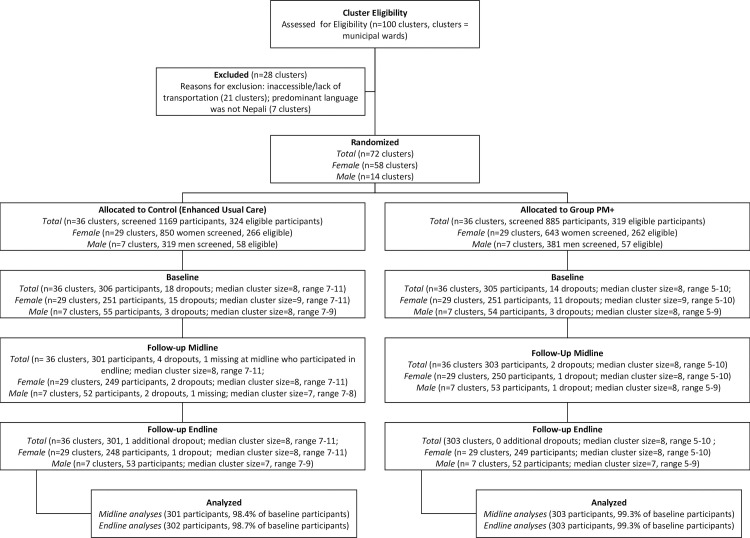
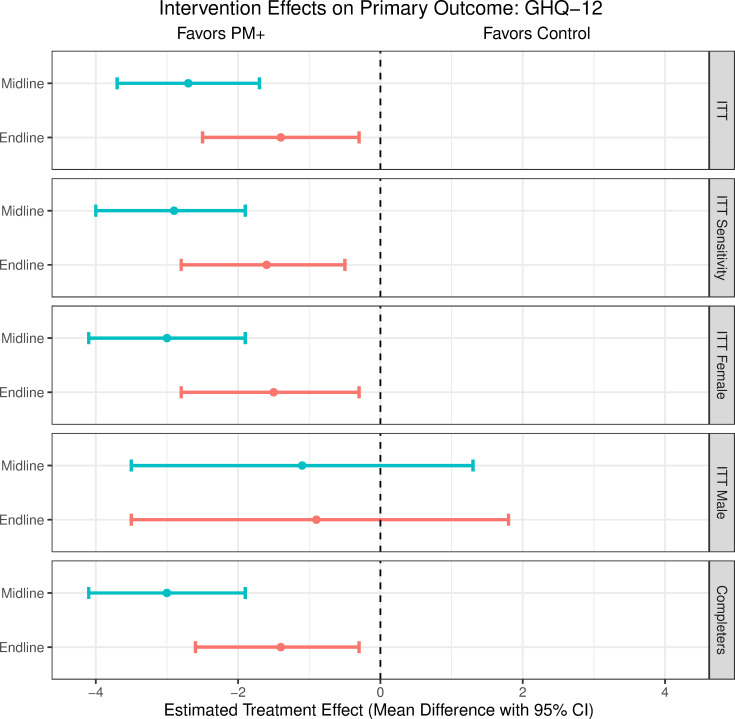
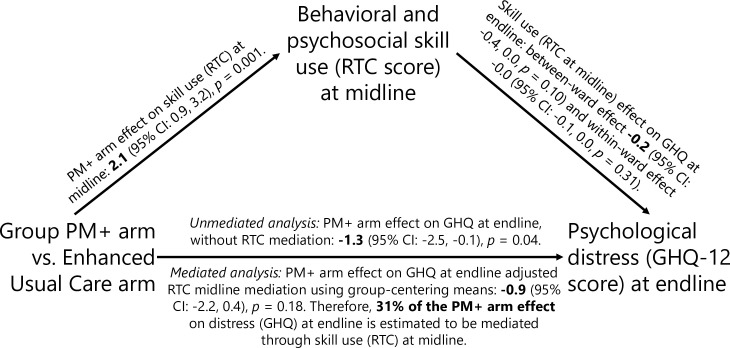
Background: Globally, 235 million people are impacted by humanitarian emergencies worldwide, presenting increased risk of experiencing a mental disorder. Our objective was to test the effectiveness of a brief group psychological treatment delivered by trained facilitators without prior professional mental health training in a disaster-prone setting. Methods and findings: We conducted a cluster randomized controlled trial (cRCT) from November 25, 2018 through September 30, 2019. Participants in both arms were assessed at baseline, midline (7 weeks post-baseline, which was approximately 1 week after treatment in the experimental arm), and endline (20 weeks post-baseline, which was approximately 3 months posttreatment). The intervention was Group Problem Management Plus (PM+), a psychological treatment of 5 weekly sessions, which was compared with enhanced usual care (EUC) consisting of a family psychoeducation meeting with a referral option to primary care providers trained in mental healthcare. The setting was 72 wards (geographic unit of clustering) in eastern Nepal, with 1 PM+ group per ward in the treatment arm. Wards were eligible if they were in disaster-prone regions and residents spoke Nepali. Wards were assigned to study arms based on covariate constrained randomization. Eligible participants were adult women and men 18 years of age and older who met screening criteria for psychological distress and functional impairment. Outcomes were measured at the participant level, with assessors blinded to group assignment. The primary outcome was psychological distress assessed with the General Health Questionnaire (GHQ-12). Secondary outcomes included depression symptoms, posttraumatic stress disorder (PTSD) symptoms, “heart–mind” problems, social support, somatic symptoms, and functional impairment. The hypothesized mediator was skill use aligned with the treatment’s mechanisms of action. A total of 324 participants were enrolled in the control arm (36 wards) and 319 in the Group PM+ arm (36 wards). The overall sample (N= 611) had a median age of 45 years (range 18–91 years), 82% of participants were female, 50% had recently experienced a natural disaster, and 31% had a chronic physical illness. Endline assessments were completed by 302 participants in the control arm (36 wards) and 303 participants in the Group PM+ arm (36 wards). At the midline assessment (immediately after Group PM+ in the experimental arm), mean GHQ-12 total score was 2.7 units lower in Group PM+ compared to control (95% CI: 1.7, 3.7,p< 0.001), with standardized mean difference (SMD) of −0.4 (95% CI: −0.5, −0.2). At 3 months posttreatment (primary endpoint), mean GHQ-12 total score was 1.4 units lower in Group PM+ compared to control (95% CI: 0.3, 2.5,p= 0.014), with SMD of −0.2 (95% CI: −0.4, 0.0). Among the secondary outcomes, Group PM+ was associated with endline with a larger proportion attaining more than 50% reduction in depression symptoms (29.9% of Group PM+ arm versus 17.3% of control arm, risk ratio = 1.7, 95% CI: 1.2, 2.4,p= 0.002). Fewer participants in the Group PM+ arm continued to have “heart–mind” problems at endline (58.8%) compared to the control arm (69.4%), risk ratio = 0.8 (95% CI, 0.7, 1.0,p= 0.042). Group PM+ was not associated with lower PTSD symptoms or functional impairment. Use of psychosocial skills at midline was estimated to explain 31% of the PM+ effect on endline GHQ-12 scores. Adverse events in the control arm included 1 suicide death and 1 reportable incidence of domestic violence; in the Group PM+ arm, there was 1 death due to physical illness. Study limitations include lack of power to evaluate gender-specific effects, lack of long-term outcomes (e.g., 12 months posttreatment), and lack of cost-effectiveness information. Conclusions: In this study, we found that a 5-session group psychological treatment delivered by nonspecialists modestly reduced psychological distress and depression symptoms in a setting prone to humanitarian emergencies. Benefits were partly explained by the degree of psychosocial skill use in daily life. To improve the treatment benefit, future implementation should focus on approaches to enhance skill use by PM+ participants. Trial registration: ClinicalTrials.govNCT03747055.
Overview
The claims and statistics of this paper haven’t been checked yet.
Run the check — free, no account needed. It reads the open-access text and checks the sources it cites.
Integrity signals
Registry
Cites
Statistics
Figures
Verification
Claims the paper makes
The claims and statistics of this paper haven’t been checked yet.
Run the check — free, no account needed. It reads the open-access text and checks the sources it cites.
Claims other papers make about this one
Each is checked against this paper’s own text: does it say what the citing paper says it does?
The cited source doesn’t support the claim as written.
In the citing paper
“Furthermore, the long-term effectiveness of some interventions cannot be assessed because ten completed studies on these interventions did not report follow-up measurements [21,27,35,36,37,40,41,47,53,57].”
From Promoting Recovery from Disasters, Pandemics, and Trauma: A Systematic Review of Brief Psychological Interventions to Reduce Distress in Adults, Children, and Adolescents (2023) · cites this paper as [36]
Checked by a reasoning model — may be wrong.
Experimental — accuracy not yet measuredThe source backs part of the claim, not all of it — or backs it for a different population, condition or comparison.
In the citing paper
“Problem Management Plus, a World Health Organization–endorsed brief psychological intervention for mental health disorders, has been shown to be effective and cost-effective in various countries globally”
From A Digital Tool (Technology-Assisted Problem Management Plus) for Lay Health Workers to Address Common Mental Health Disorders: Co-production and Usability Study in Pakistan (2025) · cites this paper as [14]
Experimental — accuracy not yet measuredThe source backs part of the claim, not all of it — or backs it for a different population, condition or comparison.
In the citing paper
“A cRCT [36] investigated an adapted PM+ program with six to eight participants per group, which was compared to enhanced usual care (psychoeducation and a referral option to primary care providers trained in mental healthcare). N = 611 adults from disaster-prone regions in Nepal received 5 weekly sessions of approximately 2.5 h.”
From Promoting Recovery from Disasters, Pandemics, and Trauma: A Systematic Review of Brief Psychological Interventions to Reduce Distress in Adults, Children, and Adolescents (2023) · cites this paper as [36]
Experimental — accuracy not yet measuredThe cited source says what the claim attributes to it.
In the citing paper
“PM+ is a low-intensity brief psychological and transdiagnostic intervention for common mental health disorders. It is an evidence-based intervention that can address various mental health issues and address the limitations posed by scarce specialized treatments in low-resource settings [8-14].”
The cited source says what the claim attributes to it.
In the citing paper
“The PM+ group showed lower psychological distress and depression symptoms, and had fewer “heart-mind” problems compared to the control group at 3-months post-treatment.”
The cited source says what the claim attributes to it.
In the citing paper
“However, the PM+ group did not show an improvement in functional impairment and PTSD symptoms.”
The cited source says what the claim attributes to it.
In the citing paper
“The results of two cRCTs [35,36] indicated that PM+ applied in a group significantly reduced psychological distress and depressive symptoms post-intervention.”
Self-check
Percentages, sums and reported differences re-computed from the paper’s own numbers.
The self-check needs the paper’s full text.
Citations
Cites
The PHQ-9: Validity of a brief depression severity measure
Kroenke, K., Spitzer, R. L., & Williams, J. B. W. (2001) · Journal of General Internal Medicine · doi:10.1046/j.1525-1497.2001.016009606.x · Cited by 44,910
SAUNDERS, J. B., AASLAND, O. G., BABOR, T. F., DE LA FUENTE, J. R., & GRANT, M. (1993) · Addiction · doi:10.1111/j.1360-0443.1993.tb02093.x · Cited by 13,597 · cited 2×
“Use Disorders Identification Test, AUDIT) [21].”
InfluentialThe Multidimensional Scale of Perceived Social Support
Zimet, G. D., Dahlem, N. W., Zimet, S. G., & Farley, G. K. (1988) · Journal of Personality Assessment · doi:10.1207/s15327752jpa5201_2 · Cited by 13,339
(1988) · NFER-Nelson eBooks · Cited by 5,560
Psychometric Characteristics of the Multidimensional Scale of Perceived Social Support
Zimet, G. D., Powell, S. S., Farley, G. K., Werkman, S., & Berkoff, K. A. (1990) · Journal of Personality Assessment · doi:10.1080/00223891.1990.9674095 · Cited by 4,855
Consort 2010 statement: extension to cluster randomised trials
Campbell, M. K., Piaggio, G., Elbourne, D. R., Altman, D. G., & for the CONSORT Group (2012) · BMJ · doi:10.1136/bmj.e5661 · Cited by 3,510
Developing the World Health Organization Disability Assessment Schedule 2.0
Üstün, T. B., Chatterji, S., Kostanjsek, N., Rehm, J., Kennedy, C., Epping-Jordan, J., Saxena, S., von Korff, M., & Pull, C. (2010) · Bulletin of the World Health Organization · doi:10.2471/blt.09.067231 · Cited by 1,851
Testing Multilevel Mediation Using Hierarchical Linear Models
Zhang, Z., Zyphur, M. J., & Preacher, K. J. (2008) · Organizational Research Methods · doi:10.1177/1094428108327450 · Cited by 1,096
Psychological Treatments for the World: Lessons from Low- and Middle-Income Countries
Singla, D. R., Kohrt, B. A., Murray, L. K., Anand, A., Chorpita, B. F., & Patel, V. (2017) · Annual Review of Clinical Psychology · doi:10.1146/annurev-clinpsy-032816-045217 · Cited by 913
Self-citationThe Somatic Symptom Scale–8 (SSS-8): A Brief Measure of Somatic Symptom Burden
Gierk, B., Kohlmann, S., Kroenke, K., Spangenberg, L., Zenger, M., Brähler, E., & Löwe, B. (2014) · JAMA Internal Medicine · doi:10.1001/jamainternmed.2013.12179 · Cited by 740
Research works printed but not linked: 6
- ZA Stein, 1992, Assessment of people with mental retardation, 12
- World Health Organization, 2020, Licence: CC BY-NC-SA 3.0 IGO
- World Health Organization, 2016, mhGAP intervention guide for mental, neurological and substance use disorders in non-specialized health settings: mental health Gap Action Programme (mhGAP)–version 2.0
- NR Koirala, 1999, Validity of the General Health Questionnaire (GHQ-12) in a Rural Community Setting in Nepal, Nepalese J Psychiatry, 1, 34
- B Rothbaum, 2005, The Traumatic Events Inventory Manual
- GA Pedersen, 2021, Development of the Group facilitation Assessment of Competencies Tool (GroupACT) for group-based mental health and psychosocial support interventions in humanitarian emergencies and low-resource settings, J Educ Emergencies
Cited by
Sorted by citations
Schäfer, S. K., Thomas, L. M., Lindner, S., & Lieb, K. (2023) · World Psychiatry · doi:10.1002/wps.21129 · Cited by 115
de Graaff, A. M., Cuijpers, P., Twisk, J. W. R., Kieft, B., Hunaidy, S., Elsawy, M., Gorgis, N., Bouman, T. K., Lommen, M. J. J., Acarturk, C., et al. (2023) · BMJ Mental Health · doi:10.1136/bmjment-2022-300637 · Cited by 97
Self-citationBrown, F. L., Taha, K., Steen, F., Kane, J. C., Gillman, A., Aoun, M., Malik, A., Bryant, R. A., Sijbrandij, M., Chammay, R. E., et al. (2023) · BMC Psychiatry · doi:10.1186/s12888-023-04571-9 · Cited by 44
Self-citationBryant, R. A., Bawaneh, A., Awwad, M., Al-Hayek, H., Giardinelli, L., Whitney, C., Jordans, M. J. D., Cuijpers, P., Sijbrandij, M., Ventevogel, P., et al. (2022) · Epidemiology and Psychiatric Sciences · doi:10.1017/s2045796022000658 · Cited by 37
Self-citationJordans, M. J. D., Brown, F. L., Kane, J. C., Taha, K., Steen, F., Ali, R., Elias, J., Meksassi, B., Aoun, M., Greene, M. C., et al. (2023) · Comprehensive Psychiatry · doi:10.1016/j.comppsych.2023.152424 · Cited by 27
Self-citation
Metadata
- Authors
- Jordans, M. J. D., Kohrt, B. A., Sangraula, M., Turner, E. L., Wang, X., Shrestha, P., Ghimire, R., van’t Hof, E., Bryant, R. A., Dawson, K. S., Marahatta, K., Luitel, N. P., & van Ommeren, M.
- Affiliations
- King's College London (GB)
- George Washington University (US)
- Duke University (US)
- UNSW Sydney (AU)
- World Health Organization (CH)
- Corresponding author
- Kohrt, Brandon A.
- ORCID
- Venue
- PLOS Medicine
- Publisher
- Public Library of Science (PLoS)
- Published
- 2021-06-17
- Volume
- 18
- Issue
- 6
- Pages
- e1003621
- ISSN
- 1549-1277 (ISSN-L)
- 1549-1676
- PMC
- PMC8211182
- OpenAlex
- W3167611877
- Cited by
- 120
- References
- 46
- Citations by year
- 2026: 22 · 2025: 27 · 2024: 21 · 2023: 26 · 2022: 21 · 2021: 3
- FWCI
- 12.09
- Type
- journal article
- Language
- en
- Open access
- gold
- doi.org
- Licence
- Locations
- PLoS Medicine (publishedVersion, cc-by)
- PubMed Central (publishedVersion, cc-by)
- PubMed (publishedVersion)
- UvA-DARE (University of Amsterdam) (submittedVersion, cc-by-nc-sa)
- DOAJ (DOAJ: Directory of Open Access Journals) (submittedVersion, cc-by-sa)
- Minerva Access (University of Melbourne) (submittedVersion, cc-by)
- Research Portal (King's College London) (submittedVersion, other-oa)
- Funders
- USAID
- National Institute of Mental Health (K01MH104310, R01MH120649)
- Topics
- Social Sciences › Psychology › Clinical Psychology › Posttraumatic Stress Disorder Research
- Health Sciences › Medicine › Psychiatry and Mental health › Mental Health Treatment and Access
- Social Sciences › Psychology › Clinical Psychology › Migration, Health and Trauma
- Keywords
- group psychological intervention, humanitarian crisis, disaster mental health, psychological distress, depression, post-traumatic stress disorder, functional disability, social support, somatic symptoms, community mental health workers, skill utilization, Nepal, natural disasters, mental health treatment gap, family psychoeducation, enhanced usual care, treatment effectiveness
- MeSH terms
- Natural Disasters, Functional Status, Adaptation, Psychological, Adolescent, Adult, Aged, Aged, 80 and over, Depression, Female, Humans, Male, Mental Health, Middle Aged, Nepal, Problem Solving, Psychotherapy, Brief, Psychotherapy, Group, Relief Work, Stress Disorders, Post-Traumatic, Stress, Psychological, Time Factors, Treatment Outcome, Young Adult
About these checks
Registry, retraction, Cites and statistics results are computed, not judged, with one exception: a printed reference that no index lists is read once by a model before it counts as a citation error. Claims are extracted by a model and kept only when their quote appears verbatim in the text; each cited source is then checked, with a model’s help, for whether it says what the claim relies on. Those verdicts can be wrong — read the claim’s quote and the cited source before relying on one.
Statistics and arithmetic are recomputed, not judged.
Confidence bands are shown only for fields calibrated on our annotated test set. None is calibrated yet, so no band is shown.
What counts as a claim ›How we measure confidence ›How we check this ›
Are you an author, or do you see a problem with this page? Request a review
