

Alcohol abstinence and mortality in a general population sample of adults in Germany: A cohort study
Open accessThe DOI matches its Crossref record; 34 of the 36 references it cites were found in a registry or an index.
Abstract
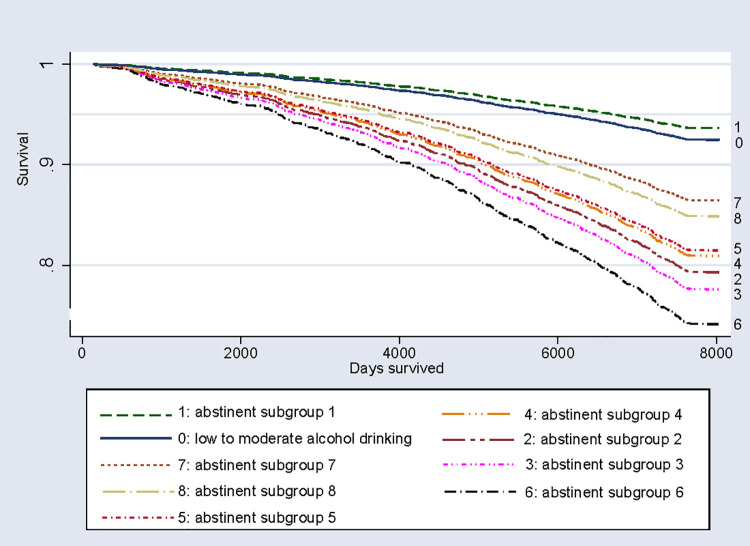
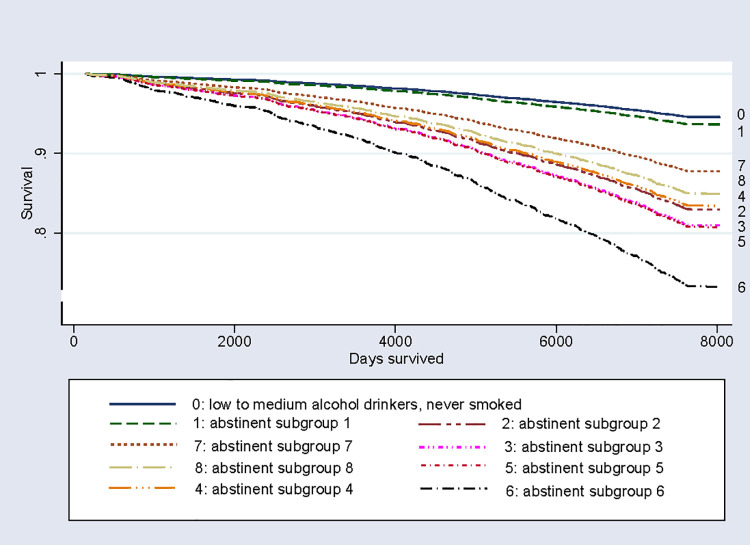
Background: Evidence suggests that people who abstain from alcohol have a higher mortality rate than those who drink low to moderate amounts. However, little is known about factors that might be causal for this finding. The objective was to analyze former alcohol or drug use disorders, risky drinking, tobacco smoking, and fair to poor health among persons who reported abstinence from alcohol drinking in the last 12 months before baseline in relation to total, cardiovascular, and cancer mortality 20 years later. Methods and findings: A sample of residents aged 18 to 64 years had been drawn at random among the general population in northern Germany and a standardized interview conducted in the years 1996 to 1997. The baseline assessment included 4,093 persons (70.2% of those who had been eligible). Vital status and death certificate data were retrieved in the years 2017 and 2018. We found that among the alcohol-abstinent study participants at baseline (447), there were 405 (90.60%) former alcohol consumers. Of the abstainers, 322 (72.04%) had met one or more criteria for former alcohol or drug dependence or abuse, alcohol risky drinking, or had tried to cut down or to stop drinking, were daily smokers, or self-rated their health as fair to poor. Among the abstainers with one or more of these risk factors, 114 (35.40%) had an alcohol use disorder or risky alcohol consumption in their history. Another 161 (50.00%) did not have such an alcohol-related risk but were daily smokers. The 322 alcohol-abstinent study participants with one or more of the risk factors had a shorter time to death than those with low to moderate alcohol consumption. The Cox proportional hazard ratio (HR) was 2.44 (95% confidence interval (CI), 1.68 to 3.56) for persons who had one or more criteria for an alcohol or drug use disorder fulfilled in their history and after adjustment for age and sex. The 125 alcohol-abstinent persons without these risk factors (27.96% of the abstainers) did not show a statistically significant difference from low to moderate alcohol consumers in total, cardiovascular, and cancer mortality. Those who had stayed alcohol abstinent throughout their life before (42; 9.40% of the alcohol-abstinent study participants at baseline) had an HR 1.64 (CI 0.72 to 3.77) compared to low to moderate alcohol consumers after adjustment for age, sex, and tobacco smoking. Main limitations of this study include its reliance on self-reported data at baseline and the fact that only tobacco smoking was analyzed as a risky behavior alongside alcohol consumption. Conclusions: The majority of the alcohol abstainers at baseline were former alcohol consumers and had risk factors that increased the likelihood of early death. Former alcohol use disorders, risky alcohol drinking, ever having smoked tobacco daily, and fair to poor health were associated with early death among alcohol abstainers. Those without an obvious history of these risk factors had a life expectancy similar to that of low to moderate alcohol consumers. The findings speak against recommendations to drink alcohol for health reasons.
Overview
The claims and statistics of this paper haven’t been checked yet.
Free: it reads the open-access text and checks the first 5 claims that cite a source we can check. Create a free account to check every claim.
Integrity signals
Registry
Cites
Statistics
Figures
Verification
Claims the paper makes
The claims and statistics of this paper haven’t been checked yet.
Free: it reads the open-access text and checks the first 5 claims that cite a source we can check. Create a free account to check every claim.
Self-check
Percentages, sums and reported differences re-computed from the paper’s own numbers.
The self-check needs the paper’s full text.
Citations
Cites
Diagnostic and Statistical Manual of Mental Disorders, Fourth Edition, Text Revision (DSM-IV-TR)
American Psychiatric Association (2000) · doi:10.1176/appi.books.9780890423349 · Cited by 11,069
Relaxing the Rule of Ten Events per Variable in Logistic and Cox Regression
Vittinghoff, E., & McCulloch, C. E. (2007) · American Journal of Epidemiology · doi:10.1093/aje/kwk052 · Cited by 4,359 · cited 1×
“We safeguarded that the minimum number of outcome events (death cases) per predictor variable was 5 or higher [30].”
BackgroundInternational Statistical Classification of Diseases and Related Health Problems
Eisfeld, J. (2014) · TSQ: Transgender Studies Quarterly · doi:10.1215/23289252-2399740 · Cited by 3,570
Griswold, M. G., Fullman, N., Hawley, C., Arian, N., Zimsen, S. R. M., Tymeson, H. D., Venkateswaran, V., Tapp, A. D., Forouzanfar, M. H., Salama, J. S., et al. (2018) · The Lancet · doi:10.1016/s0140-6736(18)31310-2 · Cited by 3,524
Miller, R. G. (1981) · Cited by 3,336
Mortality prediction with a single general self-rated health question: A meta-analysis
DeSalvo, K. B., Bloser, N., Reynolds, K., He, J., & Muntner, P. (2006) · Journal of General Internal Medicine · doi:10.1111/j.1525-1497.2005.00291.x · Cited by 2,290
International Statistical Classification of Diseases and Related Health Problems 10th Revision
(2013) · A Companion to the Classification of Mental Disorders · doi:10.1093/med/9780199669493.005.0005 · Cited by 2,059
Wood, A. M., Kaptoge, S., Butterworth, A. S., Willeit, P., Warnakula, S., Bolton, T., Paige, E., Paul, D. S., Sweeting, M., Burgess, S., et al. (2018) · The Lancet · doi:10.1016/s0140-6736(18)30134-x · Cited by 1,188 · cited 1×
“Our data are in line with those from former studies that revealed a dose relation between quantity and frequency of alcohol consumption and risk of death [4,5,32].”
ResultStockwell, T., Zhao, J., Panwar, S., Roemer, A., Naimi, T., & Chikritzhs, T. (2016) · Journal of Studies on Alcohol and Drugs · doi:10.15288/jsad.2016.77.185 · Cited by 654
Xi, B., Veeranki, S. P., Zhao, M., Ma, C., Yan, Y., & Mi, J. (2017) · Journal of the American College of Cardiology · doi:10.1016/j.jacc.2017.06.054 · Cited by 454
Research works printed but not linked: 2
- British Medical Association. Alcohol: guidelines on sensible drinking. London: British Medical Association; 1995.
- StataCorp LP. Stata 15.1. 4905 Lakeway Drive, College Station, Texas 77845, USA: StataCorp LP; 2017.
Cited by
Dementia prevention, intervention, and care: 2024 report of the Lancet standing Commission
Livingston, G., Huntley, J., Liu, K. Y., Costafreda, S. G., Selbæk, G., Alladi, S., Ames, D., Banerjee, S., Burns, A., Brayne, C., et al. (2024) · The Lancet · doi:10.1016/s0140-6736(24)01296-0 · Cited by 3,860
Kilian, C., Klinger, S., Rehm, J. T., & Manthey, J. (2023) · BMC Geriatrics · doi:10.1186/s12877-023-03972-5 · Cited by 48
“This is problematic as many current abstainers are not using alcohol anymore because of former alcohol use problems and consequently this group has a higher mortality risk than low or moderate drinkers [50].”
BackgroundNaimi, T. S., & Chikritzhs, T. N. (2024) · Alcoholism Clinical and Experimental Research · doi:10.1111/acer.15478 · Cited by 13
Redwood, L., Saarinen, K., Ivers, R. G., Garne, D., SOUZA, P. D., Bonney, A. D., Rhee, J., Mullan, J., & Thomas, S. J. (2023) · Quality of Life Research · doi:10.1007/s11136-023-03522-x · Cited by 10
“Those with serious or life-threatening medical conditions, who are likely to have lower QoL, may abstain from alcohol; in one study, abstainers had higher mortality than drinkers, with many of them being previously high-risk drinkers [44].”
BackgroundSeverity of alcohol dependence and mortality after 20 years in an adult general population sample
John, U., Rumpf, H., Hanke, M., & Meyer, C. (2022) · International Journal of Methods in Psychiatric Research · doi:10.1002/mpr.1915 · Cited by 10
“Among them, the majority turned out to have known risk factors for early death including former alcohol or drug dependence and tobacco smoking (John et al., 2021).”
BackgroundSelf-citationJohn, U., Rumpf, H., Hanke, M., & Meyer, C. (2023) · Scientific Reports · doi:10.1038/s41598-023-43669-8 · Cited by 10
“We used alcohol abstinence and AUDIT-C 5–12 as one group because evidence had shown that alcohol abstinence included former problem drinkers and had been related to death in a similar way as high alcohol consumption 39 .”
MethodSelf-citationHaddad, R. E., Matta, J., Lemogne, C., Melchior, M., Zins, M., & Airagnes, G. (2022) · Social Psychiatry and Psychiatric Epidemiology · doi:10.1007/s00127-022-02357-0 · Cited by 16
“Regarding non-alcohol users, previous studies have shown that alcohol abstinence is associated with poor health status which contraindicates alcohol use, and at least for some people because of the consequences of previous excessive use [32].”
BackgroundGalán, I., Fontán, J., Ortíz, C., López‐Cuadrado, T., Téllez-Plaza, M., & García‐Esquinas, E. (2024) · Addictive Behaviors · doi:10.1016/j.addbeh.2024.108108 · Cited by 10
Empfehlungen zum Umgang mit Alkohol
Rumpf, H., Auwärter, V., Batra, A., Bell-D‘Avis, S., Bischof, G., Bschor, T., Effertz, T., Fricke, E., Hanewinkel, R., Hansjürgens, R., et al. (2024) · SUCHT - Zeitschrift für Wissenschaft und Praxis / Journal of Addiction Research and Practice · doi:10.1024/0939-5911/a000868 · Cited by 7
Self-citationKrause, K., Guertler, D., Möhring, A., Batra, A., Eck, S., Rumpf, H., Bischof, G., Buchholz, M., John, U., & Meyer, C. (2022) · International Journal of Environmental Research and Public Health · doi:10.3390/ijerph192214664 · Cited by 6
“The results of this study and previous work showing the importance of misclassification errors in studies analyzing associations between alcohol consumption and health and mortality outcomes [27,29] provide important implications for the development of future interventions targeting alcohol consumption in large popula…”
BackgroundResultInfluentialSelf-citationJohn, U., Rumpf, H., Hanke, M., & Meyer, C. (2023) · Alcohol · doi:10.1016/j.alcohol.2023.10.003 · Cited by 4
Self-citationThe Alcohol Use Disorders Identification Test and Mortality 20 Years later
John, U., Rumpf, H., Hanke, M., & Meyer, C. (2023) · International Journal of Mental Health and Addiction · doi:10.1007/s11469-023-01008-y · Cited by 5
“According to a large body of evidence, alcohol use disorders are related to early death (John et al., 2021; Roerecke & Rehm, 2013).”
Self-citationFontán-Vela, J., Ortíz, C., López‐Cuadrado, T., Téllez-Plaza, M., García‐Esquinas, E., Ortolá, R., Rodríguez‐Artalejo, F., & Galán, I. (2025) · Public Health · doi:10.1016/j.puhe.2025.105728 · Cited by 3
Wakabayashi, I., & Groschner, K. (2025) · Environmental Health and Preventive Medicine · doi:10.1265/ehpm.25-00101 · Cited by 4
“Alcohol abstainers had a life expectancy similar to that of low-to-moderate alcohol drinkers when they did not have a history of risk factors for early death including AUD, risky alcohol drinking, ever having smoked tobacco daily and fair to poor health [12].”
Baumann, S., Staudt, A., Freyer‐Adam, J., Zeiser, M., Bischof, G., Meyer, C., & John, U. (2022) · Frontiers in Public Health · doi:10.3389/fpubh.2022.1027837 · Cited by 4
“Meanwhile, evidence is mounting that misclassification of former or occasional drinkers as abstainers and other confounders favoring low-risk drinkers over abstainers are responsible for the observed J-shape function relating alcohol use to disease and mortality (6, 7).”
BackgroundSelf-citationYang, K., Kim, S. H., Yang, H., Wang, S., Jeong, B., Lim, H. K., & Bae, S. H. (2024) · Clinical and Molecular Hepatology · doi:10.3350/cmh.2024.0278 · Cited by 7
“29 Therefore, psychiatric interventions, customized to the individual's unique psychological and behavioral profile, can target the underlying aspects of alcohol dependence, creating a comprehensive and enduring pathway to abstinence.”
BackgroundGesundheitsrisiko Alkohol – neue Empfehlungen zum Umgang mit Alkohol
Seitz, H. K., & John, U. (2023) · Die Innere Medizin · doi:10.1007/s00108-023-01574-2 · Cited by 3
Self-citationJohn, U., Rumpf, H., Hanke, M., & Meyer, C. (2023) · European Addiction Research · doi:10.1159/000534233 · Cited by 2
“Health risks from alcohol abstinence and health-protective effects from low-risk drinking have been estimated to be unlikely [26].”
BackgroundSelf-citationWang, Z., Liao, H., Zheng, Y., Ruan, H., Li, L., Zhang, M., Ma, M., & He, S. (2023) · American Journal of Preventive Medicine · doi:10.1016/j.amepre.2023.05.019 · Cited by 2
Rumpf, H., John, U., Seitz, H. K., Rehbein, F., Scherbaum, N., Havemann‐Reinecke, U., & Hayer, T. (2025) · Der Nervenarzt · doi:10.1007/s00115-025-01893-9 · Cited by 2
Self-citationAlcohol consumption and disability-free life expectancy in the United States
Chiu, C., & Chen, C.-A. (2025) · Alcohol and Alcoholism · doi:10.1093/alcalc/agaf070 · Cited by 1
Matson, T. E., Bobb, J. F., Oliver, M. M., Berger, D. B., Jack, H. E., Steel, T. L., Bradley, K. A., & Hallgren, K. A. (2025) · Alcoholism Clinical and Experimental Research · doi:10.1111/acer.70192 · Cited by 1
Yeh, C.-I., Chen, K.-H., Lin, C.-H., Chen, Y., Xiao, F., You, W.-C., Ju, Y., Chong, N. S., Barbosa, D. A. N., Halpern, C. H., et al. (2025) · Neuromodulation Technology at the Neural Interface · doi:10.1016/j.neurom.2025.10.066 · Cited by 1
「沈黙の螺旋理論」 の考察 : 世論の社会統合機能と世論過程におけるマス・メディア
加藤, 祐. (1999) · 竜谷大学大学院研究紀要. 社会学・社会福祉学
Alternativmedizin, Komplementärmedizin oder evidenzbasierte Medizin?
Erbas-Kronwitter, A. (2024) · Springer eBooks · doi:10.1007/978-3-662-68140-4_2
Chen, H., Cai, J., Wei, J., Zhang, H., Xiang, Y., Huang, Z., Xu, H., Xiao, X., & Zhao, X. (2024) · PubMed Central · doi:10.12182/20240360602
Gerbracht, C., Staudt, A., Freyer‐Adam, J., Bischof, G., Meyer, C., John, U., & Baumann, S. (2025) · European Addiction Research · doi:10.1159/000545866 · Cited by 1
“In addition, studies have shown that low-to-moderate alcohol consumption does not reduce mortality compared to lifetime abstainers [7, 8].”
Self-citationSalonsalmi, A., Lahti, J., Lahelma, E. T., Rahkonen, O., & Lallukka, T. M. (2025) · Social Psychiatry and Psychiatric Epidemiology · doi:10.1007/s00127-025-02996-z
Baumann, S., Staudt, A., Zeiser, M., Freyer‐Adam, J., Guertler, D., Markwart, H., Möhring, A., & John, U. (2025) · BMC Public Health · doi:10.1186/s12889-025-24663-3
Self-citationStaudt, A., John, U., Freyer‐Adam, J., Bischof, G., Zeiser, M., & Baumann, S. (2025) · Journal of Medical Internet Research · doi:10.2196/77921
Self-citationKilian, C., Klinger, S., Rehm, J. T., & Manthey, J. (2023) · Figshare · doi:10.6084/m9.figshare.22697319
The impact of memory training on abstinence among individuals with alcohol use disorder
Cabanis, M., Kuhl, M.-C., Wetterling, T., Margraf, M., Nikoo, M., Westenberg, J. N., & Junghanns, K. (2025) · Frontiers in Psychiatry · doi:10.3389/fpsyt.2025.1668684
Zeiser, M., Baumann, S., Freyer‐Adam, J., Ullrich, A., John, U., & Staudt, A. (2026) · BMC Public Health · doi:10.1186/s12889-025-26015-7
“The protective effects of low-to-moderate alcohol use are largely explained by misclassification and confounding factors, such as a history of dependence or comorbid smoking among abstainers [2–5].”
Self-citationGaertner, B., Eckert, G., Fuchs, J., Freyer‐Adam, J., & Starker, A. (2026) · BMC Geriatrics · doi:10.1186/s12877-026-08007-3
“Comparable to tobacco smoking, scientific evidence demonstrates a dose-response-relationship for alcohol consumption, indicating that the amount of exposure is linked to the magnitude of health outcomes and that there is no risk-free level (e.g. [24]).”
Alcohol consumption: from biochemistry to behavior, health, and beyond
Pechkovsky, E., Kershengoltz, B., Vlassov, V. V., Vlassov, V., & Turchinovich, A. (2026) · Frontiers in Toxicology · doi:10.3389/ftox.2026.1876876
“This group is often misclassified as part of the current non-drinker population and inflates the apparent harm associated with abstention relative to moderate drinking (Rehm et al., 2008; Stockwell et al., 2016; John et al., 2021; Yu et al., 2025).”
Scheuermann, J.-S., Graessel, E., Scheerbaum, P., Hanslian, E., Schiele, J. K., Keßler, C. S., & Donath, C. (2026) · BMC Public Health · doi:10.1186/s12889-026-29728-5
“Therefore, there is no protective effect associated with low alcohol consumption, nor is there any level of consumption that is risk-free for health [13, 24, 25].”
Metadata
- Authors
- John, U., Rumpf, H.-J., Hanke, M., & Meyer, C.
- Affiliations
- Universitätsmedizin Greifswald (DE)
- Corresponding author
- John, Ulrich
- Venue
- PLOS Medicine
- Publisher
- Public Library of Science (PLoS)
- Published
- 2021-11-02
- Volume
- 18
- Issue
- 11
- Pages
- e1003819
- ISSN
- 1549-1277 (ISSN-L)
- 1549-1676
- PMC
- PMC8562854
- OpenAlex
- W3210829746
- Cited by
- 36
- References
- 36
- Citations by year
- 2026: 4 · 2025: 11 · 2024: 7 · 2023: 9 · 2022: 4
- FWCI
- 3.33
- Type
- journal article
- Language
- en
- Open access
- gold
- doi.org
- Licence
- Locations
- PLoS Medicine (publishedVersion, cc-by)
- Europe PMC (PubMed Central) (publishedVersion, other-oa)
- PubMed Central (publishedVersion, cc-by)
- PubMed (publishedVersion)
- DOAJ (DOAJ: Directory of Open Access Journals) (submittedVersion, cc-by-sa)
- Funders
- Bundesministerium für Forschung und Technologie (01 EB 9406)
- Deutsche Forschungsgemeinschaft (JO 150/11-1, ME 3180/4-1, RU 1570/3-1)
- Topics
- Health Sciences › Medicine › Pathology and Forensic Medicine › Alcohol Consumption and Health Effects
- Health Sciences › Medicine › Epidemiology › Substance Abuse Treatment and Outcomes
- Health Sciences › Medicine › Pharmacology (medical) › Coffee research and impacts
- Keywords
- alcohol abstinence, mortality, cardiovascular mortality, cancer mortality, alcoholism, hazardous drinking, drug use disorders, smoking, self-rated health, life expectancy, northern Germany, general adult population
- MeSH terms
- Adolescent, Adult, Aged, Alcohol Drinking, Germany, Humans, Male, Middle Aged, Mortality, Smoking, Cohort Studies, Logistic Models, Proportional Hazards Models, Young Adult, Alcohol Abstinence
About these checks
Registry, retraction, Cites and statistics results are computed, not judged, with one exception: a printed reference that no index lists is read once by a model before it counts as a citation error. Claims are extracted by a model and kept only when their quote appears verbatim in the text; each cited source is then checked, with a model’s help, for whether it says what the claim relies on. Those verdicts can be wrong — read the claim’s quote and the cited source before relying on one.
Statistics and arithmetic are recomputed, not judged.
Confidence bands are shown only for fields calibrated on our annotated test set. None is calibrated yet, so no band is shown.
What counts as a claim ›How we measure confidence ›How we check this ›
Are you an author, or do you see a problem with this page? Request a review
Data sources
Bibliographic data: Semantic Scholar, OpenAlex, Crossref.
Contains information from the Semantic Scholar Academic Graph Datasets, made available under the ODC Attribution License (ODC-BY 1.0).
Semantic Scholar’s data is described in: Kinney, R., et al. (2023). The Semantic Scholar Open Data Platform. arXiv:2301.10140.
