

The DOI matches its Crossref record; 77 of the 77 references it cites were found in a registry or an index.
Cognitive deficits and educational loss in children with schistosome infection-A systematic review and meta-analysis
Open accessAbstract
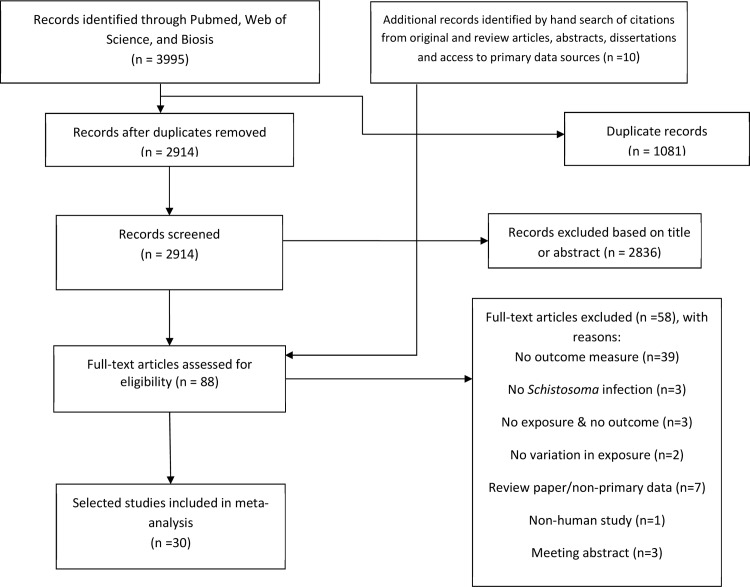
BACKGROUND: By means of meta-analysis of information from all relevant epidemiologic studies, we examined the hypothesis that Schistosoma infection in school-aged children (SAC) is associated with educational loss and cognitive deficits. METHODOLOGY/PRINCIPAL FINDINGS: This review was prospectively registered in the PROSPERO database (CRD42016040052). Medline, Biosis, and Web of Science were searched for studies published before August 2016 that evaluated associations between Schistosoma infection and cognitive or educational outcomes. Cognitive function was defined in four domains-learning, memory, reaction time, and innate intelligence. Educational outcome measures were defined as attendance and scholastic achievement. Risk of bias (ROB) was evaluated using the Newcastle-Ottawa quality assessment scale. Standardized mean differences (SMD) and 95% confidence intervals (CI) were calculated to compare cognitive and educational measures for Schistosoma infected /not dewormed vs. uninfected/dewormed children. Sensitivity analyses by study design, ROB, and sequential exclusion of individual studies were implemented. Thirty studies from 14 countries, including 38,992 SAC between 5-19 years old, were identified. Compared to uninfected children and children dewormed with praziquantel, the presence of Schistosoma infection and/or non-dewormed status was associated with deficits in school attendance (SMD = -0.36, 95%CI: -0.60, -0.12), scholastic achievement (SMD = -0.58, 95%CI: -0.96, -0.20), learning (SMD = -0.39, 95%CI: -0.70, -0.09) and memory (SMD = -0.28, 95%CI: -0.52, -0.04) tests. By contrast, Schistosoma-infected/non-dewormed and uninfected/dewormed children were similar with respect to performance in tests of reaction time (SMD = -0.06, 95%CI: -0.42, 0.30) and intelligence (SMD = -0.25, 95%CI: -0.57, 0.06). Schistosoma infection-associated deficits in educational measures were robust among observational studies, but not among interventional studies. The significance of infection-associated deficits in scholastic achievement was sensitive to ROB. Schistosoma infection-related deficits in learning and memory tests were invariant by ROB and study design. CONCLUSION/SIGNIFICANCE: Schistosoma infection/non-treatment was significantly associated with educational, learning, and memory deficits in SAC. Early treatment of children in Schistosoma-endemic regions could potentially mitigate these deficits. TRIAL REGISTRATION: ClinicalTrials.gov CRD42016040052.
Overview
The claims and statistics of this paper haven’t been checked yet.
Run the check — free, no account needed. It reads the open-access text and checks the sources it cites.
Integrity signals
Registry
Cites
Statistics
Figures
Verification
Claims the paper makes
The claims and statistics of this paper haven’t been checked yet.
Run the check — free, no account needed. It reads the open-access text and checks the sources it cites.
Claims other papers make about this one
Each is checked against this paper’s own text: does it say what the citing paper says it does?
The cited source says what the claim attributes to it.
In the citing paper
“Whilst the detrimental effects of helminth infections (both STH [4] and schistosomes [7]) have been previously reported”
The cited source says what the claim attributes to it.
In the citing paper
“while meta-analysis has indicated that schistosome infections were significantly associated with educational, learning, and memory deficits in school-aged children [7].”
Self-check
Percentages, sums and reported differences re-computed from the paper’s own numbers.
The self-check needs the paper’s full text.
Citations
Cites
Quantifying heterogeneity in a meta‐analysis
Higgins, J. P. T., & Thompson, S. G. (2002) · Statistics in Medicine · doi:10.1002/sim.1186 · Cited by 36,763 · cited 1×
“Heterogeneity between studies was measured with Higgins’s and Thompson’s I(2) statistic and chi-square pvalues [37].”
MethodDermyshi, E., Wang, Y., Yan, C., Hong, W., Qiu, G., Gong, X., & Zhang, T. (2017) · Neonatology · doi:10.1159/000454668 · Cited by 24,586
Meta-analysis of Observational Studies in Epidemiology<SUBTITLE>A Proposal for Reporting</SUBTITLE>
Stroup, D. F. (2000) · JAMA · doi:10.1001/jama.283.15.2008 · Cited by 20,623
Stang, A. (2010) · European Journal of Epidemiology · doi:10.1007/s10654-010-9491-z · Cited by 17,396 · cited 2×
“Quality ranking of each study was implemented using an adapted version of the Newcastle-Ottawa quality assessment scale (NOQAS) [42, 43] to derive a quality score for each investigation with respect to: i) representativeness of the infected population sample or the selection cases and controls (this yielded a score wi…”
MethodEstimating the mean and variance from the median, range, and the size of a sample
Hozo, S. P., Djulbegovic, B., & Hozo, I. (2005) · BMC Medical Research Methodology · doi:10.1186/1471-2288-5-13 · Cited by 9,062
Murray, C. J. L., Vos, T., Lozano, R., Naghavi, M., Flaxman, A. D., Michaud, C., Ezzati, M., Shibuya, K., Salomon, J. A., Abdalla, S., et al. (2012) · The Lancet · doi:10.1016/s0140-6736(12)61689-4 · Cited by 8,888
Self-citationMeta-analysis in social research
(1982) · Evaluation and Program Planning · doi:10.1016/0149-7189(82)90011-8 · Cited by 3,896 · cited 1×
“Hence, small to moderate deficits at the individual level may amount to large and important differences in disease burden at the population level [73, 74].”
BackgroundColley, D. G., Bustinduy, A. L., Secor, W. E., & King, C. H. (2014) · The Lancet · doi:10.1016/s0140-6736(13)61949-2 · Cited by 2,537
Newcastle-Ottawa Scale: comparing reviewers’ to authors’ assessments
Lo, C. K.-L., Mertz, D., & Loeb, M. (2014) · BMC Medical Research Methodology · doi:10.1186/1471-2288-14-45 · Cited by 2,477 · cited 4×
“793 [42, 47, 48, 52, 67, 76] Intelligence Quotient Based Assessments 4 -0.”
BackgroundMethodInfluentialPublication and related bias in meta-analysis
Sterne, J. A. C., Gavaghan, D., & Egger, M. (2000) · Journal of Clinical Epidemiology · doi:10.1016/s0895-4356(00)00242-0 · Cited by 2,282 · cited 1×
“Publication bias was assessed using the Egger test [40].”
Method
Research works printed but not linked: 5
- E.H. Epstein, 1974, Parasitic diseases and academic performance of schoolchildren, Social and Economic Studies, 23, 551
- D.C. Haycock, 1983, Schistosoma-haematobium infection and scholastic attainment amongst black schoolchildren, South African Journal of Science, 79, 370
- A.M. El-Hawey, 1990, Impacts of schistosomiasis on scholastic achievement of school children in two Egyptian rural communities, Egypt J Comm Med., 7, 27
- P.D. Ellis, 2009, Thresholds for interpreting effect sizes, Thresholds for interpreting effect sizes
- L. Manchikanti, 2009, Evidence-based medicine, systematic reviews, Pain Physician, 12, 819
Cited by
Sorted by citations
Errors in search strategies used in systematic reviews and their effects on information retrieval
Salvador-Oliván, J. A., Marco-Cuenca, G., & Arquero-Avilés, R. (2019) · Journal of the Medical Library Association · doi:10.5195/jmla.2019.567 · Cited by 199
Mawa, P. A., Kincaid-Smith, J., Tukahebwa, E. M., Webster, J. P., & Wilson, S. (2021) · Frontiers in Immunology · doi:10.3389/fimmu.2021.635869 · Cited by 129
“In children, continued inflammation has been reported to impede, amongst other pathologies, iron metabolism, with consequent disabling systemic morbidities including anemia, malnutrition, physical fitness and impaired physical and cognitive development (9, 10).”
BackgroundExum, N. G., Kibira, S. P. S., Ssenyonga, R., Nobili, J., Shannon, A. K., Ssempebwa, J. C., Tukahebwa, E. M., Radloff, S. R., Schwab, K. J., & Makumbi, F. E. (2019) · PLoS neglected tropical diseases · doi:10.1371/journal.pntd.0007617 · Cited by 95
Immune Evasion Strategies of Schistosomes
Hambrook, J. R., & Hanington, P. C. (2021) · Frontiers in Immunology · doi:10.3389/fimmu.2020.624178 · Cited by 85
Bärenbold, O., Garba, A., Colley, D. G., Fleming, F. M., Haggag, A. A., Ramzy, R. M. R., Assaré, R. K., Tukahebwa, E. M., Mbonigaba, J. B., Bucumi, V., et al. (2018) · PLoS neglected tropical diseases · doi:10.1371/journal.pntd.0006941 · Cited by 74
Metadata
- Authors
- Ezeamama, A. E., Bustinduy, A. L., Nkwata, A. K., Martinez, L., Pabalan, N., Boivin, M. J., & King, C. H.
- Affiliations
- University of Georgia (US)
- London School of Hygiene & Tropical Medicine (GB)
- Angeles University Foundation (PH)
- Michigan State University (US)
- Case Western Reserve University (US)
- Corresponding author
- Ezeamama, Amara E.
- ORCID
- Venue
- PLoS neglected tropical diseases
- Publisher
- Public Library of Science (PLoS)
- Published
- 2018-01-12
- Volume
- 12
- Issue
- 1
- Pages
- e0005524
- ISSN
- 1935-2727 (ISSN-L)
- 1935-2735
- PMC
- PMC5766129
- OpenAlex
- W2783986784
- Cited by
- 149
- References
- 77
- Citations by year
- 2026: 19 · 2025: 13 · 2024: 15 · 2023: 16 · 2022: 20 · 2021: 27 · 2020: 15 · 2019: 15 · 2018: 7
- FWCI
- 2.72
- Type
- journal article
- Language
- en
- Open access
- gold
- doi.org
- Licence
- Locations
- PLoS neglected tropical diseases (publishedVersion, cc-by)
- Europe PMC (PubMed Central) (publishedVersion, cc-by)
- PubMed Central (publishedVersion, cc-by)
- PubMed (publishedVersion)
- LSHTM Research Online (London School of Hygiene and Tropical Medicine) (acceptedVersion)
- RePEc: Research Papers in Economics (submittedVersion)
- DOAJ (DOAJ: Directory of Open Access Journals) (submittedVersion)
- Figshare (submittedVersion, cc-by)
- Funders
- Schistosomiasis Consortium for Operational Research and Evaluation (SCORE).
- Topics
- Life Sciences › Immunology and Microbiology › Parasitology › Parasites and Host Interactions
- Health Sciences › Nursing › Nutrition and Dietetics › Child Nutrition and Water Access
- Life Sciences › Agricultural and Biological Sciences › Animal Science and Zoology › Mollusks and Parasites Studies
- Keywords
- schistosomiasis, cognitive impairment, educational losses, school attendance, academic performance, praziquantel, anthelmintic treatment, school-aged children, learning, memory, reaction time, intelligence, intellectual disability, neuropsychological outcomes, neglected tropical diseases, neuroschistosomiasis, risk of bias
- MeSH terms
- Memory and Learning Tests, Adolescent, Animals, Anthelmintics, Child, Child, Preschool, Cognition, Humans, Intelligence, Learning Disabilities, Memory, Memory Disorders, Praziquantel, Reaction Time, Schistosoma, Schistosomiasis, Cognitive Dysfunction
About these checks
Registry, retraction, Cites and statistics results are computed, not judged, with one exception: a printed reference that no index lists is read once by a model before it counts as a citation error. Claims are extracted by a model and kept only when their quote appears verbatim in the text; each cited source is then checked, with a model’s help, for whether it says what the claim relies on. Those verdicts can be wrong — read the claim’s quote and the cited source before relying on one.
Statistics and arithmetic are recomputed, not judged.
Confidence bands are shown only for fields calibrated on our annotated test set. None is calibrated yet, so no band is shown.
What counts as a claim ›How we measure confidence ›How we check this ›
Are you an author, or do you see a problem with this page? Request a review
