

Entropy Bounds for Hierarchical Molecular Networks
Open accessThe DOI matches its Crossref record; 79 of the 82 references it cites were found in a registry or an index.
Abstract
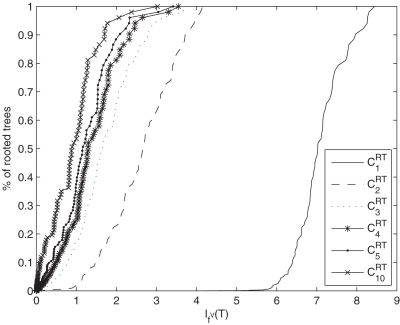
In this paper we derive entropy bounds for hierarchical networks. More precisely, starting from a recently introduced measure to determine the topological entropy of non-hierarchical networks, we provide bounds for estimating the entropy of hierarchical graphs. Apart from bounds to estimate the entropy of a single hierarchical graph, we see that the derived bounds can also be used for characterizing graph classes. Our contribution is an important extension to previous results about the entropy of non-hierarchical networks because for practical applications hierarchical networks are playing an important role in chemistry and biology. In addition to the derivation of the entropy bounds, we provide a numerical analysis for two special graph classes, rooted trees and generalized trees, and demonstrate hereby not only the computational feasibility of our method but also learn about its characteristics and interpretability with respect to data analysis.
Overview
The claims and statistics of this paper haven’t been checked yet.
Free: it reads the open-access text and checks the first 5 claims that cite a source we can check. Create a free account to check every claim.
Integrity signals
Registry
Cites
Statistics
Figures



Verification
Claims the paper makes
The claims and statistics of this paper haven’t been checked yet.
Free: it reads the open-access text and checks the first 5 claims that cite a source we can check. Create a free account to check every claim.
Claims other papers make about this one
Each is checked against this paper’s own text: does it say what the citing paper says it does?
The cited source says what the claim attributes to it.
In the citing paper
“Although previous work using complex networks theory has quantitatively tackled the problem [3, 4, 22-25, 27-31], some questions remain:”
From On the origins of hierarchy in complex networks (2013) · cites this paper as [29]
Self-check
Percentages, sums and reported differences re-computed from the paper’s own numbers.
The self-check needs the paper’s full text.
Citations
Cites
A Mathematical Theory of Communication
Shannon, C. E. (1948) · Bell System Technical Journal · doi:10.1002/j.1538-7305.1948.tb01338.x · Cited by 88,486
A Mathematical Theory of Communication
Shannon, C. E. (1948) · Bell System Technical Journal · doi:10.1002/j.1538-7305.1948.tb00917.x · Cited by 48,949
Harary, F. (1969) · Cited by 10,739
The Mathematical Theory of Communication
Shannon, C. E., Weaver, W., & Wiener, N. (1950) · Physics Today · doi:10.1063/1.3067010 · Cited by 9,801
Harary, F. (1969) · doi:10.21236/ad0705364 · Cited by 4,861
ASH, R. B. (1966) · Cited by 3,990
Dorogovtsev, S. N., & Mendes, J. F. F. (2002) · Advances in Physics · doi:10.1080/00018730110112519 · Cited by 3,171
Wooding, S. (2004) · The American Journal of Human Genetics · doi:10.1086/383584 · Cited by 3,032
Science and Information Theory
Brillouin, L., & Hellwarth, R. W. (1956) · Physics Today · doi:10.1063/1.3059856 · Cited by 1,915
Bang-Jensen, J., & Gutin, G. (2002) · doi:10.1007/978-1-4471-3886-0 · Cited by 1,856
Research works printed but not linked: 11
- Batagelj V 1988 Similarity measures between structured objects. Graovac A Dubrovnik/Yugoslavia: Proceedings of an International Course and Conference on the Interfaces between Mathematics, Chemistry and Computer Sciences 25 40
- Bunke H 1983 What is the distance between graphs? Bulletin of the EATCS 20 35 39
- Sobik F 1982 Graphmetriken und Klassifikation strukturierter Objekte. ZKI-Informationen, Akad Wiss DDR 2(82) 63 122
- Sobik F 1986 Modellierung von Vergleichsprozessen auf der Grundlage von Ähnlichkeitsmaßen für Graphen. ZKI-Informationen, Akad Wiss DDR 4 104 144
- Kaden F Graphmetriken und Distanzgraphen. ZKI-Informationen, Akad Wiss DDR 2(82) 1 63
- Fujii JI Yuki S 1997 Entropy and coding for graphs. Int J Math Stat Sci 6(1) 63 77
- Matula DW 1968 A natural rooted tree enumeration by prime factorization. SIAM Review 10 273
- Liu SC Tong LD Yeh JY 2000 Trees with the minimum wiener number. International Journal of Quantum Chemistry 78(5) 331 340
- Skorobogatov VA Dobrynin AA 1988 Metrical analysis of graphs. MATCH 23 105 155
- Semple C Steel M 2003 Phylogenetics. Graduate Series Mathematics and its Applications Oxford University Press
- Bang-Jensen J Gutin G 2002 Digraphs. Theory, Algorithms and Applications London, Berlin, Heidelberg Springer
Cited by
A history of graph entropy measures
Dehmer, M., & Mowshowitz, A. (2011) · Information Sciences · doi:10.1016/j.ins.2010.08.041 · Cited by 565
Self-citationExtremality of degree-based graph entropies
Cao, S., Dehmer, M., & Shi, Y. (2014) · Information Sciences · doi:10.1016/j.ins.2014.03.133 · Cited by 182
Self-citationA Note on Distance-based Graph Entropies
Chen, Z., Dehmer, M., & Shi, Y. (2014) · Entropy · doi:10.3390/e16105416 · Cited by 176
Self-citationOn the origins of hierarchy in complex networks
Corominas-Murtra, B., Goñi, J., Solé, R. V., & Rodríguez-Caso, C. (2013) · Proceedings of the National Academy of Sciences · doi:10.1073/pnas.1300832110 · Cited by 160
Hierarchy and dynamics of neural networks
Kaiser, M. (2010) · Frontiers in Neuroinformatics · doi:10.3389/fninf.2010.00112 · Cited by 136
Networks for systems biology: conceptual connection of data and function
Emmert‐Streib, F., & Dehmer, M. (2011) · IET Systems Biology · doi:10.1049/iet-syb.2010.0025 · Cited by 135
Self-citationThe evolutionary origins of hierarchy
Mengistu, H., Huizinga, J., Mouret, J.-B., & Clune, J. (2016) · PLOS Computational Biology · doi:10.1371/journal.pcbi.1004829 · Cited by 115
Dehmer, M., Вармуза, К., Borgert, S., & Emmert‐Streib, F. (2009) · Journal of Chemical Information and Modeling · doi:10.1021/ci900060x · Cited by 100
Self-citationLow-algorithmic-complexity entropy-deceiving graphs
Zenil, H., Kiani, N. A., & Tegner, J. N. (2017) · Physical review. E · doi:10.1103/physreve.96.012308 · Cited by 100
A Review of Graph and Network Complexity from an Algorithmic Information Perspective
Zenil, H., Kiani, N. A., & Tegner, J. N. (2018) · Entropy · doi:10.3390/e20080551 · Cited by 99
Information Indices with High Discriminative Power for Graphs
Dehmer, M., Grabner, M., & Вармуза, К. (2012) · PLoS ONE · doi:10.1371/journal.pone.0031214 · Cited by 79
Self-citationDegree-based entropies of networks revisited
Cao, S., & Dehmer, M. (2015) · Applied Mathematics and Computation · doi:10.1016/j.amc.2015.03.046 · Cited by 68
Self-citationChen, Z., Dehmer, M., Emmert‐Streib, F., & Shi, Y. (2014) · Applied Mathematics and Computation · doi:10.1016/j.amc.2014.05.105 · Cited by 61
Self-citationINFORMATION-THEORETIC CONCEPTS FOR THE ANALYSIS OF COMPLEX NETWORKS
Dehmer, M. (2008) · Applied Artificial Intelligence · doi:10.1080/08839510802164101 · Cited by 56
Self-citationTrends in information theory-based chemical structure codification
Barigye, S. J., Marrero‐Ponce, Y., Pérez‐Giménez, F., & Bonchev, D. (2014) · Molecular Diversity · doi:10.1007/s11030-014-9517-7 · Cited by 43
Information processing in the transcriptional regulatory network of yeast: Functional robustness
Emmert‐Streib, F., & Dehmer, M. (2009) · BMC Systems Biology · doi:10.1186/1752-0509-3-35 · Cited by 30
Self-citationInequalities for entropy-based measures of network information content
Dehmer, M., & Mowshowitz, A. (2010) · Applied Mathematics and Computation · doi:10.1016/j.amc.2009.12.051 · Cited by 27
Self-citationStructural Differentiation of Graphs Using Hosoya-Based Indices
Dehmer, M., Mowshowitz, A., & Shi, Y. (2014) · PLoS ONE · doi:10.1371/journal.pone.0102459 · Cited by 23
Self-citationCombining urban scaling and polycentricity to explain socio-economic status of urban regions
Khiali-Miab, A., van Strien, M. J., Axhausen, K. W., & Grêt‐Regamey, A. (2019) · PLoS ONE · doi:10.1371/journal.pone.0218022 · Cited by 27
Structural Measures for Network Biology Using QuACN
Mueller, L. A. J., Kugler, K., Graber, A., Emmert‐Streib, F., & Dehmer, M. (2011) · BMC Bioinformatics · doi:10.1186/1471-2105-12-492 · Cited by 23
Self-citationAutomatic seizure detection based on star graph topological indices
Fernández-Blanco, E., Rivero, D., Rabuñal, J. R., Dorado, J., Pazos, A., & Munteanu, C. R. (2012) · Journal of Neuroscience Methods · doi:10.1016/j.jneumeth.2012.07.004 · Cited by 16
Ebrahimi‐Fard, K., & Gracia-Bondı́a, J. M. (2016) · CRC Press eBooks · doi:10.1201/b19046-3 · Cited by 16
Recent Developments in Quantitative Graph Theory: Information Inequalities for Networks
Dehmer, M., & Selvaganesh, L. (2012) · PLoS ONE · doi:10.1371/journal.pone.0031395 · Cited by 14
Self-citationLin, M., Fan, X. X., Wang, G., & Zhao, G. (2016) · The European Physical Journal B · doi:10.1140/epjb/e2016-70004-0 · Cited by 11
Towards Information Inequalities for Generalized Graph Entropies
Selvaganesh, L., & Dehmer, M. (2012) · PLoS ONE · doi:10.1371/journal.pone.0038159 · Cited by 9
Self-citationProcess-Driven Inference of Biological Network Structure: Feasibility, Minimality, and Multiplicity
Wang, G., Rong, Y., Chen, H., Pearson, C. A. B., Du, C., Simha, R., & Zeng, C. (2012) · PLoS ONE · doi:10.1371/journal.pone.0040330 · Cited by 8
Topological reversibility and causality in feed-forward networks
Corominas‐Murtra, B., Rodríguez‐Caso, C., Goñi, J., & Solé, R. V. (2010) · New Journal of Physics · doi:10.1088/1367-2630/12/11/113051 · Cited by 9
Localization of Graph Topological Indices via Majorization Technique
Bianchi, M., Cornaro, A., Palacios, J. L., & Torriero, A. (2014) · Discrete mathematics and its applications · doi:10.1201/b17645-3 · Cited by 4
Graph Entropy: Recent Results and Perspectives
Li, X., & Wei, M. (2016) · Wiley eBooks · doi:10.1002/9783527693245.ch5 · Cited by 8
Information-Theoretic Methods in Chemical Graph Theory
Konstantinova, E. V. (2011) · Birkhäuser Boston eBooks · doi:10.1007/978-0-8176-4904-3_5 · Cited by 3
Entropy Measures of $g-C_{3}N_{5}$ using Topological Indices E. Lavanya
Lavanya, E., Sriraj, M. A., & Reddy, P. S. K. (2025) · Boletim da Sociedade Paranaense de Matemática · doi:10.5269/bspm.70717 · Cited by 2
Network-Based Methods for Computational Diagnostics by Means of R
Mueller, L. A. J., Dehmer, M., & Emmert‐Streib, F. (2012) · Springer eBooks · doi:10.1007/978-3-7091-0947-2_11 · Cited by 2
Self-citationNew Upper Bound and Lower Bound for Degree-Based Network Entropy
Lu, G., Li, B., & Wang, L. (2016) · Symmetry · doi:10.3390/sym8020008 · Cited by 5
Gil, J., Gimeno, M., Laborda, J. G., Nuviala, J., & Lahoz-Beltrá, R. (2012) · Zoomorphology · doi:10.1007/s00435-012-0171-2 · Cited by 1
Using Link Disconnection Entropy Disorder to Detect Fast Moving Nodes in MANETs
Alvarez, C. F., Palafox, L. E., Aguilar, L., Sanchez, M. A., & Martínez, L. G. (2016) · PLoS ONE · doi:10.1371/journal.pone.0155820 · Cited by 1
A survey of recent results in (generalized) graph entropiesPreprint
Li, X., & Wei, M. (2015) · arXiv (Cornell University) · doi:10.48550/arxiv.1505.04658 · Cited by 1
Process-driven inference of biological network structure: feasibility, minimality, and multiplicity
Zeng, C. (2012) · Bulletin of the American Physical Society
Lokot, T., Abramov, O., & Mehler, A. (2021) · PLoS ONE · doi:10.1371/journal.pone.0259776
Hierarchy and dynamics in neural networks
(2012) · Frontiers research topics · doi:10.3389/978-2-88919-010-2
Wang, X.-J., Dong, X., & Si, J. (2026) · Frontiers in Physics · doi:10.3389/fphy.2026.1870382
Metadata
- Authors
- Dehmer, M., Borgert, S., & Emmert-Streib, F.
- Affiliations
- TU Wien (AT)
- University of Siegen (DE)
- Corresponding author
- Dehmer, Matthias
- ORCID
- Dehmer, Matthias
- Venue
- PLoS ONE
- Publisher
- Public Library of Science (PLoS)
- Published
- 2008-08-28
- Volume
- 3
- Issue
- 8
- Pages
- e3079
- ISSN
- 1932-6203 (ISSN-L)
- PMC
- PMC2518648
- OpenAlex
- W2026781624
- Cited by
- 40
- References
- 82
- Citations by year
- 2026: 1 · 2025: 1 · 2021: 1 · 2019: 1 · 2018: 1 · 2017: 1 · 2016: 6 · 2015: 2 · 2014: 6 · 2013: 1 · 2012: 9
- FWCI
- 4.75
- Type
- journal article
- Language
- en
- Open access
- gold
- doi.org
- Locations
- PLoS ONE (publishedVersion, cc-by)
- Europe PMC (PubMed Central) (publishedVersion, cc-by)
- PubMed Central (publishedVersion, cc-by)
- PubMed (publishedVersion)
- Portuguese National Funding Agency for Science, Research and Technology (RCAAP Project by FCT) (submittedVersion, cc-by)
- Portuguese National Funding Agency for Science, Research and Technology (RCAAP Project by FCT) (submittedVersion, other-oa)
- DOAJ (DOAJ: Directory of Open Access Journals) (submittedVersion, cc-by-sa)
- Portuguese National Funding Agency for Science, Research and Technology (RCAAP Project by FCT) (submittedVersion)
- Research Portal (Queen's University Belfast) (submittedVersion)
- Topics
- Physical Sciences › Mathematics › Discrete Mathematics and Combinatorics › Graph theory and applications
- Physical Sciences › Physics and Astronomy › Statistical and Nonlinear Physics › Complex Network Analysis Techniques
- Physical Sciences › Computer Science › Computational Theory and Mathematics › Graph Theory and Algorithms
- Keywords
- entropy bounds, hierarchical networks, topological entropy, molecular networks, graph classes, rooted trees, network topology
- MeSH terms
- Algorithms, Artificial Intelligence, Computer Simulation, Models, Molecular, Pattern Recognition, Automated, Probability, Models, Statistical, Entropy, Computational Biology
About these checks
Registry, retraction, Cites and statistics results are computed, not judged, with one exception: a printed reference that no index lists is read once by a model before it counts as a citation error. Claims are extracted by a model and kept only when their quote appears verbatim in the text; each cited source is then checked, with a model’s help, for whether it says what the claim relies on. Those verdicts can be wrong — read the claim’s quote and the cited source before relying on one.
Statistics and arithmetic are recomputed, not judged.
Confidence bands are shown only for fields calibrated on our annotated test set. None is calibrated yet, so no band is shown.
What counts as a claim ›How we measure confidence ›How we check this ›
Are you an author, or do you see a problem with this page? Request a review
Data sources
Bibliographic data: Semantic Scholar, OpenAlex, Crossref.
Contains information from the Semantic Scholar Academic Graph Datasets, made available under the ODC Attribution License (ODC-BY 1.0).
Semantic Scholar’s data is described in: Kinney, R., et al. (2023). The Semantic Scholar Open Data Platform. arXiv:2301.10140.
