

Industrial Melanism in the Peppered Moth Is Not Associated with Genetic Variation in Canonical Melanisation Gene Candidates
Open accessThe DOI matches its Crossref record; 53 of the 54 references it cites were found in a registry or an index.
Abstract
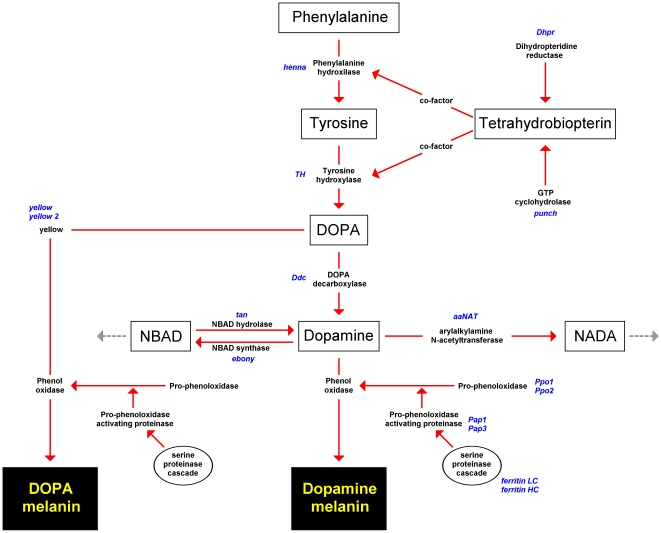
Industrial melanism in the peppered moth (Biston betularia) is an iconic case study of ecological genetics but the molecular identity of the gene determining the difference between the typical and melanic (carbonaria) morphs is entirely unknown. We applied the candidate gene approach to look for associations between genetic polymorphisms within sixteen a priori melanisation gene candidates and the carbonaria morph. The genes were isolated and sequence characterised in B. betularia using degenerate PCR and from whole-transcriptome sequence. The list of candidates contains all the genes previously implicated in melanisation pattern differences in other insects, including aaNAT, DOPA-decarboxylase, ebony, tan, tyrosine hydroxylase, yellow and yellow2 (yellow-fa). Co-segregation of candidate gene alleles and carbonaria morph was tested in 73 offspring of a carbonaria male-typical female backcross. Surprisingly, none of the sixteen candidate genes was in close linkage with the locus controlling the carbonaria-typical polymorphism. Our study demonstrates that the 'carbonaria gene' is not a structural variant of a canonical melanisation pathway gene, neither is it a cis-regulatory element of these enzyme-coding genes. The implication is either that we have failed to characterize an unknown enzyme-coding gene in the melanisation pathway, or more likely, that the 'carbonaria gene' is a higher level trans-acting factor which regulates the spatial expression of one or more of the melanisation candidates in this study to alter the pattern of melanin production.
Overview
The claims and statistics of this paper haven’t been checked yet.
Free: it reads the open-access text and checks the first 5 claims that cite a source we can check. Create a free account to check every claim.
Integrity signals
Registry
Cites
Statistics
Figures
Verification
Claims the paper makes
The claims and statistics of this paper haven’t been checked yet.
Free: it reads the open-access text and checks the first 5 claims that cite a source we can check. Create a free account to check every claim.
Claims other papers make about this one
Each is checked against this paper’s own text: does it say what the citing paper says it does?
The source backs part of the claim, not all of it — or backs it for a different population, condition or comparison.
In the citing paper
“A survey of all the candidate genes revealed that this is not the case (Van't Hof and Saccheri, 2010)”
From The peppered moth and industrial melanism: evolution of a natural selection case study (2013) · cites this paper as Van't Hof and Saccheri, 2010
Experimental — accuracy not yet measured
Self-check
Percentages, sums and reported differences re-computed from the paper’s own numbers.
The self-check needs the paper’s full text.
Citations
Cites
Gapped BLAST and PSI-BLAST: a new generation of protein database search programs
Altschul, S. (1997) · Nucleic Acids Research · doi:10.1093/nar/25.17.3389 · Cited by 73,302 · cited 2×
“All genes were identified based on a blastx search [33] against the GenBank database (www.”
BackgroundThe prophenoloxidase‐activating system in invertebrates
Cerenius, L., & Söderhäll, K. (2004) · Immunological Reviews · doi:10.1111/j.0105-2896.2004.00116.x · Cited by 1,730 · cited 5×
“In arthropods, the process of melanisation is variously used for purposes of crypsis, sexual signalling [6], and thermoregulation [7] but also plays a major role in immune response [8], wound healing and cuticular hardening [9].”
BackgroundInfluentialThe Serpins Are an Expanding Superfamily of Structurally Similar but Functionally Diverse Proteins
Silverman, G. A., Bird, P. I., Carrell, R. W., Church, F. C., Coughlin, P. B., Gettins, P. G. W., Irving, J. A., Lomas, D. A., Luke, C. J., Moyer, R. W., et al. (2001) · Journal of Biological Chemistry · doi:10.1074/jbc.r100016200 · Cited by 1,230 · cited 1×
“paralogs) often have completely unrelated functions [26,27,28,29].”
The serpin superfamily of proteinase inhibitors: structure, function, and regulation.
Potempa, J., Korzus, E., & Travis, J. (1994) · Journal of Biological Chemistry · doi:10.1016/s0021-9258(17)33954-6 · Cited by 875
Chance caught on the wing: cis-regulatory evolution and the origin of pigment patterns in Drosophila
Gompel, N., Prud'homme, B., Wittkopp, P. J., Kassner, V. A., & Carroll, S. B. (2005) · Nature · doi:10.1038/nature03235 · Cited by 646
Genetics, development and evolution of adaptive pigmentation in vertebrates
Hoekstra, H. E. (2006) · Heredity · doi:10.1038/sj.hdy.6800861 · Cited by 639 · cited 2×
“This candidate gene approach has been applied successfully to discover the genetic basis of melanism in mammals and other vertebrates, implicating several different mutations within the melanocortin-1receptor gene (Mc1r) [4,5].”
BackgroundInsect melanism: the molecules matter
True, J. R. (2003) · Trends in Ecology & Evolution · doi:10.1016/j.tree.2003.09.006 · Cited by 490 · cited 4×
“This is consistent with the WZ/ZZ sex determination system that is generally found in Lepidoptera and it reveals that these three genes are on the Z-chromosome in B. betularia, which corresponds with their location in B. mori.”
BackgroundInfluentialOLIGO 7 Primer Analysis Software
Rychlik, W. (2007) · Methods in Molecular Biology™ · doi:10.1007/978-1-59745-528-2_2 · Cited by 467
Immune reactions in Drosophila and other insects: a model for innate immunity
Hultmark, D. (1993) · Trends in Genetics · doi:10.1016/0168-9525(93)90165-e · Cited by 429 · cited 1×
“Immune-defence melanisation in arthropods is triggered by an intrusion of microbes, fungi, or other foreign objects, or by physical damage (wounds) [8,20,21].”
BackgroundMolecular and Evolutionary History of Melanism in North American Gray Wolves
Anderson, T. M., vonHoldt, B. M., Candille, S. I., Musiani, M., Greco, C., Stahler, D. R., Smith, D. W., Padhukasahasram, B., Randi, E., Leonard, J. A., et al. (2009) · Science · doi:10.1126/science.1165448 · Cited by 416 · cited 1×
“In contrast to the success of the candidate gene approach applied to melanism in vertebrates, particularly through Mc1r [4,5] but also tyrosinase-related protein 1 [41], Agouti [42], and K locus [43], the same strategy has been far less useful as a means to identifying polymorphisms controlling melanism in insects [44…”
Background
Research works printed but not linked: 1
- Cook LM Muggleton J 2003 The peppered moth, Biston betularia (Linnaeus, 1758)(Lepidoptera:Geometridae): a matter of names. Ent Gazette 54 211 221
Cited by
The peppered moth and industrial melanism: evolution of a natural selection case study
Cook, L. M., & Saccheri, I. J. (2013) · Heredity · doi:10.1038/hdy.2012.92 · Cited by 228
Self-citationIndustrial Melanism in British Peppered Moths Has a Singular and Recent Mutational Origin
van’t Hof, A. E., Edmonds, N., Dalíková, M., Marec, F., & Saccheri, I. J. (2011) · Science · doi:10.1126/science.1203043 · Cited by 228
Self-citationLommen, S. T. E., JONG, P. W. D., & Pannebakker, B. A. (2016) · Entomologia Experimentalis et Applicata · doi:10.1111/eea.12510 · Cited by 122
Phenylalanine Metabolism Regulates Reproduction and Parasite Melanization in the Malaria Mosquito
Fuchs, S., Behrends, V., Bundy, J. G., Crisanti, A., & Nolan, T. (2014) · PLoS ONE · doi:10.1371/journal.pone.0084865 · Cited by 100
Hof, A. E. V., Nguyen, P., Dalíková, M., Edmonds, N., Marec, F., & Saccheri, I. J. (2012) · Heredity · doi:10.1038/hdy.2012.84 · Cited by 79
“Van’t Hof AE, Marec F, Saccheri IJ, Brakefield PM, Zwaan BJ (2008).”
BackgroundMethodResultInfluentialSelf-citation
Metadata
- Authors
- van't Hof, A. E., & Saccheri, I. J.
- Affiliations
- University of Liverpool (GB)
- Corresponding author
- Saccheri, Ilik J.
- ORCID
- Saccheri, Ilik J.
- Venue
- PLoS ONE
- Publisher
- Public Library of Science (PLoS)
- Published
- 2010-05-28
- Volume
- 5
- Issue
- 5
- Pages
- e10889
- ISSN
- 1932-6203 (ISSN-L)
- PMC
- PMC2878321
- OpenAlex
- W2021743270
- Cited by
- 39
- References
- 54
- Citations by year
- 2026: 1 · 2025: 1 · 2024: 1 · 2023: 2 · 2022: 3 · 2021: 3 · 2020: 1 · 2017: 4 · 2016: 6 · 2015: 3 · 2014: 4 · 2013: 3 · 2012: 4
- FWCI
- 1.40
- Type
- journal article
- Language
- en
- Open access
- gold
- doi.org
- Locations
- PLoS ONE (publishedVersion, cc-by)
- PubMed Central (publishedVersion, cc-by)
- PubMed (publishedVersion)
- DOAJ (DOAJ: Directory of Open Access Journals) (submittedVersion, cc-by-sa)
- Figshare (submittedVersion, cc-by)
- Funders
- Natural Environment Research Council (NE/C003101/1)
- Topics
- Life Sciences › Biochemistry, Genetics and Molecular Biology › Cell Biology › melanin and skin pigmentation
- Life Sciences › Agricultural and Biological Sciences › Insect Science › Lepidoptera: Biology and Taxonomy
- Life Sciences › Neuroscience › Cellular and Molecular Neuroscience › Neurobiology and Insect Physiology Research
- Keywords
- industrial melanism, peppered moth, candidate gene association, genetic polymorphism, ebony, TaN, yellow, tyrosine hydroxylase, aromatic L-amino acid decarboxylase, arylalkylamine N-acetyltransferase, cis-regulatory elements, trans-acting factors, melanogenesis
- MeSH terms
- Animals, Industry, Melanosis, Moths, Phenotype, Pigmentation, Genetic Variation
About these checks
Registry, retraction, Cites and statistics results are computed, not judged, with one exception: a printed reference that no index lists is read once by a model before it counts as a citation error. Claims are extracted by a model and kept only when their quote appears verbatim in the text; each cited source is then checked, with a model’s help, for whether it says what the claim relies on. Those verdicts can be wrong — read the claim’s quote and the cited source before relying on one.
Statistics and arithmetic are recomputed, not judged.
Confidence bands are shown only for fields calibrated on our annotated test set. None is calibrated yet, so no band is shown.
What counts as a claim ›How we measure confidence ›How we check this ›
Are you an author, or do you see a problem with this page? Request a review
Data sources
Bibliographic data: Semantic Scholar, OpenAlex, Crossref.
Contains information from the Semantic Scholar Academic Graph Datasets, made available under the ODC Attribution License (ODC-BY 1.0).
Semantic Scholar’s data is described in: Kinney, R., et al. (2023). The Semantic Scholar Open Data Platform. arXiv:2301.10140.
