

The DOI matches its Crossref record; 86 of the 88 references it cites were found in a registry or an index.
A Meta-Analysis of Probiotic Efficacy for Gastrointestinal Diseases
Open accessAbstract
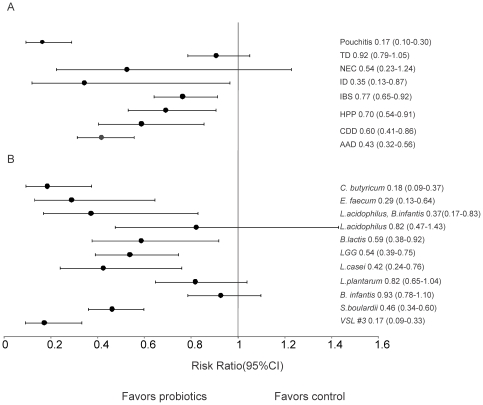
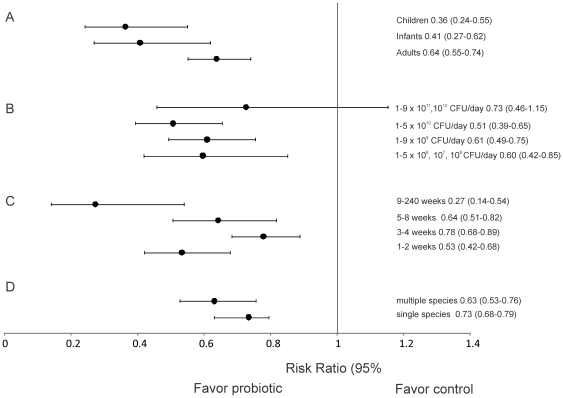
BACKGROUND: Meta-analyses on the effects of probiotics on specific gastrointestinal diseases have generally shown positive effects on disease prevention and treatment; however, the relative efficacy of probiotic use for treatment and prevention across different gastrointestinal diseases, with differing etiology and mechanisms of action, has not been addressed. METHODS/PRINCIPAL FINDINGS: We included randomized controlled trials in humans that used a specified probiotic in the treatment or prevention of Pouchitis, Infectious diarrhea, Irritable Bowel Syndrome, Helicobacter pylori, Clostridium difficile Disease, Antibiotic Associated Diarrhea, Traveler's Diarrhea, or Necrotizing Enterocolitis. Random effects models were used to evaluate efficacy as pooled relative risks across the eight diseases as well as across probiotic species, single vs. multiple species, patient ages, dosages, and length of treatment. Probiotics had a positive significant effect across all eight gastrointestinal diseases with a relative risk of 0.58 (95% (CI) 0.51-0.65). Six of the eight diseases: Pouchitis, Infectious diarrhea, Irritable Bowel Syndrome, Helicobacter pylori, Clostridium difficile Disease, and Antibiotic Associated Diarrhea, showed positive significant effects. Traveler's Diarrhea and Necrotizing Enterocolitis did not show significant effects of probiotcs. Of the 11 species and species mixtures, all showed positive significant effects except for Lactobacillus acidophilus, Lactobacillus plantarum, and Bifidobacterium infantis. Across all diseases and probiotic species, positive significant effects of probiotics were observed for all age groups, single vs. multiple species, and treatment lengths. CONCLUSIONS/SIGNIFICANCE: Probiotics are generally beneficial in treatment and prevention of gastrointestinal diseases. Efficacy was not observed for Traveler's Diarrhea or Necrotizing Enterocolitis or for the probiotic species L. acidophilus, L. plantarum, and B. infantis. When choosing to use probiotics in the treatment or prevention of gastrointestinal disease, the type of disease and probiotic species (strain) are the most important factors to take into consideration.
Overview
The claims and statistics of this paper haven’t been checked yet.
Run the check — free, no account needed. It reads the open-access text and checks the sources it cites.
Integrity signals
Registry
Cites
Statistics
Figures
Verification
Claims the paper makes
The claims and statistics of this paper haven’t been checked yet.
Run the check — free, no account needed. It reads the open-access text and checks the sources it cites.
Claims other papers make about this one
Each is checked against this paper’s own text: does it say what the citing paper says it does?
The source backs part of the claim, not all of it — or backs it for a different population, condition or comparison.
In the citing paper
“Probiotic efficacy is well established to be strain-, dose-, and formulation-specific, with clinical benefit demonstrated only for selected organisms and indications rather than for probiotics as a class.52-54”
From Safety and efficacy concerns in Indian probiotics: Insights from whole-genome sequencing and in vitro assessment (2026) · cites this paper as [54]
Experimental — accuracy not yet measured
Self-check
Percentages, sums and reported differences re-computed from the paper’s own numbers.
The self-check needs the paper’s full text.
Citations
Cites
Bias in meta-analysis detected by a simple, graphical test
Egger, M., Smith, G. D., Schneider, M., & Minder, C. (1997) · BMJ · doi:10.1136/bmj.315.7109.629 · Cited by 56,722
Assessing the quality of reports of randomized clinical trials: Is blinding necessary?
Jadad, A. R., Moore, R. A., Carroll, D., Jenkinson, C., Reynolds, D. J. M., Gavaghan, D. J., & McQuay, H. J. (1996) · Controlled Clinical Trials · doi:10.1016/0197-2456(95)00134-4 · Cited by 17,582
Operating characteristics of a rank correlation test for publication bias
Begg, C. B., & Mazumdar, M. (1994) · Biometrics · doi:10.2307/2533446 · Cited by 16,955
Gionchetti, P., Rizzello, F., Venturi, A., Brigidi, P., Matteuzzi, D., Bazzocchi, G., Poggioli, G., Miglioli, M., & Campieri, M. (2000) · Gastroenterology · doi:10.1053/gast.2000.9370 · Cited by 1,485
Functional food science and gastrointestinal physiology and function
Salminen, S., Bouley, C., Boutron, M.-C., Cummings, J. H., Franck, A., Gibson, G. R., Isolauri, E., Moreau, M.-C., Roberfroid, M., & Rowland, I. (1998) · British Journal of Nutrition · doi:10.1079/bjn19980108 · Cited by 1,398
Saavedra, J. M., Bauman, N. A., Perman, J. A., Yolken, R. H., Saavedra, J. M., Bauman, N. A., & Oung, I. (1994) · The Lancet · doi:10.1016/s0140-6736(94)91708-6 · Cited by 958
Mimura, T., Rizzello, F., Helwig, U., Poggioli, G., Schreiber, S., Talbot, I. C., Nicholls, R. J., Gionchetti, P., Campieri, M., & Kamm, M. A. (2003) · Gut · doi:10.1136/gut.53.1.108 · Cited by 912
McFarland, L. V. (2006) · The American Journal of Gastroenterology · doi:10.1111/j.1572-0241.2006.00465.x · Cited by 872
McFarland, L. V. (1994) · JAMA · doi:10.1001/jama.1994.03510480037031 · Cited by 862
Whorwell, P. J., Altringer, L., Morel, J., Bond, Y., Charbonneau, D., O'Mahony, L., Kiely, B., Shanahan, F., & Quigley, E. M. M. (2006) · The American Journal of Gastroenterology · doi:10.1111/j.1572-0241.2006.00734.x · Cited by 799
Research works printed but not linked: 3
- J Boulloche, 1994, Management of acute diarrhoea in infants and young children: controlled study of the anti-diarrhoeal efficacy of killed L. acidophilus (LB Strain) versus a placebo and a reference drug (loperamide)., Ann Pediatr, 41, 457
- JY Bodilis, 1983, Controlled clinical trial of Lacteol Fort compared with a placebo and reference drug in the treatment of acute diarrhea in the adult., Med Actuelle, 10, 232
- M Simren, 2006, Effects of Lactobacillus plantarum 299v on symptoms and rectal sensitivity in patients with irritable bowel syndrome (IBS) - A randomized, double-blind controlled trial., Gastroenterology, 130, A600
Cited by
Sorted by citations
Hill (2014) · doi:10.1038/nrgastro.2014.66 · Cited by 9,592
Probiotics, gut microbiota, and their influence on host health and disease
Sánchez, B., Delgado, S., Blanco‐Míguez, A., Lourenço, A., Gueimonde, M., & Margolles, A. (2017) · Molecular Nutrition & Food Research · doi:10.1002/mnfr.201600240 · Cited by 1,104
Gut microbiota imbalance and colorectal cancer
Gagnière, J. (2016) · World Journal of Gastroenterology · doi:10.3748/wjg.v22.i2.501 · Cited by 890
Factors affecting the composition of the gut microbiota, and its modulation
Hasan, N., & Yang, H. (2019) · PeerJ · doi:10.7717/peerj.7502 · Cited by 807
Kynurenine pathway metabolism and the microbiota-gut-brain axis
Kennedy, P. J., Cryan, J. F., Dinan, T. G., & Clarke, G. (2017) · Neuropharmacology · doi:10.1016/j.neuropharm.2016.07.002 · Cited by 724
Metadata
- Authors
- Ritchie, M. L., & Romanuk, T. N.
- Affiliations
- Dalhousie University (CA)
- Corresponding author
- Ritchie, Marina L.
- Venue
- PLoS ONE
- Publisher
- Public Library of Science (PLoS)
- Published
- 2012-04-18
- Volume
- 7
- Issue
- 4
- Pages
- e34938
- ISSN
- 1932-6203 (ISSN-L)
- PMC
- PMC3329544
- OpenAlex
- W2010508425
- Cited by
- 474
- References
- 88
- Citations by year
- 2026: 16 · 2025: 23 · 2024: 24 · 2023: 33 · 2022: 31 · 2021: 43 · 2020: 37 · 2019: 34 · 2018: 34 · 2017: 36 · 2016: 41 · 2015: 44 · 2014: 28 · 2013: 35 · 2012: 14
- FWCI
- 5.09
- Type
- journal article
- Language
- en
- Open access
- gold
- doi.org
- Locations
- PLoS ONE (publishedVersion, cc-by)
- Europe PMC (PubMed Central) (publishedVersion, cc-by)
- PubMed Central (publishedVersion, cc-by)
- PubMed (publishedVersion)
- RePEc: Research Papers in Economics (submittedVersion)
- DalSpace (Dalhousie University) (submittedVersion)
- DOAJ (DOAJ: Directory of Open Access Journals) (submittedVersion, cc-by-sa)
- Figshare (submittedVersion, cc-by)
- Funders
- Natural Sciences and Engineering Research Council of Canada
- Topics
- Life Sciences › Agricultural and Biological Sciences › Food Science › Probiotics and Fermented Foods
- Health Sciences › Medicine › Gastroenterology › Gastrointestinal motility and disorders
- Life Sciences › Biochemistry, Genetics and Molecular Biology › Molecular Biology › Gut microbiota and health
- Keywords
- probiotics, gastrointestinal diseases, probiotic efficacy, pouchitis, infectious diarrhea, irritable bowel syndrome, Helicobacter pylori, antibiotic-associated diarrhea, traveler's diarrhea, necrotizing enterocolitis, Lactobacillus acidophilus, Lactobacillus plantarum, Bifidobacterium infantis, disease prevention
- MeSH terms
- Age Factors, Gastrointestinal Diseases, Humans, Randomized Controlled Trials as Topic, Treatment Outcome, Publication Bias, Probiotics
About these checks
Registry, retraction, Cites and statistics results are computed, not judged, with one exception: a printed reference that no index lists is read once by a model before it counts as a citation error. Claims are extracted by a model and kept only when their quote appears verbatim in the text; each cited source is then checked, with a model’s help, for whether it says what the claim relies on. Those verdicts can be wrong — read the claim’s quote and the cited source before relying on one.
Statistics and arithmetic are recomputed, not judged.
Confidence bands are shown only for fields calibrated on our annotated test set. None is calibrated yet, so no band is shown.
What counts as a claim ›How we measure confidence ›How we check this ›
Are you an author, or do you see a problem with this page? Request a review
