

The DOI matches its Crossref record; 75 of the 75 references it cites were found in a registry or an index.
Lactobacillaceae and Cell Adhesion: Genomic and Functional Screening
Open accessAbstract
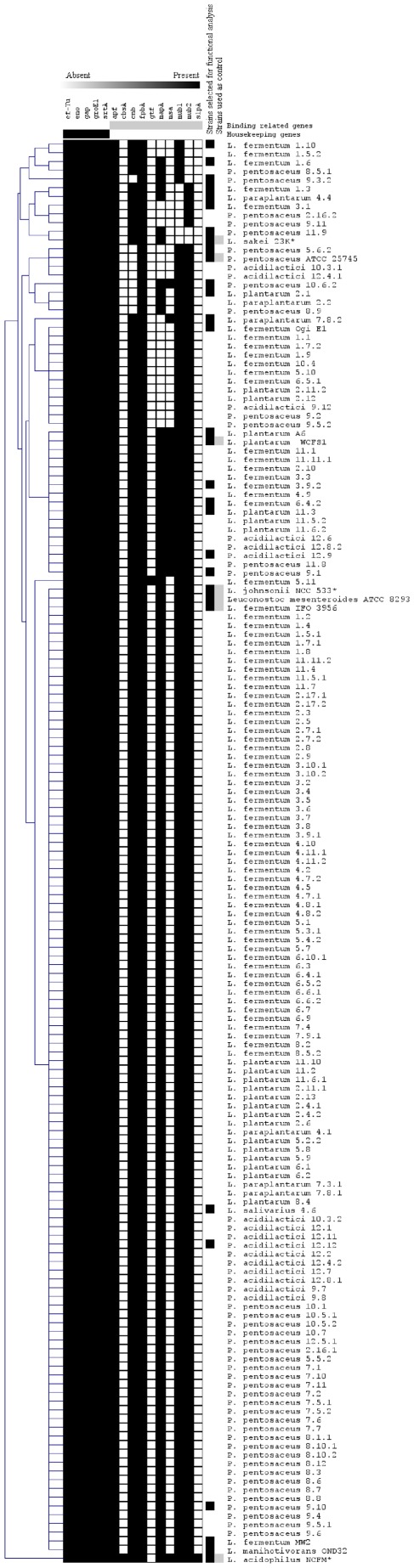
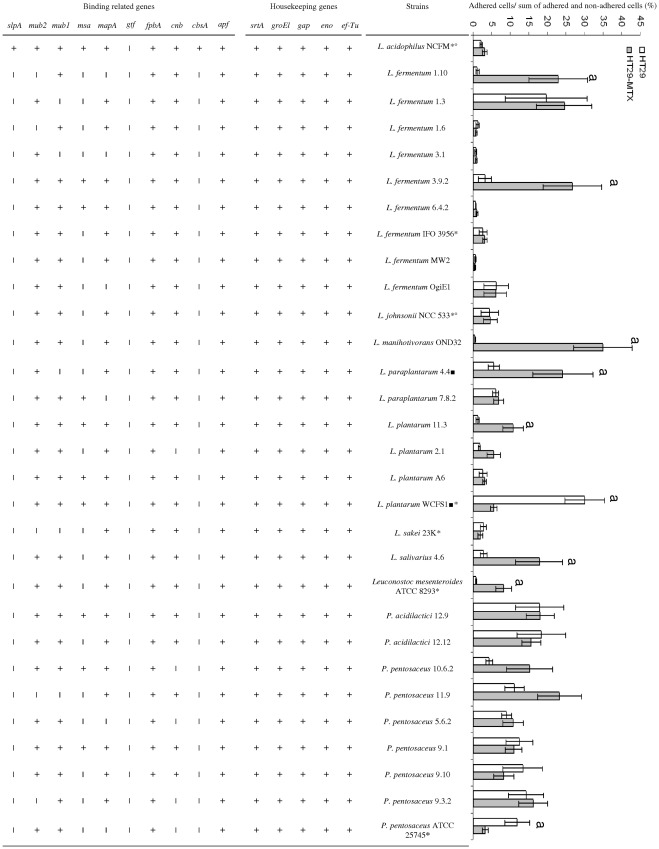
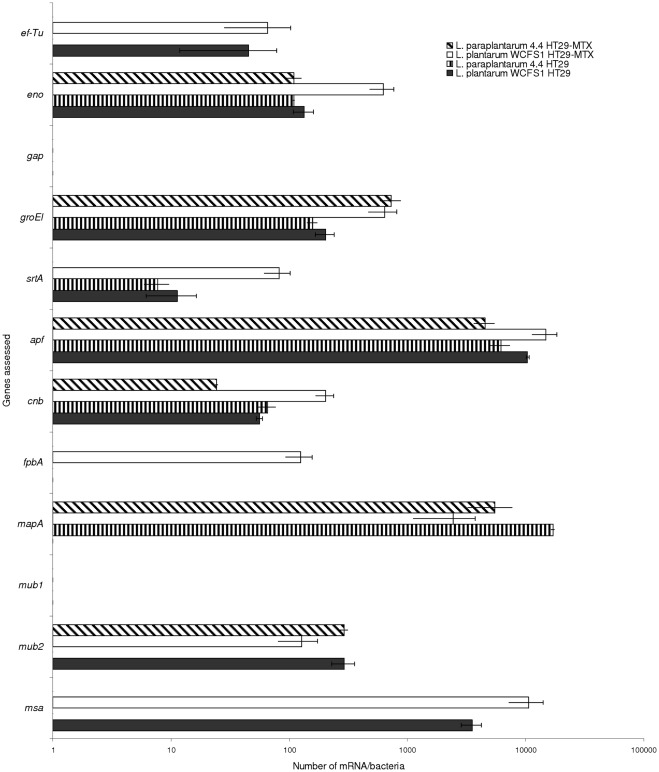
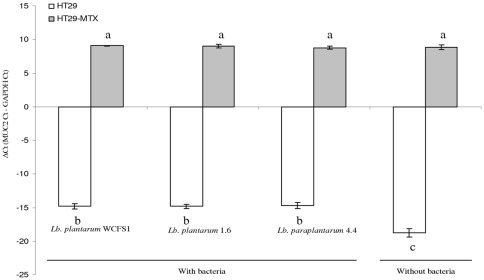
The analysis of collections of lactic acid bacteria (LAB) from traditional fermented plant foods in tropical countries may enable the detection of LAB with interesting properties. Binding capacity is often the main criterion used to investigate the probiotic characteristics of bacteria. In this study, we focused on a collection of 163 Lactobacillaceace comprising 156 bacteria isolated from traditional amylaceous fermented foods and seven strains taken from a collection and used as controls. The collection had a series of analyses to assess binding potential for the selection of new probiotic candidates. The presence/absence of 14 genes involved in binding to the gastrointestinal tract was assessed. This enabled the detection of all the housekeeping genes (ef-Tu, eno, gap, groEl and srtA) in the entire collection, of some of the other genes (apf, cnb, fpbA, mapA, mub) in 86% to 100% of LAB, and of the other genes (cbsA, gtf, msa, slpA) in 0% to 8% of LAB. Most of the bacteria isolated from traditional fermented foods exhibited a genetic profile favorable for their binding to the gastrointestinal tract. We selected 30 strains with different genetic profiles to test their binding ability to non-mucus (HT29) and mucus secreting (HT29-MTX) cell lines as well as their ability to degrade mucus. Assays on both lines revealed high variability in binding properties among the LAB, depending on the cell model used. Finally, we investigated if their binding ability was linked to tighter cross-talk between bacteria and eukaryotic cells by measuring the expression of bacterial genes and of the eukaryotic MUC2 gene. Results showed that wild LAB from tropical amylaceous fermented food had a much higher binding capacity than the two LAB currently known to be probiotics. However their adhesion was not linked to any particular genetic equipment.
Overview
The claims and statistics of this paper haven’t been checked yet.
Run the check — free, no account needed. It reads the open-access text and checks the sources it cites.
Integrity signals
Registry
Cites
Statistics
Figures
Verification
Claims the paper makes
The claims and statistics of this paper haven’t been checked yet.
Run the check — free, no account needed. It reads the open-access text and checks the sources it cites.
Claims other papers make about this one
Each is checked against this paper’s own text: does it say what the citing paper says it does?
The cited source says what the claim attributes to it.
In the citing paper
“According to Turpin et. al. the same housekeeping genes were present in all their isolates, therefore screening them was not essential to evaluate the bacteria's binding capacity [32].”
From EVALUATION OF ADHESIVE AND AGGREGATION PROPERTIES OF LACTIC ACID BACTERIA ISOLATED FROM DIFFERENT BIOTOPES (2025) · cites this paper as [32]
Self-check
Percentages, sums and reported differences re-computed from the paper’s own numbers.
The self-check needs the paper’s full text.
Citations
Cites
Thompson, J. D., Higgins, D. G., & Gibson, T. J. (1994) · Nucleic Acids Research · doi:10.1093/nar/22.22.4673 · Cited by 64,617
Primer3 on the WWW for General Users and for Biologist Programmers
Rozen, S., & Skaletsky, H. (2003) · Humana Press eBooks · doi:10.1385/1-59259-192-2:365 · Cited by 15,068
Muyzer, G., de Waal, E. C., & Uitterlinden, A. G. (1993) · Applied and Environmental Microbiology · doi:10.1128/aem.59.3.695-700.1993 · Cited by 11,490
TM4: a free, open-source system for microarray data management and analysis
Saeed, A. I., Sharov, V., White, J., Li, J., Liang, W., Bhagabati, N., Braisted, J., Klapa, M., Currier, T., Thiagarajan, M., et al. (2003) · BioTechniques · doi:10.2144/03342mt01 · Cited by 4,837
Stem Cells, Self-Renewal, and Differentiation in the Intestinal Epithelium
van der Flier, L. G., & Clevers, H. C. (2008) · Annual Review of Physiology · doi:10.1146/annurev.physiol.010908.163145 · Cited by 1,994
Complete genome sequence of Lactobacillus plantarum WCFS1
Kleerebezem, M., Boekhorst, J., van Kranenburg, R., Molenaar, D., Kuipers, O. P., Leer, R., Tarchini, R., Peters, S. A., Sandbrink, H. M., Fiers, M. W. E. J., et al. (2003) · Proceedings of the National Academy of Sciences · doi:10.1073/pnas.0337704100 · Cited by 1,472
Comparative genomics of the lactic acid bacteria.
Makarova, K., Slesarev, A., Wolf, Y., Sorokin, A., Mirkin, B., Koonin, E., Pavlov, A., Pavlova, N., Karamychev, V., Polouchine, N., et al. (2006) · Proceedings of the National Academy of Sciences · doi:10.1073/pnas.0607117103 · Cited by 1,391
Genes and Molecules of Lactobacilli Supporting Probiotic Action
Lebeer, S., Vanderleyden, J., & De Keersmaecker, S. C. J. (2008) · Microbiology and Molecular Biology Reviews · doi:10.1128/mmbr.00017-08 · Cited by 1,013
Mack, D. R., Michail, S. K., Wei, S. H., McDougall, L., & Hollingsworth, M. A. (1999) · American Journal of Physiology-Gastrointestinal and Liver Physiology · doi:10.1152/ajpgi.1999.276.4.g941 · Cited by 839
Mack, D. R., Ahrné, S., Hyde, L., Wei, S. H., & Hollingsworth, M. A. (2003) · Gut · doi:10.1136/gut.52.6.827 · Cited by 686
Research works printed but not linked: 1
- Å Ljungh, 2009, Lactobacillus Molecular Biology: From Genomics to Probiotics Caister Academic Press
Cited by
Sorted by citations
Items 101–128 of 128
Prebiotic Treatment Influence the Adhesion Properties of Three Lactobacillus strains
Sredkova, P., Iliev, I. N., Dzhambazov, B. M., & Batsalova, T. (2017) · International Journal of Current Microbiology and Applied Sciences · doi:10.20546/ijcmas.2017.609.358 · Cited by 1
Aziz, K., Zaidi, A., & Rehman, N. (2023) · Archives of Microbiology · doi:10.1007/s00203-023-03487-y · Cited by 1
Javanshir, N., Rezvani, E. M., Mazhary, Z., Razani, S., Ahmadian, G., & Fard, N. A. (2020) · doi:10.21203/rs.3.rs-116217/v1 · Cited by 1
Basumatary, Z., Saha, S., Barman, K. K., Chaudhuri, S., Maiti, S. S., & Nayak, P. K. (2022) · Research Square · doi:10.21203/rs.3.rs-2202466/v1 · Cited by 1
Turpin, W. (2011) · theses.fr (ABES) · doi:10.70675/6fb75bf8zc7dcz44cfzaa0az934bb5f0d7f5 · Cited by 1
Self-citationKafsi, H. E. (2014) · theses.fr (ABES) · doi:10.70675/c3ef71e9z2564z4f3fza520z4e48023240b0 · Cited by 1
Marinova-Yordanova, V., Kizheva, Y., Rasheva, I., & Hristova, P. (2025) · Journal of Chemical Technology and Metallurgy · doi:10.59957/jctm.v60.i6.2025.8
“[32].”
Potencialidad probiótica de lactobacilos con capa S
Carasi, P. (2014) · El Servicio de Difusión de la Creación Intelectual (National University of La Plata) · doi:10.35537/10915/43573
Karakterizacija AggLb agregacionog faktora soja Lactobacillus paracasei subsp. paracasei BGNJ1-64
Miljković, M. (2016) · IMAGINE - Repository of the Institute of molecular genetics and genetic engineering (University of Belgrade)
Widodo, W., Lestari, S., & Asmara, W. (2017) · Indonesian Journal of Biotechnology · doi:10.22146/ijbiotech.24346
Nouvelle thérapeutique anti-Pseudomonas aeruginosa dans la mucoviscidose : les Lactobacillus spp.
Fangous, M.-S. (2019) · theses.fr (ABES) · doi:10.70675/bbe6a8c0za30ez4497z81b8z9b8412664d3c
Choo, S. (2017) · Universiti Putra Malaysia Institutional Repository (Universiti Putra Malaysia)
Sliti, A., & Shin, J. (2026) · Microbiology and Biotechnology Letters · doi:10.48022/mbl.2506.06004
Cao, M., Li, W., He, X., Liao, L., Xu, Y., Wang, R., Zhang, X. F., Yi, L., Wang, J., Zuo, H., et al. (2026) · Biochemistry and Biophysics Reports · doi:10.1016/j.bbrep.2026.102481
Microbiome-based interventions for colorectal cancer prevention and treatment
Abdullah, N. A., Jayasurya, J. V., Shri, M. P. L., Thatcher, R. M., Dalbayrak, B., Arısan, E. D., Ambika, S., & Manojkumar, Y. (2026) · Elsevier eBooks · doi:10.1016/b978-0-443-40483-2.00034-0
Role of Bile-Salts Hydrolases (BSH) of probiotic lactobacilli against giardiasis
Allain, T. (2016) · theses.fr (ABES) · doi:10.70675/a14455b0z79bcz46e7z9b13z21e3b43a58df
Études structurales et fonctionnelles d'alpha-glucosidases bactériennes
Dejob, M. (2013) · theses.fr (ABES) · doi:10.70675/101e35c0ze3ecz4656za5c8z4c09c7332ec0
Awussi, A. A. (2016) · theses.fr (ABES) · doi:10.70675/d430a147z1a00z4a61z9a29zfa54ea88c91d
Kebouchi, M. (2017) · theses.fr (ABES) · doi:10.70675/ebfdb90dza291z4613z8967zca21557cc4b8
Metadata
- Authors
- Turpin, W., Humblot, C., Noordine, M.-L., Thomas, M., & Guyot, J.-P.
- Affiliations
- Institut de Recherche pour le Développement (FR)
- Microbiologie de l’alimentation au service de la santé (FR)
- Corresponding author
- Humblot, Christèle
- Venue
- PLoS ONE
- Publisher
- Public Library of Science (PLoS)
- Published
- 2012-05-31
- Volume
- 7
- Issue
- 5
- Pages
- e38034
- ISSN
- 1932-6203 (ISSN-L)
- PMC
- PMC3364998
- OpenAlex
- W2166637116
- Cited by
- 118
- References
- 75
- Citations by year
- 2026: 3 · 2025: 6 · 2024: 4 · 2023: 7 · 2022: 14 · 2021: 9 · 2020: 6 · 2019: 11 · 2018: 10 · 2017: 6 · 2016: 5 · 2015: 14 · 2014: 15 · 2013: 6
- FWCI
- 17.21
- Type
- journal article
- Language
- en
- Open access
- gold
- doi.org
- Locations
- PLoS ONE (publishedVersion, cc-by)
- Europe PMC (PubMed Central) (publishedVersion, cc-by)
- PubMed Central (publishedVersion, cc-by)
- PubMed (publishedVersion)
- HAL (submittedVersion, other-oa)
- DOAJ (DOAJ: Directory of Open Access Journals) (submittedVersion, cc-by-sa)
- Topics
- Life Sciences › Agricultural and Biological Sciences › Food Science › Probiotics and Fermented Foods
- Life Sciences › Immunology and Microbiology › Microbiology › Reproductive tract infections research
- Life Sciences › Biochemistry, Genetics and Molecular Biology › Genetics › Bacterial Genetics and Biotechnology
- Keywords
- Lactobacillaceae, lactic acid bacteria, cell adhesion, probiotics, mucus degradation, traditional fermented foods, host-bacteria interactions
- MeSH terms
- Bacterial Adhesion, Humans, Intestinal Mucosa, Lactobacillaceae, Mucins, Gene Expression Regulation, Bacterial, Genome, Bacterial, HT29 Cells, Mucin-2
About these checks
Registry, retraction, Cites and statistics results are computed, not judged, with one exception: a printed reference that no index lists is read once by a model before it counts as a citation error. Claims are extracted by a model and kept only when their quote appears verbatim in the text; each cited source is then checked, with a model’s help, for whether it says what the claim relies on. Those verdicts can be wrong — read the claim’s quote and the cited source before relying on one.
Statistics and arithmetic are recomputed, not judged.
Confidence bands are shown only for fields calibrated on our annotated test set. None is calibrated yet, so no band is shown.
What counts as a claim ›How we measure confidence ›How we check this ›
Are you an author, or do you see a problem with this page? Request a review
