

Gene Expression-Based Classifiers Identify Staphylococcus aureus Infection in Mice and Humans
Open accessThe DOI matches its Crossref record; 73 of the 73 references it cites were found in a registry or an index.
Abstract
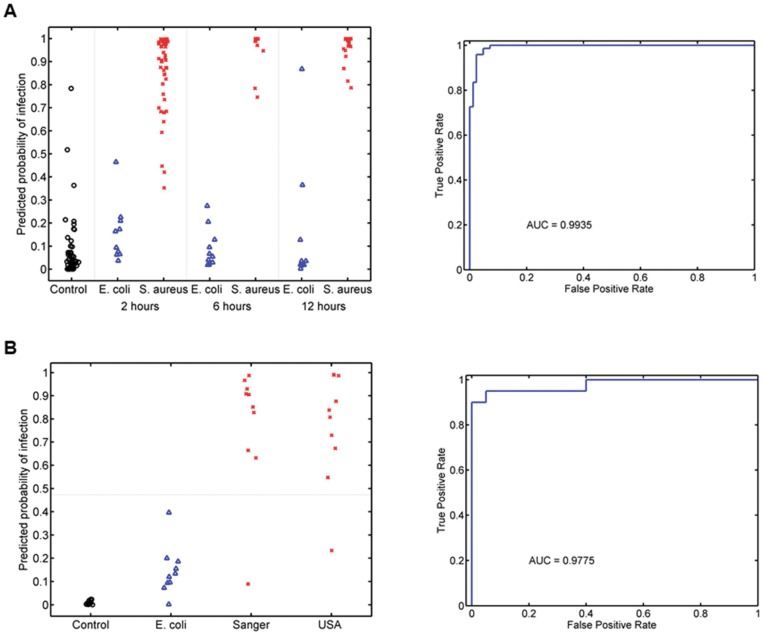
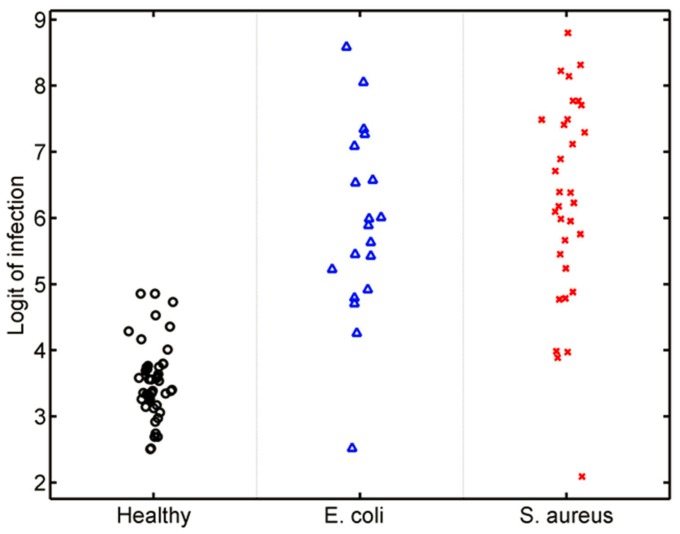
Staphylococcus aureus causes a spectrum of human infection. Diagnostic delays and uncertainty lead to treatment delays and inappropriate antibiotic use. A growing literature suggests the host's inflammatory response to the pathogen represents a potential tool to improve upon current diagnostics. The hypothesis of this study is that the host responds differently to S. aureus than to E. coli infection in a quantifiable way, providing a new diagnostic avenue. This study uses Bayesian sparse factor modeling and penalized binary regression to define peripheral blood gene-expression classifiers of murine and human S. aureus infection. The murine-derived classifier distinguished S. aureus infection from healthy controls and Escherichia coli-infected mice across a range of conditions (mouse and bacterial strain, time post infection) and was validated in outbred mice (AUC>0.97). A S. aureus classifier derived from a cohort of 94 human subjects distinguished S. aureus blood stream infection (BSI) from healthy subjects (AUC 0.99) and E. coli BSI (AUC 0.84). Murine and human responses to S. aureus infection share common biological pathways, allowing the murine model to classify S. aureus BSI in humans (AUC 0.84). Both murine and human S. aureus classifiers were validated in an independent human cohort (AUC 0.95 and 0.92, respectively). The approach described here lends insight into the conserved and disparate pathways utilized by mice and humans in response to these infections. Furthermore, this study advances our understanding of S. aureus infection; the host response to it; and identifies new diagnostic and therapeutic avenues.
Overview
The claims and statistics of this paper haven’t been checked yet.
Free: it reads the open-access text and checks the first 5 claims that cite a source we can check. Create a free account to check every claim.
Integrity signals
Registry
Cites
Statistics
Figures




Verification
Claims the paper makes
The claims and statistics of this paper haven’t been checked yet.
Free: it reads the open-access text and checks the first 5 claims that cite a source we can check. Create a free account to check every claim.
Claims other papers make about this one
Each is checked against this paper’s own text: does it say what the citing paper says it does?
In the citing paper
“Classification of genes by expression profiling using RNA-seq has been used to characterize several infections, including staphylococcal bacteraemia67, Lyme disease68, candidiasis69, tuberculosis (discriminating between latent and active disease risk)70–72 and influenza73–75.”
From Clinical metagenomics (2019) · cites this paper as [67]
Self-check
Percentages, sums and reported differences re-computed from the paper’s own numbers.
The self-check needs the paper’s full text.
Citations
Cites
Bone, R. C., Balk, R. A., Cerra, F. B., Dellinger, R. P., Fein, A. M., Knaus, W. A., Schein, R. M. H., & Sibbald, W. J. (1992) · Chest · doi:10.1378/chest.101.6.1644 · Cited by 13,198
The epidemiology of sepsis in the United States from 1979 through 2000
Martin, G. S., Mannino, D. M., Eaton, S., & Moss, M. (2003) · New England Journal of Medicine · doi:10.1056/nejmoa022139 · Cited by 5,841
Bad Bugs, No Drugs: No ESKAPE! An Update from the Infectious Diseases Society of America
Boucher, H. W., Talbot, G. H., Bradley, J. S., Edwards, J. E., Gilbert, D., Rice, L. B., Scheld, M., Spellberg, B., & Bartlett, J. (2009) · Clinical Infectious Diseases · doi:10.1086/595011 · Cited by 4,958 · cited 1×
“Conversely, diagnostic uncertainty also leads to high rates of empiric overtreatment, fueling the burden of antimicrobial resistance [6,7].”
BackgroundOf Mice and Not Men: Differences between Mouse and Human Immunology
Mestas, J., & Hughes, C. C. W. (2004) · The Journal of Immunology · doi:10.4049/jimmunol.172.5.2731 · Cited by 3,822 · cited 1×
“In fact, more than 60 incongruities between murine and human immune systems have been recognized many of which involve hostpathogen interactions [68,69].”
BackgroundTakeuchi, O., Hoshino, K., Kawai, T., Sanjo, H., Takada, H., Ogawa, T., Takeda, K., & Akira, S. (1999) · Immunity · doi:10.1016/s1074-7613(00)80119-3 · Cited by 3,362 · cited 1×
“experiments have revealed fundamental differences in host response to Gram-positive and Gram-negative bacterial infection [8–10], including significant differences in Toll-like receptor (TLR) signaling [11,12] and cytokine production [13,14].”
BackgroundAn interferon-inducible neutrophil-driven blood transcriptional signature in human tuberculosis
Berry, M. P. R., Graham, C. M., McNab, F. W., Xu, Z., Bloch, S. A. A., Oni, T., Wilkinson, K. A., Banchereau, R., Skinner, J., Wilkinson, R. J., et al. (2010) · Nature · doi:10.1038/nature09247 · Cited by 1,898 · cited 1×
“In another example, transcript abundance due to cell lineage expansions was not the primary factor in the development of a tuberculosis-specific gene expression signature [71].”
BackgroundInadequate Antimicrobial Treatment of Infections
Kollef, M. H., Sherman, G., Ward, S., & Fraser, V. J. (1999) · Chest · doi:10.1378/chest.115.2.462 · Cited by 1,805 · cited 1×
“Such diagnostic delays can extend the time to administration of effective antibiotics, which is an independent risk factor for mortality [4,5].”
BackgroundBayesian Model Averaging for Linear Regression Models
Raftery, A. E., Hoeting, J. A., & Madigan, D. (1997) · Cited by 1,746
Bayesian Model Averaging for Linear Regression Models
Raftery, A. E., Madigan, D., & Hoeting, J. A. (1997) · Journal of the American Statistical Association · doi:10.1080/01621459.1997.10473615 · Cited by 1,287 · cited 1×
“This has been shown to lead to out of sample predictive accuracies that are superior to penalized maximum likelihood approaches [34].”
Pyogenic Bacterial Infections in Humans with MyD88 Deficiency
von Bernuth, H., Picard, C., Jin, Z., Pankla, R., Xiao, H., Ku, C.-L., Chrabieh, M., Mustapha, I. B., Ghandil, P., Camcioglu, Y., et al. (2008) · Science · doi:10.1126/science.1158298 · Cited by 1,287 · cited 1×
“In fact, more than 60 incongruities between murine and human immune systems have been recognized many of which involve hostpathogen interactions [68,69].”
Background
Research works printed but not linked: 1
- Wang Q, Carvalho C, Lucas JE, West M (2007) BFRM: Bayesian factor regression modeling. Bulletin of the International Society of Bayesian Analysis 14: 4– 5.
Cited by
Chiu, C. Y., & Miller, S. A. (2019) · Nature Reviews Genetics · doi:10.1038/s41576-019-0113-7 · Cited by 1,620
Holland, T. L., Baddour, L. M., Bayer, A. S., Hoen, B., Miro, J. M., & Fowler, V. G. (2016) · Nature Reviews Disease Primers · doi:10.1038/nrdp.2016.59 · Cited by 406
Self-citationSweeney, T. E., Azad, T. D., Donato, M., Haynes, W. A., Perumal, T. M., Henao, R., Bermejo-Martin, J. F., Almansa, R., Tamayo, E., Howrylak, J. A., et al. (2018) · Critical Care Medicine · doi:10.1097/ccm.0000000000003084 · Cited by 362
Self-citationSweeney, T. E., Shidham, A., Wong, H. R., & Khatri, P. (2015) · Science Translational Medicine · doi:10.1126/scitranslmed.aaa5993 · Cited by 332
Sweeney, T. E., Wong, H. R., & Khatri, P. (2016) · Science Translational Medicine · doi:10.1126/scitranslmed.aaf7165 · Cited by 334
Host gene expression classifiers diagnose acute respiratory illness etiology
Tsalik, E. L., Henao, R., Nichols, M., Burke, T., Ko, E. R., McClain, M. T., Hudson, L. L., Mazur, A., Freeman, D. H., Veldman, T., et al. (2016) · Science Translational Medicine · doi:10.1126/scitranslmed.aad6873 · Cited by 254
“Enrolled Derivation Cohort 317 122/151 45 (6-88) 135/116/22 61% 115/70/88”
InfluentialSelf-citationA community approach to mortality prediction in sepsis via gene expression analysis
Sweeney, T. E., Perumal, T. M., Henao, R., Nichols, M., Howrylak, J. A., Choi, A. M., Bermejo-Martin, J. F., Almansa, R., Tamayo, E., Davenport, E. E., et al. (2018) · Nature Communications · doi:10.1038/s41467-018-03078-2 · Cited by 237
Self-citationA Host-Based RT-PCR Gene Expression Signature to Identify Acute Respiratory Viral Infection
Zaas, A. K., Burke, T., Chen, M., McClain, M., Nicholson, B., Veldman, T., Tsalik, E. L., Fowler, V., Rivers, E. P., Otero, R., et al. (2013) · Science Translational Medicine · doi:10.1126/scitranslmed.3006280 · Cited by 139
“Using a smaller set of genes might allow these to be combined with a similar classifier for bacterial infection once that is under development (20).”
BackgroundSelf-citationAn integrated transcriptome and expressed variant analysis of sepsis survival and death
Tsalik, E. L., Langley, R. J., Dinwiddie, D. L., Miller, N., Yoo, B., van Velkinburgh, J. C., Smith, L. D., Thiffault, I., Jaehne, A. K., Valente, A. M., et al. (2014) · Genome Medicine · doi:10.1186/s13073-014-0111-5 · Cited by 112
“We previously performed comprehensive, integrated analyses of clinical and molecular measurements in sepsis to identify and prioritize sepsis pathways in survivors and nonsurvivors without the bias of a priori mechanistic hypotheses [9-13].”
MethodSelf-citationBenchmarking Sepsis Gene Expression Diagnostics Using Public Data*
Sweeney, T. E., & Khatri, P. (2016) · Critical Care Medicine · doi:10.1097/ccm.0000000000002021 · Cited by 87
Sampson, D. L., Fox, B. A., Yager, T. D., Bhide, S., Cermelli, S., McHugh, L. C., Seldon, T. A., Brandon, R. A., Sullivan, E. M., Zimmerman, J. J., et al. (2017) · Scientific Reports · doi:10.1038/s41598-017-02325-8 · Cited by 78
Renal systems biology of patients with systemic inflammatory response syndrome
Tsalik, E. L., Willig, L. K., Rice, B., van Velkinburgh, J. C., Mohney, R. P., McDunn, J. E., Dinwiddie, D. L., Miller, N., Mayer, E. S., Glickman, S. W., et al. (2015) · Kidney International · doi:10.1038/ki.2015.150 · Cited by 66
Self-citationDeshpande, G., Beetch, J. E., Heller, J. G., Naqvi, O. H., & Kuhn, K. G. (2023) · Microorganisms · doi:10.3390/microorganisms12010050 · Cited by 64
“Categorization through gene expression profiling has proven beneficial in recognizing different infections, such as Staphylococcal bacteremia [84], distinguishing between active and latent tuberculosis [85] and identifying influenza [86] and COVID-19 [87].”
Goh, C., & Knight, J. C. (2017) · The Lancet Respiratory Medicine · doi:10.1016/s2213-2600(17)30045-0 · Cited by 58
Rao, A., Popper, S. J., Gupta, S., Davong, V., Vaidya, K., Chanthongthip, A., Dittrich, S., Robinson, M. T., Vongsouvath, M., Mayxay, M., et al. (2022) · Cell Reports Medicine · doi:10.1016/j.xcrm.2022.100842 · Cited by 50
Zheng, Q., Wang, D., Lin, R., Lv, Q., & Wang, W. (2022) · Frontiers in Immunology · doi:10.3389/fimmu.2022.1013322 · Cited by 43
Schaack, D., Siegler, B. H., Tamulyte, S., Weigand, M. A., & Uhle, F. (2018) · PLoS ONE · doi:10.1371/journal.pone.0198555 · Cited by 35
Medie, F. M., Sharma‐Kuinkel, B. K., Ruffin, F., Chan, L. C., Rossetti, M. M., Chang, Y., Park, L. P., Bayer, A. S., Filler, S. G., Ahn, R. S., et al. (2019) · Proceedings of the National Academy of Sciences · doi:10.1073/pnas.1909849116 · Cited by 34
“aureus infection on DNMT3A expression using existing whole-blood microarray expression data from our previously published cohort of patients with SAB (n = 32) or Escherichia coli (n = 19) bacteremia (11).”
MethodSelf-citationBrandes-Leibovitz, R., Riza, A. L., Yankovitz, G., Pîrvu, A., Dorobantu, S., Dragos, A., Streață, I., Ricaño-Ponce, I., de Nooijer, A., Dumitrescu, F., et al. (2024) · Cell Reports Medicine · doi:10.1016/j.xcrm.2024.101829 · Cited by 39
Yan, Q., Sharma‐Kuinkel, B. K., Deshmukh, H. S., Tsalik, E. L., Cyr, D. D., Lucas, J., Woods, C. W., Scott, W. K., Sempowski, G. D., Thaden, J. T., et al. (2014) · PLoS Pathogens · doi:10.1371/journal.ppat.1004149 · Cited by 34
Self-citationManaging the Elderly Emergency Department Patient
Shenvi, C., & Platts‐Mills, T. F. (2018) · Annals of Emergency Medicine · doi:10.1016/j.annemergmed.2018.08.426 · Cited by 35
“Acute Coronary Syndrome Older adults with acute coronary syndrome often present with atypical symptoms, defined as the absence of chest pain.(8,9) Common symptoms include dyspnea (50%), diaphoresis (26%), and nausea or vomiting (24%).”
Mapping disease regulatory circuits at cell-type resolution from single-cell multiomics data
Chen, X. X., Wang, Y., Cappuccio, A., Cheng, W.-S., Ruf-Zamojski, F. M., Nair, V. D., Miller, C. M., Rubenstein, A. B., Nudelman, G., Tadych, A., et al. (2023) · Nature Computational Science · doi:10.1038/s43588-023-00476-5 · Cited by 34
“In total, we found one adult whole-blood 49 and two pediatric PBMC bulk microarray datasets 50,51 that comprised a total of 126 subjects infected with S. aureus and 68 uninfected controls.”
BackgroundSelf-citationWhat was old is new again: using the host response to diagnose infectious disease
Ko, E. R., Yang, W. E., McClain, M. T., Woods, C. W., Ginsburg, G. S., & Tsalik, E. L. (2015) · Expert Review of Molecular Diagnostics · doi:10.1586/14737159.2015.1059278 · Cited by 29
Self-citationLei, H., Wang, C., Wang, Y., & Wang, C. (2020) · International Journal of Infectious Diseases · doi:10.1016/j.ijid.2020.11.205 · Cited by 29
The frontline of immune response in peripheral blood
Song, F., Qian, Y., Peng, X., Li, X., Xing, P., Ye, D., & Lei, H. (2017) · PLoS ONE · doi:10.1371/journal.pone.0182294 · Cited by 29
Applying Convergent Immunity to Innovative Vaccines Targeting Staphylococcus aureus
Yeaman, M. R., Filler, S. G., Schmidt, C. S., Ibrahim, A. S., Edwards, J. E., & Hennessey, J. P. (2014) · Frontiers in Immunology · doi:10.3389/fimmu.2014.00463 · Cited by 27
“, mice) in a nearly identical manner, suggesting consistent targets for vaccines and immune therapies (123, 124).”
BackgroundA diagnostic classifier for gene expression-based identification of early Lyme disease
Servellita, V., Bouquet, J., Rebman, A. W., Yang, T., Samayoa, E., Miller, S. A., Stone, M., Lanteri, M. C., Busch, M. P., Tang, P., et al. (2022) · Communications Medicine · doi:10.1038/s43856-022-00127-2 · Cited by 25
Scott, W. K., Medie, F. M., Ruffin, F., Sharma‐Kuinkel, B. K., Cyr, D. D., Guo, S., Dykxhoorn, D. M., Skov, R. L., Bruun, N. E., Dahl, A., et al. (2018) · PLoS Genetics · doi:10.1371/journal.pgen.1007667 · Cited by 21
“All detail regarding clinical information of these patients, including age, gender as well as the microarray analysis has been previously published [51], and these data are publicly available (GSE33341).”
BackgroundSelf-citationChen, H., Li, Y., Li, T., Sun, H., Tan, C., Gao, M., Xing, W., & Xiao, X. (2019) · BioMed Research International · doi:10.1155/2019/2487921 · Cited by 19
“All primary data of the four studies (GSE4607 [7–9], GSE25504 [10, 11], GSE33341 [12], and GSE65088 [13]) were downloaded from the GEO database and were analyzed, respectively, by R software and Bioconductor packages [20].”
BackgroundMethodKreitmann, L., Bodinier, M., Fleurie, A., Imhoff, K., Cazalis, M.-A., Peronnet, E., Cerrato, E., Tardiveau, C., Conti, F., Llitjos, J., et al. (2022) · Frontiers in Medicine · doi:10.3389/fmed.2022.930043 · Cited by 17
“Of these, three studies (40, 48, 56) did not contain data on three genes included in the IPP gene set (TDRD9, CD274 and ARL14EP) because associated probes were not on the chip used in these studies (Affymetrix Human Genome U133A 2.”
MethodSchaack, D., Weigand, M. A., & Uhle, F. (2021) · PLoS ONE · doi:10.1371/journal.pone.0251800 · Cited by 16
Credle, J. J., Robinson, M. L., Gunn, J., Monaco, D. R., Sie, B. M., Tchir, A., Hardick, J. P., Zheng, X. A., Shaw‐Saliba, K., Rothman, R. E., et al. (2021) · Modern Pathology · doi:10.1038/s41379-020-00730-5 · Cited by 14
The relative resistance of children to sepsis mortality: from pathways to drug candidates
Joachim, R. B., Altschuler, G. M., Hutchinson, J. N., Wong, H. R., Hide, W. A., & Kobzik, L. (2018) · Molecular Systems Biology · doi:10.15252/msb.20177998 · Cited by 19
Emerging and Resistant Infections
Clancy, C. J., Kalil, A. C., Fowler, V. G., Ghedin, E., Kolls, J. K., & Nguyen, M. H. (2014) · Annals of the American Thoracic Society · doi:10.1513/annalsats.201402-069pl · Cited by 15
Self-citationRapid, Sample-to-Answer Host Gene Expression Test to Diagnose Viral Infection
Tsalik, E. L., Khine, A., Talebpour, A., Samiei, A., Parmar, V., Burke, T. W., McClain, M. T., Ginsburg, G. S., Woods, C. W., Henao, R., et al. (2019) · Open Forum Infectious Diseases · doi:10.1093/ofid/ofz466 · Cited by 11
Self-citationA potential XGBoost Diagnostic Score for Staphylococcus aureus bloodstream infection
Shi, J., Chen, L., Yuan, X., Yang, J., Xu, Y., Shen, L., Huang, Y., Wang, B., & Yu, F. (2025) · Frontiers in Immunology · doi:10.3389/fimmu.2025.1574003 · Cited by 11
Seok, J. (2015) · PLoS ONE · doi:10.1371/journal.pone.0118017 · Cited by 9
“Finally, five mouse model and target human experiment data sets were used for the further evaluations: GSE19492 for the macrophage responses to lipopolysaccharide stimulations [15], GSE16387 for the macrophage responses to IL-4 induction [16], GSE33341 for bacterial infection [17], GSE48200 for influenza virus infecti…”
Method(2016) · Molecular Microbiology · doi:10.1128/9781555819071.ch6 · Cited by 10
“By transcriptome analyses of the human host response to infection, microarray-based methods have proven effective in the diagnosis of staphylococcal bacteremia (63), active versus latent tuberculosis (64), and acute respiratory infections such as influenza (65).”
BackgroundDebnath, M., Khandelwal, M., Lal, P., & Jain, R. (2014) · International Journal of Pharmaceutical Sciences and Drug Research · doi:10.25004/ijpsdr.2014.060312 · Cited by 9
Lei, H., Xu, X., Wang, C. C., Xue, D., Wang, C., & Jiankui, C. (2021) · International Journal of Infectious Diseases · doi:10.1016/j.ijid.2021.02.112 · Cited by 8
Yan, Q., Ahn, S. H., Medie, F. M., Sharma‐Kuinkel, B. K., Park, L. P., Scott, W. K., Deshmukh, H. S., Tsalik, E. L., Cyr, D. D., Woods, C. W., et al. (2017) · PLoS ONE · doi:10.1371/journal.pone.0179033 · Cited by 8
Self-citationShim, S.-M., Kim, J., & Jeon, J. (2017) · Scientific Reports · doi:10.1038/s41598-017-17293-2 · Cited by 8
Subramanian, D., & Natarajan, J. (2022) · Critical Reviews in Microbiology · doi:10.1080/1040841x.2022.2065905 · Cited by 7
“Consequently, the understanding of differential host responses during infection represented a novel tool for diagnosis by gene expression-based classifiers (Ahn et al. 2013; Sweeney and Khatri 2017).”
Shemirani, M. I. (2024) · PLoS ONE · doi:10.1371/journal.pone.0305920 · Cited by 6
Li, J., Cao, X., Yuanyi, H., Li, Y., Yu, Z.-Y., Lin, M., Li, Q., Chen, J.-C., & Guo, X. (2021) · BMC Microbiology · doi:10.1186/s12866-021-02392-y · Cited by 5
LILRA5 Functions to Induce ROS Production on Innate Immune Cells
Fu, Z., Rumpret, M., Kube‐Golovin, I., Lyndіn, M., Solntceva, V., Zhao, Y., Konieva, A., Liu, N., Press, A. T., Flohé, S. B., et al. (2025) · European Journal of Immunology · doi:10.1002/eji.70079 · Cited by 5
Host Transcriptional Meta-signatures Reveal Diagnostic Biomarkers for Plasmodium falciparum Malaria
Silva, N. I., Souza, P. F. L., da Silva, B. F., Fonseca, S. G., & Gardinassi, L. G. (2024) · The Journal of Infectious Diseases · doi:10.1093/infdis/jiae041 · Cited by 7
Parmar, R., Pickering, H. C., Ahn, R. S., Rossetti, M. M., Gjertson, D. W., Ruffin, F., Chan, L. C., Fowler, V. G., Yeaman, M. R., Reed, E. F., et al. (2024) · Frontiers in Immunology · doi:10.3389/fimmu.2024.1373553 · Cited by 5
Self-citationIn vivo Signatures of Genotoxic and Non-genotoxic Chemicals
Auerbach, S. S. (2016) · Royal Society of Chemistry eBooks · doi:10.1039/9781782624059-00113 · Cited by 7
Lu, H.-X., Ma, C.-C., Ma, X., Wen, M., Chen, G.-S., Zhang, F., Xu, G., Shi, Q., & Zhang, A. (2026) · Journal of Intensive Care Medicine · doi:10.1177/08850666251410538 · Cited by 3
SyNDI: synchronous network data integration framework
Lindfors, E., van Dam, J. C. J., Lam, C. M. C., Zondervan, N. A., dos Santos, V. A. P. M., & Diez, M. S. (2018) · BMC Bioinformatics · doi:10.1186/s12859-018-2426-5 · Cited by 3
“The Wnt signaling pathway has been reported in several studies as commonly regulated in human and mouse [30, 31].”
Zhang, A., Wen, D., Ma, X., Zhang, F., Chen, G.-S., Maimaiti, K., Xu, G., Jiang, J., & Lu, H.-X. (2024) · Frontiers in Immunology · doi:10.3389/fimmu.2024.1492538 · Cited by 2
Shi, J., Shen, L., Xiao, Y., Wan, C., Wang, B., Zhou, P., Zhang, J., Han, W., Hu, R., Yu, F., et al. (2024) · Frontiers in Immunology · doi:10.3389/fimmu.2024.1450782 · Cited by 2
Predictive signature of murine and human host response to typical and atypical pneumonia
McCravy, M. S., O’Grady, N., Khan, K., Betancourt-Quiroz, M., Zaas, A. K., Treece, A. E., Yang, Z., Que, L. G., Henao, R., Suchindran, S., et al. (2024) · BMJ Open Respiratory Research · doi:10.1136/bmjresp-2023-002001 · Cited by 1
Self-citationvan Dam, J. C. J. (2019) · doi:10.18174/464871 · Cited by 1
Transcriptomic Techniques in Diagnostic Microbiology
Holcomb, Z. E., & Tsalik, E. L. (2018) · Springer eBooks · doi:10.1007/978-3-319-33900-9_11
Self-citationKirsten, H., Weis, S., Ahnert, P., Witzenrath, M., Scicluna, B. P., Krohn, K., Rade, M., Horn, F., Bertram, C., Reiche, K., et al. (2026) · CHEST Pulmonary · doi:10.1016/j.chpulm.2026.100256
Tünk, Y. S., & Dalkılıç, F. (2026) · International Congress on Human-Computer Interaction, Optimization and Robotic Applications (ICHORA) · doi:10.1109/ichora69329.2026.11537061
“We GPL97 52 52 GSE17156 [17] GPL571 113 57 GSE19491 [18] GPL6947 498 102 GSE33341 [19] GPL571 94 93 GSE34205 [20] GPL570 101 101 GSE37250 [21] GPL10558 537 180 GSE38900 [22] GPL10558 36 36 GSE38900 [22] GPL6884 205 205 GSE40586 [23] GPL6244 39 39 GSE42026 [24] GPL6947 92 92 GSE51808 [25] GPL13158…”
Metadata
- Authors
- Ahn, S. H., Tsalik, E. L., Cyr, D. D., Zhang, Y., van Velkinburgh, J. C., Langley, R. J., Glickman, S. W., Cairns, C. B., Zaas, A. K., Rivers, E. P., Otero, R. M., Veldman, T., Kingsmore, S. F., Lucas, J., Woods, C. W., Ginsburg, G. S., & Fowler, V. G.
- Affiliations
- Duke University (US)
- Lovelace Respiratory Research Institute (US)
- University of North Carolina at Chapel Hill (US)
- Wayne State University (US)
- Children's Mercy Hospital (US)
- Corresponding author
- Ginsburg, Geoffrey S.
- Fowler, Vance G.
- ORCID
- Venue
- PLoS ONE
- Publisher
- Public Library of Science (PLoS)
- Published
- 2013-01-09
- Volume
- 8
- Issue
- 1
- Pages
- e48979
- ISSN
- 1932-6203 (ISSN-L)
- PMC
- PMC3541361
- OpenAlex
- W2035445456
- Cited by
- 61
- References
- 73
- Citations by year
- 2026: 3 · 2025: 3 · 2024: 7 · 2023: 3 · 2022: 6 · 2021: 4 · 2020: 1 · 2019: 5 · 2018: 8 · 2017: 5 · 2016: 6 · 2015: 4 · 2014: 5 · 2013: 1
- FWCI
- 3.89
- Type
- journal article
- Language
- en
- Open access
- gold
- doi.org
- Licence
- Locations
- PLoS ONE (publishedVersion, public-domain)
- PubMed Central (publishedVersion, public-domain)
- PubMed (publishedVersion)
- Carolina Digital Repository (University of North Carolina at Chapel Hill) (submittedVersion)
- DOAJ (DOAJ: Directory of Open Access Journals) (submittedVersion, cc-by-sa)
- DukeSpace (Duke University) (submittedVersion, cc-by-nc-nd)
- Figshare (submittedVersion, cc-by)
- UNC Libraries
- Funders
- U.S. Department of Veterans Affairs
- Wallace H. Coulter Foundation
- Pfizer
- Astellas Pharma US
- AstraZeneca
- Gilead Sciences
- Alere
- Medicines Company
- BD
- Eisai
- Astellas Pharma
- Galderma
- National Institutes of Health (and K24)
- National Institute of Allergy and Infectious Diseases (U01AI066569, AI-068804, K24AI093969, R01AI068804)
- Eunice Kennedy Shriver National Institute of Child Health and Human Development (U19HD077693)
- Topics
- Health Sciences › Medicine › Infectious Diseases › Antimicrobial Resistance in Staphylococcus
- Life Sciences › Biochemistry, Genetics and Molecular Biology › Molecular Biology › Gene expression and cancer classification
- Health Sciences › Medicine › Critical Care and Intensive Care Medicine › Sepsis Diagnosis and Treatment
- Keywords
- Staphylococcus aureus, bloodstream infection, gene expression classifier, host inflammatory response, Escherichia coli infection, peripheral blood gene expression, mouse model, cross-species validation
- MeSH terms
- Adult, Aged, Aged, 80 and over, Animals, Anti-Bacterial Agents, Humans, Mice, Inbred BALB C, Mice, Inbred C3H, Mice, Inbred C57BL, Mice, Inbred Strains, Middle Aged, Sensitivity and Specificity, Species Specificity, Staphylococcal Infections, Staphylococcus aureus, Reproducibility of Results, Mice, Inbred NOD, Sepsis, Oligonucleotide Array Sequence Analysis, Gene Expression Profiling, Mice, Host-Pathogen Interactions, Young Adult, Mice, 129 Strain
About these checks
Registry, retraction, Cites and statistics results are computed, not judged, with one exception: a printed reference that no index lists is read once by a model before it counts as a citation error. Claims are extracted by a model and kept only when their quote appears verbatim in the text; each cited source is then checked, with a model’s help, for whether it says what the claim relies on. Those verdicts can be wrong — read the claim’s quote and the cited source before relying on one.
Statistics and arithmetic are recomputed, not judged.
Confidence bands are shown only for fields calibrated on our annotated test set. None is calibrated yet, so no band is shown.
What counts as a claim ›How we measure confidence ›How we check this ›
Are you an author, or do you see a problem with this page? Request a review
Data sources
Bibliographic data: Semantic Scholar, OpenAlex, Crossref.
Contains information from the Semantic Scholar Academic Graph Datasets, made available under the ODC Attribution License (ODC-BY 1.0).
Semantic Scholar’s data is described in: Kinney, R., et al. (2023). The Semantic Scholar Open Data Platform. arXiv:2301.10140.
