

Re-Mind the Gap! Insertion—deletion data reveal neglected phylogenetic potential of the nuclear ribosomal internal transcribed spacer (ITS) of Fungi
Open accessThe DOI matches its Crossref record; 75 of the 75 references it cites were found in a registry or an index.
Abstract
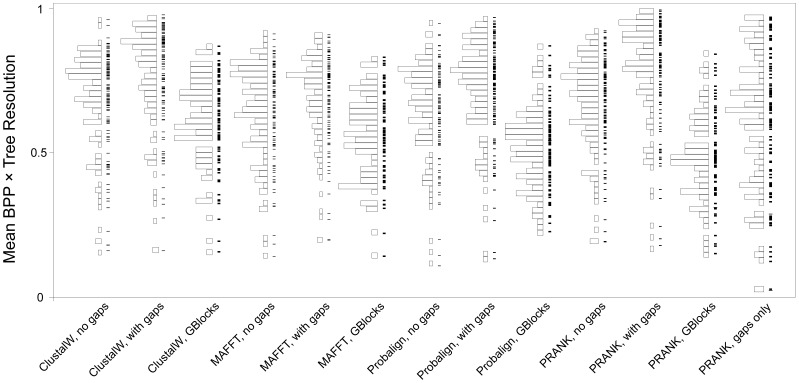
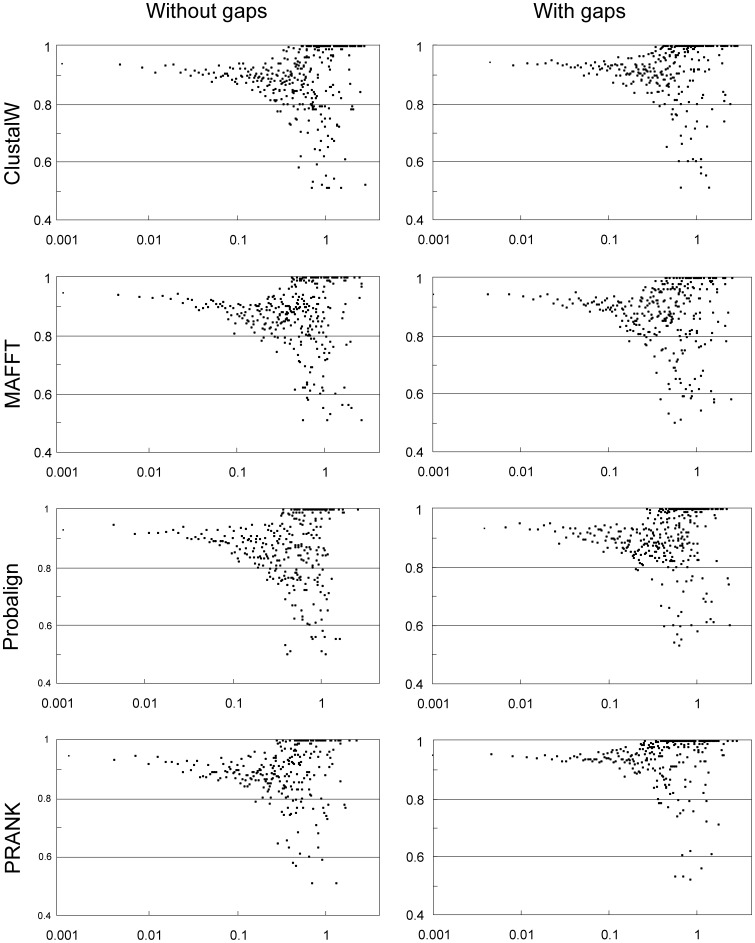
Rapidly evolving, indel-rich phylogenetic markers play a pivotal role in our understanding of the relationships at multiple levels of the tree of life. There is extensive evidence that indels provide conserved phylogenetic signal, however, the range of phylogenetic depths for which gaps retain tree signal has not been investigated in detail. Here we address this question using the fungal internal transcribed spacer (ITS), which is central in many phylogenetic studies, molecular ecology, detection and identification of pathogenic and non-pathogenic species. ITS is repeatedly criticized for indel-induced alignment problems and the lack of phylogenetic resolution above species level, although these have not been critically investigated. In this study, we examined whether the inclusion of gap characters in the analyses shifts the phylogenetic utility of ITS alignments towards earlier divergences. By re-analyzing 115 published fungal ITS alignments, we found that indels are slightly more conserved than nucleotide substitutions, and when included in phylogenetic analyses, improved the resolution and branch support of phylogenies across an array of taxonomic ranges and extended the resolving power of ITS towards earlier nodes of phylogenetic trees. Our results reconcile previous contradicting evidence for the effects of data exclusion: in the case of more sophisticated indel placement, the exclusion of indel-rich regions from the analyses results in a loss of tree resolution, whereas in the case of simpler alignment methods, the exclusion of gapped sites improves it. Although the empirical datasets do not provide to measure alignment accuracy objectively, our results for the ITS region are consistent with previous simulations studies alignment algorithms. We suggest that sophisticated alignment algorithms and the inclusion of indels make the ITS region and potentially other rapidly evolving indel-rich loci valuable sources of phylogenetic information, which can be exploited at multiple taxonomic levels.
Overview
The claims and statistics of this paper haven’t been checked yet.
Free: it reads the open-access text and checks the first 5 claims that cite a source we can check. Create a free account to check every claim.
Integrity signals
Registry
Cites
Statistics
Figures

Verification
Claims the paper makes
The claims and statistics of this paper haven’t been checked yet.
Free: it reads the open-access text and checks the first 5 claims that cite a source we can check. Create a free account to check every claim.
Claims other papers make about this one
Each is checked against this paper’s own text: does it say what the citing paper says it does?
The source backs part of the claim, not all of it — or backs it for a different population, condition or comparison.
In the citing paper
“Considering ribosomal RNA regions, they commonly present insertions and deletions, which makes multiple sequence alignment more challenging (Nagy et al., 2012).”
From The importance of molecular characters when morphological variability hinders diagnosability: systematics of the moon jellyfish genus Aurelia (Cnidaria: Scyphozoa) (2021) · cites this paper as Nagy et al., 2012
Experimental — accuracy not yet measured
Self-check
Percentages, sums and reported differences re-computed from the paper’s own numbers.
The self-check needs the paper’s full text.
Citations
Cites
Selection of Conserved Blocks from Multiple Alignments for Their Use in Phylogenetic Analysis
Castresana, J. (2000) · Molecular Biology and Evolution · doi:10.1093/oxfordjournals.molbev.a026334 · Cited by 10,508 · cited 7×
“substitutional saturation, it is possible that the beneficial effect of deleting such sites may come from the elimination of nonhomologous sites, which might explain the alleged disagreement about the significance of data exclusion found in the literature [18,28,63,64,73].”
BackgroundMethodInfluentialGARDES, M., & BRUNS, T. D. (1993) · Molecular Ecology · doi:10.1111/j.1365-294x.1993.tb00005.x · Cited by 10,480 · cited 1×
“Among the major sources of the popularity of the ITS region are the high copy number and consequently, the easy accessibility via PCR even from fragmentary or badly preserved samples, widely tested primers, which amplify the ITS across all major fungal groups [40]; a general length of 400–800 bp, which makes it easy t…”
BackgroundT-coffee: a novel method for fast and accurate multiple sequence alignment 1 1Edited by J. Thornton
Notredame, C., Higgins, D. G., & Heringa, J. (2000) · Journal of Molecular Biology · doi:10.1006/jmbi.2000.4042 · Cited by 6,852 · cited 3×
“Although our study was not designed to objectively benchmark alignment accuracy, simulation studies provide robust evidence for the accuracy of indel placement by various alignment algorithms [16,18,19,62,64,65,66], which correlate well with our observations made on the basis of tree resolution and branch support for…”
BackgroundResultTalavera, G., & Castresana, J. (2007) · Systematic Biology · doi:10.1080/10635150701472164 · Cited by 5,631 · cited 5×
“Consistent with this notion, the exclusion of gapped sites resulted in a steady decrease in tree support when the alignments were known with certainty [32].”
BackgroundMethodResultInfluentialMultiple Sequence Alignment Using ClustalW and ClustalX
Thompson, J. D., Gibson, T. J., & Higgins, D. G. (2003) · Current Protocols in Bioinformatics · doi:10.1002/0471250953.bi0203s00 · Cited by 2,971 · cited 1×
“Improving indel placement accuracy has been one of the major lines of experimentation in the development of alignment algorithms, with solutions ranging from penalizing indels [25] to modelling their evolution by Markovian models allowing single or multiple insertions/deletions at a time [22,23].”
MethodGaps as Characters in Sequence-Based Phylogenetic Analyses
Simmons, M. P., & Ochoterena, H. (2000) · Systematic Biology · doi:10.1093/sysbio/49.2.369 · Cited by 2,536 · cited 3×
“indel coding [3], GBlocks curation of alignments [31] and treating them as missing data.”
MethodRibosomal ITS sequences and plant phylogenetic inference
Álvarez, I., & Wendel, J. F. (2003) · Molecular Phylogenetics and Evolution · doi:10.1016/s1055-7903(03)00208-2 · Cited by 1,877 · cited 4×
“One is the difficulty of multiple alignment of ITS sequences of distantly related species [34,36,57,58].”
BackgroundInfluentialReconstructing the early evolution of Fungi using a six-gene phylogeny
James, T. Y., Kauff, F., Schoch, C. L., Matheny, P. B., Hofstetter, V., Cox, C. J., Celio, G., Gueidan, C., Fraker, E., Miadlikowska, J., et al. (2006) · Nature · doi:10.1038/nature05110 · Cited by 1,815 · cited 2×
“With the emerging interest in finding new sources of conserved phylogenetic information sparked by recent large scale phylogenetic [11], phylogenomic [69] as well as several order- and family level studies, indels of ITS or other rapidly evolving genes [70,71] represent good candidates to become involved in future hig…”
BackgroundKõljalg, U., Larsson, K., Abarenkov, K., Nilsson, R. H., Alexander, I. J., Eberhardt, U., Erland, S., Høiland, K., Kjøller, R., Larsson, E., et al. (2005) · New Phytologist · doi:10.1111/j.1469-8137.2005.01376.x · Cited by 1,173 · cited 1×
“These factors have contributed to ITS becoming the most widely used locus in species-level phylogenetic, metagenomic [41] and environmental sequencing projects in mycology and botany [42,43,44,45,46,47].”
BackgroundParallel Metropolis coupled Markov chain Monte Carlo for Bayesian phylogenetic inference
Altekar, G., Dwarkadas, S., Huelsenbeck, J. P., & Ronquist, F. (2004) · Bioinformatics · doi:10.1093/bioinformatics/btg427 · Cited by 1,162 · cited 1×
“The most extreme alignment lengths were inferred for two, taxonomically divergent datasets spanning the Basidiomycota and Agaricales (5701 and 4209 sites, respectively [68,69]) under PRANK.”
Background
Cited by
Houbraken, J., Kocsubé, S., Visagie, C. M., Yilmaz, N., Wang, X.-C., Meijer, M., Kraak, B., Hubka, V., Bensch, K., Samson, R. A., et al. (2020) · Studies in Mycology · doi:10.1016/j.simyco.2020.05.002 · Cited by 647
Self-citationLücking, R., Aime, M. C., Robbertse, B., Miller, A. N., Ariyawansa, H. A., Aoki, T., Cardinali, G., Crous, P. W., Druzhinina, I. S., Geiser, D. M., et al. (2020) · IMA Fungus · doi:10.1186/s43008-020-00033-z · Cited by 504
“…2003; Seifert et al. 2007; Meusnier et al. 2008; Begerow et al. 2010), the fungal ITS was proposed as the first universal fungal barcoding marker, being mostly easily amplified and sequenced and providing acceptable resolution in a wide range of taxa (Nagy et al. 2012; Schoch et al. 2012; Xu 2016).”
BackgroundBurbrink, F. T., Grazziotin, F. G., Pyron, R. A., Cundall, D., Donnellan, S., Irish, F., Keogh, J. S., Kraus, F., Murphy, R. W., Noonan, B., et al. (2020) · Systematic Biology · doi:10.1093/sysbio/syz062 · Cited by 317
Wambugu, P. W., Brozynska, M., Furtado, A., Waters, D. L., & Henry, R. J. (2015) · Scientific Reports · doi:10.1038/srep13957 · Cited by 199
Dark septate endophytic pleosporalean genera from semiarid areas
Knapp, D. G., Kovács, G. M., Zajta, E., Groenewald, J. Z., & Crous, P. W. (2015) · Persoonia - Molecular Phylogeny and Evolution of Fungi · doi:10.3767/003158515x687669 · Cited by 180
“To gain phylogenetic information of indel regions of the ITS (Nagy et al. 2012), indel coding was accomplished with FastGap v.”
MethodSelf-citation
Metadata
- Authors
- Nagy, L. G., Kocsubé, S., Csanádi, Z., Kovács, G. M., Petkovits, T., Vágvölgyi, C., & Papp, T.
- Affiliations
- Clark University (US)
- University of Szeged (HU)
- Eötvös Loránd University (HU)
- Corresponding author
- Nagy, László G.
- Venue
- PLoS ONE
- Publisher
- Public Library of Science (PLoS)
- Published
- 2012-11-19
- Volume
- 7
- Issue
- 11
- Pages
- e49794
- ISSN
- 1932-6203 (ISSN-L)
- PMC
- PMC3501463
- OpenAlex
- W2015365367
- Cited by
- 117
- References
- 73
- Citations by year
- 2026: 3 · 2025: 5 · 2024: 3 · 2023: 5 · 2022: 14 · 2021: 15 · 2020: 13 · 2019: 11 · 2018: 9 · 2017: 3 · 2016: 8 · 2015: 14 · 2014: 9 · 2013: 5
- FWCI
- 3.60
- Type
- journal article
- Language
- en
- Open access
- gold
- doi.org
- Locations
- PLoS ONE (publishedVersion, cc-by)
- Europe PMC (PubMed Central) (publishedVersion, cc-by)
- PubMed Central (publishedVersion, cc-by)
- PubMed (publishedVersion)
- ELTE Digital Institutional Repository (EDIT) (Eötvös Loránd University) (submittedVersion, cc-by)
- DOAJ (DOAJ: Directory of Open Access Journals) (submittedVersion, cc-by-sa)
- Figshare (submittedVersion, cc-by)
- Funders
- European Commission (2010-0012)
- Hungarian Scientific Research Fund
- Magyar Tudományos Akadémia
- Szegedi Tudományegyetem
- European Social Fund
- Topics
- Life Sciences › Biochemistry, Genetics and Molecular Biology › Molecular Biology › Genomics and Phylogenetic Studies
- Life Sciences › Agricultural and Biological Sciences › Plant Science › Mycorrhizal Fungi and Plant Interactions
- Life Sciences › Agricultural and Biological Sciences › Plant Science › Plant Pathogens and Fungal Diseases
- Keywords
- ITS region, ITS, fungi, indels, phylogenetic signal, sequence alignment, data exclusion, phylogenetic resolution, branch support, nuclear ribosomal DNA
- MeSH terms
- Algorithms, Fungi, Phylogeny, Ribosomes, Sequence Alignment, Evolution, Molecular, DNA, Ribosomal Spacer, INDEL Mutation
About these checks
Registry, retraction, Cites and statistics results are computed, not judged, with one exception: a printed reference that no index lists is read once by a model before it counts as a citation error. Claims are extracted by a model and kept only when their quote appears verbatim in the text; each cited source is then checked, with a model’s help, for whether it says what the claim relies on. Those verdicts can be wrong — read the claim’s quote and the cited source before relying on one.
Statistics and arithmetic are recomputed, not judged.
Confidence bands are shown only for fields calibrated on our annotated test set. None is calibrated yet, so no band is shown.
What counts as a claim ›How we measure confidence ›How we check this ›
Are you an author, or do you see a problem with this page? Request a review
Data sources
Bibliographic data: Semantic Scholar, OpenAlex, Crossref.
Contains information from the Semantic Scholar Academic Graph Datasets, made available under the ODC Attribution License (ODC-BY 1.0).
Semantic Scholar’s data is described in: Kinney, R., et al. (2023). The Semantic Scholar Open Data Platform. arXiv:2301.10140.
