

Identifying Programmatic Gaps: Inequities in Harm Reduction Service Utilization among Male and Female Drug Users in Dar es Salaam, Tanzania
Open accessThe DOI matches its Crossref record; 19 of the 19 references it cites were found in a registry or an index.
Abstract
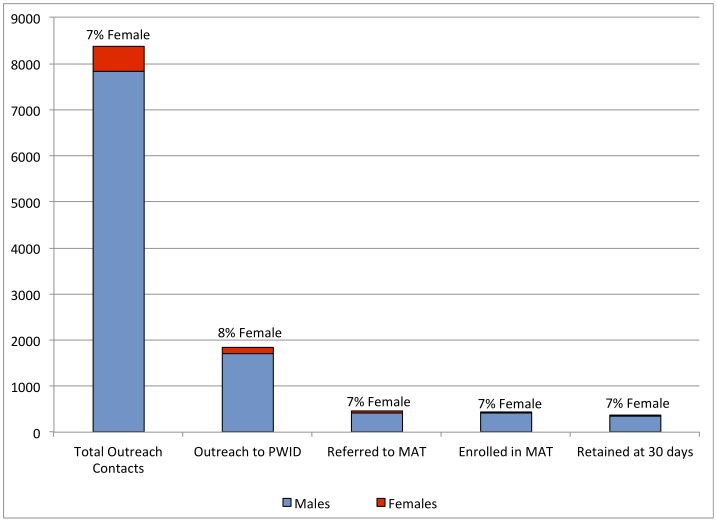
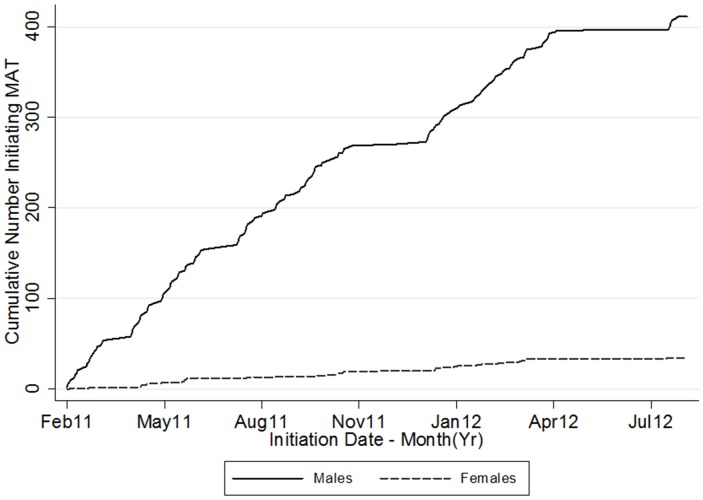
INTRODUCTION: Current estimates suggest an HIV prevalence of 42% among people who inject drugs (PWIDs) in Dar es Salaam, while HIV prevalence is estimated to be 8.8% among the general population in the city. To address the HIV epidemic in this population, the government of Tanzania began establishing HIV prevention, treatment and care services including outreach and medication assisted treatment (MAT) for PWIDs in 2010. We assessed gender inequities in utilization of outreach and MAT services and evaluated differences in HIV risk behaviors between female and male PWIDs. MATERIALS AND METHODS: Routine outreach data between December 2010 to mid-August 2012 and baseline data on clients enrolling in methadone from February 2011 to August 2012 were utilized. Binomial regression was used to estimate adjusted relative risk estimates comparing females to males. RESULTS: From December 2010 to August 2012, 8,578 contacts were made to drug users; among them 1,898 were injectors. A total of 453 injectors were eligible and referred to MAT, of which, 443 enrolled in treatment. However, regarding total outreach contacts, outreach to PWID, referral to MAT and enrollment in MAT, 8% or less of drug users accessing services were women. In contrast, weighted estimations from surveys suggest that 34% of PWIDs are female, and this approximation is similar to recent population size estimations. Overall, 43% of traditional outreach workers conducting outreach with drug users were female. Though reporting higher levels of condom usage, female PWID were more likely to report multiple sex partners, anal sex, commercial sex work and struggle under a higher burden of addiction, mental disorders and abuse. CONCLUSIONS: Services have not been mobilized adequately to address the clear needs of females who inject drugs. A clear and urgent need exists for women-centered strategies that effectively engage female PWID into HIV prevention services.
Overview
The claims and statistics of this paper haven’t been checked yet.
Free: it reads the open-access text and checks the first 5 claims that cite a source we can check. Create a free account to check every claim.
Integrity signals
Registry
Cites
Statistics
Figures
Verification
Claims the paper makes
The claims and statistics of this paper haven’t been checked yet.
Free: it reads the open-access text and checks the first 5 claims that cite a source we can check. Create a free account to check every claim.
Claims other papers make about this one
Each is checked against this paper’s own text: does it say what the citing paper says it does?
The source backs part of the claim, not all of it — or backs it for a different population, condition or comparison.
In the citing paper
“Although women who use drugs (WWUD) in Africa face specific barriers when attempting to access health services (i.e., HR and other care) due to various psychosocial and contextual factors, few studies to date have documented these barriers.”
From The gender factor in meeting the needs of women who use drugs in Senegal (2025) · cites this paper as [2]
Experimental — accuracy not yet measuredThe source backs part of the claim, not all of it — or backs it for a different population, condition or comparison.
In the citing paper
“They also highlighted contextual obstacles linked to structural inequalities at various levels, such as the absence of the gender factor in HR programme agendas, the lack of childcare services, the lack of means of transport to travel to health structures, and poverty [1–4].”
From The gender factor in meeting the needs of women who use drugs in Senegal (2025) · cites this paper as [2]
Experimental — accuracy not yet measured
Self-check
Percentages, sums and reported differences re-computed from the paper’s own numbers.
The self-check needs the paper’s full text.
Citations
Cites
Global epidemiology of injecting drug use and HIV among people who inject drugs: a systematic review
Mathers, B. M., Degenhardt, L., Phillips, B., Wiessing, L., Hickman, M., Strathdee, S. A., Wodak, A., Panda, S., Tyndall, M., Toufik, A., et al. (2008) · The Lancet · doi:10.1016/s0140-6736(08)61311-2 · Cited by 1,285 · cited 1×
“HIV/AIDS has long been linked to injection drug use, a major driver of the HIV epidemic in many countries in Asia, the Middle East and Eastern Europe [9].”
BackgroundSubstance abuse treatment entry, retention, and outcome in women: a review of the literature
Greenfield, S. F., Brooks, A. J., Gordon, S. M., Green, C. A., Kropp, F., McHugh, R. K., Lincoln, M., Hien, D., & Miele, G. M. (2007) · Drug and Alcohol Dependence · doi:10.1016/j.drugalcdep.2006.05.012 · Cited by 1,055 · cited 1×
“Programs that have directly addressed the needs specific to women have shown to be effective in other contexts [23].”
BackgroundReframing Women's Risk: Social Inequalities and HIV Infection
Zierler, S., & Krieger, N. (1997) · Annual Review of Public Health · doi:10.1146/annurev.publhealth.18.1.401 · Cited by 349 · cited 1×
“Similarly, female PWIDs face higher HIV risk and burden across several fronts [14– 17].”
BackgroundGender Inequality and Intimate Partner Violence Among Women in Moshi, Tanzania
McCloskey, L. A., Williams, C., & Larsen, U. (2005) · International Family Planning Perspectives · doi:10.1363/3112405 · Cited by 182
Pinkham, S., & Malinowska-Sempruch, K. (2008) · Reproductive Health Matters · doi:10.1016/s0968-8080(08)31345-7 · Cited by 154 · cited 1×
“In addition to increased risk for HIV, female PWIDs face higher levels of stigma, stronger barriers to accessing services and fewer services that are tailored to their needs [14–16,20].”
BackgroundTanzania HIV/AIDS Indicator Survey 2003-04
Takwimu, T. O. Y. T. Y., & Macro, O. (2005) · Cited by 127
HIV and women who use drugs: double neglect, double risk
El‐Bassel, N., Terlikbayeva, A., & Pinkham, S. (2010) · The Lancet · doi:10.1016/s0140-6736(10)61026-4 · Cited by 110 · cited 1×
“In addition to increased risk for HIV, female PWIDs face higher levels of stigma, stronger barriers to accessing services and fewer services that are tailored to their needs [14–16,20].”
BackgroundGENDER INEQUALITY INCREASES WOMEN’S RISK OF HIV INFECTION IN MOSHI, TANZANIA
SA, Z., & LARSEN, U. (2008) · Journal of Biosocial Science · doi:10.1017/s002193200700257x · Cited by 77 · cited 1×
“In Tanzania, overarching gender inequities lead to higher levels of intimate partner violence [12], HIV risk [13] and HIV burden [10].”
BackgroundHeroin and HIV risk in Dar es Salaam, Tanzania: Youth hangouts,magetoand injecting practices
McCurdy, S., Williams, M. L., Kilonzo, G. P., Ross, M. W., & Leshabari, M. T. (2005) · AIDS Care · doi:10.1080/09540120500120930 · Cited by 76 · cited 3×
“This strategy could be particularly important to consider as female PWIDs are at increased risk of sexual assault, and physical and sexual violence by male PWIDs has been reported [7].”
BackgroundInfluentialSelf-citationHIV Seroprevalence in a Sample of Tanzanian Intravenous Drug Users
Williams, M. L., McCurdy, S., Bowen, A. M., Kilonzo, G. P., Atkinson, J. S., Ross, M. W., & Leshabari, M. T. (2009) · AIDS Education and Prevention · doi:10.1521/aeap.2009.21.5.474 · Cited by 58 · cited 4×
“Coupled with the risk described above, ongoing substance use entails its own HIV-related risks that continue to place female PWIDs at high risk for HIV as reflected in the latest report estimating HIV prevalence among female PWIDs to be over twice that of male PWIDs [3,21].”
BackgroundResultInfluentialSelf-citationFlashblood: blood sharing among female injecting drug users in Tanzania
McCurdy, S., Ross, M. W., Williams, M. L., Kilonzo, G. P., & Leshabari, M. T. (2010) · Addiction · doi:10.1111/j.1360-0443.2010.02908.x · Cited by 53 · cited 1×
“flashblood - a syringe full of blood drawn back immediately after injection and shared with a companion to inject [8], shared needles at last injection, shared other equipment at last injection, cleaned needles with bleach if sharing at the last injection, polysubstance use (alcohol, cocaine, or benzodiazepine); menta…”
BackgroundSelf-citationHIV/AIDS and injection drug use in the neighborhoods of Dar es Salaam, Tanzania
McCurdy, S., Ross, M. W., Kilonzo, G. P., Leshabari, M. T., & Williams, M. L. (2006) · Drug and Alcohol Dependence · doi:10.1016/s0376-8716(06)80004-9 · Cited by 50
Self-citationDifferences in HIV Risk Behaviors by Gender in a Sample of Tanzanian Injection Drug Users
Williams, M. L., McCurdy, S., Atkinson, J. S., Kilonzo, G. P., Leshabari, M. T., & Ross, M. W. (2006) · AIDS and Behavior · doi:10.1007/s10461-006-9102-x · Cited by 48
Self-citationStefanis, C. N., & Kokkevi, A. (1986) · Psychopathology · doi:10.1159/000285143 · Cited by 46
Ross, M. W., McCurdy, S. A., Kilonzo, G. P., Williams, M. L., & Leshabari, M. T. (2008) · The American Journal of Tropical Medicine and Hygiene · doi:10.4269/ajtmh.2008.79.338 · Cited by 42 · cited 2×
“The resources acquired via sex work often allow women to afford larger volumes of better quality heroin resulting in female PWIDs being targets of theft as well as physical and sexual assault by men [1,6].”
BackgroundSelf-citationThe global Afghan opium trade : a threat assessment, 2011
Demirbüken, H., Mili, H., Cussan, R. L., & Crime (2011) · Cited by 37
Harm reduction in Tanzania: An urgent need for multisectoral intervention
McCurdy, S., Kilonzo, G. P., Williams, M. L., & Kaaya, S. (2007) · International Journal of Drug Policy · doi:10.1016/j.drugpo.2007.05.001 · Cited by 28
Self-citationNyandindi, C., Mbwambo, J., McCurdy, S., Lambdin, B. H., Copenhaver, M., & Bruce, R. D. (2014) · Drug and Alcohol Dependence · doi:10.1016/j.drugalcdep.2014.02.461 · Cited by 18
Self-citationClaeson, M. (2011) · Journal of Public Health Policy · doi:10.1057/jphp.2011.11 · Cited by 3 · cited 1×
“In addition to increased risk for HIV, female PWIDs face higher levels of stigma, stronger barriers to accessing services and fewer services that are tailored to their needs [14–16,20].”
Background
Cited by
Concentrated HIV subepidemics in generalized epidemic settings
Tanser, F. C., de Oliveira, T., Maheu‐Giroux, M., & Bärnighausen, T. (2013) · Current Opinion in HIV and AIDS · doi:10.1097/coh.0000000000000034 · Cited by 155
“Unau 1746-630X 2014 Wolters Kluwer Health | Lippincott Williams & Wilki engaging in commercial sex work as compared with less than 1% for men [43].”
Azim, T., Bontell, I., & Strathdee, S. A. (2015) · International Journal of Drug Policy · doi:10.1016/j.drugpo.2014.09.003 · Cited by 139
“• In Tanzania, 85% of FWID are sex workers and their HIV prevalence is 62%, compared to 28% among MWID (Lambdin et al., 2013)”
BackgroundInfluentialColledge‐Frisby, S., Larney, S., Peacock, A., Leung, J., Hickman, M., Grebely, J., Farrell, M., & Degenhardt, L. J. (2019) · Drug and Alcohol Dependence · doi:10.1016/j.drugalcdep.2019.107793 · Cited by 89
Ayon, S., Ndimbii, J., Jeneby, F., Abdulrahman, T., Mlewa, O., Wang, B., Ragi, A., & Mburu, G. (2018) · AIDS Care · doi:10.1080/09540121.2017.1394965 · Cited by 69
“Compared to men, they are more likely to be homeless, have more sexual partners, and engage in sex work (Lambdin et al., 2013; Williams et al., 2007).”
BackgroundRhodes, T., Guise, A., Ndimbii, J. N., Strathdee, S. A., NGUGI, E. N., Platt, L., Kurth, A., Cleland, C. M., & Vickerman, P. T. (2015) · BMJ Open · doi:10.1136/bmjopen-2014-007198 · Cited by 65
“▪ We acknowledge uncertainty in how our model assesses sexual HIV transmission potential and thus also the impact projections of OST.”
Influential
Metadata
- Authors
- Lambdin, B. H., Bruce, R. D., Chang, O., Nyandindi, C., Sabuni, N., Zamudio-Haas, S., McCurdy, S., Masao, F., Ivo, Y., Msami, A., Ubuguy, O., & Mbwambo, J.
- Affiliations
- University of Washington (US)
- Yale University (US)
- Pangaea Global AIDS Foundation (US)
- Muhimbili University of Health and Allied Sciences (TZ)
- Ministry of Health and Social Welfare (TZ)
- Corresponding author
- Lambdin, Barrot H.
- Venue
- PLoS ONE
- Publisher
- Public Library of Science (PLoS)
- Published
- 2013-06-25
- Volume
- 8
- Issue
- 6
- Pages
- e67062
- ISSN
- 1932-6203 (ISSN-L)
- PMC
- PMC3692420
- OpenAlex
- W1991574905
- Cited by
- 64
- References
- 19
- Citations by year
- 2025: 4 · 2024: 6 · 2023: 1 · 2022: 5 · 2021: 4 · 2020: 4 · 2019: 7 · 2018: 3 · 2017: 5 · 2016: 8 · 2015: 11 · 2014: 3 · 2013: 3
- FWCI
- 6.08
- Type
- journal article
- Language
- en
- Open access
- gold
- doi.org
- Locations
- PLoS ONE (publishedVersion, cc-by)
- Europe PMC (PubMed Central) (publishedVersion, cc-by)
- PubMed Central (publishedVersion, cc-by)
- PubMed (publishedVersion)
- DOAJ (DOAJ: Directory of Open Access Journals) (submittedVersion, cc-by-sa)
- Topics
- Health Sciences › Medicine › Epidemiology › HIV, Drug Use, Sexual Risk
- Health Sciences › Medicine › Infectious Diseases › HIV/AIDS Research and Interventions
- Health Sciences › Medicine › Epidemiology › Substance Abuse Treatment and Outcomes
- Keywords
- harm reduction, people who inject drugs, gender inequity, HIV prevention, medication-assisted treatment, methadone, outreach services, women who use drugs, HIV risk behavior, Dar es Salaam
- MeSH terms
- Adult, Community-Institutional Relations, Female, Health Services Accessibility, Humans, Male, Middle Aged, Risk-Taking, Sex Factors, Socioeconomic Factors, Tanzania, HIV Infections, Substance-Related Disorders, Harm Reduction, Drug Users
About these checks
Registry, retraction, Cites and statistics results are computed, not judged, with one exception: a printed reference that no index lists is read once by a model before it counts as a citation error. Claims are extracted by a model and kept only when their quote appears verbatim in the text; each cited source is then checked, with a model’s help, for whether it says what the claim relies on. Those verdicts can be wrong — read the claim’s quote and the cited source before relying on one.
Statistics and arithmetic are recomputed, not judged.
Confidence bands are shown only for fields calibrated on our annotated test set. None is calibrated yet, so no band is shown.
What counts as a claim ›How we measure confidence ›How we check this ›
Are you an author, or do you see a problem with this page? Request a review
Data sources
Bibliographic data: Semantic Scholar, OpenAlex, Crossref.
Contains information from the Semantic Scholar Academic Graph Datasets, made available under the ODC Attribution License (ODC-BY 1.0).
Semantic Scholar’s data is described in: Kinney, R., et al. (2023). The Semantic Scholar Open Data Platform. arXiv:2301.10140.
