

The DOI matches its Crossref record; 62 of the 62 references it cites were found in a registry or an index.
Long-Term Temporal Analysis of the Human Fecal Microbiota Revealed a Stable Core of Dominant Bacterial Species
Open accessAbstract
Next-generation sequencing has greatly contributed to an improved ecological understanding of the human gut microbiota. Nevertheless, questions remain regarding the characteristics of this ecosystem and the ecological processes that shape it, and controversy has arisen regarding the stability of the bacterial populations and the existence of a temporal core. In this study, we have characterized the fecal microbial communities of three human individuals over a one-year period by 454 pyrosequencing of 16S rRNA tags in order to investigate the temporal characteristics of the bacterial communities. The findings revealed a temporal core of 33 to 40 species-level Operational Taxonomic Units (OTUs) within subjects. Although these OTUs accounted only for around 12% of the total OTUs detected, they added up to >75% of the total sequences obtained for each individual. In order to determine the capacity of the sequencing and bioinformatic approaches applied during this study to accurately determine the proportion of a core microbiota, we analyzed the fecal microbiota of nine mice with a defined three-member community. This experiment revealed that the sequencing approach inflated the amount of rare OTUs, which introduced a significant degree of artificial variation across samples, and hence reduced the apparent fraction of shared OTUs. However, when assessing the data quantitatively by focusing on dominant lineages, the sequencing approaches deliver an accurate representation of the community. In conclusion, this study revealed that the human fecal microbiota is dominated by around 40 species that maintain persistent populations over the duration of one year. The findings allow conclusions about the ecological factors that shape the community and support the concept of a homeostatic ecosystem controlled largely by deterministic processes. Our analysis of a three-member community revealed that methodological artifacts of OTU-based approaches complicate core calculations, and these limitations have to be considered in the interpretation of microbiome studies.
Overview
The claims and statistics of this paper haven’t been checked yet.
Run the check — free, no account needed. It reads the open-access text and checks the sources it cites.
Integrity signals
Registry
Cites
Statistics
Figures

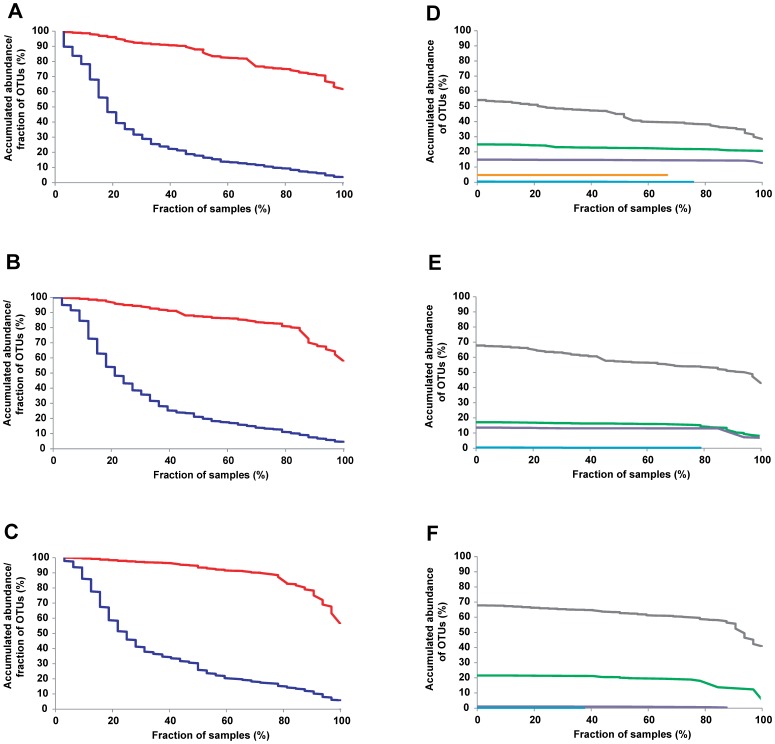
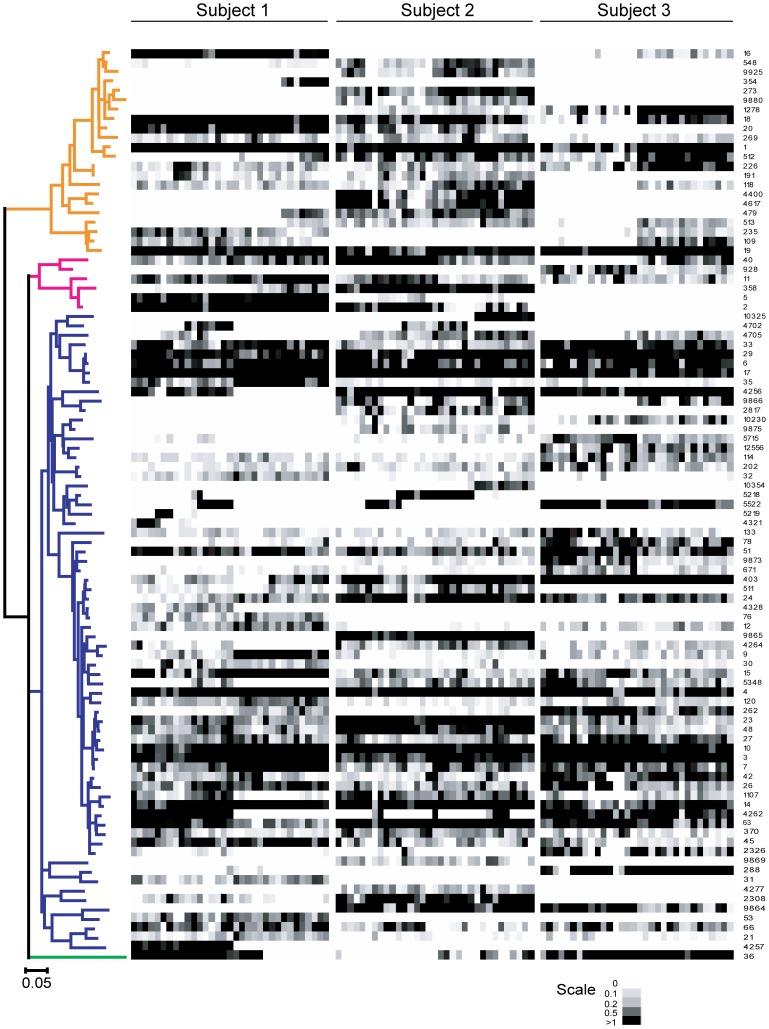
Verification
Claims the paper makes
The claims and statistics of this paper haven’t been checked yet.
Run the check — free, no account needed. It reads the open-access text and checks the sources it cites.
Claims other papers make about this one
Each is checked against this paper’s own text: does it say what the citing paper says it does?
In the citing paper
“The core gut microbiota in adulthood is relatively stable, but environmental factors have been identified that can shape the gut microbial community (23,35,36).”
From Diet and the Microbiota–Gut–Brain Axis: Sowing the Seeds of Good Mental Health (2021) · cites this paper as [35]
Self-check
Percentages, sums and reported differences re-computed from the paper’s own numbers.
The self-check needs the paper’s full text.
Citations
Cites
Tamura, K., Peterson, D., Peterson, N., Stecher, G., Nei, M., & Kumar, S. (2011) · Molecular Biology and Evolution · doi:10.1093/molbev/msr121 · Cited by 40,207
QIIME allows analysis of high-throughput community sequencing data
Caporaso, J. G., Kuczynski, J., Stombaugh, J., Bittinger, K., Bushman, F. D., Costello, E. K., Fierer, N., Peña, A. G., Goodrich, J. K., Gordon, J. I., et al. (2010) · Nature Methods · doi:10.1038/nmeth.f.303 · Cited by 34,887
Schloss, P. D., Westcott, S. L., Ryabin, T., Hall, J. R., Hartmann, M., Hollister, E. B., Lesniewski, R. A., Oakley, B. B., Parks, D. H., Robinson, C. J., et al. (2009) · Applied and Environmental Microbiology · doi:10.1128/aem.01541-09 · Cited by 19,549
A human gut microbial gene catalogue established by metagenomic sequencing
MetaHIT Consortium, Qin, J., Li, R., Raes, J., Arumugam, M., Burgdorf, K. S., Manichanh, C., Nielsen, T., Pons, N., Levenez, F., et al. (2010) · Nature · doi:10.1038/nature08821 · Cited by 11,624
Human gut microbes associated with obesity
Ley, R. E., Turnbaugh, P. J., Klein, S., & Gordon, J. I. (2006) · Nature · doi:10.1038/4441022a · Cited by 8,785
A core gut microbiome in obese and lean twins
Turnbaugh, P. J., Hamady, M., Yatsunenko, T., Cantarel, B. L., Duncan, A., Ley, R. E., Sogin, M. L., Jones, W. J., Roe, B. A., Affourtit, J. P., et al. (2009) · Nature · doi:10.1038/nature07540 · Cited by 7,823
Linking long-term dietary patterns with gut microbial enterotypes
Wu, G. D., Chen, J., Hoffmann, C., Bittinger, K., Chen, Y.-Y., Keilbaugh, S. A., Bewtra, M., Knights, D., Walters, W. A., Knight, R., et al. (2011) · Science · doi:10.1126/science.1208344 · Cited by 6,513
Gut flora metabolism of phosphatidylcholine promotes cardiovascular disease
Wang, Z., Klipfell, E., Bennett, B. J., Koeth, R., Levison, B. S., DuGar, B., Feldstein, A. E., Britt, E. B., Fu, X., Chung, Y.-M., et al. (2011) · Nature · doi:10.1038/nature09922 · Cited by 5,597
Diversity, stability and resilience of the human gut microbiota
Lozupone, C. A., Stombaugh, J. I., Gordon, J. I., Jansson, J. K., & Knight, R. (2012) · Nature · doi:10.1038/nature11550 · Cited by 5,533
The Ribosomal Database Project: improved alignments and new tools for rRNA analysis
Cole, J. R., Wang, Q., Cardenas, E., Fish, J., Chai, B., Farris, R. J., Kulam-Syed-Mohideen, A. S., McGarrell, D. M., Marsh, T. L., Garrity, G. M., et al. (2008) · Nucleic Acids Research · doi:10.1093/nar/gkn879 · Cited by 4,873
Cited by
Sorted by citations
Gut biogeography of the bacterial microbiota
Donaldson, G. P., Lee, S. M., & Mazmanian, S. K. (2016) · Nature Reviews Microbiology · doi:10.1038/nrmicro3552 · Cited by 2,535
How informative is the mouse for human gut microbiota research?
Nguyen, T. L. A., Vieira-Silva, S., Liston, A., & Raes, J. (2015) · Disease Models & Mechanisms · doi:10.1242/dmm.017400 · Cited by 1,334
“Some xenobiotics, such as antibiotics, can also strongly affect the gut microbiota composition and function (Maurice et al., 2013).”
BackgroundPerez-Muñoz, M. E., Arrieta, M.-C., Ramer-Tait, A. E., & Walter, J. (2017) · Microbiome · doi:10.1186/s40168-017-0268-4 · Cited by 1,096
Self-citationFassarella, M., Blaak, E. E., Penders, J., Nauta, A., Smidt, H., & Zoetendal, E. G. (2020) · Gut · doi:10.1136/gutjnl-2020-321747 · Cited by 818
Defining and quantifying the core microbiome: Challenges and prospects
Neu, A. T., Allen, E. E., & Roy, K. (2021) · Proceedings of the National Academy of Sciences · doi:10.1073/pnas.2104429118 · Cited by 653
Metadata
- Authors
- Martínez, I., Muller, C. E., & Walter, J.
- Affiliations
- University of Nebraska–Lincoln (US)
- Corresponding author
- Walter, Jens
- ORCID
- Walter, Jens
- Venue
- PLoS ONE
- Publisher
- Public Library of Science (PLoS)
- Published
- 2013-07-16
- Volume
- 8
- Issue
- 7
- Pages
- e69621
- ISSN
- 1932-6203 (ISSN-L)
- PMC
- PMC3712949
- OpenAlex
- W1997884922
- Cited by
- 181
- References
- 62
- Citations by year
- 2026: 2 · 2025: 9 · 2024: 9 · 2023: 10 · 2022: 14 · 2021: 20 · 2020: 17 · 2019: 8 · 2018: 14 · 2017: 20 · 2016: 17 · 2015: 26 · 2014: 11 · 2013: 4
- FWCI
- 8.67
- Type
- journal article
- Language
- en
- Open access
- gold
- doi.org
- Locations
- PLoS ONE (publishedVersion, cc-by)
- Europe PMC (PubMed Central) (publishedVersion, cc-by)
- PubMed Central (publishedVersion, cc-by)
- PubMed (publishedVersion)
- Lincoln (University of Nebraska) (submittedVersion, cc-by)
- DOAJ (DOAJ: Directory of Open Access Journals) (submittedVersion, cc-by-sa)
- Figshare (submittedVersion, cc-by)
- Topics
- Life Sciences › Biochemistry, Genetics and Molecular Biology › Molecular Biology › Gut microbiota and health
- Physical Sciences › Environmental Science › Ecology › Microbial Community Ecology and Physiology
- Health Sciences › Dentistry › Periodontics › Oral microbiology and periodontitis research
- Keywords
- human gut microbiome, fecal microbiota, temporal stability, core microbiome, operational taxonomic units, sequencing artifacts, rare OTUs, 16S rRNA, deterministic community assembly
- MeSH terms
- Adult, Bacteria, Feces, Female, Humans, RNA, Ribosomal, 16S, Young Adult
About these checks
Registry, retraction, Cites and statistics results are computed, not judged, with one exception: a printed reference that no index lists is read once by a model before it counts as a citation error. Claims are extracted by a model and kept only when their quote appears verbatim in the text; each cited source is then checked, with a model’s help, for whether it says what the claim relies on. Those verdicts can be wrong — read the claim’s quote and the cited source before relying on one.
Statistics and arithmetic are recomputed, not judged.
Confidence bands are shown only for fields calibrated on our annotated test set. None is calibrated yet, so no band is shown.
What counts as a claim ›How we measure confidence ›How we check this ›
Are you an author, or do you see a problem with this page? Request a review
