

The DOI matches its Crossref record; 49 of the 50 references it cites were found in a registry or an index, and 1 are not checked yet.
Detecting Depression in Patients with Coronary Heart Disease: a Diagnostic Evaluation of the PHQ-9 and HADS-D in Primary Care, Findings From the UPBEAT-UK Study
Open accessAbstract
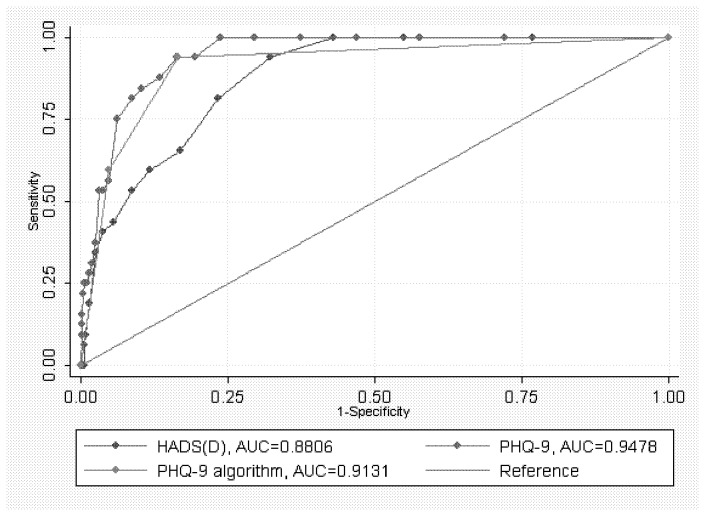
OBJECTIVE: People with coronary heart disease (CHD) are at heightened risk of depression, and this co-occurrence of conditions is associated with poorer outcomes including raised mortality. This study compares the diagnostic accuracy of two depression case finding instruments in CHD patients relative to a diagnostic standard, the revised Clinical Interview Schedule (CIS-R). METHODS: The Patient Health Questionnaire (PHQ-9), the Hospital Anxiety and Depression Scale depression subscale (HADS-D) and the CIS-R depression module were administered to 803 patients identified from the CHD registers of GP practices in Greater London. RESULTS: Of 730 recruited patients without previously identified depression, 32 (4.4%) met ICD-10 depressive episode criteria according to the CIS-R. For the PHQ-9 and HADS-D lower cut-points than those routinely recommended were associated with improved case identifying properties. The PHQ-9 appeared the superior instrument using a cut-point of ≥8 (sensitivity=94%; specificity=84%). Using categorical scoring the PHQ-9 was 59% sensitive and 95% specific. For the HADS-D using cut-point ≥5, sensitivity was 81% and specificity was 77%. Areas under the curves (AUC) (standard error) were 0.95 (0.01) and 0.88 (0.02) for the PHQ-9 and HADS-D, and 0.91 (0.02) for PHQ-9 using the categorical algorithm. Statistically significant differences between AUCs of the PHQ-9 and the HADS-D favoured the former. Severity ratings compared across measures indicated inconsistency between recommended bandings: the PHQ-9 categorised a larger proportion of participants with mild and moderate depression. CONCLUSION: This is the first large-scale investigation of the accuracy of these commonly used measures within a primary care CHD population. Our results suggest that although both scales have acceptable abilities and can be used as case identification instruments for depression in patients with CHD, the PHQ-9 appeared diagnostically superior. Importantly, optimal cut-off points for depression identification in this population appear to differ from standard values, and severity ratings differ between these measures.
Overview
The claims and statistics of this paper haven’t been checked yet.
Run the check — free, no account needed. It reads the open-access text and checks the sources it cites.
Integrity signals
Registry
Cites
Statistics
Figures
Verification
Claims the paper makes
The claims and statistics of this paper haven’t been checked yet.
Run the check — free, no account needed. It reads the open-access text and checks the sources it cites.
Claims other papers make about this one
Each is checked against this paper’s own text: does it say what the citing paper says it does?
The cited source says what the claim attributes to it.
In the citing paper
“HADS has good psychometric properties and is widely used on patients with somatic diseases (36, 37), including cardiology patients (38, 39).”
Self-check
Percentages, sums and reported differences re-computed from the paper’s own numbers.
The self-check needs the paper’s full text.
Citations
Cites
The Hospital Anxiety and Depression Scale
Zigmond, A. S., & Snaith, R. P. (1983) · Acta Psychiatrica Scandinavica · doi:10.1111/j.1600-0447.1983.tb09716.x · Cited by 47,139
The PHQ-9: Validity of a brief depression severity measure
Kroenke, K., Spitzer, R. L., & Williams, J. B. W. (2001) · Journal of General Internal Medicine · doi:10.1046/j.1525-1497.2001.016009606.x · Cited by 44,910
Depression and quality of life in older persons: A review
Sivertsen, H., Bjørkløf, G. H., Engedal, K., Selbæk, G., & Helvik, A.-S. (2015) · Dementia and Geriatric Cognitive Disorders · doi:10.1159/000437299 · Cited by 14,152
Kessler, R. C., Chiu, W. T., Demler, O., & Walters, E. E. (2005) · Archives of General Psychiatry · doi:10.1001/archpsyc.62.6.617 · Cited by 12,052
Spitzer, R. L. (1999) · JAMA · doi:10.1001/jama.282.18.1737 · Cited by 9,802
The validity of the Hospital Anxiety and Depression Scale
Bjelland, I., Dahl, A. A., Haug, T. T., & Neckelmann, D. (2002) · Journal of Psychosomatic Research · doi:10.1016/s0022-3999(01)00296-3 · Cited by 9,779 · cited 1×
“Studies of common mental disorders in primary care settings have utilised this cut-off score for caseness [35] and a systematic review reported that this threshold provides an optimal balance between sensitivity and specificity for both HADS-A and HADS-D [36].”
BackgroundDepression, chronic diseases, and decrements in health: results from the World Health Surveys
Moussavi, S., Chatterji, S., Verdes, E., Tandon, A., Patel, V., & Ustun, B. (2007) · The Lancet · doi:10.1016/s0140-6736(07)61415-9 · Cited by 4,070
Case-finding instruments for depression: Two questions are as good as many
Whooley, M. A., Avins, A. L., Miranda, J., & Browner, W. S. (1997) · Journal of General Internal Medicine · doi:10.1046/j.1525-1497.1997.00076.x · Cited by 1,826
Lewis, G., Pelosi, A. J., Araya, R., & Dunn, G. (1992) · Psychological Medicine · doi:10.1017/s0033291700030415 · Cited by 1,487
Lichtman, J. H., Bigger, J. T., Blumenthal, J. A., Frasure-Smith, N., Kaufmann, P. G., Lespérance, F., Mark, D. B., Sheps, D. S., Taylor, C. B., & Froelicher, E. S. (2008) · Circulation · doi:10.1161/circulationaha.108.190769 · Cited by 1,482
Cited by
Sorted by citations
Screening and Management of Depression in Patients With Cardiovascular Disease
Jha, M. K., Qamar, A., Vaduganathan, M., Charney, D. S., & Murrough, J. W. (2019) · Journal of the American College of Cardiology · doi:10.1016/j.jacc.2019.01.041 · Cited by 389
Which instruments to support diagnosis of depression have sufficient accuracy? A systematic review
Pettersson, A., Boström, K. B., Gustavsson, P., & Ekselius, L. (2015) · Nordic Journal of Psychiatry · doi:10.3109/08039488.2015.1008568 · Cited by 187
Validation and calibration of the patient health questionnaire (PHQ-9) in Argentina
Lanza, M. U., Daray, F. M., Teti, G. L., Coppolillo, F., Herlax, G., Saba, G., Rubinstein, A., Araya, R., & Irazola, V. E. (2019) · BMC Psychiatry · doi:10.1186/s12888-019-2262-9 · Cited by 171
Gender-Based Differences in Anxiety and Depression Following Acute Myocardial Infarction
Šerpytis, P., Navickas, P., Lukavičiūtė, L., Navickas, A., Aranauskas, R., Šerpytis, R., Deksnytė, A., Glaveckaitė, S., Petrulionienė, Ž., & Samalavicius, R. S. (2018) · Arquivos Brasileiros de Cardiologia · doi:10.5935/abc.20180161 · Cited by 120
Validity of the Hospital Anxiety and Depression Scale (HADS) in primary care patients in Colombia
Cassiani-Miranda, C. A., Scoppetta, O., & Cabanzo-Arenas, D. F. (2021) · General Hospital Psychiatry · doi:10.1016/j.genhosppsych.2021.01.014 · Cited by 83
Metadata
- Authors
- Haddad, M., Walters, P., Phillips, R., Tsakok, J., Williams, P., Mann, A., & Tylee, A.
- Affiliations
- City, University of London (GB)
- King's College London (GB)
- Venue
- PLoS ONE
- Publisher
- Public Library of Science (PLoS)
- Published
- 2013-10-10
- Volume
- 8
- Issue
- 10
- Pages
- e78493
- ISSN
- 1932-6203 (ISSN-L)
- PMC
- PMC3795055
- OpenAlex
- W2159522765
- Cited by
- 109
- References
- 49
- Citations by year
- 2026: 3 · 2025: 11 · 2024: 9 · 2023: 9 · 2022: 8 · 2021: 10 · 2020: 17 · 2019: 16 · 2018: 4 · 2017: 5 · 2016: 6 · 2015: 7 · 2014: 4
- FWCI
- 3.85
- Type
- journal article
- Language
- en
- Open access
- gold
- doi.org
- Locations
- PLoS ONE (publishedVersion, cc-by)
- Europe PMC (PubMed Central) (publishedVersion, cc-by)
- PubMed Central (publishedVersion, cc-by)
- PubMed (publishedVersion)
- Research Portal (King's College London) (publishedVersion, other-oa)
- City Research Online (City University London) (acceptedVersion)
- RePEc: Research Papers in Economics (submittedVersion)
- DOAJ (DOAJ: Directory of Open Access Journals) (submittedVersion, cc-by-sa)
- Figshare (submittedVersion, cc-by)
- Spiral (Imperial College London) (submittedVersion, other-oa)
- Funders
- National Institute for Health and Care Research (RP-PG-0606-1048, MET-08-08-101)
- Programme Grants for Applied Research
- Topics
- Health Sciences › Medicine › Cardiology and Cardiovascular Medicine › Cardiac Health and Mental Health
- Social Sciences › Psychology › Experimental and Cognitive Psychology › Anxiety, Depression, Psychometrics, Treatment, Cognitive Processes
- Health Sciences › Medicine › Psychiatry and Mental health › Mental Health Treatment and Access
- Keywords
- depression, coronary artery disease, PHQ-9, Hospital Anxiety and Depression Scale, case finding, diagnostic accuracy, cut-off values, depression severity, primary care, comorbidities
- MeSH terms
- Aged, Aged, 80 and over, Coronary Disease, Cross-Sectional Studies, Depressive Disorder, Female, United Kingdom, Humans, Male, Middle Aged, Primary Health Care, Psychometrics, Surveys and Questionnaires
About these checks
Registry, retraction, Cites and statistics results are computed, not judged, with one exception: a printed reference that no index lists is read once by a model before it counts as a citation error. Claims are extracted by a model and kept only when their quote appears verbatim in the text; each cited source is then checked, with a model’s help, for whether it says what the claim relies on. Those verdicts can be wrong — read the claim’s quote and the cited source before relying on one.
Statistics and arithmetic are recomputed, not judged.
Confidence bands are shown only for fields calibrated on our annotated test set. None is calibrated yet, so no band is shown.
What counts as a claim ›How we measure confidence ›How we check this ›
Are you an author, or do you see a problem with this page? Request a review
