

The DOI matches its Crossref record; the references it cites are not checked yet.
How River Rocks Round: Resolving the Shape-Size Paradox
Open accessAbstract
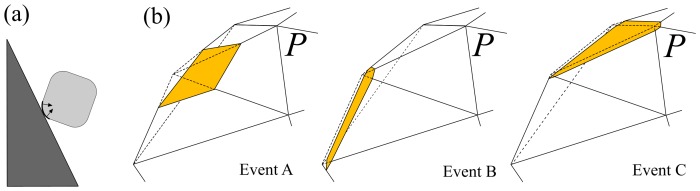
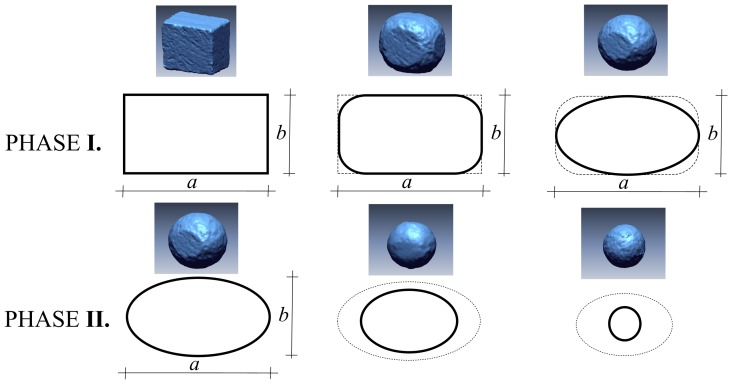
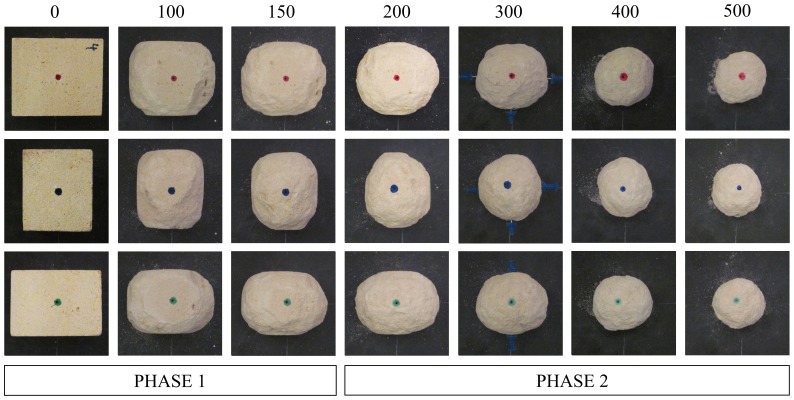
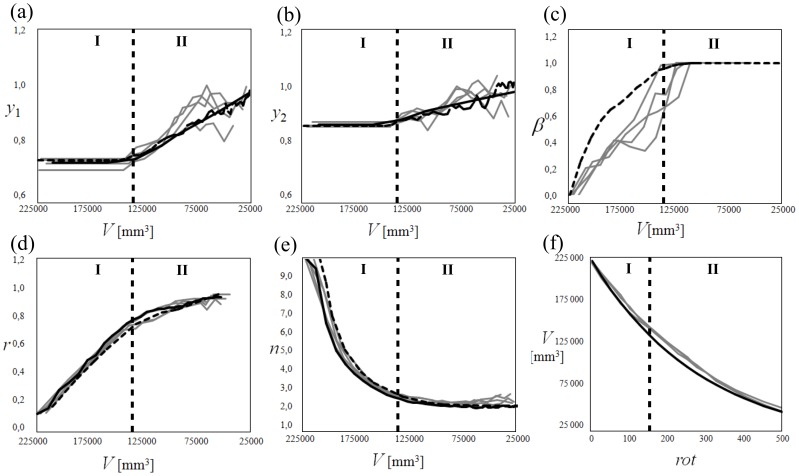
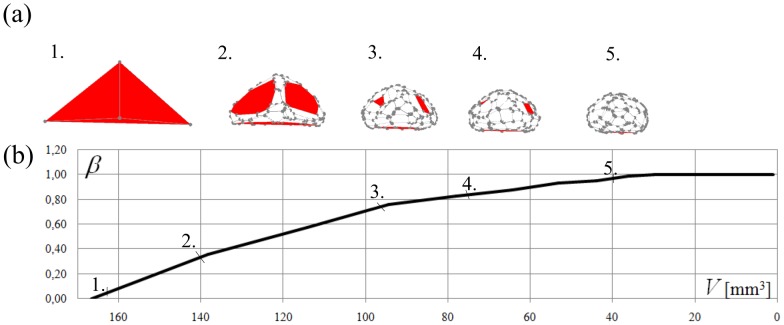
River-bed sediments display two universal downstream trends: fining, in which particle size decreases; and rounding, where pebble shapes evolve toward ellipsoids. Rounding is known to result from transport-induced abrasion; however many researchers argue that the contribution of abrasion to downstream fining is negligible. This presents a paradox: downstream shape change indicates substantial abrasion, while size change apparently rules it out. Here we use laboratory experiments and numerical modeling to show quantitatively that pebble abrasion is a curvature-driven flow problem. As a consequence, abrasion occurs in two well-separated phases: first, pebble edges rapidly round without any change in axis dimensions until the shape becomes entirely convex; and second, axis dimensions are then slowly reduced while the particle remains convex. Explicit study of pebble shape evolution helps resolve the shape-size paradox by reconciling discrepancies between laboratory and field studies, and enhances our ability to decipher the transport history of a river rock.
Overview
The claims and statistics of this paper haven’t been checked yet.
Run the check — free, no account needed. It reads the open-access text and checks the sources it cites.
Integrity signals
Registry
Cites
Statistics
Figures
Verification
Claims the paper makes
The claims and statistics of this paper haven’t been checked yet.
Run the check — free, no account needed. It reads the open-access text and checks the sources it cites.
Self-check
Percentages, sums and reported differences re-computed from the paper’s own numbers.
The self-check needs the paper’s full text.
Citations
The citation lists haven’t been fetched yet
References 47 · Cited by 163
Research works printed but not linked: 43
- PD Krynine, 1960, On the Antiquity of “Sedimentation” and Hydrology, Bulletin of the Geological Society America, 71, 1721, 10.1130/0016-7606(1960)71[1721:OTAOSA]2.0.CO;2 · DOI
- G Parker, 1991, Selective Sorting and Abrasion of River Gravel. 1. Theory. J. Hydraul. Eng, -ASCE, 117(2), 131
- M Attal, 2009, Pebble abrasion during fluvial transport: experimental results and implications for the evolution of the sediment load along rivers, Journal of Geophysical Research, 114, F04023, 10.1029/2009JF001328 · DOI
- WC Krumbein, 1941, The effects of abrasion on the size, shape and roundness of rock fragments, The Journal of Geology, 49(5), 482, 10.1086/624985 · DOI
- J Lewin, 2002, Laboratory simulation of clast abrasion, Earth Surface Processes and Landforms, 27(2), 145, 10.1002/esp.306 · DOI
- DJ Jerolmack, 2010, Equivalence of abrupt grain-size transitions in alluvial rivers and eolian sand seas: A hypothesis, Geology, 38(8), 719, 10.1130/G30922.1 · DOI
- Boggs Jr S (2006) Sedimentology and Stratigraphy. Pearson Education.
- H Sternberg, 1875, Untersuchungen Uber Langen-und Querprofil geschiebefuhrender Flusse, Zeitschrift für Bauwesen, XXV, 483
- CK Wentworth, 1919, A Laboratory and Field Study of Cobble Abrasion, The Journal of Geology, 27(7), 507, 10.1086/622676 · DOI
- PH Kuenen, 1956, Experimental Abrasion of Pebbles: 2. Rolling by Current, The Journal of Geology, 64(4), 336, 10.1086/626370 · DOI
- Y Kodama, 1994, Experimental-study of abrasion and its role in producing downstream fining in gravel-bed rivers, Journal of Sedimentary Research Section A-Sedimentary Petrology, 64(1), 76, 10.2110/jsr.64.76 · DOI
- R Ferguson, 1996, Field evidence for rapid downstream fining of river gravels through selective transport, Geology, 24(2), 179, 10.1130/0091-7613(1996)024<0179:FEFRDF>2.3.CO;2 · DOI · Paper page
- P Morris, 1999, A worldwide correlation for exponential bed particle size variation in subaerial aqueous flows, Earth Surface Processes and Landforms, 24(9), 835, 10.1002/(SICI)1096-9837(199908)24:9<835::AID-ESP15>3.0.CO;2-G · DOI
- T Hoey, 1999, Identifying the controls over downstream fining of river gravels, Journal of Sedimentary Research, 69(1), 40, 10.2110/jsr.69.40 · DOI
- C Paola, 1992, Downstream Fining by Selective Deposition in a Laboratory Flume, Science, 258(5089), 1757, 10.1126/science.258.5089.1757 · DOI
- R Seal, 1997, Experiments on downstream fining of gravel. 1. Narrow-channel runs. J. Hydraul. Eng, -ASCE, 123(10), 874
- Jerolmack DJ, Reitz MD, Martin RL (2011) Sorting out abrasion in a gypsum dune field. J. Geophys. Res. 116(F2). doi:10.1029/2010JF001821. · DOI
- Durian D, Bideaud H, Duringer P, Schröder A, Thalmann F, et al. (2006) What Is in a Pebble Shape? Phys. Rev. Lett. 97(2). doi:10.1103/PhysRevLett.97.028001. · DOI
- AE Roth, 2011, Abrasion of flat rotating shapes,, Phys. Rev. E, 83(3), 031303, 10.1103/PhysRevE.83.031303 · DOI
- WJ Firey, 1974, The shape of worn stones, Mathematika, 21, 1, 10.1112/S0025579300005714 · DOI
- FJ Bloore, 1977, The shape of pebbles, Mathematical Geology, 9(2), 113, 10.1007/BF02312507 · DOI
- G Domokos, 2009, Continuous and discrete models for abrasion processes, Periodica Polytechnica – Architecture, 40(1), 3, 10.3311/pp.ar.2009-1.01 · DOI
- SJ Blott, 2008, Particle shape: a review and new methods of characterization and classification, Sedimentology, 55, 31, 10.1111/j.1365-3091.2007.00892.x · DOI
- T Zingg, 1935, Beitrag zur Schotteranalyse. Schweiz. Mineral. Petrogr, Mitt, 15, 39
- H Wadell, 1935, Volume, Shape and Roundness of Quartz Particles, Journal of Geology, 43(3), 250, 10.1086/624298 · DOI
- P Várkonyi, 2011, A general model for collision-based abrasion processes, IMA J. Appl. Math, 76 (1), 47, 10.1093/imamat/hxq066 · DOI
- Mitchell IM, Templeton JA (2005) A Toolbox of Hamilton-Jacobi Solvers for Analysis of Nondeterministic Continuous and Hybrid System. HSCC'05 Proceedings of the 8th international conference on Hybrid Systems computation and control: 480–494. · DOI
- IM Mitchell, 2008, The Flexible, Extensible and Efficient Toolbox of Level Set Methods, Journal of Scientific Computing, 35, 300, 10.1007/s10915-007-9174-4 · DOI
- G Domokos, 2012, The evolution of pebble size and shape in space and time, Proc. R. Soc. A-Math. Phys. Eng. Sci, 468(2146), 3059, 10.1098/rspa.2011.0562 · DOI
- G Domokos, 2009, Formation of sharp edges and planar areas of asteroids by polyhedral abrasion, Astrophysical Journal, 699(1), L13, 10.1088/0004-637X/699/1/L13 · DOI
- John F (1986) Partial differential equations. 4th ed, Springer.
- RS Hamilton, 1994, Worn stones with flat sides, in: A tribute to Ilya Bakelman (College. Station, TX 1993),, Discourses Math. Appl, 3, 69
- J Adams, 1979, Wear of Unsound Pebbles in River Headwaters, Science, 203(4376), 171, 10.1126/science.203.4376.171 · DOI
- Szabó T, Fityus S, Domokos G. (2013) Abrasion model of downstream changes in grain shape and size along the Williams River, Australia. J.Geophyiscal Research/Earth Surface, DOI:10.1002/jgrf.20142. · DOI
- Domokos G, Gibbons GW (2013) Geometrical and physical models of abrasion. ArXiv preprint. Available: http://arxiv.org/abs/1307.5633. Accessed 2014 Jan 21. · arXiv
- R Anderson, 1986, Erosion profiles due to particles entrained by wind - application of an eolian sediment-transport model, Geological Society of America Bulletin, 97(10), 1270, 10.1130/0016-7606(1986)97<1270:EPDTPE>2.0.CO;2 · DOI
- Wang ZT, Wang HT, Niu QH, Dong ZB, Wang T (2011) Abrasion of yardangs. Phys. Rev. E. 84(3). doi:10.1103/PhysRevE.84.031304. · DOI
- SM Colman, 1983, Ages Estimated from a Diffusion Equation Model for Scarp Degradation, 221(4607), 263
- RME Williams, 2013, Martian Fluvial Conglomerates at Gale Crater, Science, 340(6136), 1068, 10.1126/science.1237317 · DOI · Paper page
- DJ Jerolmack, 2013, Pebbles on Mars, Science, 340(6136), 1055, 10.1126/science.1239343 · DOI
- M Kardar, 1986, Dynamic scaling of growing interfaces, Phys. Rev. Lett, 56, 889, 10.1103/PhysRevLett.56.889 · DOI
- Á Török, 2002, Oolitic limestone in polluted atmospheric environment in Budapest: weathering phenomena and alterations in physical properties, Geological Society London Special Publications, 205, 363, 10.1144/GSL.SP.2002.205.01.26 · DOI
- PL Krapivsky, 2006, Smoothing rock by chipping, Physical Review E, 75(3 Pt 1), 031119
Metadata
- Authors
- Domokos, G., Jerolmack, D. J., Sipos, A. Á., & Török, Á.
- Affiliations
- Budapest University of Technology and Economics (HU)
- University of Pennsylvania (US)
- Corresponding author
- Jerolmack, Douglas J.
- Venue
- PLoS ONE
- Publisher
- Public Library of Science (PLoS)
- Published
- 2014-02-12
- Volume
- 9
- Issue
- 2
- Pages
- e88657
- ISSN
- 1932-6203 (ISSN-L)
- PMC
- PMC3922984
- OpenAlex
- W1997823684
- Cited by
- 163
- References
- 47
- Citations by year
- 2026: 7 · 2025: 8 · 2024: 15 · 2023: 12 · 2022: 5 · 2021: 14 · 2020: 34 · 2019: 10 · 2018: 33 · 2017: 5 · 2016: 7 · 2015: 4 · 2014: 8
- FWCI
- 6.95
- Type
- journal article
- Language
- en
- Open access
- gold
- doi.org
- Locations
- PLoS ONE (publishedVersion, cc-by)
- Europe PMC (PubMed Central) (publishedVersion, cc-by)
- PubMed Central (publishedVersion, cc-by)
- PubMed (publishedVersion)
- arXiv (Cornell University) (submittedVersion)
- ScholarlyCommons (University of Pennsylvania) (submittedVersion, other-oa)
- ScholarlyCommons (University of Pennsylvania) (submittedVersion)
- RePEc: Research Papers in Economics (submittedVersion)
- DOAJ (DOAJ: Directory of Open Access Journals) (submittedVersion, cc-by-sa)
- arXiv (Cornell University)
- Funders
- National Science Foundation (1224943)
- Hungarian Scientific Research Fund (T104601)
- Topics
- Physical Sciences › Earth and Planetary Sciences › Earth-Surface Processes › Hydrology and Sediment Transport Processes
- Physical Sciences › Earth and Planetary Sciences › Earth-Surface Processes › Geological formations and processes
- Physical Sciences › Environmental Science › Environmental Engineering › Groundwater flow and contamination studies
- Keywords
- riverbed sediments, downstream fining, curvature-driven flow, fluvial sedimentology
- MeSH terms
- Algorithms, Geology, Minerals, Models, Theoretical, Probability, Normal Distribution, Geologic Sediments, Imaging, Three-Dimensional, Rivers
About these checks
Registry, retraction, Cites and statistics results are computed, not judged, with one exception: a printed reference that no index lists is read once by a model before it counts as a citation error. Claims are extracted by a model and kept only when their quote appears verbatim in the text; each cited source is then checked, with a model’s help, for whether it says what the claim relies on. Those verdicts can be wrong — read the claim’s quote and the cited source before relying on one.
Statistics and arithmetic are recomputed, not judged.
Confidence bands are shown only for fields calibrated on our annotated test set. None is calibrated yet, so no band is shown.
What counts as a claim ›How we measure confidence ›How we check this ›
Are you an author, or do you see a problem with this page? Request a review
How to cite
Cite CoChat for the checks on this page, and the paper for its own findings.
- This page
- CoChat. (2026). Citation check: How River Rocks Round: Resolving the Shape-Size Paradox. https://app.cochat.ai/papers/10.1371/journal.pone.0088657
- The paper
- Domokos, G., Jerolmack, D. J., Sipos, A. Á., & Török, Á. (2014). How River Rocks Round: Resolving the Shape-Size Paradox. PLoS ONE. https://doi.org/10.1371/journal.pone.0088657
