

The DOI matches its Crossref record; 46 of the 46 references it cites were found in a registry or an index.
Population Structure of Clinical Pseudomonas aeruginosa from West and Central African Countries
Open accessAbstract
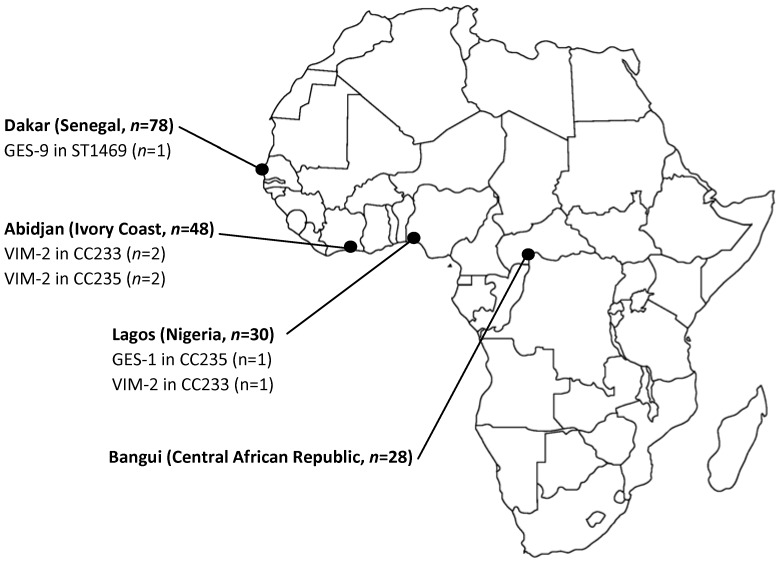
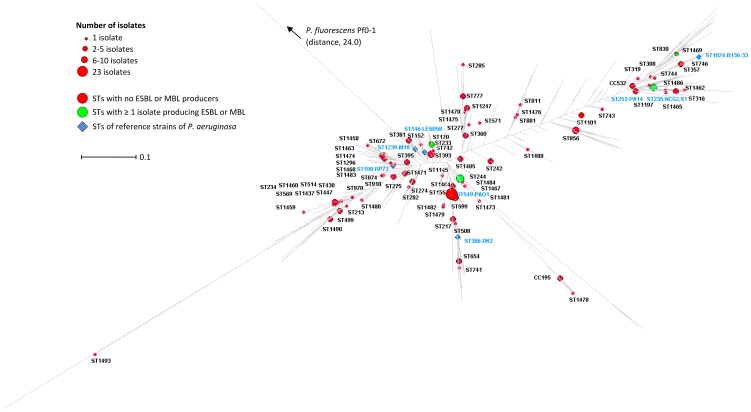
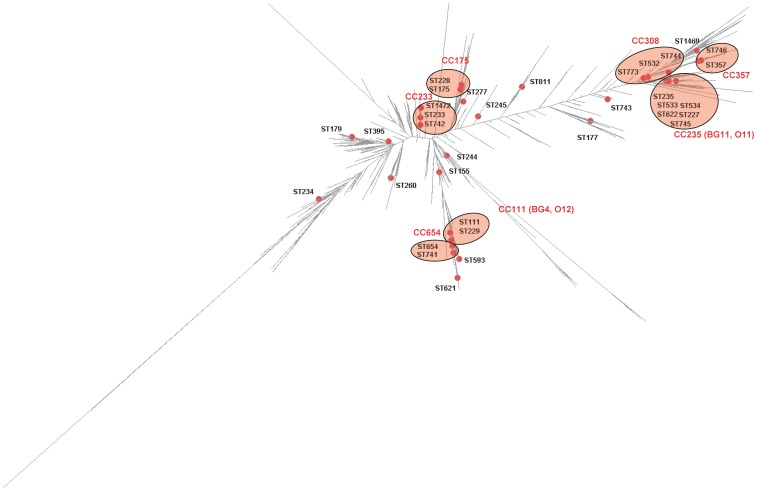
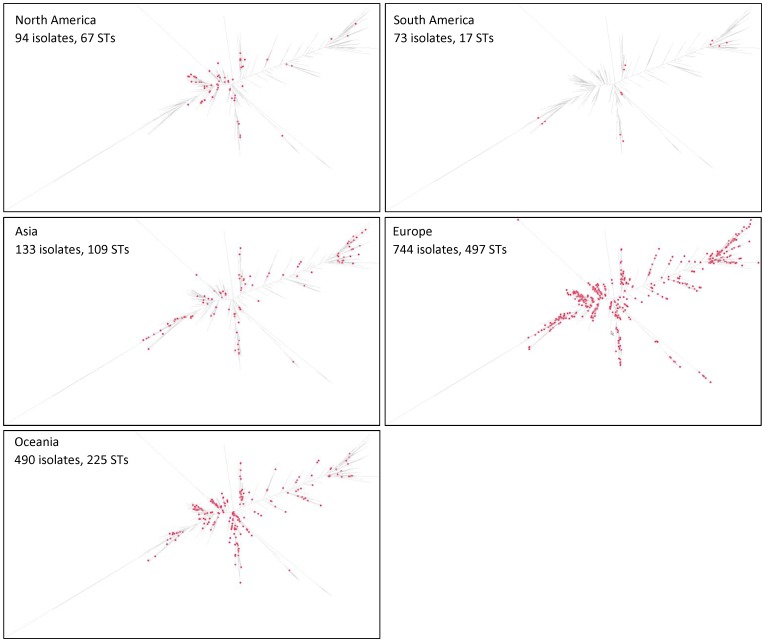
BACKGROUND: Pseudomonas aeruginosa (PA) has a non-clonal, epidemic population with a few widely distributed and frequently encountered sequence types (STs) called 'high-risk clusters'. Clinical P. aeruginosa (clinPA) has been studied in all inhabited continents excepted in Africa, where a very few isolates have been analyzed. Here, we characterized a collection of clinPA isolates from four countries of West and Central Africa. METHODOLOGY: 184 non-redundant isolates of clinPA from hospitals of Senegal, Ivory Coast, Nigeria, and Central African Republic were genotyped by MLST. We assessed their resistance level to antibiotics by agar diffusion and identified the extended-spectrum β-lactamases (ESBLs) and metallo-β-lactamases (MBLs) by sequencing. The population structure of the species was determined by a nucleotide-based analysis of the entire PA MLST database and further localized on the phylogenetic tree (i) the sequence types (STs) of the present collection, (ii) the STs by continents, (iii) ESBL- and MBL-producing STs from the MLST database. PRINCIPAL FINDINGS: We found 80 distinct STs, of which 24 had no relationship with any known STs. 'High-risk' international clonal complexes (CC155, CC244, CC235) were frequently found in West and Central Africa. The five VIM-2-producing isolates belonged to CC233 and CC244. GES-1 and GES-9 enzymes were produced by one CC235 and one ST1469 isolate, respectively. We showed the spread of 'high-risk' international clonal complexes, often described as multidrug-resistant on other continents, with a fully susceptible phenotype. The MBL- and ESBL-producing STs were scattered throughout the phylogenetic tree and our data suggest a poor association between a continent and a specific phylogroup. CONCLUSIONS: ESBL- and MBL-encoding genes are borne by both successful international clonal complexes and distinct local STs in clinPA of West and Central Africa. Furthermore, our data suggest that the spread of a ST could be either due to its antibiotic resistance or to features independent from the resistance to antibiotics.
Overview
The claims and statistics of this paper haven’t been checked yet.
Run the check — free, no account needed. It reads the open-access text and checks the sources it cites.
Integrity signals
Registry
Cites
Statistics
Figures
Verification
Claims the paper makes
The claims and statistics of this paper haven’t been checked yet.
Run the check — free, no account needed. It reads the open-access text and checks the sources it cites.
Claims other papers make about this one
Each is checked against this paper’s own text: does it say what the citing paper says it does?
The source backs part of the claim, not all of it — or backs it for a different population, condition or comparison.
In the citing paper
“Of concern is its resistance to beta-lactams, 175 especially carbapenems, as they are often used for empiric treatment of last resort.176”
From Antimicrobial Resistance Rates and Surveillance in Sub-Saharan Africa: Where Are We Now? (2022) · cites this paper as [175]
Experimental — accuracy not yet measured
Self-check
Percentages, sums and reported differences re-computed from the paper’s own numbers.
The self-check needs the paper’s full text.
Citations
Cites
RAxML-VI-HPC: maximum likelihood-based phylogenetic analyses with thousands of taxa and mixed models
Stamatakis, A. (2006) · Bioinformatics · doi:10.1093/bioinformatics/btl446 · Cited by 15,582
Magiorakos, A.-P., Srinivasan, A., Carey, R. B., Carmeli, Y., Falagas, M. E., Giske, C. G., Harbarth, S., Hindler, J. F., Kahlmeter, G., Olsson-Liljequist, B., et al. (2012) · Clinical Microbiology and Infection · doi:10.1111/j.1469-0691.2011.03570.x · Cited by 14,449
jModelTest: Phylogenetic Model Averaging
Posada, D. (2008) · Molecular Biology and Evolution · doi:10.1093/molbev/msn083 · Cited by 10,578
Tenover, F. C., Arbeit, R. D., Goering, R. V., Mickelsen, P. A., Murray, B. E., Persing, D. H., & Swaminathan, B. (1995) · Journal of Clinical Microbiology · doi:10.1128/jcm.33.9.2233-2239.1995 · Cited by 8,203
BIGSdb: Scalable analysis of bacterial genome variation at the population level
Jolley, K. A., & Maiden, M. C. J. (2010) · BMC Bioinformatics · doi:10.1186/1471-2105-11-595 · Cited by 2,341
Dendroscope 3: An Interactive Tool for Rooted Phylogenetic Trees and Networks
Huson, D. H., & Scornavacca, C. (2012) · Systematic Biology · doi:10.1093/sysbio/sys062 · Cited by 1,674
Pseudomonas aeruginosa: all roads lead to resistance
Breidenstein, E. B. M., de la Fuente‐Núñez, C., & Hancock, R. E. W. (2011) · Trends in Microbiology · doi:10.1016/j.tim.2011.04.005 · Cited by 1,358
Establishment of infection: lessons from a versatile opportunist
Lyczak, J. B., Cannon, C. L., & Pier, G. B. (2000) · Microbes and Infection · doi:10.1016/s1286-4579(00)01259-4 · Cited by 1,343
Pseudomonas Aeruginosa: Resistance to the Max
Poole, K. (2011) · Frontiers in Microbiology · doi:10.3389/fmicb.2011.00065 · Cited by 950
Woodford, N., Turton, J. F., & Livermore, D. M. (2011) · FEMS Microbiology Reviews · doi:10.1111/j.1574-6976.2011.00268.x · Cited by 881
Pseudomonas aeruginosa: resistance and therapeutic options at the turn of the new millennium
Mesaros, N. E., Nordmann, P., Plésiat, P., Roussel‐Delvallez, M., Eldere, J. V., Glupczynski, Y., Laethem, Y. V., Jacobs, F., Lebecque, P., Malfroot, A., et al. (2007) · Clinical Microbiology and Infection · doi:10.1111/j.1469-0691.2007.01681.x · Cited by 585
DNA sequence‐based analysis of the Pseudomonas species
Mulet, M., Lalucat, J., & Garcı́a-Valdés, E. (2010) · Environmental Microbiology · doi:10.1111/j.1462-2920.2010.02181.x · Cited by 571
Emerging carbapenemases: a global perspective
Walsh, T. R. (2010) · International Journal of Antimicrobial Agents · doi:10.1016/s0924-8579(10)70004-2 · Cited by 528
Curran, B., Jonas, D., Grundmann, H., Pitt, T. L., & Dowson, C. G. (2004) · Journal of Clinical Microbiology · doi:10.1128/jcm.42.12.5644-5649.2004 · Cited by 526
Sequence type analysis and recombinational tests (START)
Jolley, K. A., Feil, E. J., Chan, M. S., & Maiden, M. C. J. (2001) · Bioinformatics · doi:10.1093/bioinformatics/17.12.1230 · Cited by 512
Wieser, A., Schneider, L., Jung, J., & Schubert, S. (2011) · Applied Microbiology and Biotechnology · doi:10.1007/s00253-011-3783-4 · Cited by 455
The Accessory Genome of Pseudomonas aeruginosa
Kung, V. L., Ozer, E. A., & Hauser, A. R. (2010) · Microbiology and Molecular Biology Reviews · doi:10.1128/mmbr.00027-10 · Cited by 340
Population structure of Pseudomonas aeruginosa
Wiehlmann, L., Wagner, G., Cramer, N., Siebert, B., Gudowius, P., Morales, G., Köhler, T., van Delden, C., Weinel, C., Slickers, P., et al. (2007) · Proceedings of the National Academy of Sciences · doi:10.1073/pnas.0609213104 · Cited by 338
Pseudomonas aeruginosa Population Structure Revisited
Pirnay, J., Bilocq, F., Pot, B., Cornélis, P., Zizi, M., Eldere, J. V., Deschaght, P., Vaneechoutte, M., Jennes, S., Pitt, T. L., et al. (2009) · PLoS ONE · doi:10.1371/journal.pone.0007740 · Cited by 323
Unusual Features of Pomoviral RNA Movement
Torrance, L., Wright, K. M., Crutzen, F., Cowan, G. H., Lukhovitskaya, N. I., Bragard, C., & Savenkov, E. I. (2011) · Frontiers in Microbiology · doi:10.3389/fmicb.2011.00259 · Cited by 235
Genetic Markers of Widespread Extensively Drug-Resistant Pseudomonas aeruginosa High-Risk Clones
Cabot, G., Ocampo-Sosa, A. A., Domínguez, M. Á., Gago, J. F., Juan, C., Tubau, F., Rodríguez, C., Moyá, B., Peña, C., Martı́nez-Martı́nez, L., et al. (2012) · Antimicrobial Agents and Chemotherapy · doi:10.1128/aac.01388-12 · Cited by 228
Pathogen typing in the genomics era: MLST and the future of molecular epidemiology
Pérez‐Losada, M., Cabezas, P., Castro‐Nallar, E., & Crandall, K. A. (2013) · Infection Genetics and Evolution · doi:10.1016/j.meegid.2013.01.009 · Cited by 207
Edelstein, M. V., Skleenova, E. Y., Shevchenko, O. V., D'souza, J. W., Tapalski, D. V., Azizov, I., Витальевна, С. М., Pavlukov, R. A., Kozlov, R. S., Toleman, M. A., et al. (2013) · The Lancet Infectious Diseases · doi:10.1016/s1473-3099(13)70168-3 · Cited by 176
Samuelsen, Ø., Toleman, M. A., Sundsfjord, A., Rydberg, J., Leegaard, T. M., Walder, M., Lia, A., Ranheim, T. E., Rajendra, Y., Hermansen, N. O., et al. (2009) · Antimicrobial Agents and Chemotherapy · doi:10.1128/aac.00824-09 · Cited by 150
Maâtallah, M., Cheriaa, J., Backhrouf, A., Iversen, A., Grundmann, H., Do, T., Lanotte, P., Mastouri, M., Elghmati, M. S., Rojo, F., et al. (2011) · PLoS ONE · doi:10.1371/journal.pone.0025617 · Cited by 143
Kidd, T. J., Ritchie, S. R., Ramsay, K. A., Grimwood, K., Bell, S. C., & Rainey, P. B. (2012) · PLoS ONE · doi:10.1371/journal.pone.0044199 · Cited by 131
DeFlaun, M. F., Tanzer, A. S., McAteer, A. L., Marshall, B. M., & Levy, S. B. (1990) · Applied and Environmental Microbiology · doi:10.1128/aem.56.1.112-119.1990 · Cited by 119
Empel, J., Filczak, K., Mrówka, A., Hryniewicz, W., Livermore, D. M., & Gniadkowski, M. (2007) · Journal of Clinical Microbiology · doi:10.1128/jcm.00997-07 · Cited by 112
Cholley, P., Thouverez, M., Hocquet, D., van der Mee-Marquet, N. L., Talon, D. R., & Bertrand, X. (2011) · Journal of Clinical Microbiology · doi:10.1128/jcm.00102-11 · Cited by 111
Self-citationViedma, E., Juan, C., Acosta, J., Zamorano, L., Otero, J. R., Sanz, F., Cháves, F., & Oliver, A. (2009) · Antimicrobial Agents and Chemotherapy · doi:10.1128/aac.00900-09 · Cited by 110
García-Castillo, M., del Campo, R., Morosini, M. I., Riera, E., Cabot, G., Willems, R. J. L., van Mansfeld, R., Oliver, A., & Cantón, R. (2011) · Journal of Clinical Microbiology · doi:10.1128/jcm.00753-11 · Cited by 90
Fournier, D., Richardot, C., Müller, E., Robert-Nicoud, M., Llanes, C., Plésiat, P., & Jeannot, K. (2013) · Journal of Antimicrobial Chemotherapy · doi:10.1093/jac/dkt098 · Cited by 89
Genetic and Phenotypic Variations of a ResistantPseudomonas aeruginosaEpidemic Clone
Hocquet, D., Bertrand, X., Köhler, T., Talon, D. R., & Plésiat, P. (2003) · Antimicrobial Agents and Chemotherapy · doi:10.1128/aac.47.6.1887-1894.2003 · Cited by 85
Self-citationLópez-Causapé, C., Rojo‐Molinero, E., Mulet, X., Cabot, G., Moyá, B., Figuerola, J., Togores, B., Pérez, J. L., & Oliver, A. (2013) · PLoS ONE · doi:10.1371/journal.pone.0071001 · Cited by 81
Talon, D. R., Cailleaux, V., Thouverez, M., & Michel-Briand, Y. (1996) · Journal of Hospital Infection · doi:10.1016/s0195-6701(96)90055-9 · Cited by 78
Self-citationPoirel, L., Briñas, L., Fortineau, N., & Nordmann, P. (2005) · Antimicrobial Agents and Chemotherapy · doi:10.1128/aac.49.8.3593-3597.2005 · Cited by 66
van Mansfeld, R., Willems, R. J. L., Brimicombe, R. W., Heijerman, H. G. M., van Berkhout, F. T., Wolfs, T. F. W., van der Ent, C. K., & Bonten, M. J. M. (2009) · Journal of Clinical Microbiology · doi:10.1128/jcm.01462-09 · Cited by 64
Hocquet, D., Plésiat, P., Dehecq, B., Mariotte, P., Talon, D. R., & Bertrand, X. (2010) · Antimicrobial Agents and Chemotherapy · doi:10.1128/aac.01646-09 · Cited by 61
Self-citationVatcheva-Dobrevska, R., Mulet, X., Ivanov, I. N., Zamorano, L., Dobreva, E. G., Velinov, T., Kantardjiev, T., & Oliver, A. (2013) · Microbial Drug Resistance · doi:10.1089/mdr.2013.0004 · Cited by 56
Libisch, B., Balogh, B., & Füzi, M. (2008) · Current Microbiology · doi:10.1007/s00284-008-9285-7 · Cited by 41
Fernández-Olmos, A., García-Castillo, M., Alba, J. M., Morosini, M. I., Lamas, A., Romero, B., Galán, J. C., del Campo, R., & Cantón, R. (2013) · Journal of Clinical Microbiology · doi:10.1128/jcm.00802-13 · Cited by 38
Pournaras, S., Kock, R. A., Mossialos, D., Mellmann, A., Sakellaris, V., Stathopoulos, C., Friedrich, A. W., & Tsakris, A. (2013) · Journal of Antimicrobial Chemotherapy · doi:10.1093/jac/dkt004 · Cited by 27
García-Castillo, M., Máiz, L., Morosini, M.-I., Rodríguez-Baños, M., Suárez, L., Fernández-Olmos, A., Baquero, F., Cantón, R., & del Campo, R. (2012) · Journal of Clinical Microbiology · doi:10.1128/jcm.05478-11 · Cited by 27
Santella, G., Pollini, S., Docquier, J., Mereuţă, A. I., Gutkind, G., Rossolini, G. M., & Radice, M. A. (2010) · Journal of Clinical Microbiology · doi:10.1128/jcm.00614-10 · Cited by 26
Outbreak of metallo- -lactamase VIM-2-positive strains of Pseudomonas aeruginosa in the Ivory Coast
Jeannot, K., Guessennd, N., Fournier, P., Muller, E., Gbonon, V., & Plésiat, P. (2013) · Journal of Antimicrobial Chemotherapy · doi:10.1093/jac/dkt296 · Cited by 24
Self-citationHocquet, D., Dehecq, B., Bertrand, X., & Plésiat, P. (2011) · Journal of Clinical Microbiology · doi:10.1128/jcm.02585-10 · Cited by 18
Self-citation
Cited by
Sorted by citations
The increasing threat of Pseudomonas aeruginosa high-risk clones
Oliver, A., Mulet, X., López-Causapé, C., & Juan, C. (2015) · Drug Resistance Updates · doi:10.1016/j.drup.2015.08.002 · Cited by 673
The current status on the taxonomy of Pseudomonas revisited: An update
Péix, Á., Ramírez-Bahena, M.-H., & Velázquez, E. (2017) · Infection Genetics and Evolution · doi:10.1016/j.meegid.2017.10.026 · Cited by 262
Antimicrobial Resistance Rates and Surveillance in Sub-Saharan Africa: Where Are We Now?
Kariuki, S., Kering, K., Wairimu, C., Onsare, R., & Mbae, C. (2022) · Infection and Drug Resistance · doi:10.2147/idr.s342753 · Cited by 245
Mobile Carbapenemase Genes in Pseudomonas aeruginosa
Yoon, E.-J., & Jeong, S. H. (2021) · Frontiers in Microbiology · doi:10.3389/fmicb.2021.614058 · Cited by 221
What It Takes to Be a Pseudomonas aeruginosa? The Core Genome of the Opportunistic Pathogen Updated
Valot, B., Guyeux, C., Rolland, J. Y., Mazouzi, K., Bertrand, X., & Hocquet, D. (2015) · PLoS ONE · doi:10.1371/journal.pone.0126468 · Cited by 141
Self-citation
Metadata
- Authors
- Cholley, P., Ka, R., Guyeux, C., Thouverez, M., Guessennd, N., Ghebremedhin, B., Frank, T., Bertrand, X., & Hocquet, D.
- Affiliations
- Centre National de la Recherche Scientifique (FR)
- Centre Hospitalier National Universitaire de Fann (SN)
- Institut Pasteur de Côte d'Ivoire (CI)
- Otto-von-Guericke-Universität Magdeburg (DE)
- Institut Pasteur de Bangui (CF)
- Corresponding author
- Hocquet, Didier
- Venue
- PLoS ONE
- Publisher
- Public Library of Science (PLoS)
- Published
- 2014-09-04
- Volume
- 9
- Issue
- 9
- Pages
- e107008
- ISSN
- 1932-6203 (ISSN-L)
- PMC
- PMC4154784
- OpenAlex
- W2009368899
- Cited by
- 31
- References
- 46
- Citations by year
- 2025: 3 · 2024: 2 · 2023: 2 · 2022: 2 · 2021: 5 · 2020: 1 · 2019: 4 · 2018: 3 · 2017: 1 · 2016: 2 · 2015: 6
- FWCI
- 1.37
- Type
- journal article
- Language
- en
- Open access
- gold
- doi.org
- Locations
- PLoS ONE (publishedVersion, cc-by)
- Europe PMC (PubMed Central) (publishedVersion, cc-by)
- PubMed Central (publishedVersion, cc-by)
- PubMed (publishedVersion)
- HAL (submittedVersion, cc-by)
- DOAJ (DOAJ: Directory of Open Access Journals) (submittedVersion, cc-by-sa)
- Funders
- Wellcome Trust
- University of Oxford
- Topics
- Health Sciences › Medicine › Microbiology (medical) › Antibiotic Resistance in Bacteria
- Life Sciences › Biochemistry, Genetics and Molecular Biology › Molecular Biology › Bacterial biofilms and quorum sensing
- Health Sciences › Medicine › Microbiology (medical) › Infections and bacterial resistance
- Keywords
- Pseudomonas aeruginosa, population structure, sequence types, extended-spectrum beta-lactamase, metallo-beta-lactamase, VIM-2, GES-1, multidrug resistance, phylogenetic analysis, West Africa, Central Africa, antimicrobial resistance dissemination
- MeSH terms
- Anti-Bacterial Agents, beta-Lactamases, Central African Republic, Genotype, Humans, Cote d'Ivoire, Nigeria, Phylogeny, Pseudomonas aeruginosa, Pseudomonas Infections, Senegal, Molecular Epidemiology, beta-Lactam Resistance, Multilocus Sequence Typing
About these checks
Registry, retraction, Cites and statistics results are computed, not judged, with one exception: a printed reference that no index lists is read once by a model before it counts as a citation error. Claims are extracted by a model and kept only when their quote appears verbatim in the text; each cited source is then checked, with a model’s help, for whether it says what the claim relies on. Those verdicts can be wrong — read the claim’s quote and the cited source before relying on one.
Statistics and arithmetic are recomputed, not judged.
Confidence bands are shown only for fields calibrated on our annotated test set. None is calibrated yet, so no band is shown.
What counts as a claim ›How we measure confidence ›How we check this ›
Are you an author, or do you see a problem with this page? Request a review
