

The DOI matches its Crossref record; 43 of the 43 references it cites were found in a registry or an index.
Reducing Frequent Visits to the Emergency Department: A Systematic Review of Interventions
Open accessAbstract
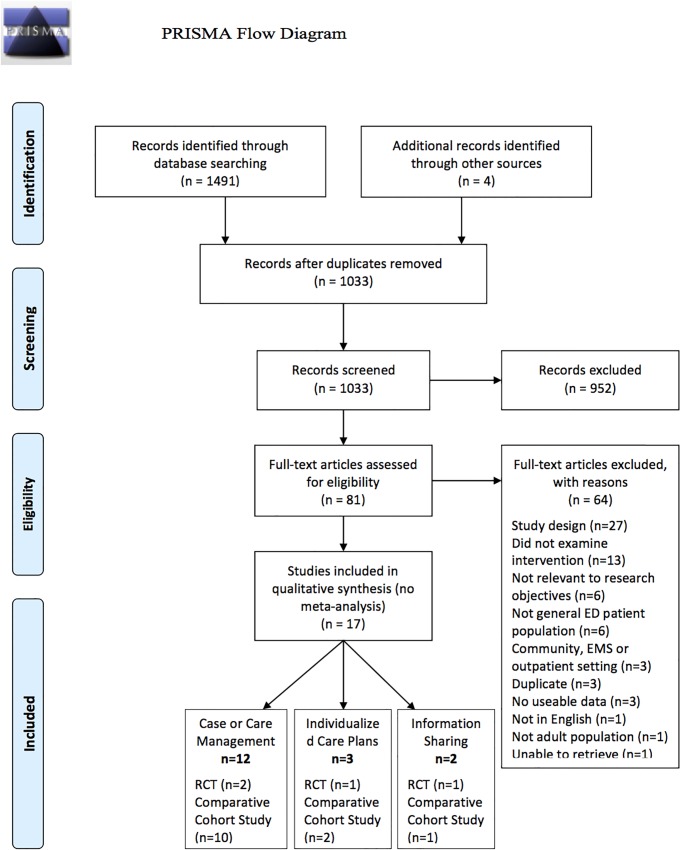
OBJECTIVE: The objective of this study was to establish the effectiveness of interventions to reduce frequent emergency department (ED) use among a general adult high ED-use population. METHODS: Systematic review of the literature from 1950-January 2015. Studies were included if they: had a control group (controlled trials or comparative cohort studies), were set in an ED or acute care facility, and examined the impact of an intervention to reduce frequent ED use in a general adult population. Studies reporting non-original data or focused on a specific patient population were excluded. Study design, patient population, intervention, the frequency of ED visits, and costs of frequent ED use and/or interventions were extracted and narratively synthesized. RESULTS: Among 17 included articles, three intervention categories were identified: case management (n = 12), individualized care plans (n = 3), and information sharing (n = 2). Ten studies examining case management reported reductions in mean (-0.66 to -37) or median (-0.1 to -20) number of ED visits after 12-months; one study reported an increase in mean ED visits (+2.79); and one reported no change. Of these, 6 studies also reported reduced hospital costs. Only 1 study evaluating individualized care plans examined ED utilization and found no change in median ED visits post-intervention. Costs following individualized care plans were also only evaluated in 1 study, which reported savings in hospital costs of $742/patient. Evidence was mixed regarding information sharing: 1 study reported no change in mean ED visits and did not examine costs; whereas the other reported a decrease in mean ED visits (-16.9) and ED cost savings of $15,513/patient. CONCLUSIONS: The impact of all three frequent-user interventions was modest. Case management had the most rigorous evidence base, yielded moderate cost savings, but with variable reductions in ED use. Future studies evaluating non-traditional interventions, tailoring to patient subgroups or socio-cultural contexts, are warranted.
Overview
The claims and statistics of this paper haven’t been checked yet.
Run the check — free, no account needed. It reads the open-access text and checks the sources it cites.
Integrity signals
Registry
Cites
Statistics
Figures
Verification
Claims the paper makes
The claims and statistics of this paper haven’t been checked yet.
Run the check — free, no account needed. It reads the open-access text and checks the sources it cites.
Claims other papers make about this one
Each is checked against this paper’s own text: does it say what the citing paper says it does?
In the citing paper
“The relative strength of the association we observed with past ED visits is informative, suggesting that past ED use would be useful measure to identify patients who would benefit from closer follow-up, geriatric referral, ED-to-community transition support, and closer engagement with primary care and home care.36”
From Factors associated with recurrent emergency department visits among people living with dementia: A retrospective cohort study (2023) · cites this paper as [36]
Self-check
Percentages, sums and reported differences re-computed from the paper’s own numbers.
The self-check needs the paper’s full text.
Citations
Cites
Preferred Reporting Items for Systematic Reviews and Meta-Analyses: the PRISMA statement
Moher, D., Liberati, A., Tetzlaff, J., Altman, D. G., & for the PRISMA Group (2009) · BMJ · doi:10.1136/bmj.b2535 · Cited by 83,823
Preferred reporting items for systematic reviews and meta-analyses: the PRISMA Statement.
(2009) · PubMed Central · Cited by 44,859
Preferred reporting items for systematic reviews and meta-analyses: The PRISMA statement
Moher, D., Liberati, A., Tetzlaff, J., Altman, D. G., & the PRISMA Group* (2009) · Annals of Internal Medicine · doi:10.7326/0003-4819-151-4-200908180-00135 · Cited by 37,554
The Cochrane Collaboration's tool for assessing risk of bias in randomised trials
Higgins, J. P. T., Altman, D. G., Gotzsche, P. C., Juni, P., Moher, D., Oxman, A. D., Savovic, J., Schulz, K. F., Weeks, L., Sterne, J. A. C., et al. (2011) · BMJ · doi:10.1136/bmj.d5928 · Cited by 33,817
Dermyshi, E., Wang, Y., Yan, C., Hong, W., Qiu, G., Gong, X., & Zhang, T. (2017) · Neonatology · doi:10.1159/000454668 · Cited by 24,586
Downs, S. H., & Black, N. (1998) · Journal of Epidemiology and Community Health · doi:10.1136/jech.52.6.377 · Cited by 8,252
Frequent Users of Emergency Departments: The Myths, the Data, and the Policy Implications
LaCalle, E., & Rabin, E. (2010) · Annals of Emergency Medicine · doi:10.1016/j.annemergmed.2010.01.032 · Cited by 648
Althaus, F., Paroz, S., Hügli, O., Ghali, W. A., Daeppen, J., Peytremann‐Bridevaux, I., & Bodenmann, P. (2011) · Annals of Emergency Medicine · doi:10.1016/j.annemergmed.2011.03.007 · Cited by 319
Hansagi, H., Olsson, M., Sjöberg, S., Tomson, Y., & Göransson, S. (2001) · Annals of Emergency Medicine · doi:10.1067/mem.2001.111762 · Cited by 318
Weintraub, N. L., Collins, S. P., Pang, P. S., Levy, P. D., Anderson, A. S., Arslanian‐Engoren, C., Gibler, W. B., McCord, J., Parshall, M. B., Francis, G. S., et al. (2010) · Circulation · doi:10.1161/cir.0b013e3181f9a223 · Cited by 274
Cited by
Sorted by citations
Interventions to reduce emergency department utilisation: A review of reviews
den Heede, K. V., & de Voorde, C. V. (2016) · Health Policy · doi:10.1016/j.healthpol.2016.10.002 · Cited by 210
Soril, L. J. J., Leggett, L. E., Lorenzetti, D., Noseworthy, T., & Clement, F. M. (2016) · Health Policy · doi:10.1016/j.healthpol.2016.02.006 · Cited by 140
Self-citation"Hospital was the only option": Experiences of frequent emergency department users in mental health.
Wise-Harris, D., Pauly, D., Kahan, D., Tan de Bibiana, J., Hwang, S. W., & Stergiopoulos, V. (2017) · Administration and Policy in Mental Health and Mental Health Services Research · doi:10.1007/s10488-016-0728-3 · Cited by 126
Hudon, C., Chouinard, M., Pluye, P., Sherif, R. E., Bush, P. L., Rihoux, B., Poitras, M.-È., Lambert, M., Zomahoun, H. T. V., & Légaré, F. (2019) · The Annals of Family Medicine · doi:10.1370/afm.2419 · Cited by 99
Case Management in Primary Care for Frequent Users of Health Care Services: A Mixed Methods Study
Hudon, C., Chouinard, M., Dubois, M., Roberge, P., Loignon, C., Nguemeleu, E. T., Lambert, M., Hudon, É., Diadiou, F., & Bouliane, D. (2018) · The Annals of Family Medicine · doi:10.1370/afm.2233 · Cited by 94
Metadata
- Authors
- Soril, L. J. J., Leggett, L. E., Lorenzetti, D. L., Noseworthy, T. W., & Clement, F. M.
- Affiliations
- O'Brien Institute for Public Health (CA)
- Institute of Health Economics (CA)
- Corresponding author
- Clement, Fiona M.
- Venue
- PLOS ONE
- Publisher
- Public Library of Science (PLoS)
- Published
- 2015-04-13
- Volume
- 10
- Issue
- 4
- Pages
- e0123660
- ISSN
- 1932-6203 (ISSN-L)
- PMC
- PMC4395429
- OpenAlex
- W1965434882
- Cited by
- 251
- References
- 43
- Citations by year
- 2026: 18 · 2025: 17 · 2024: 13 · 2023: 34 · 2022: 28 · 2021: 32 · 2020: 31 · 2019: 22 · 2018: 24 · 2017: 17 · 2016: 14 · 2015: 1
- FWCI
- 4.35
- Type
- journal article
- Language
- en
- Open access
- gold
- doi.org
- Licence
- Locations
- PLoS ONE (publishedVersion, cc-by)
- PubMed Central (publishedVersion, cc-by)
- PubMed (publishedVersion)
- RePEc: Research Papers in Economics (submittedVersion)
- DOAJ (DOAJ: Directory of Open Access Journals) (submittedVersion)
- Figshare (submittedVersion, cc-by)
- Topics
- Health Sciences › Medicine › Emergency Medicine › Emergency and Acute Care Studies
- Health Sciences › Medicine › Epidemiology › Chronic Disease Management Strategies
- Health Sciences › Nursing › Leadership and Management › Hospital Admissions and Outcomes
- Keywords
- frequent emergency department users, emergency department utilization, case management, individualized care plans, information sharing, hospital costs, cost reduction, intervention effectiveness
- MeSH terms
- Adult, Emergency Service, Hospital, Humans, Patient Care Planning, Quality Assurance, Health Care, Randomized Controlled Trials as Topic, Cost Savings, Hospital Costs, Case Management
About these checks
Registry, retraction, Cites and statistics results are computed, not judged, with one exception: a printed reference that no index lists is read once by a model before it counts as a citation error. Claims are extracted by a model and kept only when their quote appears verbatim in the text; each cited source is then checked, with a model’s help, for whether it says what the claim relies on. Those verdicts can be wrong — read the claim’s quote and the cited source before relying on one.
Statistics and arithmetic are recomputed, not judged.
Confidence bands are shown only for fields calibrated on our annotated test set. None is calibrated yet, so no band is shown.
What counts as a claim ›How we measure confidence ›How we check this ›
Are you an author, or do you see a problem with this page? Request a review
