

Are Sex Drive and Hypersexuality Associated with Pedophilic Interest and Child Sexual Abuse in a Male Community Sample?
Open accessThe DOI matches its Crossref record; 37 of the 38 references it cites were found in a registry or an index.
Abstract
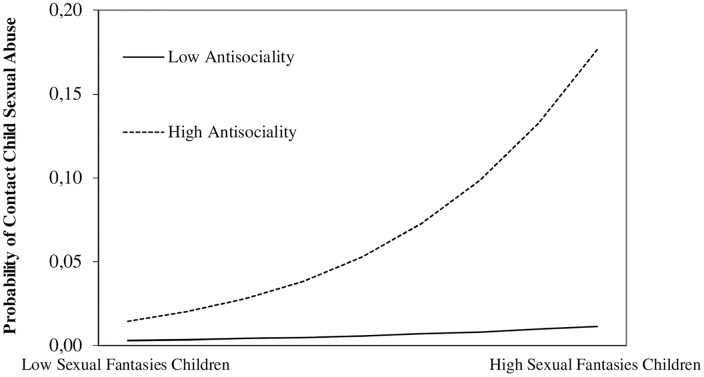
Although much is currently known about hypersexuality (in the form of excessive sexual behavior) among sexual offenders, the degree to which hypersexual behavior is linked to paraphilic and especially pedophilic interests in non-forensic populations has not been established.The purpose of the present study was to elucidate the associations between total sexual outlets(TSO) and other sex drive indicators, antisocial behavior, pedophilic interests, and sexual offending behavior in a large population-based community sample of males. The sample included 8,718 German men who participated in an online study. Hypersexual behavior as measured by self-reported TSO, self-reported sex drive, criminal history, and pedophilic interests were assessed. In moderated hierarchical logistic regression analyses self-reported contact sexual offending against children was linked to sexual fantasizing about children and anti sociality.There was no association between aggregated sex drive, and sexual abusive behaviour in the multivariate analyses. In contrast, self-reported child pornography consumption was associated with sex drive, sexual fantasies involving children, and anti sociality. Nevertheless, in convicted sexual offenders anti sociality, sexual preoccupation (like hypersexuality), and pedophilic interest are important predictors of sexual reoffending against prepubescent children.Therefore, in clinical practice an assessment of criminal history and pedophilic interests in hypersexual individuals and vice versa hypersexuality in antisocial or pedophilic men should be considered [corrected].
Overview
The claims and statistics of this paper haven’t been checked yet.
Free: it reads the open-access text and checks the first 5 claims that cite a source we can check. Create a free account to check every claim.
Integrity signals
Registry
Cites
Statistics
Figures
Verification
Claims the paper makes
The claims and statistics of this paper haven’t been checked yet.
Free: it reads the open-access text and checks the first 5 claims that cite a source we can check. Create a free account to check every claim.
Claims other papers make about this one
Each is checked against this paper’s own text: does it say what the citing paper says it does?
The source backs part of the claim, not all of it — or backs it for a different population, condition or comparison.
In the citing paper
“However, co-occurrence of paraphilias such as pedophilia, sexual sadism, or exhibitionism with CSB may pose an increased risk for sexual (re)offending.129,130”
From Assessment and treatment of compulsive sexual behavior disorder: a sexual medicine perspective (2024) · cites this paper as [129]
Experimental — accuracy not yet measuredThe cited source says what the claim attributes to it.
In the citing paper
“While sexual interest in children is a key motivational factor, it is not the only motivating factor for CSAM use (see Klein et al. 2015, who report on the relationship between sex drive and CSAM use).”
From AI-generated child sexual abuse material: what’s the harm? (2026) · cites this paper as Klein et al. 2015
Self-check
Percentages, sums and reported differences re-computed from the paper’s own numbers.
The self-check needs the paper’s full text.
Citations
Cites
Applied Multiple Regression/Correlation Analysis for the Behavioral Sciences
Cohen, P., Cohen, P., West, S. G., & Aiken, L. S. (2014) · Psychology Press eBooks · doi:10.4324/9781410606266 · Cited by 20,737
Applied Multiple Regression/Correlation Analysis for the Behavioral Sciences
Kemp, F. (2003) · Journal of the Royal Statistical Society: Series D (The Statistician) · doi:10.1046/j.1467-9884.2003.t01-2-00383_4.x · Cited by 9,293
Sexual Behavior in the Human Male
(1948) · Physical Therapy · doi:10.1093/ptj/28.2.93 · Cited by 5,134
Leys, C., Ley, C., Klein, O., Bernard, P., & Licata, L. (2013) · Journal of Experimental Social Psychology · doi:10.1016/j.jesp.2013.03.013 · Cited by 4,147 · cited 3×
“The MAD analyses yielded cut-offs for outliers of TSO 10, 165 minutes for daily sexual fantasies, urges, and behaviors, as well as 95 minutes for daily pornography consumption.”
MethodInfluentialThe social organization of sexuality: sexual practices in the United States
(1995) · Choice Reviews Online · doi:10.5860/choice.32-4802a · Cited by 2,890
The characteristics of persistent sexual offenders: a meta-analysis of recidivism studies
Hanson, R. K., & Morton-Bourgon, K. E. (2005) · Journal of Consulting and Clinical Psychology · doi:10.1037/0022-006x.73.6.1154 · Cited by 1,795
The Social Organization of Sexuality. Sexual Practices in the United States
Giami, A., Laumann, E. O., Gagnon, J. H., Michael, R. T., Michaels, S., Michael, R. T., Laumann, E. O., & Kolata, G. (1997) · Population (French Edition) · doi:10.2307/1534637 · Cited by 1,555
Sexual Behavior in the Human Male
Stone, A., Kinsey, A. C., Pomeroy, W. B., & Martin, C. E. (1948) · Marriage and Family Living · doi:10.2307/347934 · Cited by 1,343
Hypersexual disorder: A proposed diagnosis for DSM-V
Kafka, M. P. (2010) · Archives of Sexual Behavior · doi:10.1007/s10508-009-9574-7 · Cited by 1,095
Mann, R. E., Hanson, R. K., & Thornton, D. (2010) · Sexual Abuse · doi:10.1177/1079063210366039 · Cited by 957 · cited 1×
“In sexual offender populations paraphilic interest has been meta-analytically established as the most important risk factor [9, 10].”
Background
Cited by
Items 101–111 of 111
How does sexual deviance develop?
Schippers, E. E. (2024) · Research Publications (Maastricht University) · doi:10.26481/dis.20240422es · Cited by 3
Paraphilias and Sexual Offending
(2024) · Sexual Offending Theory Research and Prevention · doi:10.5964/sotrap.arco1
A Compositional Explanation of Deviant Sexual Fantasy: A Pluralistic Modelling Approach
Murray, L. (2024) · Open Access Victoria University of Wellington | Te Herenga Waka (Figshare) · doi:10.26686/wgtn.28022402
Modelle des sexuellen Groomings
Winters, G. M., & Jeglic, E. L. (2024) · Springer eBooks · doi:10.1007/978-3-031-73131-0_2
Assessing pedophilic sexual interest: The utility of objective correlates in diagnostic decisions
Yeomans, R., & Kingston, D. A. (2025) · Sexual Offending Theory Research and Prevention · doi:10.5964/sotrap.14917
Garant, E., & Proulx, J. (2026) · Sexual Abuse · doi:10.1177/10790632261415814
“Since some MAPs experience intrusive sexual ideation which is often linked to hypersexuality (Bonagura et al., 2022; Bruce et al., 2018; Klein et al., 2015; Lampalzer et al., 2021; Sorrentino & Abramowitz, 2021), addressing these issues is essential.”
Castro, N. I. Q., Suárez-López, A. G., Valencia, F. A. L., Quiñonez, F. G., Morales, L., López, M., & Tamayo-Vanegas, E. A. (2026) · Cureus · doi:10.7759/cureus.112155
Scoring Algorithms to Optimize Viewing Time Measures of Sexual Interest in Children
Meißner, L., Schmidt, A. F., & Banse, R. (2026) · Archives of Sexual Behavior · doi:10.1007/s10508-026-03490-6
“In related work using the same dataset, researchers have more deeply examined the scope of sex drive and hypersexual-ity (Klein et al., 2015), commercial sexual exploitation of children (Koops et al., 2017) as well as risk factors specifically for the group of men working with children (Turner et…”
Self-citationdo Canto, G. C., Jordani, J. G. D. A., Marchi, N. C., Branco, D. I., Roza, T. H., Schwarz, K., Beier, K. M., Bőthe, B., & Lobato, M. (2026) · Frontiers in Psychiatry · doi:10.3389/fpsyt.2026.1807692
“According to previous studies, individuals with pedophilic disorder and other paraphilic conditions (such as sexual sadism and exhibitionism) show a considerably higher risk to recidivism when comorbid CSBD is present (53).”
The Target x Behavior Interaction Within Sexual Fantasies
Manganaro, J. L., Vanni, F., Scarpazza, C., & Bartels, R. M. (2026) · Journal of Sex & Marital Therapy · doi:10.1080/0092623x.2026.2755762
Chouinard-Thivierge, S., Ian, M., Stephens, S., & Igoumenou, A. (2026) · Criminologie · doi:10.7202/1129098ar
Metadata
- Authors
- Klein, V., Schmidt, A. F., Turner, D., & Briken, P.
- Affiliations
- University Medical Center Hamburg-Eppendorf (DE)
- University of Luxembourg (LU)
- Corresponding author
- Klein, Verena
- Venue
- PLOS ONE
- Publisher
- Public Library of Science (PLoS)
- Published
- 2015-07-06
- Volume
- 10
- Issue
- 7
- Pages
- e0129730
- ISSN
- 1932-6203 (ISSN-L)
- PMC
- PMC4492978
- OpenAlex
- W2123976454
- Cited by
- 109
- References
- 38
- Citations by year
- 2026: 9 · 2025: 12 · 2024: 10 · 2023: 13 · 2022: 10 · 2021: 10 · 2020: 12 · 2019: 7 · 2018: 7 · 2017: 8 · 2016: 9 · 2015: 2
- FWCI
- 10.68
- Type
- journal article
- Language
- en
- Update notices
- correction (2015-09-28)
- Open access
- gold
- doi.org
- Licence
- Locations
- PLoS ONE (publishedVersion, cc-by)
- Europe PMC (PubMed Central) (publishedVersion, cc-by)
- PubMed Central (publishedVersion, cc-by)
- PubMed (publishedVersion)
- Open Repository and Bibliography (University of Luxembourg) (submittedVersion, other-oa)
- RePEc: Research Papers in Economics (submittedVersion)
- DOAJ (DOAJ: Directory of Open Access Journals) (submittedVersion, cc-by-sa)
- Topics
- Social Sciences › Psychology › Clinical Psychology › Psychopathy, Forensic Psychiatry, Sexual Offending
- Social Sciences › Psychology › Clinical Psychology › Sexuality, Behavior, and Technology
- Social Sciences › Sociology and Political Science › Crime, Deviance, and Social Control
- Keywords
- hypersexuality, sexual desire, pedophilic interests, child sexual abuse, child sexual offending, antisocial behavior, sexual fantasies, sexual preoccupation, sexual reoffending, paraphilias
- MeSH terms
- Adolescent, Adult, Aged, Aged, 80 and over, Antisocial Personality Disorder, Child Abuse, Sexual, Erotica, Humans, Male, Middle Aged, Residence Characteristics, Risk Factors, Sexual Behavior, Young Adult, Criminals, Self Report
About these checks
Registry, retraction, Cites and statistics results are computed, not judged, with one exception: a printed reference that no index lists is read once by a model before it counts as a citation error. Claims are extracted by a model and kept only when their quote appears verbatim in the text; each cited source is then checked, with a model’s help, for whether it says what the claim relies on. Those verdicts can be wrong — read the claim’s quote and the cited source before relying on one.
Statistics and arithmetic are recomputed, not judged.
Confidence bands are shown only for fields calibrated on our annotated test set. None is calibrated yet, so no band is shown.
What counts as a claim ›How we measure confidence ›How we check this ›
Are you an author, or do you see a problem with this page? Request a review
Data sources
Bibliographic data: Semantic Scholar, OpenAlex, Crossref.
Contains information from the Semantic Scholar Academic Graph Datasets, made available under the ODC Attribution License (ODC-BY 1.0).
Semantic Scholar’s data is described in: Kinney, R., et al. (2023). The Semantic Scholar Open Data Platform. arXiv:2301.10140.
