

The DOI matches its Crossref record; 80 of the 81 references it cites were found in a registry or an index.
Hip Joint Stresses Due to Cam-Type Femoroacetabular Impingement: A Systematic Review of Finite Element Simulations
Open accessAbstract
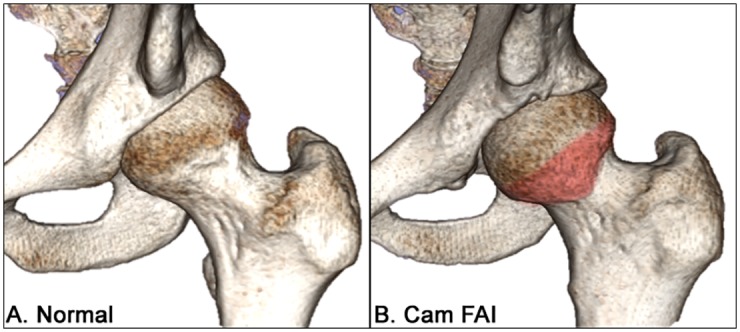
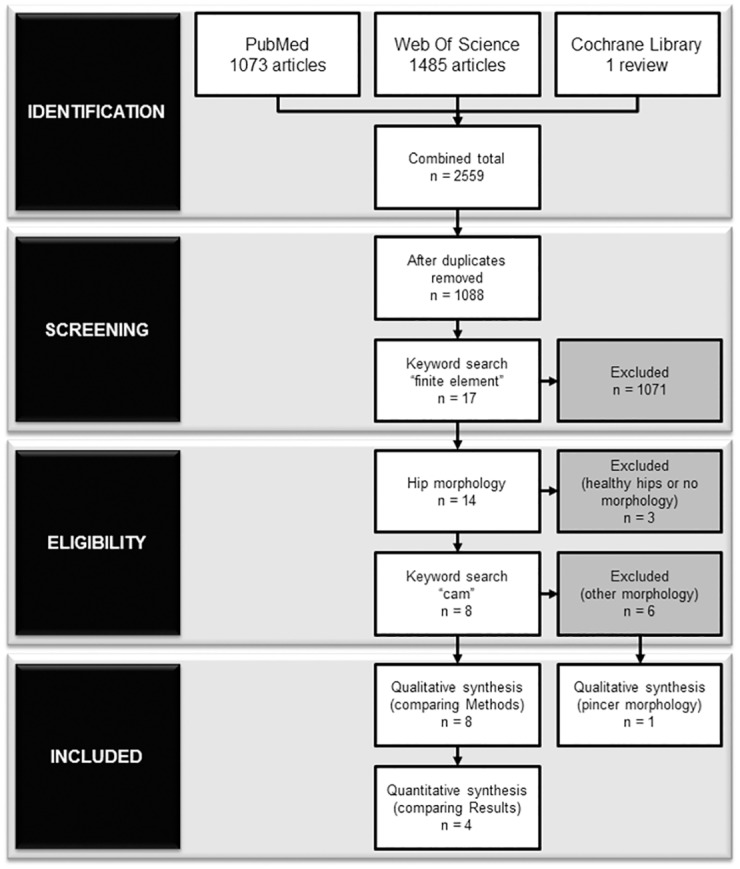
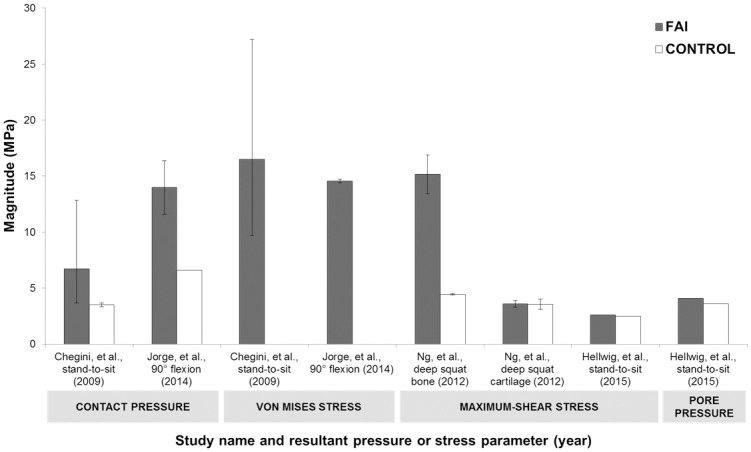
BACKGROUND: The cam deformity causes the anterosuperior femoral head to obstruct with the acetabulum, resulting in femoroacetabular impingement (FAI) and elevated risks of early osteoarthritis. Several finite element models have simulated adverse loading conditions due to cam FAI, to better understand the relationship between mechanical stresses and cartilage degeneration. Our purpose was to conduct a systematic review and examine the previous finite element models and simulations that examined hip joint stresses due to cam FAI. METHODS: The systematic review was conducted to identify those finite element studies of cam-type FAI. The review conformed to the Preferred Reporting Items for Systematic Reviews and Meta-Analyses guidelines and studies that reported hip joint contact pressures or stresses were included in the quantitative synthesis. RESULTS: Nine articles studied FAI morphologies using finite element methods and were included in the qualitative synthesis. Four articles specifically examined contact pressures and stresses due to cam FAI and were included in the quantitative synthesis. The studies demonstrated that cam FAI resulted in substantially elevated contact pressures (median = 10.4 MPa, range = 8.5-12.2 MPa) and von Mises stresses (median 15.5 MPa, range = 15.0-16.0 MPa) at the acetabular cartilage; and elevated maximum-shear stress on the bone (median = 15.2 MPa, range = 14.3-16.0 MPa), in comparison with control hips, during large amplitudes of hip motions. Many studies implemented or adapted idealized, ball-and-cup, parametric models to predict stresses, along with homogeneous bone material properties and in vivo instrumented prostheses loading data. CONCLUSION: The formulation of a robust subject-specific FE model, to delineate the pathomechanisms of FAI, remains an ongoing challenge. The available literature provides clear insight into the estimated stresses due to the cam deformity and provides an assessment of its risks leading to early joint degeneration.
Overview
The claims and statistics of this paper haven’t been checked yet.
Run the check — free, no account needed. It reads the open-access text and checks the sources it cites.
Integrity signals
Registry
Cites
Statistics
Figures
Verification
Claims the paper makes
The claims and statistics of this paper haven’t been checked yet.
Run the check — free, no account needed. It reads the open-access text and checks the sources it cites.
Claims other papers make about this one
Each is checked against this paper’s own text: does it say what the citing paper says it does?
The source backs part of the claim, not all of it — or backs it for a different population, condition or comparison.
In the citing paper
“Persons with FAI exhibit impaired mobility at the hip (specifically hip flexion) and deficits in gluteal muscle activation.51,53”
From A Biomechanical Review of the Squat Exercise: Implications for Clinical Practice. (2024) · cites this paper as [51]
Experimental — accuracy not yet measuredThe cited source says what the claim attributes to it.
In the citing paper
“FAI, or abutment or impingement of the femoral neck against the acetabular labrum, can result in chondrolabral damage, thereby contributing to early onset of hip osteoarthritis.51,52”
From A Biomechanical Review of the Squat Exercise: Implications for Clinical Practice. (2024) · cites this paper as [51]
Self-check
Percentages, sums and reported differences re-computed from the paper’s own numbers.
The self-check needs the paper’s full text.
Citations
Cites
OpenSim: Open-Source Software to Create and Analyze Dynamic Simulations of Movement
Delp, S. L., Anderson, F. C., Arnold, A. S., Loan, P., Habib, A., John, C. T., Guendelman, E., & Thelen, D. G. (2007) · IEEE Transactions on Biomedical Engineering · doi:10.1109/tbme.2007.901024 · Cited by 4,933
Femoroacetabular Impingement: A Cause for Osteoarthritis of the Hip
Ganz, R., Parvizi, J., Beck, M., Leunig, M., Nötzli, H., & Siebenrock, K. A. (2003) · Clinical Orthopaedics & Related Research · doi:10.1097/01.blo.0000096804.78689.c2 · Cited by 3,479
Hip contact forces and gait patterns from routine activities
Bergmann, G., Deuretzbacher, G., Heller, M., Graichen, F., Rohlmann, A., Strauss, J., & Duda, G. N. (2001) · Journal of Biomechanics · doi:10.1016/s0021-9290(01)00040-9 · Cited by 2,215
Beck, M., Kalhor, M., Leunig, M., & Ganz, R. (2005) · The Journal of Bone and Joint Surgery. British volume · doi:10.1302/0301-620x.87b7.15203 · Cited by 1,988
The contour of the femoral head-neck junction as a predictor for the risk of anterior impingement
Nötzli, H. P., Wyss, T. F., Stoecklin, C. H., Schmid, M. R., Treiber, K., & Hodler, J. (2002) · The Journal of Bone and Joint Surgery. British volume · doi:10.1302/0301-620x.84b4.0840556 · Cited by 1,798
Hip joint loading during walking and running, measured in two patients
Bergmann, G., Graichen, F., & Rohlmann, A. (1993) · Journal of Biomechanics · doi:10.1016/0021-9290(93)90058-m · Cited by 1,276
An EMG-driven musculoskeletal model to estimate muscle forces and knee joint moments in vivo
Lloyd, D. G., & Besier, T. F. (2003) · Journal of Biomechanics · doi:10.1016/s0021-9290(03)00010-1 · Cited by 1,199
Femoroacetabular Impingement: Radiographic Diagnosis—What the Radiologist Should Know
Tannast, M., Siebenrock, K. A., & Anderson, S. E. (2007) · American Journal of Roentgenology · doi:10.2214/ajr.06.0921 · Cited by 1,020
Buchanan, T. S., Lloyd, D. G., Manal, K., & Besier, T. F. (2004) · Journal of Applied Biomechanics · doi:10.1123/jab.20.4.367 · Cited by 941
Ito, K., Minka-II, M.-A., Leunig, M., Werlen, S., & Ganz, R. (2001) · The Journal of Bone and Joint Surgery. British volume · doi:10.1302/0301-620x.83b2.0830171 · Cited by 838
Research works printed but not linked: 1
- M Lamontagne, 2011, Preoperative and Postoperative Lower-Extremity Joint and Pelvic Kinematics During Maximal Squatting of Patients with Cam Femoro-Acetabular Impingement, The Journal of Bone & Joint Surgery, 93, 40, 10.2106/JBJS.J.01809 · DOI
Cited by
A Biomechanical Review of the Squat Exercise: Implications for Clinical Practice.
Straub, R. K., & Powers, C. M. (2024) · International journal of sports physical therapy · doi:10.26603/001c.94600 · Cited by 70
Beaulé, P. E., Speirs, A., Anwander, H., Melkus, G., Rakhra, K. S., Frei, H., & Lamontagne, M. (2017) · Journal of Bone and Joint Surgery · doi:10.2106/jbjs.16.00415 · Cited by 61
Self-citationAnatomic Predictors of Sagittal Hip and Pelvic Motions in Patients With a Cam Deformity
Ng, K. C. G., Lamontagne, M., Jeffers, J. R. T., Grammatopoulos, G. A., & Beaulé, P. E. (2018) · The American Journal of Sports Medicine · doi:10.1177/0363546518755150 · Cited by 59
Self-citationChen, A. W., Craig, M. J., Yuen, L. C., Ortiz-Declet, V., Maldonado, D. R., & Domb, B. G. (2019) · The American Journal of Sports Medicine · doi:10.1177/0363546519836429 · Cited by 54
Ng, G. K. C., Mantovani, G., Lamontagne, M., Labrosse, M. R., & Beaulé, P. E. (2016) · Clinical Orthopaedics and Related Research · doi:10.1007/s11999-016-5038-2 · Cited by 44
Self-citation
Metadata
- Authors
- Ng, K. C. G., Lamontagne, M., Labrosse, M. R., & Beaulé, P. E.
- Affiliations
- University of Ottawa (CA)
- Corresponding author
- Lamontagne, Mario
- Venue
- PLoS ONE
- Publisher
- Public Library of Science (PLoS)
- Published
- 2016-01-26
- Volume
- 11
- Issue
- 1
- Pages
- e0147813
- ISSN
- 1932-6203 (ISSN-L)
- PMC
- PMC4727804
- OpenAlex
- W2266069582
- Cited by
- 54
- References
- 81
- Citations by year
- 2026: 2 · 2025: 7 · 2024: 4 · 2023: 3 · 2022: 3 · 2021: 7 · 2020: 4 · 2019: 5 · 2018: 11 · 2017: 4 · 2016: 4
- FWCI
- 1.58
- Type
- journal article
- Language
- en
- Open access
- gold
- doi.org
- Licence
- Locations
- PLoS ONE (publishedVersion, cc-by)
- PubMed Central (publishedVersion, cc-by)
- PubMed (publishedVersion)
- RePEc: Research Papers in Economics (submittedVersion)
- DOAJ (DOAJ: Directory of Open Access Journals) (submittedVersion, cc-by-sa)
- uO Research (University of Ottawa) (submittedVersion, public-domain)
- Spiral (Imperial College London) (submittedVersion, other-oa)
- Funders
- Canadian Institutes of Health Research (97778A)
- Natural Sciences and Engineering Research Council of Canada (106769, 106769-2013)
- Topics
- Health Sciences › Medicine › Surgery › Hip disorders and treatments
- Physical Sciences › Engineering › Biomedical Engineering › Lower Extremity Biomechanics and Pathologies
- Health Sciences › Medicine › Surgery › Orthopaedic implants and arthroplasty
- Keywords
- cam-type femoroacetabular impingement, von Mises stress, maximum shear stress, hip osteoarthritis, hip biomechanics, finite element model
- MeSH terms
- Hip Joint, Humans, Models, Biological, Stress, Mechanical, Databases, Factual, Finite Element Analysis, Femoracetabular Impingement
About these checks
Registry, retraction, Cites and statistics results are computed, not judged, with one exception: a printed reference that no index lists is read once by a model before it counts as a citation error. Claims are extracted by a model and kept only when their quote appears verbatim in the text; each cited source is then checked, with a model’s help, for whether it says what the claim relies on. Those verdicts can be wrong — read the claim’s quote and the cited source before relying on one.
Statistics and arithmetic are recomputed, not judged.
Confidence bands are shown only for fields calibrated on our annotated test set. None is calibrated yet, so no band is shown.
What counts as a claim ›How we measure confidence ›How we check this ›
Are you an author, or do you see a problem with this page? Request a review
Data sources
Bibliographic data: Semantic Scholar, OpenAlex, Crossref.
Contains information from the Semantic Scholar Academic Graph Datasets, made available under the ODC Attribution License (ODC-BY 1.0).
Semantic Scholar’s data is described in: Kinney, R., et al. (2023). The Semantic Scholar Open Data Platform. arXiv:2301.10140.
