

Record-Breaking Pain: The Largest Number and Variety of Forelimb Bone Maladies in a Theropod Dinosaur
Open accessThe DOI matches its Crossref record; 72 of the 76 references it cites were found in a registry or an index; none of the 59 sources its claims cite is checked for support yet.
Abstract
Bone abnormalities are common in theropod dinosaur skeletons, but before now no specimen was known with more than four afflicted bones of the pectoral girdle and/or forelimb. Here we describe the pathology of a specimen of the theropod dinosaur Dilophosaurus wetherilli with eight afflicted bones of the pectoral girdle and forelimb. On its left side the animal has a fractured scapula and radius and large fibriscesses in the ulna and the proximal thumb phalanx. On its right side the animal has abnormal torsion of the humeral shaft, bony tumors on the radius, a truncated distal articular surface of metacarpal III, and angular deformities of the first phalanx of the third finger. Healing and remodeling indicates that the animal survived for months and possibly years after its ailments began, but its right third finger was permanently deformed and lacked the capability of flexion. The deformities of the humerus and the right third finger may be due to developmental osteodysplasia, a condition known in extant birds but unreported in non-avian dinosaurs before now.
Overview
CoChat Summary
TL;DR
The *Dilophosaurus wetherilli* holotype UCMP 37302 has eight pathological pectoral girdle and forelimb bones, the largest number and variety known in a non-avian theropod. Healing indicates the animal survived its ailments for months and possibly years, and some deformities may represent osteodysplasia previously unreported in non-avian dinosaurs.
Key findings
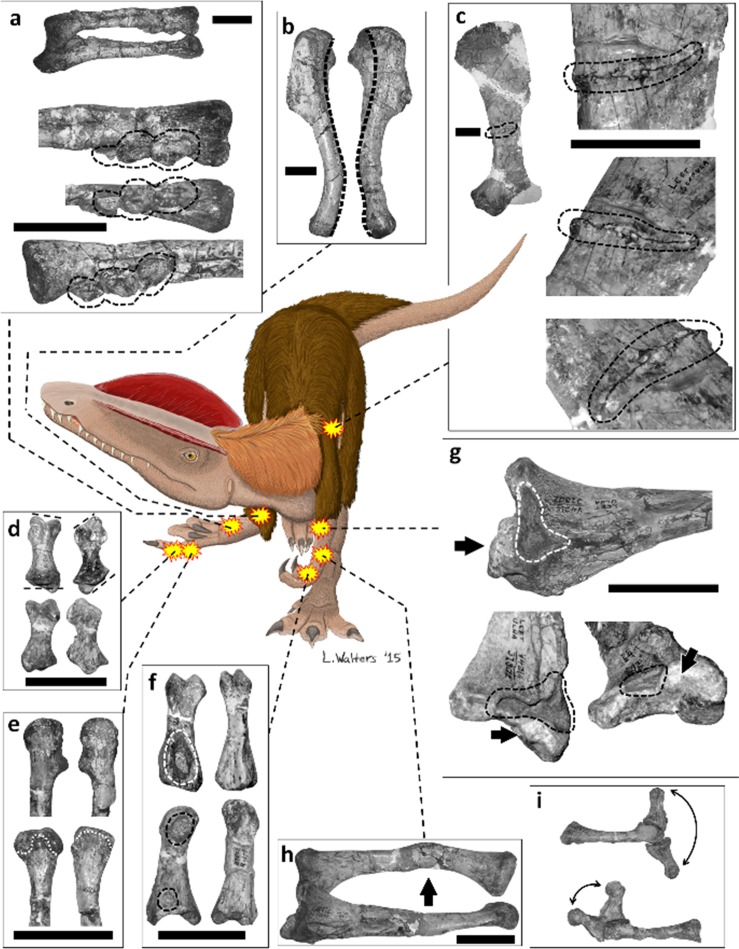
The specimen has eight afflicted bones: left scapula fracture; left radius fracture with about 20° bending toward the ulna; left ulna lytic depression/fibriscess (16 mm long × 35 mm high) plus abnormal bony growth; left proximal thumb phalanx fibriscesses (cavity floor about 7 mm wide × 13 mm long; rim about 13 mm wide × 23 mm long); right humerus with about 35° more torsion than the left; right radius with three bony tumors (proximal 19 × 17 × 11 mm; middle 18 × 10 × 9 mm; distal 23 × 9.5 × 9 mm); right metacarpal III with a truncated distal articular surface; and right first phalanx of digit III with angular deformities.
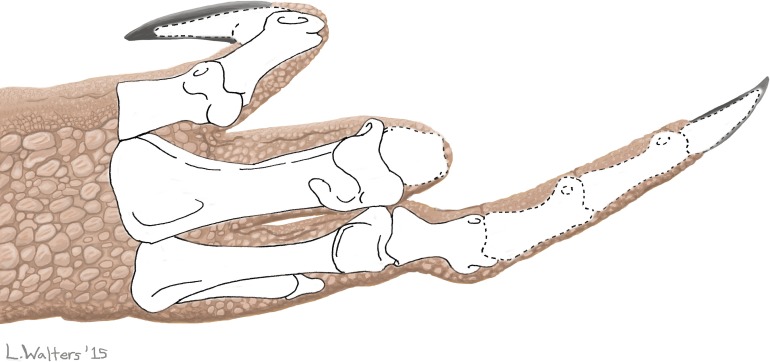
- The right third finger was permanently deformed and lacked flexion, restricted to extension/hyperextension, with abnormal angles at two joints.
- Healing and remodeling of fractures and fibriscesses indicate the animal survived long after the ailments began; the paper states this was months and possibly years.
- The paper reports this as the only known dinosaur specimen with fractures in the pectoral girdle and ipsilateral forelimb, maladies in an ipsilateral radius and ulna, maladies in both radii, fibriscesses in both forearm and hand, and evidence of possible osteodysplasia in a limb.
Methods
The study is a surface examination of the publicly deposited holotype UCMP 37302 at the University of California Museum of Paleontology, Berkeley.
- Diagnosis used macroscopic, externally visible features and compared them with extant reptiles and birds as model organisms, because non-avian dinosaurs are phylogenetically bracketed by them; Table 1 lists symptoms for extant amniotes.
- The authors ruled out conditions such as arthritis, gout, and metabolic bone disease using those comparative features, and interpreted several lesions as healed fractures, osteomyelitis/fibriscesses, possible tumors, and possible osteodysplasia.
Limitations
Stated in the paper: the etiology of the right radial tumors cannot be determined at present, and a full diagnosis awaits future studies.
- Stated in the paper: the number of traumatic events cannot be determined with certainty; healing rates for fractured bones in non-avian dinosaurs are unknown; osteodysplasia may be difficult to recognize because developmental deformity can resemble taphonomic distortion; and pathological features in dinosaur skeletons are underreported.
- Evident from the text: the study relies on surface examination and macroscopic comparison, with no histology or CT reported, so internal bone structure and definitive disease mechanisms remain unassessed.
Model-written summary. Check it against the paper before relying on it.
Integrity signals
Registry
Cites
Statistics
Figures
Verification
Claims the paper makes
0 Valid · 1 Not valid · 33 Not checked · 84 Own results and interpretations
A result the paper reports from its own data — it cites no other source for it, so there is none to check. The quote shows it is in the paper.
In the paper
“angular deformities of the first phalanx of the third finger”
§ Record-Breaking Pain: The Largest Number and Variety of Forelimb Bone Maladies in a Theropod Dinosaur > Abstract
plainSingle case- Asserted: passes — The authors put it forward as true.
- Checkable: passes — It can be checked against evidence.
- Load-bearing: passes — The paper’s conclusions depend on it.
- Based: passes — The paper gives a reason why it holds.
A result the paper reports from its own data — it cites no other source for it, so there is none to check. The quote shows it is in the paper.
In the paper
“Here we describe the pathology of a specimen of the theropod dinosaur Dilophosaurus wetherilli with eight afflicted bones of the pectoral girdle and forelimb.”
- Also stated in: § Introduction · plain
“Eight pectoral girdle and forelimb bones bear pathological features in the specimen (Fig 1A–1H).”
§ Record-Breaking Pain: The Largest Number and Variety of Forelimb Bone Maladies in a Theropod Dinosaur > Abstract
plainSingle case- Asserted: passes — The authors put it forward as true.
- Checkable: passes — It can be checked against evidence.
- Load-bearing: passes — The paper’s conclusions depend on it.
- Based: passes — The paper gives a reason why it holds.
- Also stated in: § Introduction · plain
A result the paper reports from its own data — it cites no other source for it, so there is none to check. The quote shows it is in the paper.
In the paper
“bony tumors on the radius”
§ Record-Breaking Pain: The Largest Number and Variety of Forelimb Bone Maladies in a Theropod Dinosaur > Abstract
plainSingle case- Asserted: passes — The authors put it forward as true.
- Checkable: passes — It can be checked against evidence.
- Load-bearing: passes — The paper’s conclusions depend on it.
- Based: passes — The paper gives a reason why it holds.
A result the paper reports from its own data — it cites no other source for it, so there is none to check. The quote shows it is in the paper.
In the paper
“On its right side the animal has abnormal torsion of the humeral shaft”
§ Record-Breaking Pain: The Largest Number and Variety of Forelimb Bone Maladies in a Theropod Dinosaur > Abstract
plainSingle case- Asserted: passes — The authors put it forward as true.
- Checkable: passes — It can be checked against evidence.
- Load-bearing: passes — The paper’s conclusions depend on it.
- Based: passes — The paper gives a reason why it holds.
A result the paper reports from its own data — it cites no other source for it, so there is none to check. The quote shows it is in the paper.
In the paper
“a truncated distal articular surface of metacarpal III”
§ Record-Breaking Pain: The Largest Number and Variety of Forelimb Bone Maladies in a Theropod Dinosaur > Abstract
plainSingle case- Asserted: passes — The authors put it forward as true.
- Checkable: passes — It can be checked against evidence.
- Load-bearing: passes — The paper’s conclusions depend on it.
- Based: passes — The paper gives a reason why it holds.
63 more claims
Create a free account to see all 118 claims and to verify the 53 references still open.
- It may state two separate claims as one. 39
- Probably not a substantial claim. 19
- The quote only partly states this claim. 1
Self-check
Percentages, sums and reported differences re-computed from the paper’s own numbers.
Each contradiction between two passages listed here was confirmed by an independent check.
Rated minor: it would not touch a result — a value no result rests on, a p-value that stays on the same side of the significance level, or a conflict that is clerical, resolved elsewhere in the paper, or outside its own findings.
In the paper
§ Record-Breaking Pain: The Largest Number and Variety of Forelimb Bone Maladies in a Theropod Dinosaur > Descriptions and Diagnoses > Left thumb: proximal phalanx
“The palmar surface of the proximal phalanx of the left thumb exhibits a large, smooth-walled, abnormal cavity (Fig 1H and 1F).”
§ Record-Breaking Pain: The Largest Number and Variety of Forelimb Bone Maladies in a Theropod Dinosaur > Introduction
“(h) Left radius and ulna in medial view, with arrow indicating healed fracture.”
Citations
Cites
Identification of Pathological Conditions in Human Skeletal Remains
(2003) · Elsevier eBooks · doi:10.1016/b978-0-12-528628-2.x5037-6 · Cited by 2,517
Gallagher, B. A. (1923) · U.S. Dept. of Agriculture eBooks · Cited by 2,308
Textbook of Small Animal Surgery
Aron, D. N. (1985) · Veterinary Surgery · doi:10.1111/j.1532-950x.1985.tb00886.x · Cited by 2,087
(2006) · Elsevier eBooks · doi:10.1016/b0-7216-9327-x/x5001-9 · Cited by 1,494
Identification of pathological conditions in human skeletal remains
Ortner, D. J., & Putschar, W. G. J. (1985) · Smithsonian Contributions to Anthropology · doi:10.5479/si.00810223.28.1 · Cited by 1,044
Textbook of Small Animal Surgery
SLATTER, D. H. (1993) · Medical Entomology and Zoology · Cited by 980
Avioli, L. V., & Krane, S. M. (1977) · Cited by 622
(2002) · Choice Reviews Online · doi:10.5860/choice.39-3984 · Cited by 567
Trauma analysis in paleopathology
Lovell, N. C. (1997) · American Journal of Physical Anthropology · doi:10.1002/(sici)1096-8644(1997)25+<139::aid-ajpa6>3.0.co;2-# · Cited by 509
A Bioarchaeological Perspective on the History of Violence
Walker, P. L. (2001) · Annual Review of Anthropology · doi:10.1146/annurev.anthro.30.1.573 · Cited by 506
Research works printed but not linked: 16
- Peterson K, Isakson JI, Madsen JH Jr. Preliminary study of paleopathologies in the Cleveland-Lloyd dinosaur collection. Proc Ut Acad Sci Arts Lett. 1972; 49: 44– 47.
- Osmólska H, Roniewicz E. Deinocheiridae, a new family of theropod dinosaurs. Palaeontol Pol. 1972; 27: 5– 19.
- Silverman S, Janssen DL. Diagnostic imaging In Mader DR, editor. Reptile Medicine and Surgery. Philadelphia: Saunders; 1996 pp. 258– 264.
- Mader DR. Gout In Mader DR, editor. Reptile Medicine and Surgery. Philadelphia: Saunders; 1996 pp. 374– 379.
- Krautwald-Junghanns M-E, Schmidt V. Birds. Special diagnostics, pathological findings. Skeletal system In Krautwald-Junghanns M-E, Pees M, Reese S, Tully T, editors. Diagnostic imaging of exotic pets. Hannover: Schlütersche; 2011 pp. 70– 53.
- Reese S, Fehr M. Small mammals. Special diagnostics, pathological findings. Skeletal system In Krautwald-Junghanns M-E, Pees M, Reese S, Tully T, editors. Diagnostic imaging of exotic pets. Hannover: Schlütersche; 2011 pp. 244– 255.
- Kirkwood J. Metabolic bone disease In Seymour J, editor. Avian Medicine. London: Mosby; 2000a pp. 170–173, 176– 177.
- Ippen R. Vergleichend pathologische Betrachtungen über einige Knochenerkrankungen bei Reptilien. Zbl Allg Path 1966; 108: 424– 434. 5299033
- Rothschild BM, Martin LD. Paleopathology Disease in the fossil record. Boca Raton: CRC Press; 1993.
- Kirkwood J. Twisting and bending deformities in the long bones of growing birds In Seymour J, editor. Avian Medicine. London: Mosby; 2000b pp. 173– 177.
- Bennett RA. Fracture management In Mader DR, editor. Reptile Medicine and Surgery. Philadelphia: Saunders; 1996 pp. 281– 287.
- Gilsleider E. Ratite orthopedics. Sem Avian Exot Pet Med 1994; 3: 81– 91.
- Roberts C, Manchester K. The archaeology of disease. New York: Cornell University Press; 2007.
- Gishlick AD. The function of the manus and forelimb of Deinonychus antirrhopus and its importance of the origin of avian flight In Gauthier J, Gall LF, editors. New Perspectives on the Origin and Early Evolution of Birds. New Haven, CT: Yale Peabody Museum; 2001 pp. 301– 318.
- Crabill MR, Honnas CM. Surgical conditions of ratites In Tully TN Jr, Shane SM, editors. Ratite management, medicine, and surgery. Malabar, Florida: Krieger; 1996 pp. 95– 104.
- Moodie RL. Paleopathology An introduction to the study of ancient evidences of disease. Urbana: University of Illinois Press; 1923.
Cited by
Marsh, A. D., & Rowe, T. B. (2020) · Journal of Paleontology · doi:10.1017/jpa.2020.14 · Cited by 93
Walters, E. T. (2019) · Philosophical Transactions of the Royal Society B Biological Sciences · doi:10.1098/rstb.2019.0277 · Cited by 65
ANALYSIS AND INTERPRETATION OF TRAUMA IN SKELETAL REMAINS
Lovell, N. C., & Grauer, A. L. (2018) · Wiley eBooks · doi:10.1002/9781119151647.ch10 · Cited by 43
Aureliano, T., Nascimento, C. S. I., Fernandes, M. A., Ricardi-Branco, F., & Ghilardi, A. M. (2020) · Cretaceous Research · doi:10.1016/j.cretres.2020.104672 · Cited by 37
Hunt, T., Peterson, J. E., Frederickson, J. A., Cohen, J. E., & Berry, J. L. (2019) · Scientific Reports · doi:10.1038/s41598-019-45101-6 · Cited by 30
Metadata
- Authors
- Senter, P., & Juengst, S. L.
- Affiliations
- Fayetteville State University (US)
- Appalachian State University (US)
- Corresponding author
- Senter, Phil
- ORCID
- Juengst, Sara L.
- Venue
- PLOS ONE
- Publisher
- Public Library of Science (PLoS)
- Published
- 2016-02-24
- Volume
- 11
- Issue
- 2
- Pages
- e0149140
- ISSN
- 1932-6203 (ISSN-L)
- PMC
- PMC4765892
- OpenAlex
- W2276154026
- Cited by
- 27
- References
- 76
- Citations by year
- 2026: 1 · 2025: 3 · 2024: 2 · 2023: 3 · 2022: 2 · 2021: 2 · 2020: 7 · 2019: 4 · 2018: 2 · 2016: 1
- FWCI
- 1.11
- Type
- journal article
- Language
- en
- Open access
- gold
- doi.org
- Licence
- Locations
- PLoS ONE (publishedVersion, cc-by)
- Europe PMC (PubMed Central) (publishedVersion, cc-by)
- PubMed Central (publishedVersion, cc-by)
- PubMed (publishedVersion)
- DigitalCommons@Fayetteville State University (Fayetteville State University) (submittedVersion)
- DOAJ (DOAJ: Directory of Open Access Journals) (submittedVersion)
- Topics
- Physical Sciences › Earth and Planetary Sciences › Paleontology › Paleontology and Evolutionary Biology
- Social Sciences › Arts and Humanities › Archeology (arts and humanities) › Paleopathology and ancient diseases
- Health Sciences › Medicine › Anatomy › Comparative Animal Anatomy Studies
- Keywords
- theropod dinosaurs, shoulder girdle, scapular fracture, humeral torsion, osteodysplasia
- MeSH terms
- Animals, Bone Diseases, Forelimb, Dinosaurs
About these checks
Registry, retraction, Cites and statistics results are computed, not judged, with one exception: a printed reference that no index lists is read once by a model before it counts as a citation error. Claims are extracted by a model and kept only when their quote appears verbatim in the text; each cited source is then checked, with a model’s help, for whether it says what the claim relies on. Those verdicts can be wrong — read the claim’s quote and the cited source before relying on one.
A language model drew the claims from the paper on 2026-11-23, under version 3 of the claim definition (model deepseek-v4.1-flash, prompt extract-v3).
A second model labelled each claim on 2026-11-23 (model jev-1.13-20260917, definition revision gold-guideline-v0.2).
Statistics and arithmetic are recomputed, not judged.
Confidence bands are shown only for fields calibrated on our annotated test set. None is calibrated yet, so no band is shown.
What counts as a claim ›How we measure confidence ›How we check this ›
Are you an author, or do you see a problem with this page? Request a review
Data sources
Bibliographic data: Semantic Scholar, OpenAlex, Crossref.
Contains information from the Semantic Scholar Academic Graph Datasets, made available under the ODC Attribution License (ODC-BY 1.0).
Semantic Scholar’s data is described in: Kinney, R., et al. (2023). The Semantic Scholar Open Data Platform. arXiv:2301.10140.
