

Foot Conditions among Homeless Persons: A Systematic Review
Open accessThe DOI matches its Crossref record; 22 of the 22 references it cites were found in a registry or an index; none of the 168 sources its claims cite is checked for support yet.
Abstract
INTRODUCTION: Foot problems are common among homeless persons, but are often overlooked. The objectives of this systematic review are to summarize what is known about foot conditions and associated interventions among homeless persons. METHODS: A literature search was conducted on MEDLINE (1966-2016), EMBASE (1947-2016), and CINAHL (1982-2016) and complemented by manual searches of reference lists. Articles that described foot conditions in homeless persons or associated interventions were included. Data were independently extracted on: general study characteristics; participants; foot assessment methods; foot conditions and associated interventions; study findings; quality score assessed using the Downs and Black checklist. RESULTS: Of 333 articles screened, 17 articles met criteria and were included in the study. Prevalence of any foot problem ranged from 9% to 65% across study populations. Common foot-related concerns were corns and calluses, nail pathologies, and infections. Foot pathologies related to chronic diseases such as diabetes were identified. Compared to housed individuals across studies, homeless individuals were more likely to have foot problems including tinea pedis, foot pain, functional limitations with walking, and improperly-fitting shoes. DISCUSSION: Foot conditions were highly prevalent among homeless individuals with up to two thirds reporting a foot health concern, approximately one quarter of individuals visiting a health professional, and one fifth of individuals requiring further follow-up due to the severity of their condition. Homeless individuals often had inadequate foot hygiene practices and improperly-fitting shoes. These findings have service provision and public health implications, highlighting the need for evidence-based interventions to improve foot health in this population. An effective interventional approach could include optimization of foot hygiene and footwear, provision of comprehensive medical treatment, and addressing social factors that lead to increased risk of foot problems. Targeted efforts to screen for and treat foot problems could result in improved health and social outcomes for homeless individuals.
Overview
CoChat Summary
TL;DR
This systematic review of 17 studies found that foot conditions are highly prevalent among homeless persons, with any foot problem ranging from 9% to 65% across study populations. Only one interventional study was identified, a mobile health service for diabetic foot ulcers that reported improvement in 86% of treated patients.
Key findings
- Across 17 included studies, prevalence of any foot problem ranged from 9% to 65%; up to two thirds of homeless individuals reported a foot health concern, approximately one quarter visited a health professional, and one fifth required further follow-up due to severity.
- Common foot concerns included calluses/corns (7.7–57%), nail pathologies/ingrown toenails (15–65%), tinea pedis (3.2–38%), foot injuries (24–43%), foot deformities (14%), trauma (6%), fractures (2.5%), bunions (14%), hammertoes (7%), gout (6%), plantar warts (2–4%), and foot ulcers (0.7–4%). Diabetes prevalence ranged from 6.2% to 23%; among homeless individuals with diabetes, 41% had difficulty walking, 42% had loss of foot sensitivity, 43% had permanently reduced mobility, and 17% had lower limb amputation, with 1 in 3 at high or very high podiatric risk.
- Compared with housed individuals, homeless individuals were more likely to have tinea pedis and scratching lesions of socks, foot pain when walking (mean 2.0 vs. 1.7 on a 1–4 scale, p = 0.003), functional limitations walking uphill (functional status score 6 vs. 8, p = 0.001), and improperly fitting shoes; 43.5% had foot-shoe size mismatch greater than 1 size and 16.9% greater than 1.5 sizes.
- The only interventional study included 930 homeless individuals, of whom 21 (2.3%) had diabetic foot ulcers treated weekly by a mobile health team for a mean of 17.6 ± 12 months; 18 (86%) improved, including 13 completely resolved and 5 partially improved, while one patient required amputation and later died and two required amputation due to worsening ulcers.
Methods
- Systematic review guided by PRISMA; searched MEDLINE (1966–2016), EMBASE (1947–2016), and CINAHL (1982–2016) with no language exclusions, complemented by manual reference-list searches; search concluded July 2016.
- Included original research articles reporting foot conditions in homeless persons; excluded reviews, case reports, commentaries, and articles without clear foot health outcomes. Two independent reviewers screened titles/abstracts and extracted data, resolving discrepancies by consensus.
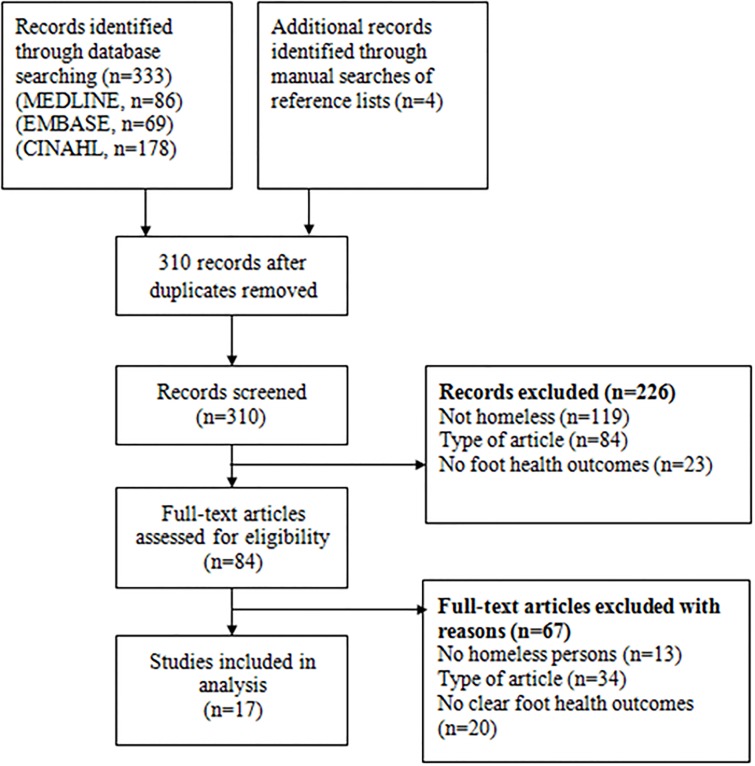
- Of 333 articles screened, 81 full texts were retrieved, 64 were excluded, and 17 articles were included. Quality was assessed with the Downs and Black checklist (maximum score 22 after excluding 6 randomized-trial items and simplifying the power item); median quality score was 12 (range 8–20). Quantitative variables were summarized in Microsoft Excel.
Limitations
- Stated by the authors: the review was limited by a small body of literature, few studies reporting foot health as a primary outcome, possible publication bias, and low reported quality of several studies that limited conclusions.
- Stated by the authors: many studies lacked clear objectives and outcomes, provided limited participant data, had low internal and external validity, and were insufficiently powered to detect clinically significant differences.
- Evident from the text: only one interventional study was identified, and no clinical trials or qualitative studies were found; definitions of homelessness varied across studies and were generally inadequately described; no studies assessed differences in outcomes by race.
Model-written summary. Check it against the paper before relying on it.
Integrity signals
Registry
Cites
Statistics
Figures
Verification
Claims the paper makes
0 Valid · 1 Not valid · 115 Not checked · 54 Own results and interpretations
A result the paper reports from its own data — it cites no other source for it, so there is none to check. The quote shows it is in the paper.
In the paper
“Seven (50%) studies included patients from clinics that served homeless individuals, [9], [10], [13]-[15], [21], [22] while eight (47%) studies recruited participants directly from homeless shelters.”
§ Foot Conditions among Homeless Persons: A Systematic Review > Results > Setting
plain- Asserted: passes — The authors put it forward as true.
- Checkable: passes — It can be checked against evidence.
- Load-bearing: unclear — It is unclear whether the paper’s conclusions depend on it.
- Based: passes — The paper gives a reason why it holds.
A result the paper reports from its own data — it cites no other source for it, so there is none to check. The quote shows it is in the paper.
In the paper
“The main outcomes were inadequately described in 4 (24%) studies.”
§ Foot Conditions among Homeless Persons: A Systematic Review > Results > Methodological Quality
plain- Asserted: passes — The authors put it forward as true.
- Checkable: passes — It can be checked against evidence.
- Load-bearing: unclear — It is unclear whether the paper’s conclusions depend on it.
- Based: passes — The paper gives a reason why it holds.
A result the paper reports from its own data — it cites no other source for it, so there is none to check. The quote shows it is in the paper.
In the paper
“Only two studies longitudinally assessed participants’ foot concerns over time.”
§ Foot Conditions among Homeless Persons: A Systematic Review > Results > Study Design and Foot Assessment
plainn = 2- Asserted: passes — The authors put it forward as true.
- Checkable: passes — It can be checked against evidence.
- Load-bearing: unclear — It is unclear whether the paper’s conclusions depend on it.
- Based: passes — The paper gives a reason why it holds.
None of the sources cited for this claim have been checked yet.
In the paper
“Foot deformities (14%), trauma (6%) and fractures (2.5%) were common. [16], [21]”
§ Foot Conditions among Homeless Persons: A Systematic Review > Results > Foot Conditions
What the sources say
- Not checked yetcites [16] Jones CL. Foot care for the homeless. J Am Podiatr Med Assoc. 1990; 80(1): 41– 4. 10.7547/87507315-80-1-41 2304011 source
- Not checked yetcites [21] Toon PD, Thomas K, Doherty M. Audit of work at a medical centre for the homeless over one year. J R Coll Gen Pract. 1987; 37(296): 120– 2. 3681848 PMC1710758
plain- Asserted: passes — The authors put it forward as true.
- Checkable: passes — It can be checked against evidence.
- Load-bearing: unclear — It is unclear whether the paper’s conclusions depend on it.
- Based: passes — The paper gives a reason why it holds.
None of the sources cited for this claim have been checked yet.
In the paper
“(6%), plantar warts (2–4%), and foot ulcers (0.7–4%) were also identified. [12], [14], [19]”
§ Foot Conditions among Homeless Persons: A Systematic Review > Results > Foot Conditions
What the sources say
- Not checked yetcites [12] Stratigos AJ, Stern R, González E, Johnson RA, O'Connell J, Dover JS. Prevalence of skin disease in a cohort of shelter-based homeless men. J Am Acad Dermatol. 1999; 41(2 Pt 1): 197– 202. 10426888 source
- Not checked yetcites [14] Robbins JM, Roth LS, Villanueva MC. "Stand down for the homeless". Podiatric screening of homeless population in Cleveland. J Am Podiatr Med Assoc. 1996; 86(6): 275– 9. 10.7547/87507315-86-6-275 8699351 source
- Not checked yetcites [19] Chen B, Mitchell A, Tran D. "Step up for foot care": addressing podiatric care needs in a sample homeless population. J Am Podiatr Med Assoc. 2014 5; 104(3): 269– 76. 10.7547/0003-0538-104.3.269 24901586 source
plain- Asserted: passes — The authors put it forward as true.
- Checkable: passes — It can be checked against evidence.
- Load-bearing: unclear — It is unclear whether the paper’s conclusions depend on it.
- Based: passes — The paper gives a reason why it holds.
104 more claims
Create a free account to see all 170 claims and to verify the 167 references still open.
- It may state two separate claims as one. 33
- Probably not a substantial claim. 32
- The quote only partly states this claim. 4
Claims other papers make about this one
Each is checked against this paper’s own text: does it say what the citing paper says it does?
In the citing paper
“They are also known to be at increased risk for cardiovascular disease and amputations (14,15).”
From The association of homelessness with rates of diabetes complications: a population-based cohort study (2023) · cites this paper as [15]
Self-check
Percentages, sums and reported differences re-computed from the paper’s own numbers.
Rated minor: it would not touch a result — a value no result rests on, a p-value that stays on the same side of the significance level, or a conflict that is clerical, resolved elsewhere in the paper, or outside its own findings.
In the paper
“Seven (50%) studies included patients from clinics that served homeless individuals”
§ Foot Conditions among Homeless Persons: A Systematic Review > Results > Setting
Reported 50 · recomputed 41.176471
Citations
Cites
Liberati, A., Altman, D. G., Tetzlaff, J., Mulrow, C., Gøtzsche, P. C., Ioannidis, J. P. A., Clarke, M., Devereaux, P. J., Kleijnen, J., & Moher, D. (2009) · PLoS Medicine · doi:10.1371/journal.pmed.1000100 · Cited by 28,164
Liberati, A., Altman, D. G., Tetzlaff, J., Mulrow, C., Gotzsche, P. C., Ioannidis, J. P. A., Clarke, M., Devereaux, P. J., Kleijnen, J., & Moher, D. (2009) · BMJ · doi:10.1136/bmj.b2700 · Cited by 17,648
Liberati, A., Altman, D. G., Tetzlaff, J., Mulrow, C., Gøtzsche, P. C., Ioannidis, J. P. A., Clarke, M., Devereaux, P. J., Kleijnen, J., & Moher, D. (2009) · Annals of Internal Medicine · doi:10.7326/0003-4819-151-4-200908180-00136 · Cited by 10,349
Downs, S. H., & Black, N. (1998) · Journal of Epidemiology and Community Health · doi:10.1136/jech.52.6.377 · Cited by 8,252
Gelberg, L., Andersen, R. M., & Leake, B. D. (2000) · PubMed · Cited by 1,257
(2002) · Journal of Urban Health: Bulletin of the New York Academy of Medicine · doi:10.1093/jurban/79.suppl_1.s141 · Cited by 701
The population prevalence of foot and ankle pain in middle and old age: A systematic review
Thomas, M. J., Roddy, E., Zhang, W., Menz, H. B., Hannan, M. T., & Peat, G. M. (2011) · Pain · doi:10.1016/j.pain.2011.09.019 · Cited by 282
Homelessness, health status, and health care use
Schanzer, B., Dominguez, B., Shrout, P. E., & Caton, C. L. M. (2007) · American Journal of Public Health · doi:10.2105/ajph.2005.076190 · Cited by 270
Tinea pedis: The etiology and global epidemiology of a common fungal infection
Ilkit, M., & Durdu, M. (2015) · Critical Reviews in Microbiology · doi:10.3109/1040841x.2013.856853 · Cited by 140
Health, homelessness, and poverty. A study of clinic users
Gelberg, L. (1990) · Archives of Internal Medicine · doi:10.1001/archinte.150.11.2325 · Cited by 130
Research works printed but not linked: 7
- Chen B, Mitchell A, Tran D. Podiatric health needs of homeless populations as a public health concern. J Am Podiatr Med Assoc. 2012; 102(1): 54– 6. 22232322
- Wrenn K. Foot problems in homeless persons. Ann Intern Med. 1990; 113(8): 567– 9 2205141
- Schwarzkopf R, Perretta DJ, Russell TA, Sheskier SC. Foot and shoe size mismatch in three different New York City populations. J Foot Ankle Surg. 2011; 50(4): 391– 4. 10.1053/j.jfas.2011.04.030 21616688 · DOI · Paper page
- Macnee CL, Hemphill JC, Letran J. Screening clinics for the homeless: evaluating outcomes. J Community Health Nurs. 1996; 13(3): 167– 77. 10.1207/s15327655jchn1303_4 8916606 · DOI · Paper page
- Robbins JM, Roth LS, Villanueva MC. "Stand down for the homeless". Podiatric screening of homeless population in Cleveland. J Am Podiatr Med Assoc. 1996; 86(6): 275– 9. 10.7547/87507315-86-6-275 8699351 · DOI · Paper page
- Jones CL. Foot care for the homeless. J Am Podiatr Med Assoc. 1990; 80(1): 41– 4. 10.7547/87507315-80-1-41 2304011 · DOI · Paper page
- MacIntyre D. Medical care for the homeless—some experience in Glasgow. Scott Med J. 1979; 24(3): 240– 5. 493952
Cited by
Sharan, R., Wiens, K., Ronksley, P. E., Hwang, S. W., Booth, G. L., Austin, P. C., Spackman, E., Bai, L., & Campbell, D. J. T. (2023) · Diabetes Care · doi:10.2337/dc23-0211 · Cited by 30
Anti-homeless Hostile Design as Wrongful Discrimination
Albertsen, A., & Knight, C. (2025) · British Journal of Political Science · doi:10.1017/s0007123424000796 · Cited by 1
“The physical health of the homeless is often affected by respiratory problems, cardiovascular disorders, injuries, foot problems, intoxication, and infectious and parasitic diseases (Kaduszkiewicz et al. 2017; Liu, Chai, and Watt 2020; To, Brothers, and Van Zoost 2016).”
Metadata
- Authors
- To, M. J., Brothers, T. D., & Van Zoost, C.
- Affiliations
- Dalhousie University (CA)
- Corresponding author
- To, Matthew J.
- Venue
- PLOS ONE
- Publisher
- Public Library of Science (PLoS)
- Published
- 2016-12-09
- Volume
- 11
- Issue
- 12
- Pages
- e0167463
- ISSN
- 1932-6203 (ISSN-L)
- PMC
- PMC5147925
- OpenAlex
- W2560080889
- Semantic Scholar
- e431140289b21ebdd09d51e11734ea65df09a69c
- Cited by
- 93
- References
- 22
- Citations by year
- 2026: 2 · 2025: 9 · 2024: 19 · 2023: 11 · 2022: 11 · 2021: 15 · 2020: 6 · 2019: 12 · 2018: 7 · 2017: 1
- FWCI
- 1.58
- Type
- journal article
- Language
- en
- Open access
- gold
- doi.org
- Licence
- Locations
- PLoS ONE (publishedVersion, cc-by)
- PubMed Central (publishedVersion, cc-by)
- PubMed (publishedVersion)
- RePEc: Research Papers in Economics (submittedVersion)
- DOAJ (DOAJ: Directory of Open Access Journals) (submittedVersion)
- Figshare (submittedVersion, cc-by)
- Funders
- Dalhousie Medical Research Foundation
- Topics
- Social Sciences › Sociology and Political Science › Homelessness and Social Issues
- Health Sciences › Medicine › Endocrinology, Diabetes and Metabolism › Diabetic Foot Ulcer Assessment and Management
- Health Sciences › Medicine › Dermatology › Nail Diseases and Treatments
- Keywords
- homelessness, foot conditions, foot health, tinea pedis, nail pathology, foot infection, diabetes mellitus, foot hygiene, footwear fit, foot pain, prevalence
- MeSH terms
- Community Health Services, Foot Diseases, Health Services Accessibility, Ill-Housed Persons, Humans, Patient Acceptance of Health Care, Podiatry, Surveys and Questionnaires, Needs Assessment, Social Determinants of Health
About these checks
Registry, retraction, Cites and statistics results are computed, not judged, with one exception: a printed reference that no index lists is read once by a model before it counts as a citation error. Claims are extracted by a model and kept only when their quote appears verbatim in the text; each cited source is then checked, with a model’s help, for whether it says what the claim relies on. Those verdicts can be wrong — read the claim’s quote and the cited source before relying on one.
A language model drew the claims from the paper on 2026-11-25, under version 3 of the claim definition (model deepseek-v4.1-flash, prompt extract-v3).
A second model labelled each claim on 2026-11-25 (model jev-1.13-20260917, definition revision gold-guideline-v0.2).
Statistics and arithmetic are recomputed, not judged.
Confidence bands are shown only for fields calibrated on our annotated test set. None is calibrated yet, so no band is shown.
What counts as a claim ›How we measure confidence ›How we check this ›
Are you an author, or do you see a problem with this page? Request a review
Data sources
Bibliographic data: Semantic Scholar, OpenAlex, Crossref.
Contains information from the Semantic Scholar Academic Graph Datasets, made available under the ODC Attribution License (ODC-BY 1.0).
Semantic Scholar’s data is described in: Kinney, R., et al. (2023). The Semantic Scholar Open Data Platform. arXiv:2301.10140.
