

Maintenance nifedipine therapy for preterm symptomatic placenta previa: A randomized, multicenter, double‐blind, placebo‐controlled trial
Open accessThe DOI matches its Crossref record; 22 of the 22 references it cites were found in a registry or an index.
Abstract
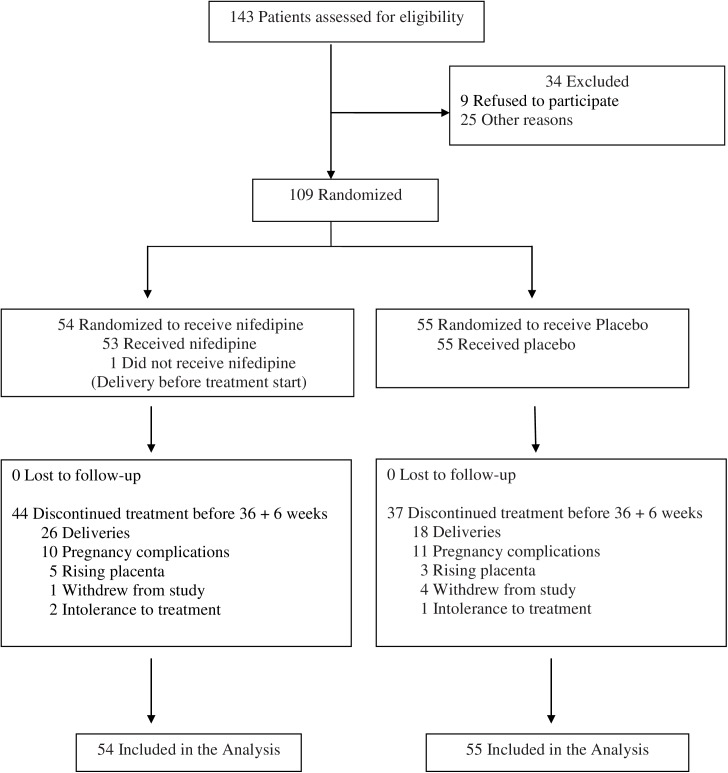
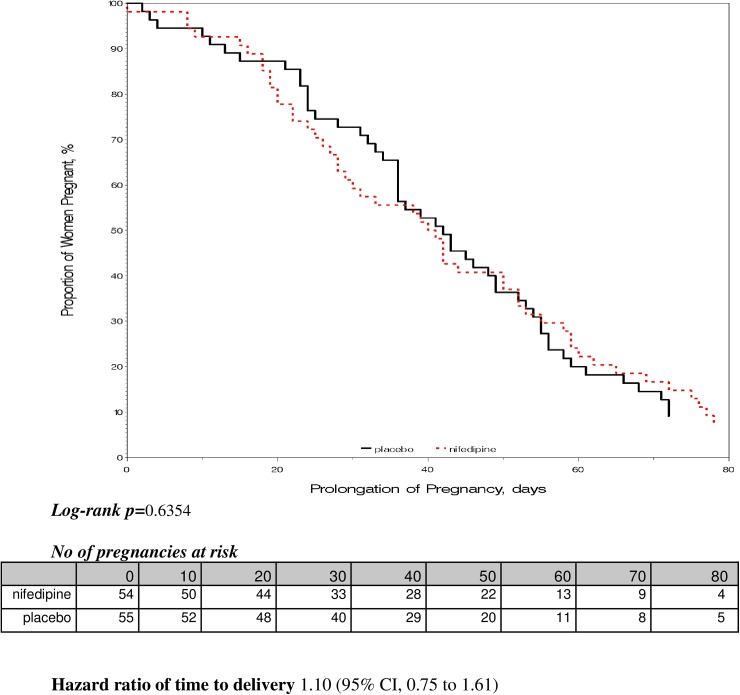
OBJECTIVE: To assess the impact of maintenance nifedipine therapy on pregnancy duration in women with preterm placenta previa bleeding. METHODS: PPADAL was a randomized, double-blind, placebo-controlled trial conducted between 05/2008 and 05/2012 in five French hospitals. The trial included 109 women, aged ≥ 18 years, with at least one episode of placenta previa bleeding, intact membranes and no other pregnancy complication, at gestational age 24 to 34 weeks and after 48 hours of complete acute tocolysis. Women were randomly allocated to receive either 20 mg of slow-release nifedipine three times daily (n = 54) or placebo (n = 55) until 36 + 6 weeks of gestation. The primary outcome for the trial was length of pregnancy measured in days after enrolment. Main secondary outcomes were rates of recurrent bleeding, cesarean delivery due to hemorrhage, blood transfusion, maternal side effects, gestational age at delivery and adverse perinatal outcomes (perinatal death, chronic lung disease, neonatal sepsis, intraventricular hemorrhage > grade 2, perventricular leukomalacia > grade 1, or necrotizing enterocolitis). Analysis was by intention to treat. RESULTS: Mean (SD) prolongation of pregnancy was not different between the nifedipine (n = 54) and the placebo (n = 55) group; 42.5 days ± 23.8 versus 44.2 days ± 24.5, p = 0.70. Cesarean due to hemorrhage performed before 37 weeks occurred more frequently in the nifedipine group in comparison with the placebo group (RR, 1.66; 95% confidence interval, 1.05-2.72). Adverse perinatal outcomes were comparable between groups; 3.8% for nifedipine versus 5.5% for placebo (relative risk, 0.52; 95% confidence interval 0.10-2.61). No maternal mortality or perinatal death occurred. CONCLUSION: Maintenance oral nifedipine neither prolongs duration of pregnancy nor improves maternal or perinatal outcomes. TRIAL REGISTRATION: ClinicalTrials.gov NCT00620724.
Overview
The claims and statistics of this paper haven’t been checked yet.
Free: it reads the open-access text and checks the first 5 claims that cite a source we can check. Create a free account to check every claim.
Integrity signals
Registry
Cites
Statistics
Figures
Verification
Claims the paper makes
The claims and statistics of this paper haven’t been checked yet.
Free: it reads the open-access text and checks the first 5 claims that cite a source we can check. Create a free account to check every claim.
Claims other papers make about this one
Each is checked against this paper’s own text: does it say what the citing paper says it does?
The cited source says what the claim attributes to it.
In the citing paper
“Adverse perinatal outcomes were comparable between groups.”
From Placenta Praevia and Placenta Accreta: Diagnosis and Management: Green‐top Guideline No. 27a (2019) · cites this paper as [70]
The cited source says what the claim attributes to it.
In the citing paper
“A randomised, double-blind, placebo-controlled multicentre trial including 109 women at 24 +0 to 33 +6 weeks with at least one episode of placenta praevia bleeding and intact membranes has shown that there was no difference in the prolongation of pregnancy between the nifedipine (n = 54) and placebo (n = 55) groups.70”
From Placenta Praevia and Placenta Accreta: Diagnosis and Management: Green‐top Guideline No. 27a (2019) · cites this paper as [70]
Self-check
Percentages, sums and reported differences re-computed from the paper’s own numbers.
The self-check needs the paper’s full text.
Citations
Cites
Abnormal placentation: Twenty-year analysis
Wu, S., Kocherginsky, M., & Hibbard, J. U. (2005) · American Journal of Obstetrics and Gynecology · doi:10.1016/j.ajog.2004.12.074 · Cited by 1,331
Placenta Previa, Placenta Accreta, and Vasa Previa
Oyelese, Y., & Smulian, J. C. (2006) · Obstetrics & Gynecology · doi:10.1097/01.aog.0000207559.15715.98 · Cited by 975
Tocolytic therapy for preterm delivery: systematic review and network meta-analysis
Haas, D. M., Caldwell, D. M., Kirkpatrick, P., McIntosh, J. J., & Welton, N. J. (2012) · BMJ · doi:10.1136/bmj.e6226 · Cited by 419
Calcium channel blockers for inhibiting preterm labour
King, J. F., Flenady, V., Papatsonis, D., Dekker, G., & Carbonne, B. (2003) · Cochrane Database of Systematic Reviews · doi:10.1002/14651858.cd002255 · Cited by 377
Cesarean Delivery and Peripartum Hysterectomy
Knight, M., Kurinczuk, J. J., Spark, P., & Brocklehurst, P. (2008) · Obstetrics & Gynecology · doi:10.1097/01.aog.0000296658.83240.6d · Cited by 289
Conservative Versus Extirpative Management in Cases of Placenta Accreta
Kayem, G., Davy, C., Goffinet, F., Thomas, C., Clément, D., & Cabrol, D. (2004) · Obstetrics & Gynecology · doi:10.1097/01.aog.0000136086.78099.0f · Cited by 283
The epidemiology of placenta previa in the United States, 1979 through 1987
Iyasu, S., Saftlas, A. K., Rowley, D. L., Koonin, L. M., Lawson, H. W., & Atrash, H. K. (1993) · American Journal of Obstetrics and Gynecology · doi:10.1016/s0002-9378(11)90776-5 · Cited by 184
Bhide, A., Prefumo, F., Moore, J., Hollis, B., & Thilaganathan, B. (2003) · BJOG: An International Journal of Obstetrics & Gynaecology · doi:10.1111/j.1471-0528.2003.02491.x · Cited by 154
Ananth, C. V., Smulian, J. C., & Vintzileos, A. M. (2003) · American Journal of Obstetrics and Gynecology · doi:10.1067/mob.2003.76 · Cited by 147
Wing, D. A., Paul, R. H., & Millar, L. K. (1996) · American Journal of Obstetrics and Gynecology · doi:10.1016/s0002-9378(96)80003-2 · Cited by 108
Cited by
Placenta Praevia and Placenta Accreta: Diagnosis and Management: Green‐top Guideline No. 27a
Jauniaux, E., Alfirevic, Z., Bhide, A., Belfort, M., Burton, G., Collins, S., Dornan, S., Jurkovic, D., Kayem, G., Kingdom, J., et al. (2019) · BJOG: An International Journal of Obstetrics & Gynaecology · doi:10.1111/1471-0528.15306 · Cited by 506
“A randomised, double-blind, placebo-controlled multicentre trial including 109 women at 24 to 33 weeks with at least one episode of placenta praevia bleeding and intact membranes has shown that there was no difference in the prolongation of pregnancy between the nifedipine (n = 54) and placebo (n = 55) groups.(70) Adv…”
ResultGuideline No. 402: Diagnosis and Management of Placenta Previa
Jain, V., Bos, H., & Bujold, E. (2020) · Journal of Obstetrics and Gynaecology Canada · doi:10.1016/j.jogc.2019.07.019 · Cited by 139
Tocolytics for delaying preterm birth: a network meta-analysis (0924)
Wilson, A., Morton, V. H., Marson, E. J., Markland, A. D., Larkai, E., Papadopoulou, A., Coomarasamy, A., Tobías, A., Chou, D., Oladapo, O. T., et al. (2022) · Cochrane Database of Systematic Reviews · doi:10.1002/14651858.cd014978.pub2 · Cited by 117
Morfaw, F., Fundoh, M., Bartoszko, J. J., Mbuagbaw, L. C. E., & Thabane, L. (2018) · Systematic Reviews · doi:10.1186/s13643-018-0923-2 · Cited by 8
Placenta Praevia and Placenta Accreta Spectrum: Diagnosis and Management
Jauniaux, E. R. M., Bhide, A., Hussein, A. M., Lees, C. C., D'Antonio, F., Robson, S. C., Agten, A. K., & Jurkovic, D. (2026) · BJOG An International Journal of Obstetrics & Gynaecology · doi:10.1111/1471-0528.70239 · Cited by 14
“…multicentre RCT involving 109 women at 24 +0 –33 +6 weeks of gestation with at least one episode of bleeding due to placenta praevia and intact membranes has demonstrated that there is no difference in the prolongation of pregnancy between the nifedipine ( n = 54) and placebo ( n = 55) groups [99].”
Beta adrenergic antagonists and antianginal drugs
Stever, L. M., Demitraszek, C. J., Murray, S. A., & Ali, A. N. (2021) · Side effects of drugs annual · doi:10.1016/bs.seda.2021.08.015 · Cited by 5
Ju, G., Chen, L., Wang, R., Zhang, L., Liu, Z., & Chen, S. (2025) · Medicine · doi:10.1097/md.0000000000045113 · Cited by 2
“[48,55] In our study, we similarly observed signals of AEs related to placental dysfunction and fetal growth abnormalities, including preterm delivery, fetal growth restriction, placental disorders, fetal distress syndrome, and low birth weight, indicating a potential risk to pregnancy outcomes.”
Directive clinique no 402 : Placenta prævia : Diagnostic et prise en charge
Jain, V., Bos, H., & Bujold, E. (2020) · Journal of Obstetrics and Gynaecology Canada · doi:10.1016/j.jogc.2020.05.001 · Cited by 3
Shaamash, A. H., Ali, M. K., & Attyia, K. M. (2019) · Journal of Obstetrics and Gynaecology · doi:10.1080/01443615.2019.1645099 · Cited by 6
“…tocolytic agents may have a role in conservative management of selected cases of placenta praevia such as magnesium sulphate, calcium channel blocking agents and b-sympathomimetics, however, the ideal and effective tocolytic agent is still controversial (Bose et al. 2011; Verspyck et al. 2017).”
BackgroundEnengl, S., Rath, W. H., Kehl, S., Oppelt, P., Mayr, A. J., Strömer, A., Eichinger, T., Lastinger, J., & Stelzl, P. (2024) · Geburtshilfe und Frauenheilkunde · doi:10.1055/a-2446-1828 · Cited by 4
Is Vaginal Progesterone more Effective to Treat Threatened Preterm Labour than Oral Nifedipine?
Hafeez, S., Khan, B., Khan, M. R., Syed, S. Z., Waheed, F., Mustafa, R., & Khan, M. M. (2022) · Pakistan Journal of Medical and Health Sciences · doi:10.53350/pjmhs22169240 · Cited by 1
Beta Adrenergic Antagonists and Antianginal Drugs
Ali, A. N., Kim, J. J., Pisano, M. E., Hudgins, D. K., Wireku, M., & Ray, S. D. (2018) · Side effects of drugs annual · doi:10.1016/bs.seda.2018.07.015
PRETERM MULTIGRAVIDA WITH A LATERAL PLACENTA PREVIA AND CHRONIC HBV : CASE STUDY
Tarsikah, & Oktaviani, N. A. (2022) · MIKIA Mimbar Ilmiah Kesehatan Ibu dan Anak (Maternal and Neonatal Health Journal) · doi:10.36696/mikia.v6i1.101
Ibrahim, M., Elsenosy, E., Mostafa, D., Seddik, M. I., & Ali, M. S. (2023) · Evidence Based Women s Health Journal · doi:10.21608/ebwhj.2023.188254.1232
Goffinet, F., Anselem, O., Barrois, M., Girault, A., Grangé, G., Lepercq, J. A., Ray, C. L., Pannier, E., Théau, A., & Tsatsaris, V. (2023) · Elsevier eBooks · doi:10.1016/b978-2-294-78205-3.00010-8
Metadata
- Authors
- Verspyck, E., de Vienne, C., Muszynski, C., Bubenheim, M., Chanavaz-Lacheray, I., Dreyfus, M., Deruelle, P., & Benichou, J.
- Affiliations
- Centre Hospitalier Universitaire Amiens-Picardie (FR)
- Centre Hospitalier Universitaire de Caen Normandie (FR)
- Université de Lille (FR)
- Venue
- PLOS ONE
- Publisher
- Public Library of Science (PLoS)
- Published
- 2017-03-23
- Volume
- 12
- Issue
- 3
- Pages
- e0173717
- ISSN
- 1932-6203 (ISSN-L)
- PMC
- PMC5363821
- OpenAlex
- W2599208884
- Cited by
- 17
- References
- 22
- Citations by year
- 2026: 1 · 2025: 1 · 2024: 1 · 2023: 2 · 2022: 5 · 2021: 1 · 2020: 2 · 2019: 1 · 2018: 3
- FWCI
- 1.79
- Type
- journal article
- Language
- en
- Open access
- gold
- doi.org
- Licence
- Locations
- PLoS ONE (publishedVersion, cc-by)
- PubMed Central (publishedVersion, cc-by)
- PubMed (publishedVersion)
- DOAJ (DOAJ: Directory of Open Access Journals) (submittedVersion, cc-by-sa)
- Figshare (submittedVersion, cc-by)
- Funders
- clinical research program for hospitals (PHRC) of the French Health Ministry (2005/065/HP)
- Topics
- Health Sciences › Medicine › Pediatrics, Perinatology and Child Health › Maternal and fetal healthcare
- Health Sciences › Medicine › Obstetrics and Gynecology › Pregnancy and preeclampsia studies
- Health Sciences › Medicine › Obstetrics and Gynecology › Preterm Birth and Chorioamnionitis
- Keywords
- nifedipine, placenta previa, maintenance therapy, tocolysis, pregnancy prolongation, perinatal outcomes, preterm birth, placental insufficiency, calcium channel blockers, blood transfusion, neonatal sepsis, intraventricular hemorrhage, necrotizing enterocolitis
- MeSH terms
- Adult, Double-Blind Method, Female, Gestational Age, Humans, Nifedipine, Placenta Previa, Pregnancy, Pregnancy Outcome, Tocolytic Agents
About these checks
Registry, retraction, Cites and statistics results are computed, not judged, with one exception: a printed reference that no index lists is read once by a model before it counts as a citation error. Claims are extracted by a model and kept only when their quote appears verbatim in the text; each cited source is then checked, with a model’s help, for whether it says what the claim relies on. Those verdicts can be wrong — read the claim’s quote and the cited source before relying on one.
Statistics and arithmetic are recomputed, not judged.
Confidence bands are shown only for fields calibrated on our annotated test set. None is calibrated yet, so no band is shown.
What counts as a claim ›How we measure confidence ›How we check this ›
Are you an author, or do you see a problem with this page? Request a review
Data sources
Bibliographic data: Semantic Scholar, OpenAlex, Crossref.
Contains information from the Semantic Scholar Academic Graph Datasets, made available under the ODC Attribution License (ODC-BY 1.0).
Semantic Scholar’s data is described in: Kinney, R., et al. (2023). The Semantic Scholar Open Data Platform. arXiv:2301.10140.
