

Blindness enhances auditory obstacle circumvention: Assessing echolocation, sensory substitution, and visual-based navigation
Open accessThe DOI matches its Crossref record; the references it cites are not checked yet.
Abstract
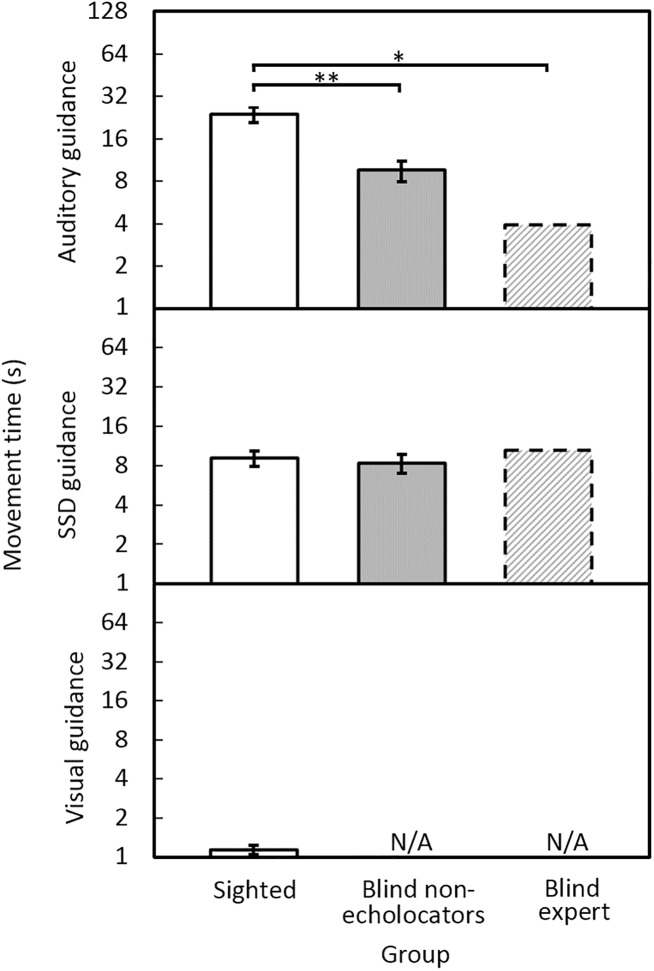
Performance for an obstacle circumvention task was assessed under conditions of visual, auditory only (using echolocation) and tactile (using a sensory substitution device, SSD) guidance. A Vicon motion capture system was used to measure human movement kinematics objectively. Ten normally sighted participants, 8 blind non-echolocators, and 1 blind expert echolocator navigated around a 0.6 x 2 m obstacle that was varied in position across trials, at the midline of the participant or 25 cm to the right or left. Although visual guidance was the most effective, participants successfully circumvented the obstacle in the majority of trials under auditory or SSD guidance. Using audition, blind non-echolocators navigated more effectively than blindfolded sighted individuals with fewer collisions, lower movement times, fewer velocity corrections and greater obstacle detection ranges. The blind expert echolocator displayed performance similar to or better than that for the other groups using audition, but was comparable to that for the other groups using the SSD. The generally better performance of blind than of sighted participants is consistent with the perceptual enhancement hypothesis that individuals with severe visual deficits develop improved auditory abilities to compensate for visual loss, here shown by faster, more fluid, and more accurate navigation around obstacles using sound.
Overview
The claims and statistics of this paper haven’t been checked yet.
Free: it reads the open-access text and checks the first 5 claims that cite a source we can check. Create a free account to check every claim.
Integrity signals
Registry
Cites
Statistics
Figures




Verification
Claims the paper makes
The claims and statistics of this paper haven’t been checked yet.
Free: it reads the open-access text and checks the first 5 claims that cite a source we can check. Create a free account to check every claim.
Claims other papers make about this one
Each is checked against this paper’s own text: does it say what the citing paper says it does?
The source backs part of the claim, not all of it — or backs it for a different population, condition or comparison.
In the citing paper
“Laboratory research has shown that click-based echolocation provides sensory advantages above and beyond passive echolocation via ambient sound fields, e.g. [18–20] or active echolocation using footsteps or cane-taps [21,22].”
From Human click-based echolocation: Effects of blindness and age, and real-life implications in a 10-week training program (2021) · cites this paper as [21]
Experimental — accuracy not yet measured
Self-check
Percentages, sums and reported differences re-computed from the paper’s own numbers.
The self-check needs the paper’s full text.
Citations
The citation lists are queued
They are fetched later and appear here then.
References 70 · Cited by 59
Research works printed but not linked: 1
- C Rice, 1970, Early blindness, early experience and perceptual enhancement, Res Bull Am Found Blind, 22, 1
Metadata
- Authors
- Kolarik, A. J., Scarfe, A. C., Moore, B. C. J., & Pardhan, S.
- Affiliations
- University of London (GB)
- Sheffield Teaching Hospitals NHS Foundation Trust (GB)
- University of Cambridge (GB)
- Anglia Ruskin University (GB)
- Corresponding author
- Kolarik, Andrew J.
- Venue
- PLOS ONE
- Publisher
- Public Library of Science (PLoS)
- Published
- 2017-04-13
- Volume
- 12
- Issue
- 4
- Pages
- e0175750
- ISSN
- 1932-6203 (ISSN-L)
- PMC
- PMC5391114
- OpenAlex
- W2605700245
- Cited by
- 59
- References
- 70
- Citations by year
- 2026: 3 · 2025: 3 · 2024: 5 · 2023: 4 · 2022: 10 · 2021: 10 · 2020: 8 · 2019: 8 · 2018: 5 · 2017: 3
- FWCI
- 3.72
- Type
- journal article
- Language
- en
- Open access
- gold
- doi.org
- Licence
- Locations
- PLoS ONE (publishedVersion, cc-by)
- PubMed Central (publishedVersion, cc-by)
- PubMed (publishedVersion)
- UEA Digital Repository (University of East Anglia) (acceptedVersion)
- Anglia Ruskin Research Online (Anglia Ruskin University) (submittedVersion)
- DOAJ (DOAJ: Directory of Open Access Journals) (submittedVersion, cc-by-sa)
- Figshare (submittedVersion, cc-by)
- Apollo (University of Cambridge) (submittedVersion, cc-by)
- Apollo (cc-by)
- Funders
- Medical Research Council (G0701870)
- Vision and Eye Research Unit, Postgraduate Medical Institute at Anglia Ruskin University
- Topics
- Life Sciences › Neuroscience › Cognitive Neuroscience › Tactile and Sensory Interactions
- Health Sciences › Health Professions › Occupational Therapy › Assistive Technology in Communication and Mobility
- Social Sciences › Psychology › Experimental and Cognitive Psychology › Spatial Cognition and Navigation
- Keywords
- blindness, echolocation, sensory substitution devices, auditory navigation, visual impairment
- MeSH terms
- Adult, Biomechanical Phenomena, Blindness, Female, Humans, Male, Middle Aged, Motion Perception, Sound Localization, Touch Perception, Young Adult, Spatial Processing
About these checks
Registry, retraction, Cites and statistics results are computed, not judged, with one exception: a printed reference that no index lists is read once by a model before it counts as a citation error. Claims are extracted by a model and kept only when their quote appears verbatim in the text; each cited source is then checked, with a model’s help, for whether it says what the claim relies on. Those verdicts can be wrong — read the claim’s quote and the cited source before relying on one.
Statistics and arithmetic are recomputed, not judged.
Confidence bands are shown only for fields calibrated on our annotated test set. None is calibrated yet, so no band is shown.
What counts as a claim ›How we measure confidence ›How we check this ›
Are you an author, or do you see a problem with this page? Request a review
How to cite
Cite CoChat for the checks on this page, and the paper for its own findings.
- This page
- CoChat. (2026). Citation check: Blindness enhances auditory obstacle circumvention: Assessing echolocation, sensory substitution, and visual-based navigation. https://app.cochat.ai/papers/10.1371/journal.pone.0175750
- The paper
- Kolarik, A. J., Scarfe, A. C., Moore, B. C. J., & Pardhan, S. (2017). Blindness enhances auditory obstacle circumvention: Assessing echolocation, sensory substitution, and visual-based navigation. PLOS ONE. https://doi.org/10.1371/journal.pone.0175750
Data sources
Bibliographic data: Semantic Scholar, OpenAlex, Crossref.
Contains information from the Semantic Scholar Academic Graph Datasets, made available under the ODC Attribution License (ODC-BY 1.0).
Semantic Scholar’s data is described in: Kinney, R., et al. (2023). The Semantic Scholar Open Data Platform. arXiv:2301.10140.
