

The DOI matches its Crossref record; 33 of the 36 references it cites were found in a registry or an index.
Psychometric analysis of the Generalized Anxiety Disorder scale (GAD-7) in primary care using modern item response theory
Open accessAbstract
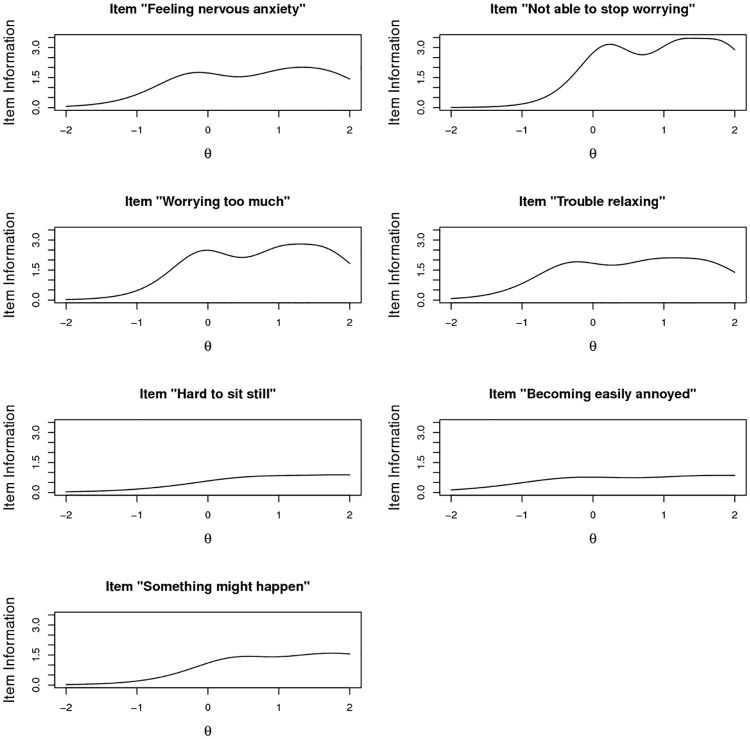
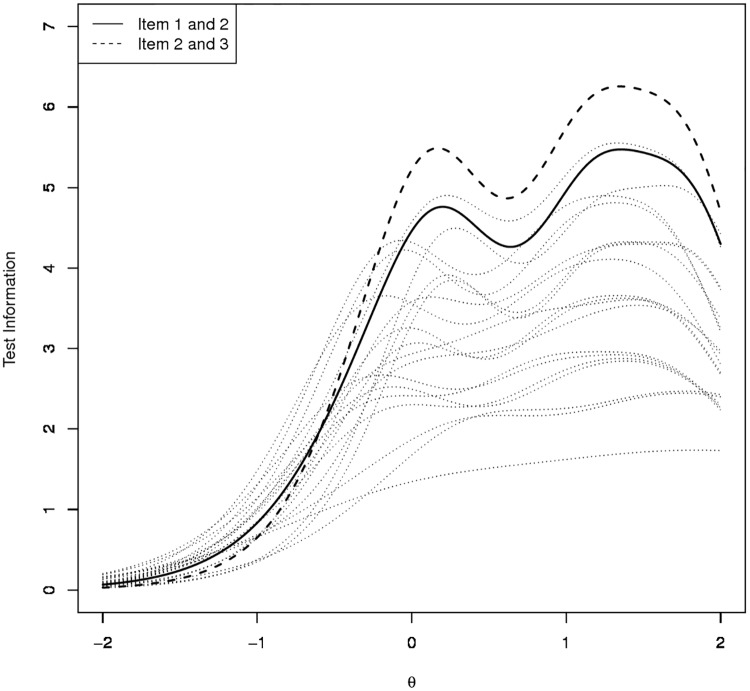
OBJECTIVE: The Generalized Anxiety Disorder scale (GAD-7) is one of the most frequently used diagnostic self-report scales for screening, diagnosis and severity assessment of anxiety disorder. Its psychometric properties from the view of the Item Response Theory paradigm have rarely been investigated. We aimed to close this gap by analyzing the GAD-7 within a large sample of primary care patients with respect to its psychometric properties and its implications for scoring using Item Response Theory. METHODS: Robust, nonparametric statistics were used to check unidimensionality of the GAD-7. A graded response model was fitted using a Bayesian approach. The model fit was evaluated using posterior predictive p-values, item information functions were derived and optimal predictions of anxiety were calculated. RESULTS: The sample included N = 3404 primary care patients (60% female; mean age, 52,2; standard deviation 19.2) The analysis indicated no deviations of the GAD-7 scale from unidimensionality and a decent fit of a graded response model. The commonly suggested ultra-brief measure consisting of the first two items, the GAD-2, was supported by item information analysis. The first four items discriminated better than the last three items with respect to latent anxiety. CONCLUSION: The information provided by the first four items should be weighted more heavily. Moreover, estimates corresponding to low to moderate levels of anxiety show greater variability. The psychometric validity of the GAD-2 was supported by our analysis.
Overview
The claims and statistics of this paper haven’t been checked yet.
Run the check — free, no account needed. It reads the open-access text and checks the sources it cites.
Integrity signals
Registry
Cites
Statistics
Figures
Verification
Claims the paper makes
The claims and statistics of this paper haven’t been checked yet.
Run the check — free, no account needed. It reads the open-access text and checks the sources it cites.
Claims other papers make about this one
Each is checked against this paper’s own text: does it say what the citing paper says it does?
In the citing paper
“This threshold has previously been shown to have good levels of sensitivity and specificity [34].”
Self-check
Percentages, sums and reported differences re-computed from the paper’s own numbers.
The self-check needs the paper’s full text.
Citations
Cites
Hu, L., & Bentler, P. M. (1999) · Structural Equation Modeling A Multidisciplinary Journal · doi:10.1080/10705519909540118 · Cited by 108,788
A Brief Measure for Assessing Generalized Anxiety Disorder: The GAD-7
Spitzer, R. L., Kroenke, K., Williams, J. B. W., & Löwe, B. (2006) · Archives of Internal Medicine · doi:10.1001/archinte.166.10.1092 · Cited by 31,765
Self-citationlavaan : An R Package for Structural Equation Modeling
Rosseel, Y. (2012) · Journal of Statistical Software · doi:10.18637/jss.v048.i02 · Cited by 27,955
Gelman, A., Carlin, J. B., Stern, H. S., & Rubin, D. B. (2003) · doi:10.1201/9780429258480 · Cited by 27,276
An inventory for measuring clinical anxiety: Psychometric properties.
Beck, A. T., Epstein, N., Brown, G., & Steer, R. A. (1988) · Journal of Consulting and Clinical Psychology · doi:10.1037/0022-006x.56.6.893 · Cited by 14,407
RUBIN, D. B. (1976) · Biometrika · doi:10.1093/biomet/63.3.581 · Cited by 9,925
WinBUGS - A Bayesian modelling framework: Concepts, structure, and extensibility
Lunn, D. J., Thomas, A., Best, N., & Spiegelhalter, D. J. (2000) · Statistics and Computing · doi:10.1023/a:1008929526011 · Cited by 5,397
Anxiety disorders in primary care: prevalence, impairment, comorbidity, and detection
Kroenke, K., Spitzer, R. L., Williams, J. B. W., Monahan, P. O., & Löwe, B. (2007) · Annals of Internal Medicine · doi:10.7326/0003-4819-146-5-200703060-00004 · Cited by 4,741
Self-citationLöwe, B., Decker, O., Müller, S., Brähler, E., Schellberg, D., Herzog, W., & Herzberg, P. Y. (2008) · Medical Care · doi:10.1097/mlr.0b013e318160d093 · Cited by 4,527
Self-citationAn Ultra-Brief Screening Scale for Anxiety and Depression: The PHQ–4
Kroenke, K., Spitzer, R. L., Williams, J. B. W., & Löwe, B. (2009) · Psychosomatics · doi:10.1016/s0033-3182(09)70864-3 · Cited by 4,261
Self-citationKroenke, K., Spitzer, R. L., Williams, J. B. W., & Löwe, B. (2010) · General Hospital Psychiatry · doi:10.1016/j.genhosppsych.2010.03.006 · Cited by 4,057
Self-citationOn the use, the misuse, and the very limited usefulness of Cronbach’s alpha
Sijtsma, K. (2009) · Psychometrika · doi:10.1007/s11336-008-9101-0 · Cited by 2,814
Psychosomatic medicine in Germany: more timely than ever
Zipfel, S., Herzog, W., Kruse, J., & Henningsen, P. (2016) · Psychotherapy and Psychosomatics · doi:10.1159/000447701 · Cited by 2,323
POSTERIOR PREDICTIVE ASSESSMENT OF MODEL FITNESS VIA REALIZED DISCREPANCIES
Gelman, A., Meng, X., & Stern, H. S. (1996) · Cited by 1,982
A Theory and Procedure of Scale Analysis: With Applications in Political Research
Mokken, R. J. (1971) · doi:10.1515/9783110813203 · Cited by 1,120
Introduction to Nonparametric Item Response Theory
Sijtsma, K., & Molenaar, I. W. (2002) · Sage eBooks · doi:10.4135/9781412984676 · Cited by 765
Generalized anxiety disorder: prevalence, burden, and cost to society
Wittchen, H.-U. (2002) · Depression and Anxiety · doi:10.1002/da.10065 · Cited by 733
The Attack of the Psychometricians
Borsboom, D. (2006) · Psychometrika · doi:10.1007/s11336-006-1447-6 · Cited by 599
(2002) · PubMed · Cited by 518
van der Ark, L. A. (2007) · Journal of Statistical Software · doi:10.18637/jss.v020.i11 · Cited by 469
The relationship between anxiety and depression
Dobson, K. S. (1985) · Clinical Psychology Review · doi:10.1016/0272-7358(85)90010-8 · Cited by 348
Conditional Association and Unidimensionality in Monotone Latent Variable Models
Holland, P. W., & Rosenbaum, P. R. (1986) · The Annals of Statistics · doi:10.1214/aos/1176350174 · Cited by 316
The Value of Item Response Theory in Clinical Assessment: A Review
Thomas, M. L. (2010) · Assessment · doi:10.1177/1073191110374797 · Cited by 283
Schalet, B. D., Cook, K. F., Choi, S. W., & Cella, D. F. (2013) · Journal of Anxiety Disorders · doi:10.1016/j.janxdis.2013.11.006 · Cited by 260
Testing the Conditional Independence and Monotonicity Assumptions of Item Response Theory
Rosenbaum, P. R. (1984) · Psychometrika · doi:10.1007/bf02306030 · Cited by 206
Assessing Fit of Unidimensional Item Response Theory Models Using a Bayesian Approach
Sinharay, S. (2005) · Journal of Educational Measurement · doi:10.1111/j.1745-3984.2005.00021.x · Cited by 121
Information Functions of the Generalized Partial Credit Model
Muraki, E. (1993) · Applied Psychological Measurement · doi:10.1177/014662169301700403 · Cited by 120
BUGSCode for Item Response Theory
Curtis, S. M. (2010) · Journal of Statistical Software · doi:10.18637/jss.v036.c01 · Cited by 93
Estimation of maximal reliability: A note on a covariance structure modelling approach
Raykov, T. (2004) · British Journal of Mathematical and Statistical Psychology · doi:10.1348/000711004849295 · Cited by 83
Assessing Fit of Unidimensional Graded Response Models Using Bayesian Methods
Zhu, X., & Stone, C. A. (2011) · Journal of Educational Measurement · doi:10.1111/j.1745-3984.2011.00132.x · Cited by 36
Löwe, B., Piontek, K., Daubmann, A., Härter, M. C., Wegscheider, K., König, H., & Mora, M. C. S. (2017) · Psychosomatic Medicine · doi:10.1097/psy.0000000000000491 · Cited by 34
Self-citationCollaborative stepped care for somatoform disorders: A pre–post-intervention study in primary care
Mora, M. C. S., Groß, B., Lau, K., Gumz, A., Wegscheider, K., & Löwe, B. (2015) · Journal of Psychosomatic Research · doi:10.1016/j.jpsychores.2015.11.004 · Cited by 33
Self-citationComputerized Adaptive Testing—Ready for Ambulatory Monitoring?
Rose, M., Bjørner, J. B., Fischer, F. H., Anatchkova, M., Gandek, B., Klapp, B. F., & Ware, J. E. (2012) · Psychosomatic Medicine · doi:10.1097/psy.0b013e3182547392 · Cited by 31
Cited by
Sorted by citations
The role of perceived social support on depression and sleep during the COVID-19 pandemic
Grey, I., Arora, T., Thomas, J., Saneh, A., Tohme, P., & Abi-Habib, R. (2020) · Psychiatry Research · doi:10.1016/j.psychres.2020.113452 · Cited by 587
Every‐Palmer, S., Jenkins, M., Gendall, P. J., Hoek, J. A., Beaglehole, B., Bell, C., Williman, J. A., Rapsey, C. M., & Stanley, J. (2020) · PLoS ONE · doi:10.1371/journal.pone.0241658 · Cited by 415
Smith, B. J., Miller, R. A., Ericsson, A. C., Harrison, D. C., Strong, R., & Schmidt, T. M. (2019) · BMC Microbiology · doi:10.1186/s12866-019-1494-7 · Cited by 351
Using Generalized Anxiety Disorder-2 (GAD-2) and GAD-7 in a Primary Care Setting
Sapra, A., Bhandari, P., Sharma, S., Chanpura, T., & Lopp, L. (2020) · Cureus · doi:10.7759/cureus.8224 · Cited by 298
Zhang, C., Wang, T., Zeng, P., Zhao, M., Zhang, G., Zhai, S., Meng, L., Wang, Y., & Liu, D. (2021) · Frontiers in Psychiatry · doi:10.3389/fpsyt.2021.648755 · Cited by 175
Metadata
- Authors
- Jordan, P., Shedden-Mora, M. C., & Löwe, B.
- Affiliations
- Universität Hamburg (DE)
- Schön Klinik Hamburg Eilbek (DE)
- Corresponding author
- Jordan, Pascal
- Venue
- PLOS ONE
- Publisher
- Public Library of Science (PLoS)
- Published
- 2017-08-03
- Volume
- 12
- Issue
- 8
- Pages
- e0182162
- ISSN
- 1932-6203 (ISSN-L)
- PMC
- PMC5542568
- OpenAlex
- W2745129199
- Cited by
- 225
- References
- 36
- Citations by year
- 2026: 13 · 2025: 25 · 2024: 29 · 2023: 35 · 2022: 31 · 2021: 37 · 2020: 31 · 2019: 14 · 2018: 9 · 2017: 1
- FWCI
- 13.29
- Type
- journal article
- Language
- en
- Open access
- gold
- doi.org
- Licence
- Locations
- PLoS ONE (publishedVersion, cc-by)
- PubMed Central (publishedVersion, cc-by)
- PubMed (publishedVersion)
- RePEc: Research Papers in Economics (submittedVersion)
- DOAJ (DOAJ: Directory of Open Access Journals) (submittedVersion, cc-by-sa)
- Figshare (submittedVersion, cc-by)
- Funders
- Bundesministerium für Bildung und Forschung (01KQ1002B)
- Topics
- Social Sciences › Decision Sciences › Management Science and Operations Research › Psychometric Methodologies and Testing
- Social Sciences › Psychology › Experimental and Cognitive Psychology › Anxiety, Depression, Psychometrics, Treatment, Cognitive Processes
- Social Sciences › Psychology › Experimental and Cognitive Psychology › Mental Health Research Topics
- Keywords
- Generalized Anxiety Disorder Scale, GAD-7, GAD-2, anxiety screening, item response theory, graded response model, unidimensionality, item information function, primary care patients, Bayesian item response theory, posterior predictive p-values, scale scoring
- MeSH terms
- Adolescent, Adult, Aged, Aged, 80 and over, Anxiety Disorders, Bayes Theorem, Female, Humans, Male, Markov Chains, Middle Aged, Primary Health Care, Psychiatric Status Rating Scales, Young Adult, Self Report
About these checks
Registry, retraction, Cites and statistics results are computed, not judged, with one exception: a printed reference that no index lists is read once by a model before it counts as a citation error. Claims are extracted by a model and kept only when their quote appears verbatim in the text; each cited source is then checked, with a model’s help, for whether it says what the claim relies on. Those verdicts can be wrong — read the claim’s quote and the cited source before relying on one.
Statistics and arithmetic are recomputed, not judged.
Confidence bands are shown only for fields calibrated on our annotated test set. None is calibrated yet, so no band is shown.
What counts as a claim ›How we measure confidence ›How we check this ›
Are you an author, or do you see a problem with this page? Request a review
