

Bone metabolism dynamics in the early post-transplant period following kidney and liver transplantation
Open accessThe DOI matches its Crossref record; 48 of the 48 references it cites were found in a registry or an index.
Abstract
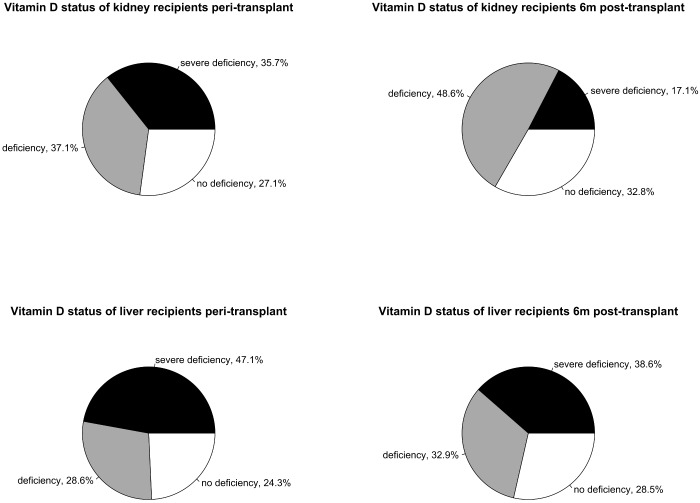
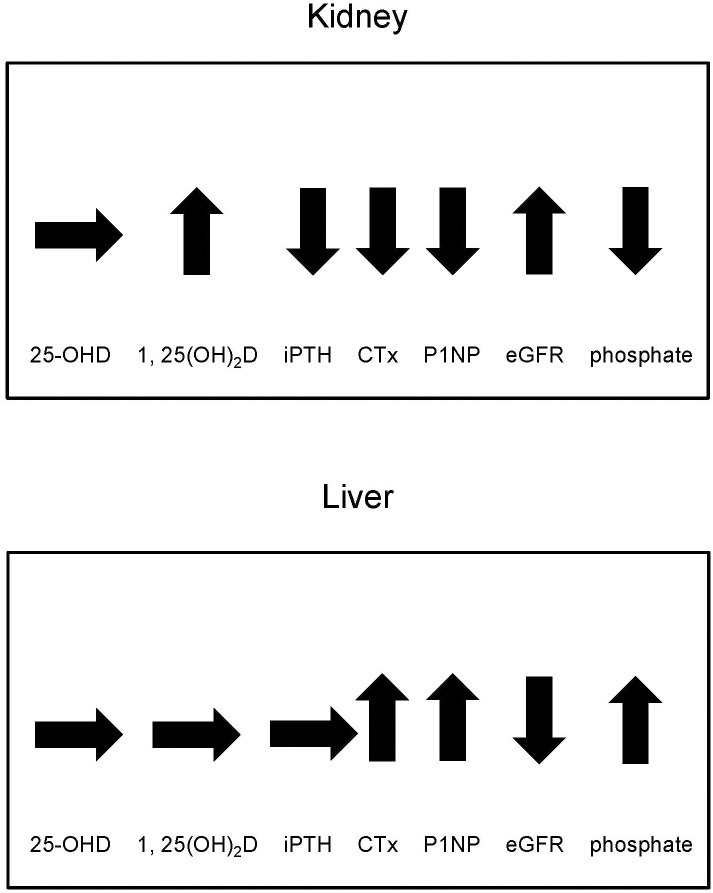
Bone disease contributes to relevant morbidity after solid organ transplantation. Vitamin D has a crucial role for bone metabolism. Activation of vitamin D depends on the endocrine function of both, liver and kidney. Our study assessed key markers of bone metabolism at time of transplantation and 6 months after transplantation among 70 kidney and 70 liver recipients. In 70 kidney recipients 25-OH vitamin D levels did not differ significantly between peri-transplant (median 32.5nmol/l) and 6 months post-transplant (median 41.9nmol/l; P = 0.272). Six months post-transplant median 1, 25-(OH)2 vitamin D levels increased by >300% (from 9.1 to 36.5ng/l; P<0.001) and median intact parathyroid hormone levels decreased by 68.4% (from 208.7 to 66.0 ng/l; P<0.001). Median β-Crosslaps (CTx) and total procollagen type 1 amino-terminal propeptide (P1NP) decreased by 65.1% (from 1.32 to 0.46ng/ml; P<0.001) and 60.6% (from 158.2 to 62.3ng/ml; P<0.001), respectively. Kidney recipients with incident fractures had significantly lower levels of 1, 25-(OH)2 vitamin D at time of transplantation and of intact parathyroid hormone 6 months post-transplant. Among 70 liver recipients, 25-OH vitamin D, 1, 25-(OH)2 vitamin D and intact parathyroid hormone levels were not significantly altered between peri-transplant and 6 months post-transplant. Contrary to kidney recipients, median CTx increased by 60.0% (from 0.45 to 0.72 ng/ml; P = 0.002) and P1NP by 49.3% (from 84.0 to 125.4ng/ml; P = 0.001) in the longitudinal course. Assessed biomarkers didn't differ between liver recipients with and without fractures. To conclude, the assessed panel of biomarkers proved highly dynamic after liver as well as kidney transplantation in the early post-transplant period. After kidney transplantation a significant gain in 1, 25-(OH)2 vitamin D combined with a decline in iPTH, CTx and P1NP, whereas after liver transplantation an increase in CTx and P1NP were characteristic.
Overview
The claims and statistics of this paper haven’t been checked yet.
Free: it reads the open-access text and checks the first 5 claims that cite a source we can check. Create a free account to check every claim.
Integrity signals
Registry
Cites
Statistics
Figures
Verification
Claims the paper makes
The claims and statistics of this paper haven’t been checked yet.
Free: it reads the open-access text and checks the first 5 claims that cite a source we can check. Create a free account to check every claim.
Claims other papers make about this one
Each is checked against this paper’s own text: does it say what the citing paper says it does?
In the citing paper
“Two main phases of bone loss after LT have been identified: early and late post-transplantation periods [146].”
From Bone diseases in patients with chronic liver disease (2019) · cites this paper as [146]
Self-check
Percentages, sums and reported differences re-computed from the paper’s own numbers.
The self-check needs the paper’s full text.
Citations
Cites
Toprak, O., Kurt, H., Sarı, Y., Şarkış, C., Us, H., & Kırık, A. (2017) · Kidney and Blood Pressure Research · doi:10.1159/000468530 · Cited by 29,627
A New Equation to Estimate Glomerular Filtration Rate
Levey, A. S., Stevens, L. A., Schmid, C. H., Zhang, Y. (., Castro, A. F., Feldman, H. I., Kusek, J. W., Eggers, P., Van Lente, F., Greene, T., et al. (2009) · Annals of Internal Medicine · doi:10.7326/0003-4819-150-9-200905050-00006 · Cited by 25,603
Holick, M. F. (2007) · New England Journal of Medicine · doi:10.1056/nejmra070553 · Cited by 13,720
Vitamin D: Metabolism, Molecular Mechanism of Action, and Pleiotropic Effects
Christakos, S., Dhawan, P., Verstuyf, A., Verlinden, L., & Carmeliet, G. (2016) · Physiological Reviews · doi:10.1152/physrev.00014.2015 · Cited by 1,957
Use of Inhaled Corticosteroids and Risk of Fractures
Van Staa, T. P., Leufkens, H. G. M., & Cooper, C. (2001) · Journal of Bone and Mineral Research · doi:10.1359/jbmr.2001.16.3.581 · Cited by 1,308
Vitamin D Status: Measurement, Interpretation, and Clinical Application
Holick, M. F. (2009) · Annals of Epidemiology · doi:10.1016/j.annepidem.2007.12.001 · Cited by 1,286
Use of oral corticosteroids and risk of fractures
Van Staa, T. P., Leufkens, H. G. M., Abenhaim, L., Zhang, B., & Cooper, C. (2000) · Journal of Bone and Mineral Research · doi:10.1359/jbmr.2000.15.6.993 · Cited by 1,263
Hruska, K. A., & Teitelbaum, S. L. (1995) · New England Journal of Medicine · doi:10.1056/nejm199507203330307 · Cited by 404
Vasikaran, S., Cooper, C., Eastell, R., Griesmacher, A., Morris, H. A., Trenti, T., & Kanis, J. A. (2011) · Clinical Chemistry and Laboratory Medicine (CCLM) · doi:10.1515/cclm.2011.602 · Cited by 380
The clinical utility of bone marker measurements in osteoporosis
Wheater, G., Elshahaly, M., Tuck, S. P., Datta, H. K., & van Laar, J. M. (2013) · Journal of Translational Medicine · doi:10.1186/1479-5876-11-201 · Cited by 322
Leidig-Bruckner, G., Hosch, S., Dodidou, P., Ritschel, D., Conradt, C., Klose, C., Otto, G., Lange, R., Theilmann, L., Zimmerman, R., et al. (2001) · The Lancet · doi:10.1016/s0140-6736(00)03641-2 · Cited by 267
Bone turnover markers: use in osteoporosis
Naylor, K., & Eastell, R. (2012) · Nature Reviews Rheumatology · doi:10.1038/nrrheum.2012.86 · Cited by 262
Gallego-Rojo, F. J., Gonzalez-Calvin, J. L., Muñoz-Torres, M., Mundi, J. L., Fernandez-Perez, R., & Rodrigo-Moreno, D. (1998) · Hepatology · doi:10.1002/hep.510280315 · Cited by 241
The Regulation of Parathyroid Hormone Secretion and Synthesis
Kumar, R., & Thompson, J. R. (2011) · Journal of the American Society of Nephrology · doi:10.1681/asn.2010020186 · Cited by 224
Changing bone patterns with progression of chronic kidney disease
Drüeke, T. B., & Massy, Z. A. (2016) · Kidney International · doi:10.1016/j.kint.2015.12.004 · Cited by 219
Garnero, P. (2008) · Molecular Diagnosis & Therapy · doi:10.1007/bf03256280 · Cited by 196
Bone loss after liver transplantation
McDonald, J. A., Dunstan, C. R., Dilworth, P., Sherbon, K., Sheil, R. A. G., Evans, R. A., & McCaughan, G. W. (1991) · Hepatology · doi:10.1002/hep.1840140407 · Cited by 184
Monegal, A., Navasa, M., Guañabens, N., Peris, P., Pons, F., Martinez de Osaba, M. J., Ordi, J., Rimola, A., Rodés, J., & Muñoz-Gómez, J. (2001) · Osteoporosis International · doi:10.1007/s001980170094 · Cited by 183
Risk of Fractures After Renal Transplantation in the United States
Nikkel, L. E., Hollenbeak, C. S., Fox, E. J., Uemura, T., & Ghahramani, N. (2009) · Transplantation · doi:10.1097/tp.0b013e3181a6bbda · Cited by 166
Phipps, A. I., Ichikawa, L., Bowles, E. J. A., Carney, P. A., Kerlikowske, K., Miglioretti, D. L., & Buist, D. S. M. (2010) · Maturitas · doi:10.1016/j.maturitas.2010.04.015 · Cited by 161
Chronic renal dysfunction late after liver transplantation
Cohen, A. J., Stegall, M. D., Rosen, C. B. B., Wiesner, R. H., Leung, N., Kremers, W. K., & Zein, N. N. (2002) · Liver Transplantation · doi:10.1053/jlts.2002.35668 · Cited by 148
Clinical usefulness of bone turnover marker concentrations in osteoporosis
Morris, H. A., Eastell, R., Jørgensen, N. R., Cavalier, E., Vasikaran, S. D., Chubb, S. A. P., Kanis, J. А., Cooper, C. C., & Makris, K. (2016) · Clinica Chimica Acta · doi:10.1016/j.cca.2016.06.036 · Cited by 137
Aroldi, A., Tarantino, A., Montagnino, G., Cesana, B., Cocucci, C., & Ponticelli, C. (1997) · Transplantation · doi:10.1097/00007890-199702150-00009 · Cited by 130
Koller, M. T., van Delden, C., Müller, N. J., Baumann, P., Lovis, C., Marti, H.-P., Fehr, T., Binet, I., De Geest, S., Bucher, H. C., et al. (2013) · European Journal of Epidemiology · doi:10.1007/s10654-012-9754-y · Cited by 128
Ninkovic, M., Love, S. A., Tom, B., Alexander, G. J. M., & Compston, J. E. (2001) · Calcified Tissue International · doi:10.1007/s00223-001-2028-4 · Cited by 123
Incidence of vertebral fractures in the first three months after orthotopic liver transplantation
Ninkovic, M., Skingle, S. J., Bearcroft, P. W. P., Bishop, N., Alexander, G. J. M., & Compston, J. E. (2000) · European Journal of Gastroenterology & Hepatology · doi:10.1097/00042737-200012080-00013 · Cited by 117
Fracture Risk in Kidney Transplant Recipients: A Systematic Review
Naylor, K. L., Li, A. H., Lam, N. N., Hodsman, A. B., Jamal, S. A., & Garg, A. X. (2013) · Transplantation · doi:10.1097/tp.0b013e31828eead8 · Cited by 101
Chavassieux, P., Portero-Muzy, N., Roux, J.-P., Garnero, P., & Chapurlat, R. (2015) · The Journal of Clinical Endocrinology & Metabolism · doi:10.1210/jc.2015-2957 · Cited by 99
Endocrinology and Dialysis Jean L. Holley, Series Editor: Osteoporosis and Chronic Kidney Disease
Gal‐Moscovici, A., & Sprague, S. M. (2007) · Seminars in Dialysis · doi:10.1111/j.1525-139x.2007.00319.x · Cited by 90
Ten-Year Outcome after Rapid Discontinuation of Prednisone in Adult Primary Kidney Transplantation
Rizzari, M. D., Suszynski, T. M., Gillingham, K. J., Dunn, T. B., Ibrahim, H. N., Payne, W. D., Chinnakotla, S., Finger, E. B., Sutherland, D. E. R., Kandaswamy, R., et al. (2012) · Clinical Journal of the American Society of Nephrology · doi:10.2215/cjn.08630811 · Cited by 86
The Risk of Fractures Among Patients With Cirrhosis or Chronic Pancreatitis
Bang, U. C., Benfield, T., Bendtsen, F., Hyldstrup, L., & Jensen, J. B. (2013) · Clinical Gastroenterology and Hepatology · doi:10.1016/j.cgh.2013.04.031 · Cited by 76
Ruiz-Gaspà, S., Martinez-Ferrer, A., Guañabens, N., Dubreuil, M., Peris, P., Enjuanes, A., de Osaba, M. J. M., Alvarez, L., Monegal, A., Combalia, A., et al. (2010) · Hepatology · doi:10.1002/hep.24605 · Cited by 75
Floreani, A., Mega, A., Tizian, L., Burra, P., Boccagni, P., Baldo, V., FAGIUOLI, S., Naccarato, R., & Luisetto, G. (2001) · Osteoporosis International · doi:10.1007/s001980170051 · Cited by 66
Ueda, M., Inaba, M., Okuno, S., Nagasue, K., Kitatani, K., Ishimura, E., Shimizu, M., Miki, T., Kim, M., & Nishizawà, Y. (2002) · American Journal of Kidney Diseases · doi:10.1053/ajkd.2002.35692 · Cited by 66
Cueto-Manzano, A. M., Konel, S., Crowley, V., France, M. W., Freemont, A. J., Adams, J. E., Mawer, B., Gokal, R., & Hutchison, A. J. (2003) · Transplantation · doi:10.1097/01.tp.0000068869.21770.f6 · Cited by 65
Fracture Incidence in Adult Kidney Transplant Recipients
Naylor, K. L., Jamal, S. A., Zou, G., McArthur, E., Lam, N. N., Leslie, W. D., Hodsman, A. B., Kim, S., Knoll, G. A., Fraser, L.-A., et al. (2015) · Transplantation · doi:10.1097/tp.0000000000000808 · Cited by 61
Influence of age on cyclosporin A-induced alterations in bone mineral metabolism in the rat in vivo
Katz, I. A., Li, M., Joffe, I. I., Stein, B., Jacobs, T. W., Liang, X. G., Ke, H. Z., Jee, W. S. S., & Epstein, S. (1994) · Journal of Bone and Mineral Research · doi:10.1002/jbmr.5650090109 · Cited by 49
Evaluation and management of bone disease and fractures post transplant
BIA, M. J. (2007) · Transplantation Reviews · doi:10.1016/j.trre.2007.09.001 · Cited by 49
Evolving Role of Bone Biomarkers in Castration-Resistant Prostate Cancer
Brown, J. E., & Sim, S. (2010) · Neoplasia · doi:10.1593/neo.10610 · Cited by 48
Cavalier, E., Lukas, P., Carlisi, A., Gadisseur, R., & Delanaye, P. (2013) · Clinica Chimica Acta · doi:10.1016/j.cca.2013.07.016 · Cited by 44
Krol, C. G., Dekkers, O. M., Kroon, H. M., Rabelink, T. J., van Hoek, B., & Hamdy, N. A. (2014) · Journal of Bone and Mineral Research · doi:10.1002/jbmr.2214 · Cited by 43
Biochemical markers of bone turnover in diagnosis of myeloma bone disease
Dizdar, O., Barista, I., Kalyoncu, U., Karadag, O., Hascelik, G., Cila, A., Pinar, A., Celik, I., Kars, A., & Tekuzman, G. (2007) · American Journal of Hematology · doi:10.1002/ajh.20794 · Cited by 32
Hardinger, K. L., Ho, B., Schnitzler, M. A., Desai, N., Lowell, J., Shenoy, S., Chapman, W. C., & Crippin, J. S. (2003) · Liver Transplantation · doi:10.1053/jlts.2003.50135 · Cited by 28
Fracture incidence after liver transplantation: results of a 10-year audit
Premaor, M. O., Das, T., Debiram, I., Parker, R. A., Ninkovic, M., Alexander, G., & Compston, J. E. (2011) · QJM · doi:10.1093/qjmed/hcr025 · Cited by 24
Monegal, A., Navasa, M., Peris, P., Colmenero, J., Cuervo, A. M., Muxí, Á., Gifre, L., & Guañabens, N. (2013) · Calcified Tissue International · doi:10.1007/s00223-013-9797-4 · Cited by 24
Haggan, W. E., Barthe, N., Vendrely, B., Chauveau, P., Berger, F., Aparicio, M., & Potaux, L. (2002) · Transplantation Proceedings · doi:10.1016/s0041-1345(02)03094-4 · Cited by 15
Zitta, S., Schaffellner, S., Gutschi, J., Meinitzer, A., Kniepeiss, D., Artinger, K., Reibnegger, G. J., Rosenkranz, A. R., & Wagner, D. (2015) · Transplantation · doi:10.1097/tp.0000000000000521 · Cited by 11
Mineral Metabolism in Health and Disease
Agus, Z. S., Goldfarb, S., & Wasserstein, A. G. (1981) · Springer eBooks · doi:10.1007/978-1-4615-6719-6_6 · Cited by 4
Cited by
Bone diseases in patients with chronic liver disease
Jeong, H., & Kim, D. (2019) · International Journal of Molecular Sciences · doi:10.3390/ijms20174270 · Cited by 113
“Two main phases of bone loss after LT have been identified: early and late post-transplantation periods [146].”
BackgroundAnastasilakis, A. D., Tsourdi, E., Makras, P., Polyzos, S. A., Meier, C., McCloskey, E. V., Pepe, J., & Zillikens, M. C. (2019) · Bone · doi:10.1016/j.bone.2019.07.006 · Cited by 71
Lim, W. H., Ng, C. H., Ow, Z. G. W., Ho, O. T. W., Tay, P. W. L., Wong, K. L., Tan, E. X. X., Tang, S. Y., Teo, C. M., & Muthiah, M. D. (2021) · Transplant International · doi:10.1111/tri.13863 · Cited by 29
“reported non-significant effects [6,7,15,16,37,50], while two studies reported a significant increase in fracture rates [7,31].”
BackgroundResultInfluentialMartucci, G., Volpes, R., Panarello, G., Tuzzolino, F., Carlo, D. D., Ricotta, C., Gruttadauria, S., Conaldi, P. G., Luca, A., Amrein, K., et al. (2020) · Clinical Nutrition · doi:10.1016/j.clnu.2020.10.027 · Cited by 23
Denosumab-Induced Hypocalcemia and Hyperparathyroidism in de novo Kidney Transplant Recipients
Cianciolo, G., Tondolo, F., Barbuto, S., Iacovella, F., Zavatta, G., Altieri, P., Grandinetti, V., Comai, G., Cozzolino, M. G., & Manna, G. L. (2021) · American Journal of Nephrology · doi:10.1159/000518363 · Cited by 16
Metadata
- Authors
- Schreiber, P. W., Bischoff-Ferrari, H. A., Boggian, K., Bonani, M., van Delden, C., Enriquez, N., Fehr, T., Garzoni, C., Hirsch, H. H., Hirzel, C., Manuel, O., Meylan, P., Saleh, L., Weisser, M., Mueller, N. J., & (STCS), T. S. T. C. S.
- Affiliations
- University of Zurich (CH)
- Kantonsspital St. Gallen (CH)
- University of Geneva (CH)
- Kantonsspital Graubünden (CH)
- University of Bern (CH)
- University Hospital of Basel (CH)
- Centre Hospitalier Universitaire Vaudois (CH)
- University Hospital Zurich (CH)
- Corresponding author
- Mueller, Nicolas J.
- ORCID
- Venue
- PLoS ONE
- Publisher
- Public Library of Science (PLoS)
- Published
- 2018-01-16
- Volume
- 13
- Issue
- 1
- Pages
- e0191167
- ISSN
- 1932-6203 (ISSN-L)
- PMC
- PMC5770064
- OpenAlex
- W2783734929
- Cited by
- 22
- References
- 48
- Citations by year
- 2026: 4 · 2025: 2 · 2024: 2 · 2022: 4 · 2021: 5 · 2020: 1 · 2019: 4
- FWCI
- 2.72
- Type
- journal article
- Language
- en
- Open access
- gold
- doi.org
- Licence
- Locations
- PLoS ONE (publishedVersion, cc-by)
- Europe PMC (PubMed Central) (publishedVersion, cc-by)
- PubMed Central (publishedVersion, cc-by)
- PubMed (publishedVersion)
- SERVAL (Université de Lausanne) (publishedVersion, cc-by)
- Archive ouverte UNIGE (University of Geneva) (publishedVersion, other-oa)
- Zurich Open Repository and Archive (University of Zurich) (acceptedVersion, cc-by)
- IRIS (submittedVersion, cc-by)
- Bern Open Repository and Information System (University of Bern) (submittedVersion, cc-by)
- DOAJ (DOAJ: Directory of Open Access Journals) (submittedVersion, cc-by-sa)
- Figshare (submittedVersion, cc-by)
- Archive ouverte UNIGE (University of Geneva) (submittedVersion, cc-by)
- Zurich Open Repository and Archive (University of Zurich) (submittedVersion, cc-by)
- Zurich Open Repository and Archive (University of Zurich)
- Funders
- This study has been conducted in the framework of the Swiss Transplant Cohort Study, supported by the Swiss National Science Foundation, the Swiss University Hospitals and transplant centers
- Topics
- Health Sciences › Medicine › Orthopedics and Sports Medicine › Bone health and osteoporosis research
- Health Sciences › Medicine › Nephrology › Parathyroid Disorders and Treatments
- Health Sciences › Medicine › Endocrinology, Diabetes and Metabolism › Vitamin D Research Studies
- Keywords
- bone metabolism, kidney transplantation, liver transplantation, vitamin D, 1,25-dihydroxyvitamin D, parathyroid hormone, bone turnover markers, bone-specific alkaline phosphatase, P1NP, fracture, post-transplant period, liver function
- MeSH terms
- Adult, Bone and Bones, Female, Glomerular Filtration Rate, Humans, Male, Middle Aged, Parathyroid Hormone, Peptide Fragments, Peptides, Phosphates, Procollagen, Prospective Studies, Vitamin D, Biomarkers, Bone Density, Kidney Transplantation, Liver Transplantation, Bone Remodeling, Collagen Type I, Fractures, Bone
About these checks
Registry, retraction, Cites and statistics results are computed, not judged, with one exception: a printed reference that no index lists is read once by a model before it counts as a citation error. Claims are extracted by a model and kept only when their quote appears verbatim in the text; each cited source is then checked, with a model’s help, for whether it says what the claim relies on. Those verdicts can be wrong — read the claim’s quote and the cited source before relying on one.
Statistics and arithmetic are recomputed, not judged.
Confidence bands are shown only for fields calibrated on our annotated test set. None is calibrated yet, so no band is shown.
What counts as a claim ›How we measure confidence ›How we check this ›
Are you an author, or do you see a problem with this page? Request a review
Data sources
Bibliographic data: Semantic Scholar, OpenAlex, Crossref.
Contains information from the Semantic Scholar Academic Graph Datasets, made available under the ODC Attribution License (ODC-BY 1.0).
Semantic Scholar’s data is described in: Kinney, R., et al. (2023). The Semantic Scholar Open Data Platform. arXiv:2301.10140.
