

Changes of attachment characteristics during psychotherapy of patients with social anxiety disorder: Results from the SOPHO-Net trial
Open accessThe DOI matches its Crossref record; 47 of the 47 references it cites were found in a registry or an index; none of the 46 sources its claims cite is checked for support yet.
Abstract
OBJECTIVES: Within a randomized controlled trial contrasting the outcome of manualized cognitive-behavioral (CBT) and short term psychodynamic therapy (PDT) compared to a waiting list condition (the SOPHO-Net trial), we set out to test whether self-reported attachment characteristics change during the treatments and if these changes differ between treatments. RESEARCH DESIGN AND METHODS: 495 patients from the SOPHO-Net trial (54.5% female, mean age 35.2 years) who were randomized to either CBT, PDT or waiting list (WL) completed the partner-related revised Experiences in Close Relationships Questionnaire (ECR-R) before and after treatment and at 6 and 12 months follow-up. The Liebowitz Social Anxiety Scale (LSAS) was administered at pre-treatment, post-treatment, and at 6-month and 1-year follow-up. ECR-R scores were first compared to a representative healthy sample (n = 2508) in order to demonstrate that the clinical sample differed significantly from the non-clinical sample with respect to attachment anxiety and avoidance. RESULTS: LSAS scores correlated significantly with both ECR-R subscales. Post-therapy, patients treated with CBT revealed significant changes in attachment anxiety and avoidance whereas patients treated with PDT showed no significant changes. Changes between post-treatment and the two follow-ups were significant in both conditions, with minimal (insignificant) differences between treatments at the 12- month follow-up. CONCLUSIONS: The current study supports recent reviews of mostly naturalistic studies indicating changes in attachment as a result of psychotherapy. Although there were differences between conditions at the end of treatment, these largely disappeared during the follow-up period which is line with the other results of the SOPHO-NET trial. TRIAL REGISTRATION: Controlled-trials.com ISRCTN53517394.
Overview
CoChat Summary
TL;DR
In the SOPHO-Net RCT, patients with social anxiety disorder reported higher attachment anxiety and avoidance than a representative non-clinical sample, and both attachment scales correlated with social anxiety symptoms. CBT produced significant pre-post reductions in attachment anxiety and avoidance relative to waiting list, whereas PDT did not; treatment differences largely disappeared by 12-month follow-up.
Key findings
- The SOPHO-Net sample differed significantly from the representative German sample on ECR-R attachment anxiety (adjusted means 3.71 vs. 2.55; difference 1.16; Cohen’s d = 0.68; p < 0.0001) and attachment avoidance (2.77 vs. 2.59; difference 0.18; d = 0.12; p = 0.005). LSAS total scores correlated with attachment anxiety (r = .29, p < .05) and attachment avoidance (r = .28, p < .05).
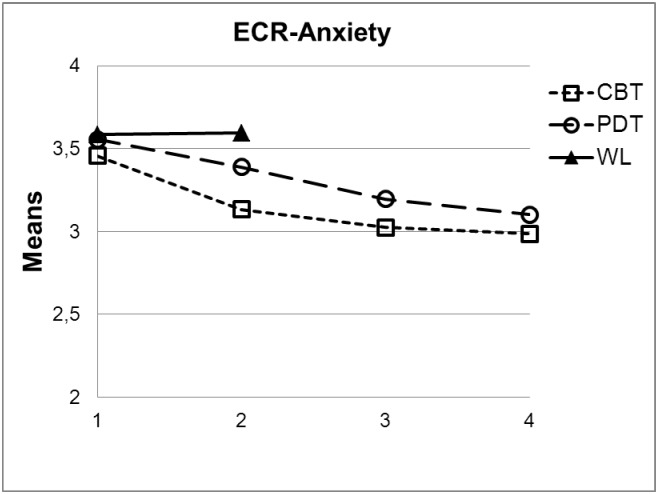
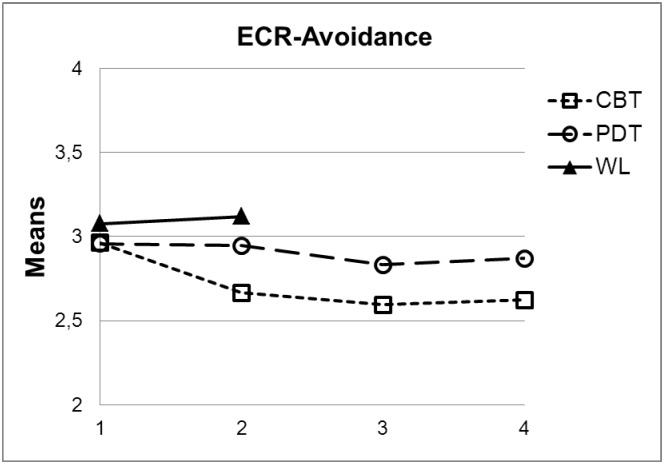
- Waiting-list patients showed no pre-post change in attachment anxiety (Mpre = 3.58, SD = 1.14 vs. Mpost = 3.59, SD = 1.16; t(53) = .29, p = .77) or avoidance (Mpre = 3.08, SD = 1.04 vs. Mpost = 3.12, SD = 1.12; t(53) = -.03, p = .987).
- Compared with waiting list, CBT showed significant pre-post improvement in attachment anxiety (ES = -.30, p = .005) and avoidance (ES = -.23, p = .034); PDT did not (anxiety ES = -.12, p = .254; avoidance ES = -.01, p = .976). Pre-post CBT vs. PDT favored CBT for avoidance (ES = -.24, p = .009) but not significantly for anxiety (ES = -.16, p = .060).
- From post-treatment to 12-month follow-up, attachment anxiety decreased significantly in both CBT (Mpost = 3.13 vs. M12 = 2.99; t(97) = 2.21, p = .03) and PDT (Mpost = 3.39 vs. M12 = 3.10; t(89) = 2.45, p = .02), while avoidance remained stable. CBT vs. PDT differences at 6 and 12 months were not statistically significant, and no significant treatment type × pre-treatment attachment interactions were detected.
Methods
- Randomized controlled trial (SOPHO-Net) comparing manualized CBT, short-term PDT, and waiting list in patients with social anxiety disorder; 495 were randomized, and analyses used 474 patients with valid ECR scores (244 CBT, 230 PDT).
- Attachment was measured with the German 33-item ECR-R at pre-treatment, post-treatment, 6 months, and 12 months (Cronbach’s α = .93 anxiety, .92 avoidance); social anxiety was measured with the LSAS at pre-treatment, post-treatment, 6 months, and 12 months. A representative non-clinical sample (N = 2508) completed a 12-item ECR-R short version for comparison.
- Analyses used generalized ANCOVA via EffectLite v.3.1.3 with a multi-sample structural equation approach and full information maximum likelihood, adjusted means, t-tests, Spearman correlations, and Cohen’s d; pre-treatment scores served as covariates, with alpha adjusted for multiple comparisons.
Limitations
- The paper states one limitation: there is a lack of longer-term follow-up data in the control group.
- Evident from the text: waiting-list patients had only pre-post measures and were then randomized to active treatment, so no long-term untreated control comparison was available.
- Evident from the text: attachment was assessed only by self-report ECR-R, and the clinical sample used the 33-item long version while the representative sample used a 12-item short version with selected subscales for comparison.
Model-written summary. Check it against the paper before relying on it.
Integrity signals
Registry
Cites
Statistics
Figures
Verification
Claims the paper makes
0 Valid · 0 Not valid · 31 Not checked · 31 Own results and interpretations
A result the paper reports from its own data — it cites no other source for it, so there is none to check. The quote shows it is in the paper.
In the paper
“LSAS scores correlated significantly with both ECR-R subscales.”
§ Changes of attachment characteristics during psychotherapy of patients with social anxiety disorder: Results from the SOPHO-Net trial > Abstract > Results
plainstates an association- Asserted: passes — The authors put it forward as true.
- Checkable: passes — It can be checked against evidence.
- Load-bearing: unclear — It is unclear whether the paper’s conclusions depend on it.
- Based: passes — The paper gives a reason why it holds.
A result the paper reports from its own data — it cites no other source for it, so there is none to check. The quote shows it is in the paper.
In the paper
“Post-therapy, patients treated with CBT revealed significant changes in attachment anxiety and avoidance whereas patients treated with PDT showed no significant changes.”
§ Changes of attachment characteristics during psychotherapy of patients with social anxiety disorder: Results from the SOPHO-Net trial > Abstract > Results
plainstates a cause- Asserted: passes — The authors put it forward as true.
- Checkable: passes — It can be checked against evidence.
- Load-bearing: passes — The paper’s conclusions depend on it.
- Based: passes — The paper gives a reason why it holds.
A result the paper reports from its own data — it cites no other source for it, so there is none to check. The quote shows it is in the paper.
In the paper
“Post-therapy, patients treated with CBT revealed significant changes in attachment anxiety and avoidance whereas patients treated with PDT showed no significant changes.”
§ Changes of attachment characteristics during psychotherapy of patients with social anxiety disorder: Results from the SOPHO-Net trial > Abstract > Results
plain- Asserted: passes — The authors put it forward as true.
- Checkable: passes — It can be checked against evidence.
- Load-bearing: passes — The paper’s conclusions depend on it.
- Based: passes — The paper gives a reason why it holds.
A result the paper reports from its own data — it cites no other source for it, so there is none to check. The quote shows it is in the paper.
In the paper
“Changes between post-treatment and the two follow-ups were significant in both conditions, with minimal (insignificant) differences between treatments at the 12- month follow-up.”
§ Changes of attachment characteristics during psychotherapy of patients with social anxiety disorder: Results from the SOPHO-Net trial > Abstract > Results
plain- Asserted: passes — The authors put it forward as true.
- Checkable: passes — It can be checked against evidence.
- Load-bearing: passes — The paper’s conclusions depend on it.
- Based: passes — The paper gives a reason why it holds.
A result the paper reports from its own data — it cites no other source for it, so there is none to check. The quote shows it is in the paper.
In the paper
“With regard to long-term treatment effects we did not find statistically significant differences between the treatment groups.”
- Also stated in: § Discussion and conclusions · hedged
“differences between the treatment conditions were not or only marginally significant at 6-months and 12 months follow-up.”
§ Changes of attachment characteristics during psychotherapy of patients with social anxiety disorder: Results from the SOPHO-Net trial > Results
plain- Asserted: passes — The authors put it forward as true.
- Checkable: passes — It can be checked against evidence.
- Load-bearing: passes — The paper’s conclusions depend on it.
- Based: passes — The paper gives a reason why it holds.
- Also stated in: § Discussion and conclusions · hedged
22 more claims
Create a free account to see all 62 claims and to verify the 45 references still open.
- It may state two separate claims as one. 20
- Probably not a substantial claim. 24
Statistics that don’t add up
Each reported p-value recomputed from its test statistic and degrees of freedom, each partial η² from its F, and each ratio, mean difference or B printed with a p checked against its own confidence interval.
Rated minor: it would not touch a result — a value no result rests on, a p-value that stays on the same side of the significance level, or a conflict that is clerical, resolved elsewhere in the paper, or outside its own findings.
In the paper
“t(53) = -.03, p = .987”
§ Changes of attachment characteristics during psychotherapy of patients with social anxiety disorder: Results from the SOPHO-Net trial > Results
Reported p = .987 · recomputed p = .976
Statistics recomputed
Every reported test result, recomputed from its test statistic and degrees of freedom. A result shows as not adding up only once an independent check has confirmed it.
- Doesn’t add upt(53) = -0.03reported p = .987 · recomputed p = .976
“t(53) = -.03, p = .987”
- Consistentt(53) = 0.29reported p = .77 · recomputed p = .773
“t(53) = .29, p = .77”
- Consistentt(97) = 2.21reported p = .03 · recomputed p = .029
“t(97) = 2.21, p = .03”
- Consistentt(89) = 2.45reported p = .02 · recomputed p = .016
“t(89) = 2.45, p = .02”
- Consistentt(97) = -0.23reported p = .82 · recomputed p = .819
“t(97) = -.23, p = .82”
1 more recomputed test
Create a free account to see every test the Stats check recomputed.
Self-check
Percentages, sums and reported differences re-computed from the paper’s own numbers.
Each contradiction between two passages listed here was confirmed by an independent check.
Rated major: it would touch a result — a value a result rests on, reported and recomputed p-values on opposite sides of the significance level, two passages that conflict with no sign which is right, or a cited work retracted before this paper was published.
In the paper
§ Changes of attachment characteristics during psychotherapy of patients with social anxiety disorder: Results from the SOPHO-Net trial > Materials and methods > The SOPHO-NET study
“Both manual-guided treatments comprised up to 25 individual (50-minute) treatment sessions.”
§ Changes of attachment characteristics during psychotherapy of patients with social anxiety disorder: Results from the SOPHO-Net trial > Materials and methods > The SOPHO-NET study
“The mean (±SD) number of completed sessions was 25.84±9.13 for CBT and 25.67±9.61 for psychodynamic therapy”
Rated minor: it would not touch a result — a value no result rests on, a p-value that stays on the same side of the significance level, or a conflict that is clerical, resolved elsewhere in the paper, or outside its own findings.
In the paper
§ Changes of attachment characteristics during psychotherapy of patients with social anxiety disorder: Results from the SOPHO-Net trial > Materials and methods > Sample
“| ECR anxiety (short version) | 2,4 | (1,3) | 3,7 | (1,1) | 3,7 | (1,5) | 3,8 | (1,5) |”
§ Changes of attachment characteristics during psychotherapy of patients with social anxiety disorder: Results from the SOPHO-Net trial > Materials and methods > Sample
“a total of 474 patients, 244 in the CBT and 230 in the PDT condition”
Rated minor: it would not touch a result — a value no result rests on, a p-value that stays on the same side of the significance level, or a conflict that is clerical, resolved elsewhere in the paper, or outside its own findings.
In the paper
§ Changes of attachment characteristics during psychotherapy of patients with social anxiety disorder: Results from the SOPHO-Net trial > Abstract > Results
“Changes between post-treatment and the two follow-ups were significant in both conditions”
§ Changes of attachment characteristics during psychotherapy of patients with social anxiety disorder: Results from the SOPHO-Net trial > Results
“attachment avoidance remained rather stable after treatment with no differential treatment effects (CBT: Mpost = 2.67, SDpre = .99 vs. M12-months = 2.62, SD12-months = 1.03; t(97) = -.23, p = .82; PDT: Mpost = 2.95, SDpre = 1.07 vs. M12-months = 2.87, SD12-months = 1.09; t(88) = .93, p = .36).”
Rated minor: it would not touch a result — a value no result rests on, a p-value that stays on the same side of the significance level, or a conflict that is clerical, resolved elsewhere in the paper, or outside its own findings.
In the paper
§ Changes of attachment characteristics during psychotherapy of patients with social anxiety disorder: Results from the SOPHO-Net trial > Materials and methods > Sample
“| ECR avoidance (short version) | 2,6 | (1,4) | 2,8 | (0,9) | 2,8 | (1,2) | 2,8 | (1,3) |”
§ Changes of attachment characteristics during psychotherapy of patients with social anxiety disorder: Results from the SOPHO-Net trial > Materials and methods > Sample
“a total of 474 patients, 244 in the CBT and 230 in the PDT condition”
Rated minor: it would not touch a result — a value no result rests on, a p-value that stays on the same side of the significance level, or a conflict that is clerical, resolved elsewhere in the paper, or outside its own findings.
In the paper
§ Changes of attachment characteristics during psychotherapy of patients with social anxiety disorder: Results from the SOPHO-Net trial > Results
“although—with respect to attachment anxiety—the contrast was not statistically significant using two-tailed tests (p = .60)”
§ Changes of attachment characteristics during psychotherapy of patients with social anxiety disorder: Results from the SOPHO-Net trial > Results
“| CBT vs. PDT | -.16 | .060 |”
Citations
Cites
Attachment styles among young adults: A test of a four-category model.
Bartholomew, K., & Horowitz, L. M. (1991) · Journal of Personality and Social Psychology · doi:10.1037//0022-3514.61.2.226 · Cited by 8,384
Handbook of attachment: theory, research, and clinical applications
(1999) · Choice Reviews Online · doi:10.5860/choice.37-1841 · Cited by 5,389
(1998) · Cited by 3,968
Handbook of attachment: theory, research, and clinical applications
(2009) · Choice Reviews Online · doi:10.5860/choice.46-4135 · Cited by 3,806
An Item-Response Theory Analysis of Self-Report Measures of Adult Attachment
Fraley, R. C., Waller, N. G., & Brennan, K. A. (2000) · Journal of Personality and Social Psychology · doi:10.1037/0022-3514.78.2.350 · Cited by 3,385
Ainsworth, M. S. (1989) · American Psychologist · doi:10.1037/0003-066x.44.4.709 · Cited by 3,231
Kessler, R. C., Petukhova, M., Sampson, N. A., Zaslavsky, A. M., & Wittchen, H. (2012) · International Journal of Methods in Psychiatric Research · doi:10.1002/mpr.1359 · Cited by 2,947
Psychosomatic medicine in Germany: more timely than ever
Zipfel, S., Herzog, W., Kruse, J., & Henningsen, P. (2016) · Psychotherapy and Psychosomatics · doi:10.1159/000447701 · Cited by 2,323
Liebowitz, M. R. (2015) · Modern Trends in Pharmacopsychiatry · doi:10.1159/000414022 · Cited by 2,266
Avoidance of Intimacy: An Attachment Perspective
Bartholomew, K. (1990) · Journal of Social and Personal Relationships · doi:10.1177/0265407590072001 · Cited by 2,153
Research works printed but not linked: 2
- Kessler RC. The impairments caused by social phobia in the general population. Acta Psychiatrica Scandinavica. 2003; 108, 19– 27. 12950433 · DOI · Paper page
- Brown TA, diNardo P, Barlow DH. Anxiety Disorders Interview Schedule Adult Version. Oxford: Oxford University Press; 1994.
Cited by
Roles for the gut microbiota in regulating neuronal feeding circuits
Yu, K. B., & Hsiao, E. Y. (2021) · Journal of Clinical Investigation · doi:10.1172/jci143772 · Cited by 88
Aira, A., Fehér, C., Rubio-García, E., & Soriano, À. (2019) · Infectious Diseases and Therapy · doi:10.1007/s40121-019-00272-7 · Cited by 45
Conrad, R., Forstner, A. J., Chung, M., Mücke, M., Geiser, F., Schumacher, J., & Carnehl, F. (2021) · BMC Psychiatry · doi:10.1186/s12888-021-03098-1 · Cited by 39
Strauss, B. M., Altmann, U., Schönherr, D., Schurig, S., Singh, S., & Petrowski, K. (2022) · Psychotherapy Research · doi:10.1080/10503307.2021.2020930 · Cited by 32
Self-citationZhou, Y., Arend, J. L., Mufson, L. H., & Gunlicks‐Stoessel, M. (2020) · Psychotherapy Research · doi:10.1080/10503307.2020.1756513 · Cited by 19
The efficacy of psychodynamic therapy for social anxiety disorder–A comprehensive meta-analysis
Zhang, Q., Yi, P., Song, G., Xu, K., Wang, Y., Liu, J., Chen, Z., Zhang, H., Ma, L., Liu, W., et al. (2022) · Psychiatry Research · doi:10.1016/j.psychres.2022.114403 · Cited by 18
Gorelik, M., Szepsenwol, O., & Doron, G. (2023) · Heliyon · doi:10.1016/j.heliyon.2023.e21673 · Cited by 18
Tian, X., Tang, L., Wei, F., Chen, H., Sheng, L., Yang, Y., Zhou, X., Li, Y., Xu, X., Zhang, B., et al. (2021) · Molecular Immunology · doi:10.1016/j.molimm.2021.01.019 · Cited by 17
Altmann, U., Nodop, S., Dinger, U., Ehrenthal, J. C., Schauenburg, H., Dymel, W., Willutzki, U., & Strauss, B. M. (2020) · Clinical Psychology & Psychotherapy · doi:10.1002/cpp.2513 · Cited by 13
Self-citationIntegrative Psychotherapy: A Mindfulness- and Compassion-Oriented Approach
Žvelc, G., & Žvelc, M. (2020) · Routledge eBooks · doi:10.4324/9780429290480 · Cited by 12
Swee, M. B., Butler, R. M., Ross, B. V., Horenstein, A., O’Day, E. B., & Heimberg, R. G. (2021) · Cognitive Therapy and Research · doi:10.1007/s10608-020-10192-3 · Cited by 9
Zalaznik, D., Zlotnick, E., Barzilay, S., Ganor, T., Sorka, H., Ebert, D. D., Andersson, G., & Huppert, J. D. (2024) · Psychotherapy Research · doi:10.1080/10503307.2024.2325510 · Cited by 8
Müller, S., Spitzer, C., Flemming, E., Ehrenthal, J. C., Mestel, R., Strauss, B. M., & Lübke, L. (2023) · Journal of Personality Assessment · doi:10.1080/00223891.2023.2238816 · Cited by 7
Smith, K. V., Skjerdingstad, N., Ebrahimi, O. V., Maccallum, F., & Ehlers, A. (2025) · Psychological Medicine · doi:10.1017/s0033291725101669 · Cited by 5
Sekowski, M. M., & Gambin, M. (2025) · Journal of Clinical Psychology · doi:10.1002/jclp.70019 · Cited by 5
Leutritz, A. L., Čolić, L., Borchardt, V., Cheng, X. M., Zhang, B., Lison, S., Frommer, J., Buchheim, A., Strauss, B. M., Fonagy, P., et al. (2019) · Psychology and Psychotherapy Theory Research and Practice · doi:10.1111/papt.12258 · Cited by 4
Self-citationStrauss, B. M., Grass, N., Ritter, V., Stangier, U., Nolting, B., Herpertz, S., Dymel, W., Willutzki, U., & Nodop, S. (2018) · PPmP - Psychotherapie · Psychosomatik · Medizinische Psychologie · doi:10.1055/a-0639-5568 · Cited by 4
Self-citationBarazzone, N., Santos, I., McGowan, J. F., Crowley, M., Chamberlain, A. R., & Donaghay‐Spire, E. G. (2023) · Journal of EMDR Practice and Research · doi:10.1891/emdr-2022-0053 · Cited by 2
Margraf, J., & Pittig, A. (2021) · Elsevier eBooks · doi:10.1016/b978-3-437-21352-6.00012-2 · Cited by 1
Predictors of Clinical Outcomes in IADC Therapy
D’Antoni, F., & Lalla, C. (2026) · Psychology International · doi:10.3390/psycholint8010014 · Cited by 1
Olssøn, I., & Dahl, A. A. (2020) · Personality and Mental Health · doi:10.1002/pmh.1500 · Cited by 1
Sasin, D., Rybczynski, B., Maj, B. W., Chwaszcz, J., Pruc, M., Niewiadomska, I., & Szarpak, Ł. (2026) · Journal of Clinical Medicine · doi:10.3390/jcm15114223 · Cited by 1
Investigation of polygenic risk scores and subphenotypes in social anxiety disorder
Sindermann, L., Röhrig, A., David, F. S., Schmidt, B., Domschke, K., Nieratschker, V., Dannlowski, U., Leehr, E. J., Leibing, E., Nöthen, M. M., et al. (2026) · Translational Psychiatry · doi:10.1038/s41398-026-04155-7
Self-citationCONTRIBUIÇÃO DA CINOTERAPIA PARA PSICOTERAPIA EM IDOSOS INSTITUCIONALIZADOS
Corrêa, G. T., Araujo, M. N., Lourenço, C. H. L., Costa, D. B., Pereira, J. D. A., Serra, R. D. C. E. S., Fonteles, T. F., & Santana, L. N. (2021) · doi:10.22533/at.ed.63721070712
A IMPORTÂNCIA DA PSICOLOGIA JURÍDICA NOS PROCESSOS JUDICIAIS DE ALIENAÇÃO PARENTAL
da Silveira, F. M., Castro, A. B. S., Barbosa, E. D. L., da Silva, V. A., & Santos, V. L. S. (2021) · doi:10.22533/at.ed.63721070715
PSICOSES, FAMÍLIA E ARTE: MEIOS PARA PSICOEDUCAÇÃO DE FAMILIARES PELA ARTE
dos Santos, B. L., Nogueira, A. A., & de Meis, C. (2021) · doi:10.22533/at.ed.63721070716
LUTO PERINATAL: OS DANOS PSICOLÓGICOS CAUSADOS PELAS PERDAS GESTACIONAL E NEONATAL
Santos, L. D. S., Damasceno, R. A., de Farias, R. R. S., & Souza, S. C. (2021) · doi:10.22533/at.ed.63721070713
Docasar, D., Silva, A. D. S., Silva, D. C. D. S., Lima, G. V. D. S., & Barboza, R. M. (2021) · doi:10.22533/at.ed.63721070719
Cano, P. L. C., Alba, D. M., Effinger, R. J., Sánchez, A. M., Reina, S., Barrios, M. T. C., & Berenguer, N. R. (2019) · UMA Editorial eBooks · doi:10.24310/mumaedmumaed.59
Abapolnikova, M., Coyne, A. E., Glushka, L. R., Liu, C. J., Constantino, M. J., Atkinson, L. R., Bagby, R. M., Ravitz, P., & McBride, C. (2026) · Psychotherapy Research · doi:10.1080/10503307.2026.2656698
Krasko, J., & Mohr, P. (2026) · Die Psychotherapie · doi:10.1007/s00278-026-00882-w
A bio-psycho-social perspective on anxiety disorders treated with cognitive behavioral therapy
Lange, J. (2026) · Publication Server of the Catholic University Eichstätt-Ingolstadt (Catholic University of Eichstätt-Ingolstadt) · doi:10.17904/ku.opus-1048
Schönherr, D. (2019) · Common Library Network (Der Gemeinsame Bibliotheksverbund) · doi:10.22032/dbt.38613
Durand, K. (2023) · ScholarWorks (Walden University)
Understanding social anxiety and self-disclosure in male friendships: a thematic analysis
Connolly, K. M. (2024) · London Met Repository (London Metropolitan University)
PANDEMIA DO MEDO E COVID-19: IMPACTOS DA PANDEMIA NA SAÚDE MENTAL
Lima, C. S. D. A., Tolentino, C. F., Beserra, M. M., Camacho, C. R. D., Souza, A. L. M., Souza, G. C. M., Souza, G. J. M., de Moraes, M. G. T., Alencar, C. A. M., Reis, D. M. M., et al. (2021) · doi:10.22533/at.ed.6372107071
Junior, F. J. B. M. (2022) · Zenodo (CERN European Organization for Nuclear Research) · doi:10.5281/zenodo.7330834
Bicknell, S. (2025) · University Of Wales Trinity Saint David Research Repository (University of Wales Trinity Saint David) · doi:10.82227/repository.uwtsd.ac.uk.00003648
Bağlanma Stilleri ile Bilişsel Davranışçı Terapi Temelli Değişkenler Üzerine Bir Sistematik Derleme
Sıla, Ç. B., & Karaaziz, M. (2026) · WORLD WOMEN STUDIES JOURNAL · doi:10.5281/zenodo.20369083
Metadata
- Authors
- Strauß, B., Altmann, U., Manes, S., Tholl, A., Koranyi, S., Nolte, T., Beutel, M. E., Wiltink, J., Herpertz, S., Hiller, W., Hoyer, J., Joraschky, P., Nolting, B., Ritter, V., Stangier, U., Willutzki, U., Salzer, S., Leibing, E., Leichsenring, F., & Kirchmann, H.
- Affiliations
- Jena University Hospital (DE)
- Anna Freud Centre (GB)
- Johannes Gutenberg University Mainz (DE)
- LWL-Universitätsklinikum Bochum (DE)
- Technische Universität Dresden (DE)
- Goethe University Frankfurt (DE)
- Witten/Herdecke University (DE)
- International Psychoanalytic University Berlin (DE)
- University of Göttingen (DE)
- Justus-Liebig-Universität Gießen (DE)
- Corresponding author
- Strauß, Bernhard
- ORCID
- Venue
- PLOS ONE
- Publisher
- Public Library of Science (PLoS)
- Published
- 2018-03-08
- Volume
- 13
- Issue
- 3
- Pages
- e0192802
- ISSN
- 1932-6203 (ISSN-L)
- PMC
- PMC5843211
- OpenAlex
- W2790682781
- Cited by
- 39
- References
- 47
- Citations by year
- 2026: 7 · 2025: 3 · 2024: 2 · 2023: 4 · 2022: 3 · 2021: 11 · 2020: 4 · 2019: 4 · 2018: 1
- FWCI
- 4.54
- Type
- journal article
- Language
- en
- Open access
- gold
- doi.org
- Licence
- Locations
- PLoS ONE (publishedVersion, cc-by)
- PubMed Central (publishedVersion, cc-by)
- PubMed (publishedVersion)
- RePEc: Research Papers in Economics (submittedVersion)
- DOAJ (DOAJ: Directory of Open Access Journals) (submittedVersion)
- GoeScholar The Publication Server of the Georg-August-Universität Göttingen (Georg-August-Universität Göttingen) (submittedVersion, cc-by)
- Publication Server of Goethe University Frankfurt am Main (Goethe University Frankfurt) (submittedVersion, cc-by)
- Funders
- Bundesministerium für Bildung und Forschung (BMBF) (01GV0607)
- Topics
- Social Sciences › Psychology › Clinical Psychology › Psychotherapy Techniques and Applications
- Social Sciences › Psychology › Experimental and Cognitive Psychology › Anxiety, Depression, Psychometrics, Treatment, Cognitive Processes
- Social Sciences › Psychology › Social Psychology › Attachment and Relationship Dynamics
- Keywords
- attachment, social anxiety disorder, cognitive behavioral therapy, psychodynamic psychotherapy, attachment anxiety, attachment avoidance, Liebowitz Social Anxiety Scale, psychotherapy outcome
- MeSH terms
- Adult, Aged, Anxiety Disorders, Female, Humans, Male, Middle Aged, Object Attachment, Psychiatric Status Rating Scales, Surveys and Questionnaires, Time Factors, Waiting Lists, Cognitive Behavioral Therapy, Treatment Outcome, Young Adult, Psychotherapy, Psychodynamic
About these checks
Registry, retraction, Cites and statistics results are computed, not judged, with one exception: a printed reference that no index lists is read once by a model before it counts as a citation error. Claims are extracted by a model and kept only when their quote appears verbatim in the text; each cited source is then checked, with a model’s help, for whether it says what the claim relies on. Those verdicts can be wrong — read the claim’s quote and the cited source before relying on one.
A language model drew the claims from the paper on 2026-11-24, under version 3 of the claim definition (model deepseek-v4.1-flash, prompt extract-v3).
A second model labelled each claim on 2026-11-24 (model jev-1.13-20260917, definition revision gold-guideline-v0.2).
Statistics and arithmetic are recomputed, not judged.
Confidence bands are shown only for fields calibrated on our annotated test set. None is calibrated yet, so no band is shown.
What counts as a claim ›How we measure confidence ›How we check this ›
Are you an author, or do you see a problem with this page? Request a review
Data sources
Bibliographic data: Semantic Scholar, OpenAlex, Crossref.
Contains information from the Semantic Scholar Academic Graph Datasets, made available under the ODC Attribution License (ODC-BY 1.0).
Semantic Scholar’s data is described in: Kinney, R., et al. (2023). The Semantic Scholar Open Data Platform. arXiv:2301.10140.
