

The DOI matches its Crossref record; 36 of the 36 references it cites were found in a registry or an index.
Nighttime lights as a proxy for human development at the local level
Open accessAbstract
Nighttime lights, calculated from weather satellite recordings, are increasingly used by social scientists as a proxy for economic activity or economic development in subnational regions of developing countries where disaggregated data from statistical offices are not available. However, so far, our understanding of what nighttime lights capture in these countries is limited. We use geo-referenced Demographic and Health Surveys (DHS) from 29 African countries to construct indicators of household wealth, education and health for DHS cluster locations as well as for grid cells of roughly 50 × 50 km. We show that nighttime lights are positively associated with these location-specific indicators of human development, and that the variation in nighttime lights can explain a substantial share in the variation in these indicators. We conclude that nighttime lights are a good proxy for human development at the local level.
Overview
The claims and statistics of this paper haven’t been checked yet.
Run the check — free, no account needed. It reads the open-access text and checks the sources it cites.
Integrity signals
Registry
Cites
Statistics
Figures
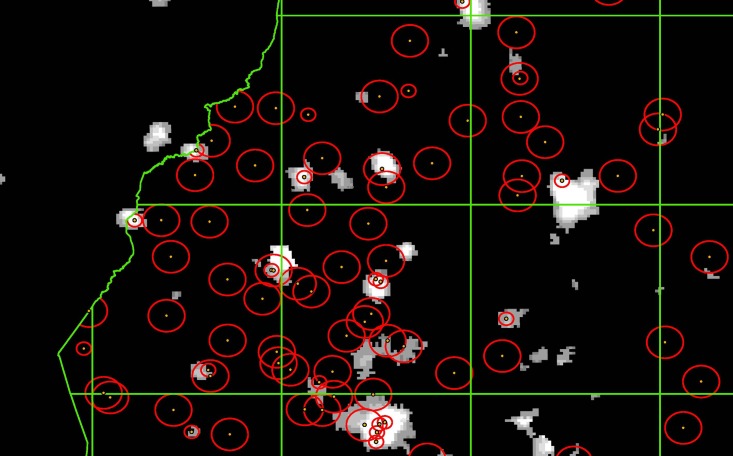
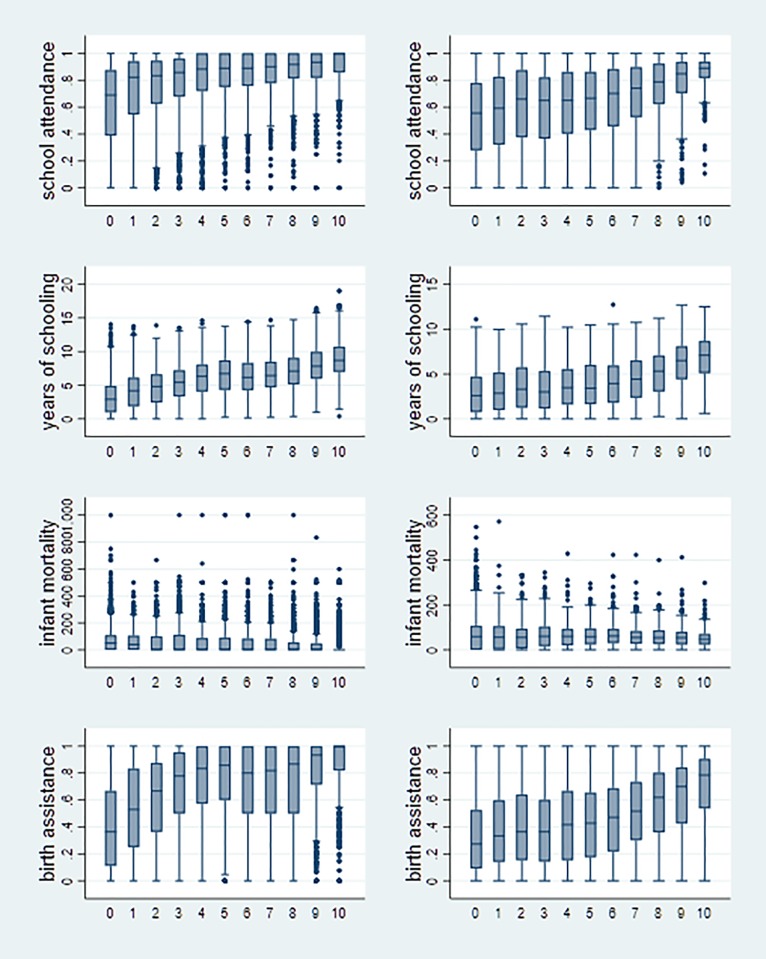
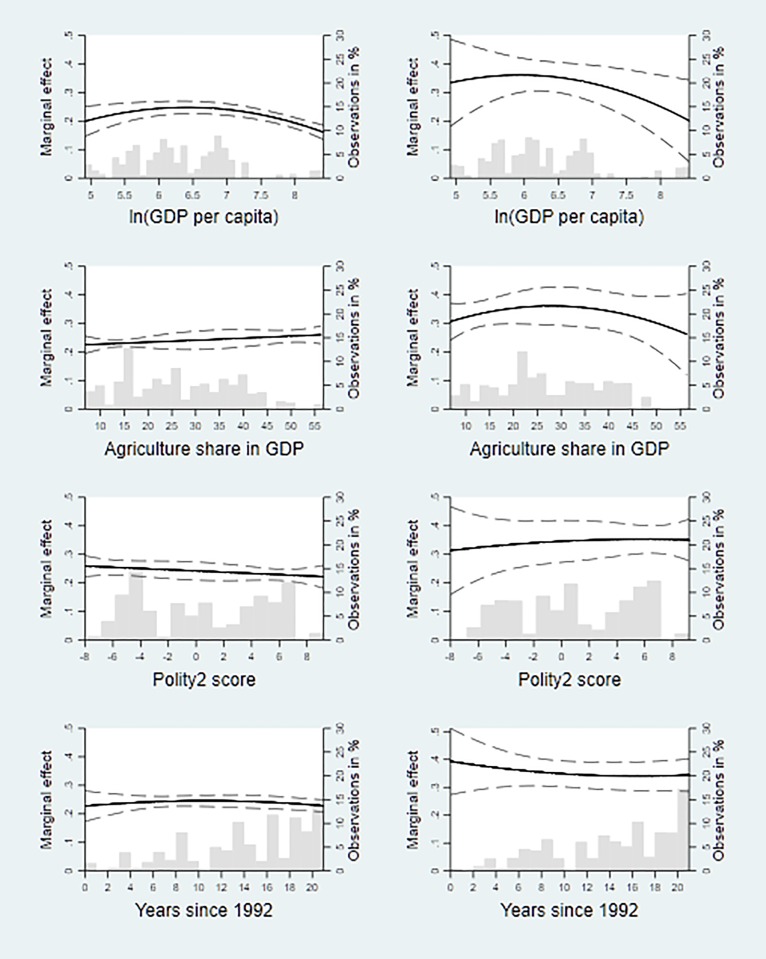
Verification
Claims the paper makes
The claims and statistics of this paper haven’t been checked yet.
Run the check — free, no account needed. It reads the open-access text and checks the sources it cites.
Claims other papers make about this one
Each is checked against this paper’s own text: does it say what the citing paper says it does?
The source backs part of the claim, not all of it — or backs it for a different population, condition or comparison.
In the citing paper
“Compared to previous studies of economic activity and nightlights, 𝑅 2 in Table 2 are in general slightly lower than ranges in previous studies [7, 15, 18, 29].”
From Under the Radar -- Auditing Fairness in ML for Humanitarian Mapping (2021) · cites this paper as [7]
Experimental — accuracy not yet measured
Self-check
Percentages, sums and reported differences re-computed from the paper’s own numbers.
The self-check needs the paper’s full text.
Citations
Cites
Murray, D. D., Suzuki, K., Law, M. G., Trebicka, J., Neuhaus, J., Wentworth, D. N., Johnson, M. A., Vjecha, M. J., Kelleher, A. D., Emery, S., et al. (2015) · PLoS ONE · doi:10.1371/journal.pone.0139981 · Cited by 2,740
Measuring Economic Growth from Outer Space
Henderson, J. V., Storeygard, A., & Weil, D. N. (2012) · American Economic Review · doi:10.1257/aer.102.2.994 · Cited by 2,596
(2017) · The SHAFR Guide Online · doi:10.1163/2468-1733_shafr_sim010030025 · Cited by 2,357
Combining satellite imagery and machine learning to predict poverty
Jean, N., Burke, M., Xie, M., Davis, W. M., Lobell, D. B., & Ermon, S. (2016) · Science · doi:10.1126/science.aaf7894 · Cited by 1,664
Alternative Transformations to Handle Extreme Values of the Dependent Variable
Burbidge, J. B., Magee, L., & Robb, A. L. (1988) · Journal of the American Statistical Association · doi:10.1080/01621459.1988.10478575 · Cited by 1,425
Using luminosity data as a proxy for economic statistics
Chen, X., & Nordhaus, W. D. (2011) · Proceedings of the National Academy of Sciences · doi:10.1073/pnas.1017031108 · Cited by 1,188
Rutstein, S. O., & Johnson, K. (2004) · doi:10.13140/2.1.2806.4809 · Cited by 1,169
Pre-Colonial Ethnic Institutions and Contemporary African Development
(2013) · Econometrica · doi:10.3982/ecta9613 · Cited by 953
Hodler, R., & Raschky, P. A. (2014) · The Quarterly Journal of Economics · doi:10.1093/qje/qju004 · Cited by 744
Self-citationMapping regional economic activity from night-time light satellite imagery
Doll, C., Muller, J., & Morley, J. (2006) · Ecological Economics · doi:10.1016/j.ecolecon.2005.03.007 · Cited by 703
Cited by
Sorted by citations
African leaders and the geography of China's foreign assistance
Dreher, A., Fuchs, A., Hodler, R., Parks, B. C., Raschky, P. A., & Tierney, M. J. (2019) · Journal of Development Economics · doi:10.1016/j.jdeveco.2019.04.003 · Cited by 333
Self-citationDrivers of global mangrove loss and gain in social-ecological systems
Hagger, V., Worthington, T. A., Lovelock, C. E., Adame, M. F., Amano, T., Brown, B. M., Friess, D. A., Landis, E., Mumby, P. J., Morrison, T. H., et al. (2022) · Nature Communications · doi:10.1038/s41467-022-33962-x · Cited by 267
Machine learning in agricultural and applied economics
Storm, H., Baylis, K., & Heckelei, T. (2019) · European Review of Agricultural Economics · doi:10.1093/erae/jbz033 · Cited by 240
Global emergence of unprecedented lifetime exposure to climate extremes
Grant, L., Vanderkelen, I., Gudmundsson, L., Fischer, E. M., Seneviratne, S. I., & Thiery, W. (2025) · Nature · doi:10.1038/s41586-025-08907-1 · Cited by 203
Leveraging mobile phones to attain sustainable development
Rotondi, V., Kashyap, R., Pesando, L. M., Spinelli, S., & Billari, F. C. (2020) · Proceedings of the National Academy of Sciences · doi:10.1073/pnas.1909326117 · Cited by 146
Metadata
- Authors
- Bruederle, A., & Hodler, R.
- Affiliations
- University of St.Gallen (CH)
- Corresponding author
- Hodler, Roland
- Venue
- PLOS ONE
- Publisher
- Public Library of Science (PLoS)
- Published
- 2018-09-05
- Volume
- 13
- Issue
- 9
- Pages
- e0202231
- ISSN
- 1932-6203 (ISSN-L)
- PMC
- PMC6124706
- OpenAlex
- W2742305379
- Cited by
- 259
- References
- 36
- Citations by year
- 2026: 19 · 2025: 31 · 2024: 37 · 2023: 36 · 2022: 40 · 2021: 58 · 2020: 15 · 2019: 16 · 2018: 6
- FWCI
- 13.90
- Type
- journal article
- Language
- en
- Open access
- gold
- doi.org
- Licence
- Locations
- PLoS ONE (publishedVersion, cc-by)
- Europe PMC (PubMed Central) (publishedVersion, cc-by)
- PubMed Central (publishedVersion, cc-by)
- PubMed (publishedVersion)
- RePEc: Research Papers in Economics (submittedVersion)
- Alexandria (UniSG) (University of St.Gallen) (submittedVersion)
- DOAJ (DOAJ: Directory of Open Access Journals) (submittedVersion, cc-by-sa)
- Figshare (submittedVersion, cc-by)
- Funders
- Universität St. Gallen (Basic Research Grant)
- Topics
- Physical Sciences › Environmental Science › Global and Planetary Change › Impact of Light on Environment and Health
- Social Sciences › Transportation › Human Mobility and Location-Based Analysis
- Social Sciences › Development › Culture, Economy, and Development Studies
- Keywords
- nighttime lights, human development, proxy indicators, household wealth, subnational regions, developing countries, African countries, satellite remote sensing, local economic development
- MeSH terms
- Africa, Algorithms, Developing Countries, Geography, Humans, Lighting, Surveys and Questionnaires, Socioeconomic Factors, Time Factors, Models, Economic
About these checks
Registry, retraction, Cites and statistics results are computed, not judged, with one exception: a printed reference that no index lists is read once by a model before it counts as a citation error. Claims are extracted by a model and kept only when their quote appears verbatim in the text; each cited source is then checked, with a model’s help, for whether it says what the claim relies on. Those verdicts can be wrong — read the claim’s quote and the cited source before relying on one.
Statistics and arithmetic are recomputed, not judged.
Confidence bands are shown only for fields calibrated on our annotated test set. None is calibrated yet, so no band is shown.
What counts as a claim ›How we measure confidence ›How we check this ›
Are you an author, or do you see a problem with this page? Request a review
