

Safety, efficacy, and dose response of the maturation inhibitor GSK3532795 (formerly known as BMS-955176) plus tenofovir/emtricitabine once daily in treatment-naive HIV-1-infected adults: Week 24 primary analysis from a randomized Phase IIb trial
Open accessThe DOI matches its Crossref record; 12 of the 12 references it cites were found in a registry or an index.
Abstract
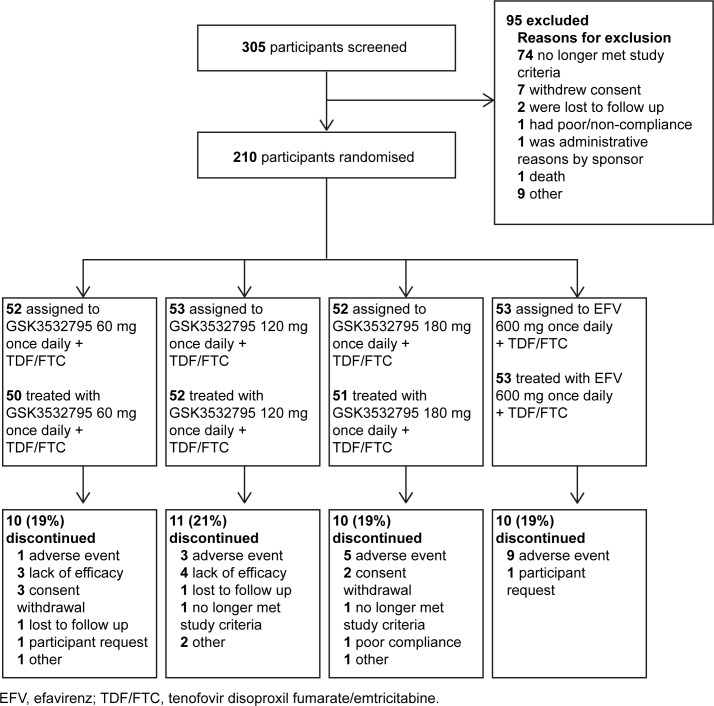
GSK3532795 (formerly known as BMS-955176) is a second-generation maturation inhibitor targeting a specific Gag cleavage site between capsid p24 and spacer peptide 1 of HIV-1. Study 205891 (previously AI468038) investigated the efficacy, safety, and dose response of GSK3532795 in treatment-naive, HIV-1-infected participants. Study 205891 (NCT02415595) was a Phase IIb, randomized, active-controlled, double-blind, international trial. Participants were randomized 1:1:1:1 to one of three GSK3532795 arms at doses 60 mg, 120 mg or 180 mg once daily (QD), or to efavirenz (EFV) at 600 mg QD, each in combination with tenofovir disoproxil fumarate and emtricitabine (TDF/FTC) (300/200 mg QD). Primary endpoint was proportion of participants with plasma HIV-1 RNA <40 copies/mL at Week 24. Between May 2015 and May 2016, 206 participants received treatment. At Week 24, 76-83% participants receiving GSK3532795 and 77% receiving EFV achieved HIV-1 RNA <40 copies/mL. Fifteen participants receiving GSK3532795 and one receiving EFV met resistance testing criteria; 10/15 receiving GSK3532795 had emergent substitutions at reverse transcriptase positions M184, and one at position K65, while the participant receiving EFV did not have any nucleoside reverse transcriptase inhibitor (NRTI)/non-NRTI mutations. EFV, relative to GSK3532795, had more serious adverse events (9% versus 5%) and adverse events leading to discontinuation (17% versus 5%). However, 3-4-fold higher rates of gastrointestinal adverse events were observed with GSK3532795 relative to EFV. GSK3532795 combined with TDF/FTC is efficacious with 24 weeks of therapy. However, GSK3532795 showed a higher rate of gastrointestinal intolerability and treatment-emergent resistance to the NRTI backbone relative to EFV. Trial registration: ClinicalTrials.gov NCT02415595.
Overview
The claims and statistics of this paper haven’t been checked yet.
Free: it reads the open-access text and checks the first 5 claims that cite a source we can check. Create a free account to check every claim.
Integrity signals
Registry
Cites
Statistics
Figures
Verification
Claims the paper makes
The claims and statistics of this paper haven’t been checked yet.
Free: it reads the open-access text and checks the first 5 claims that cite a source we can check. Create a free account to check every claim.
Claims other papers make about this one
Each is checked against this paper’s own text: does it say what the citing paper says it does?
The source backs part of the claim, not all of it — or backs it for a different population, condition or comparison.
In the citing paper
“However, its development was discontinued after the emergence of pre-existing CA-SP1 resistance mutations in a subset of patients during clinical trials (36).”
From Research progress on HIV-1 structural proteins and antiviral therapies (2026) · cites this paper as [36]
Experimental — accuracy not yet measured
Self-check
Percentages, sums and reported differences re-computed from the paper’s own numbers.
The self-check needs the paper’s full text.
Citations
Cites
Guidelines for the Use of Antiretroviral Agents in HIV-Infected Adults and Adolescents
(1998) · Annals of Internal Medicine · doi:10.7326/0003-4819-128-12_part_2-199806151-00003 · Cited by 5,209
Wiegers, K., Rutter, G., Kottler, H., Tessmer, U., Hohenberg, H., & Kräusslich, H.-G. (1998) · Journal of Virology · doi:10.1128/jvi.72.4.2846-2854.1998 · Cited by 336 · cited 1×
“This final step in the HIV-1 life cycle involves viral protease cleavage between capsid p24 and spacer peptide 1 within HIV-1 Gag, leading to rearrangement of the virion, condensation of the capsid core and release of infectious virus from the host cell [3,4].”
BackgroundSmith, P. F., Ogundele, A., Forrest, A., Wilton, J., Salzwedel, K., Doto, J., Allaway, G. P., & Martin, D. E. (2007) · Antimicrobial Agents and Chemotherapy · doi:10.1128/aac.00152-07 · Cited by 190
Zhou, J., Yuan, X., Dismuke, D., Forshey, B. M., Lundquist, C., Lee, K.-H., Aiken, C., & Chen, C. H. (2004) · Journal of Virology · doi:10.1128/jvi.78.2.922-929.2004 · Cited by 176 · cited 1×
“Disruption of this maturation step results in the production of non-infectious HIV-1 particles, and exploitation of this feature therefore offers a crucial target for the development of newer therapeutic agents [5,6].”
BackgroundPettit, S. C., Henderson, G. J., Schiffer, C. A., & Swanstrom, R. (2002) · Journal of Virology · doi:10.1128/jvi.76.20.10226-10233.2002 · Cited by 113 · cited 1×
“This final step in the HIV-1 life cycle involves viral protease cleavage between capsid p24 and spacer peptide 1 within HIV-1 Gag, leading to rearrangement of the virion, condensation of the capsid core and release of infectious virus from the host cell [3,4].”
BackgroundBevirimat: A Novel Maturation Inhibitor for the Treatment of HIV-1 Infection
Martin, D. E., Salzwedel, K., & Allaway, G. P. (2008) · Antiviral chemistry & chemotherapy · doi:10.1177/095632020801900301 · Cited by 90 · cited 1×
“A prior maturation inhibitor (MI), bevirimat [7,8], ceased clinical development due to lack of activity towards naturally occurring Gag polymorphisms present in approximately 50% of HIV-1-infected participants.”
BackgroundAdamson, C. S., Sakalian, M., Salzwedel, K., & Freed, E. O. (2010) · Retrovirology · doi:10.1186/1742-4690-7-36 · Cited by 87
Van Baelen, K., Salzwedel, K., Rondelez, E., Van Eygen, V., De Vos, S., Verheyen, A., Steegen, K., Verlinden, Y., Allaway, G. P., & Stuyver, L. J. (2009) · Antimicrobial Agents and Chemotherapy · doi:10.1128/aac.01650-08 · Cited by 85
Maturation inhibitors: a new therapeutic class targets the virus structure.
Salzwedel, K., Martin, D. E., & Sakalian, M. (2007) · PubMed · Cited by 81
Margot, N., Gibbs, C. S., & Miller, M. D. (2010) · Antimicrobial Agents and Chemotherapy · doi:10.1128/aac.01784-09 · Cited by 64
Research works printed but not linked: 3
- Knapp DJHF, Huang S, Harrigan PR. Stable prevalence of bevirimat-related HIV gag polymorphisms both before and after HAART exposure. Proceedings of the 16th Conference on Retroviruses and Opportunistic Infections; 8–11 Feb 2009; Montreal, Canada.
- Dicker I, Nowicka-Sans B, Zhang S, Ray N, Beno B, Regueiro-Ren A, et al. Resistance profile of HIV-1 maturation inhibitor GSK3532795. 26th International Workshop on HIV Drug Resistance and Treatment Strategies; 6–8 Nov 2017; Johannesburg, South Africa.
- Brown H, Prescott R. Applied Mixed Models in Medicine First ed West Sussex: John Wiley and Sons Ltd; 1999.
Cited by
HIV-1 Maturation: Lessons Learned from Inhibitors
Kleinpeter, A. B., & Freed, E. O. (2020) · Viruses · doi:10.3390/v12090940 · Cited by 119
“However, clinical development of this compound was halted because of gastrointestinal intolerability and the emergence of the SP1-A1V resistance mutation, which is often observed with this class of molecules in vitro [103].”
BackgroundSever, B., Otsuka, M., Fujita, M., & Ciftci, H. I. (2024) · International Journal of Molecular Sciences · doi:10.3390/ijms25073659 · Cited by 78
Cyclic sulfoxides and sulfones in drug design
Regueiro‐Ren, A. (2020) · Advances in heterocyclic chemistry · doi:10.1016/bs.aihch.2020.10.003 · Cited by 55
Cambou, M. C., & Landovitz, R. J. (2020) · Current HIV/AIDS Reports · doi:10.1007/s11904-020-00486-2 · Cited by 32
“In addition to higher rates of treatment-emergent resistance compared with the efavirenz-based control, there was a 4-fold higher rate of gastrointestinal adverse effects [22].”
BackgroundGSK3640254 Is a Novel HIV-1 Maturation Inhibitor with an Optimized Virology Profile
Dicker, I., Jeffrey, J. L., Protack, T., Lin, Z., Cockett, M., Chen, Y., Sit, S.-Y., Gartland, M., Meanwell, N. A., Regueiro-Ren, A., et al. (2021) · Antimicrobial Agents and Chemotherapy · doi:10.1128/aac.01876-21 · Cited by 31
“During the phase IIb study, GSK’795 in combination with the nucleoside reverse transcriptase inhibitors (NRTIs) emtricitabine and tenofovir disoproxil fumarate elicited a number of gastrointestinal adverse events, resulting in the discontinuation of GSK’795 (13).”
BackgroundMethodSelf-citationThe Discovery of GSK3640254, a Next-Generation Inhibitor of HIV-1 Maturation
Regueiro‐Ren, A., Sit, S., Chen, Y., Chen, J., Swidorski, J. J., Liu, Z., Venables, B. L., Sin, N., Hartz, R. A., Protack, T., et al. (2022) · Journal of Medicinal Chemistry · doi:10.1021/acs.jmedchem.2c00879 · Cited by 31
Self-citationJoshi, S. R., Fernando, D., Igwe, S., McKenzie, L., Krishnatry, A. S., Halliday, F. C., Zhan, J., Greene, T. J., Xu, J., Ferron‐Brady, G., et al. (2020) · Pharmacology Research & Perspectives · doi:10.1002/prp2.671 · Cited by 29
Self-citationRecent advances in HIV-1 Gag inhibitor design and development
Dick, A., & Cocklin, S. (2020) · Molecules · doi:10.3390/molecules25071687 · Cited by 28
“A recent randomized phase IIb study showed that GSK3532795 could reduce plasma HIV-1 RNA below 40 copies/mL at Week 24 [44].”
BackgroundFostemsavir for the treatment of HIV
Seval, N., Frank, C. A., & Kozal, M. J. (2020) · Expert Review of Anti-infective Therapy · doi:10.1080/14787210.2021.1865801 · Cited by 29
“Previous generations of early pipeline maturation inhibitors (MIs) were hindered by naturally occurring and treatment acquired Gag polymorphisms that compromised efficacy [9] and by tolerability issues in early secondgeneration MIs.”
BackgroundSu, C. T.-T., Koh, D. W., & Gan, S. K. (2019) · Molecules · doi:10.3390/molecules24183243 · Cited by 27
“second-generation maturation inhibitors based on Berivimat continue to be developed and explored [84,85].”
BackgroundSpinner, C. D., Felizarta, F., Rizzardini, G., Philibert, P., Mitha, E., Domingo, P., Stephan, C., DeGrosky, M., Bainbridge, V., Zhan, J., et al. (2022) · Clinical Infectious Diseases · doi:10.1093/cid/ciab1065 · Cited by 23
Self-citationSecond Generation Inhibitors of HIV-1 Maturation
Regueiro‐Ren, A., Dicker, I. B., Hanumegowda, U., & Meanwell, N. A. (2019) · ACS Medicinal Chemistry Letters · doi:10.1021/acsmedchemlett.8b00656 · Cited by 22
Self-citationSwidorski, J. J., Jenkins, S., Hanumegowda, U., Parker, D. D., Beno, B. R., Protack, T., Ng, A., Gupta, A., Shanmugam, Y., Dicker, I. B., et al. (2021) · Bioorganic & Medicinal Chemistry Letters · doi:10.1016/j.bmcl.2021.127823 · Cited by 20
Self-citationResistance profile of the HIV-1 maturation inhibitor GSK3532795 in vitro and in a clinical study
Dicker, I., Zhang, S., Ray, N., Beno, B. R., Regueiro‐Ren, A., Joshi, S. R., Cockett, M. I., Krystal, M., & Lataillade, M. (2019) · PLoS ONE · doi:10.1371/journal.pone.0224076 · Cited by 19
Self-citationDumitrescu, T. P., Joshi, S. R., Xu, J., Zhan, J., Johnson, M., Butcher, L., Zimmerman, E. I., Webster, L. O., Davidson, A. M., Lataillade, M., et al. (2021) · Antimicrobial Agents and Chemotherapy · doi:10.1128/aac.02173-20 · Cited by 19
Self-citationAzzman, N., Gill, M. S. A., Hassan, S. S., Christ, F., Debyser, Z., Mohamed, W. A. S., & Ahemad, N. (2024) · Reviews in Medical Virology · doi:10.1002/rmv.2529 · Cited by 24
“GSK3532795 ( 68 ), a first ‐ generation MI, was effective with TDF/FTC. 138 However, it was proven ineffective against HIV with Gag mutations such as V362I and other relatively frequent variations of Gag protein amino acids 369 and 371.”
BackgroundExploring HIV-1 Maturation: A New Frontier in Antiviral Development
McGraw, A., Hillmer, G., Mehedincu, S. M., Hikichi, Y., Gagliardi, S., Narayan, K., Tibebe, H., Marquez, D., Bose, L. M., Keating, A., et al. (2024) · Viruses · doi:10.3390/v16091423 · Cited by 20
“Thus, GSK3532795 has been evaluated in two Phase 2b studies; the dose range-finding study showed a Week 24 efficacy rate of approximately 82% on a backbone of two NRTIs in treatment-naïve adults with HIV-1 [210].”
Self-citationDumitrescu, T. P., Joshi, S. R., Xu, J., Greene, T., Johnson, M., Butcher, L., Zimmerman, E. I., Webster, L. O., Pham, T. T., Lataillade, M., et al. (2021) · British Journal of Clinical Pharmacology · doi:10.1111/bcp.14759 · Cited by 17
“However, despite increased availability and recent advancements in antiretroviral therapy, drug resistance and intolerability may occur and can result in treatment failure.(2) In addition, HIV regimens may be complex and involve a combination of several agents.”
BackgroundSelf-citationBenn, P. D., Zhang, Y., Kahl, L. P., Greene, T. J., Bainbridge, V., Fishman, C. E., Wen, B., & Gartland, M. (2023) · Pharmacology Research & Perspectives · doi:10.1002/prp2.1093 · Cited by 12
Self-citationBetulin and its derivatives – precursors of new drugs
Drąg‐Zalesińska, M., & Borska, S. (2019) · World Scientific News · Cited by 12
Sit, S., Chen, Y., Chen, J., Venables, B. L., Swidorski, J. J., Xu, L. J., Sin, N., Hartz, R. A., Lin, Z., Zhang, S., et al. (2024) · ACS Medicinal Chemistry Letters · doi:10.1021/acsmedchemlett.4c00419 · Cited by 8
Self-citationJohnson, M., Dumitrescu, T. P., Joshi, S. R., Mathew, A. A., Bainbridge, V., Zhan, J., & Lataillade, M. (2022) · Clinical Pharmacology in Drug Development · doi:10.1002/cpdd.1051 · Cited by 8
Self-citationFuture options for long-acting HIV treatment and prevention
Arens, Y., & Gulick, R. M. (2024) · Current Opinion in HIV and AIDS · doi:10.1097/coh.0000000000000901 · Cited by 11
Dumitrescu, T. P., Greene, T. J., Joshi, S. R., Xu, J., Johnson, M., Halliday, F. C., Butcher, L., Zimmerman, E. I., Webster, L. O., Pham, T. T., et al. (2021) · British Journal of Clinical Pharmacology · doi:10.1111/bcp.15051 · Cited by 7
“Despite advances in ART, drug resistance and intolerability may occur, and need exists for novel ART for people living with HIV infection.(1,2)”
BackgroundSelf-citationCurrent status of the small molecule anti-HIV drugs in the pipeline or recently approved
Umumararungu, T., Nyandwi, J. B., Katandula, J., Twizeyimana, E. F., Tomani, J. C. D., Gahamanyi, N., Ishimwe, N., Olawode, E. O., Habarurema, G., Mpenda, M., et al. (2024) · Bioorganic & Medicinal Chemistry · doi:10.1016/j.bmc.2024.117860 · Cited by 11
Meanwell, N. A. (2023) · ACS Medicinal Chemistry Letters · doi:10.1021/acsmedchemlett.3c00279 · Cited by 7
Zhang, Y., Johnson, M., Joshi, S. R., Yazdani, P., Zhan, J., Wen, B., Bainbridge, V., Gartland, M., & Lataillade, M. (2023) · British Journal of Clinical Pharmacology · doi:10.1111/bcp.15699 · Cited by 6
“However, some people living with HIV-1 (PLWH) may develop drug resistance and intolerability to current ART agents, leading to treatment failure.(3) Hence, a need has arisen for a new class of therapeutic agents for PLWH.”
BackgroundSelf-citationAn Update on Antiretroviral Therapy
Menéndez‐Arias, L., Martín-Alonso, S., & Frutos-Beltrán, E. (2021) · Advances in experimental medicine and biology · doi:10.1007/978-981-16-0267-2_2 · Cited by 9
Hartz, R. A., Xu, L. J., Sit, S., Chen, J., Venables, B. L., Lin, Z., Zhang, S., Li, Z., Parker, D. D., Simmons, T. S., et al. (2022) · Journal of Medicinal Chemistry · doi:10.1021/acs.jmedchem.2c01618 · Cited by 5
Self-citationIntrinsic resistance of HIV-2 and SIV to the maturation inhibitor GSK2838232
Smith, R. A., Raugi, D. N., Nixon, R. S., Song, J. K., Seydi, M., & Gottlieb, G. S. (2023) · PLoS ONE · doi:10.1371/journal.pone.0280568 · Cited by 6
“GSK3532795 (GSK795; Fig 1), exhibits broader antiviral activity against polymorphic HIV-1 isolates in culture [49], but the development of GSK795 was discontinued after high rates of adverse gastrointestinal events and treatment-emergent resistance were observed in a phase IIb trial [52].”
Joshi, S. R., Masiá, M., Mitha, E., Castagna, A., Córdova, E., Ramgopal, M. N., Gaudion, A., Karthika, S., Oyee, J., Bainbridge, V., et al. (2025) · EClinicalMedicine · doi:10.1016/j.eclinm.2025.103566 · Cited by 4
Self-citationYuvraj, K. C., Pal, S., Nitz, T. J., Wild, C. T., & Gaur, R. (2023) · Journal of Biomolecular Structure and Dynamics · doi:10.1080/07391102.2023.2238079 · Cited by 3
“Another BVM analog, GSK3532795 (formerly BMS955176), with modifications at C-3 and C-28 positions, had entered Phase 2B trials but was discontinued due to higher rates of gastrointestinal intolerability and appearance of resistant viruses (Morales-Ramirez et al., 2018; Nowicka-Sans et al., 2016).”
A single G10T polymorphism in HIV-1 subtype C Gag-SP1 regulates sensitivity to maturation inhibitors
Ghimire, D., Yuvraj, K. C., Timilsina, U., Goel, K., Nitz, T. J., Wild, C. T., & Gaur, R. (2021) · Retrovirology · doi:10.1186/s12977-021-00553-5 · Cited by 4
“mutation that conferred resistance against all the MIs tested [28, 30, 36, 38, 40].”
BackgroundReflections on a 40-year career in drug design and discovery
Meanwell, N. A. (2023) · Medicinal Chemistry Research · doi:10.1007/s00044-023-03070-6 · Cited by 3
Preclinical Profile of the HIV-1 Maturation Inhibitor VH3739937
McAuliffe, B. V., Falk, P. J., Chen, J., Chen, Y., Sit, S., Swidorski, J. J., Hartz, R. A., Xu, L. J., Venables, B. L., Sin, N., et al. (2024) · Viruses · doi:10.3390/v16101508 · Cited by 4
“…virologic e ffi cacy in phase 2b clinical trials in people living with HIV-1 who are naive to treatment with a viral load ≥ 1000 copies/mL and CD4+ T-cell counts ≥ 200 cells/mm 3 [18,19,30]. possibility, A364V emerged in one of four cultures undergoing dose-escalating resistance selection.”
Research progress on HIV-1 structural proteins and antiviral therapies
Wang, H., Yuan, J., & Wang, H. (2026) · Frontiers in Immunology · doi:10.3389/fimmu.2026.1805597 · Cited by 2
Ouyang, T., Fu, M., Liang, G., Wang, S., Liu, Y., Ma, S., Xu, H., & Zhu, Y. (2025) · Bioorganic & Medicinal Chemistry · doi:10.1016/j.bmc.2025.118284 · Cited by 2
Joshi, S. R., Córdova, E., Mitha, E., Castagna, A., Ramgopal, M. N., Llibre, J. M., Potthoff, A., Эдуардовна, Ч. О., Núñez, S. A., Man, C. Y., et al. (2025) · EClinicalMedicine · doi:10.1016/j.eclinm.2025.103567 · Cited by 2
Self-citationZhang, Y., Joshi, S. R., Yazdani, P., Zhan, J., Wen, B., Bainbridge, V., Ballesteros‐Perez, A., Gartland, M., & Lataillade, M. (2023) · British Journal of Clinical Pharmacology · doi:10.1111/bcp.15893 · Cited by 1
Self-citationJeyaraj, V. S., & Aarthy, T. (2020) · ChemRxiv · doi:10.26434/chemrxiv.12746558 · Cited by 1
Vivanco-Lira, A., & Nieto-Saucedo, J.-R. (2021) · arXiv (Cornell University) · doi:10.48550/arxiv.2102.03876 · Cited by 1
New prospects in the treatment of HIV infection: results of clinical trials of drugs
Abdullaeva, S. R., & Zavadskiy, S. P. (2023) · Glavvrač (Chief Medical Officer) · doi:10.33920/med-03-2312-11 · Cited by 1
BindingDB (2023) · UC San Diego · doi:10.7270/q26w9g2j
BindingDB (2026) · UC San Diego · doi:10.7270/q22v2mzm
Sapiyeva, A., Sadykov, N., Omari, A., Akpayeva, K., Aipova, G., & Zhakipbekov, K. S. (2026) · International Journal of Molecular Sciences · doi:10.3390/ijms27219509
Metadata
- Authors
- Morales-Ramirez, J., Bogner, J. R., Molina, J.-M., Lombaard, J., Dicker, I. B., Stock, D. A., DeGrosky, M., Gartland, M., Pene Dumitrescu, T., Min, S., Llamoso, C., Joshi, S. R., & Lataillade, M.
- Affiliations
- Clinical Research Puerto Rico (PR)
- Ludwig-Maximilians-Universität München (DE)
- Hôpital Saint-Louis (FR)
- Bristol-Myers Squibb (United States) (US)
- Corresponding author
- Lataillade, Max
- ORCID
- Venue
- PLOS ONE
- Publisher
- Public Library of Science (PLoS)
- Published
- 2018-10-23
- Volume
- 13
- Issue
- 10
- Pages
- e0205368
- ISSN
- 1932-6203 (ISSN-L)
- PMC
- PMC6198970
- OpenAlex
- W2897410129
- Semantic Scholar
- 19255cd0da8ea0c93bdb63366bab660e219ec5f5
- Cited by
- 44
- References
- 12
- Citations by year
- 2026: 3 · 2025: 3 · 2024: 7 · 2023: 8 · 2022: 4 · 2021: 8 · 2020: 7 · 2019: 4
- FWCI
- 3.59
- Type
- journal article
- Language
- en
- Open access
- gold
- doi.org
- Licence
- Locations
- PLoS ONE (publishedVersion, cc-by)
- Europe PMC (PubMed Central) (publishedVersion, cc-by)
- PubMed Central (publishedVersion, cc-by)
- PubMed (publishedVersion)
- RePEc: Research Papers in Economics (submittedVersion)
- DOAJ (DOAJ: Directory of Open Access Journals) (submittedVersion, cc-by-sa)
- Open access LMU (Ludwid Maxmilian's Universitat Munchen) (submittedVersion, cc-by)
- Figshare (submittedVersion, cc-by)
- Funders
- Bristol-Myers Squibb
- GlaxoSmithKline
- Gilead Sciences
- Teva Pharmaceutical Industries
- ViiV Healthcare
- Topics
- Health Sciences › Medicine › Infectious Diseases › HIV/AIDS drug development and treatment
- Life Sciences › Immunology and Microbiology › Virology › HIV Research and Treatment
- Health Sciences › Medicine › Infectious Diseases › HIV/AIDS Research and Interventions
- Keywords
- HIV-1 maturation inhibitors, HIV-1 infection, treatment-naive adults, tenofovir/emtricitabine, efavirenz, antiretroviral therapy, viral suppression, dose-response relationship, antiviral resistance, gastrointestinal adverse effects
- MeSH terms
- Emtricitabine, Tenofovir, Adult, Alkynes, Cyclopropanes, Double-Blind Method, Drug Administration Schedule, Drug Therapy, Combination, Female, Half-Life, Humans, Male, Middle Aged, RNA, Viral, Triterpenes, HIV-1, HIV Infections, Treatment Outcome, Anti-HIV Agents, Drug Resistance, Viral, Benzoxazines
About these checks
Registry, retraction, Cites and statistics results are computed, not judged, with one exception: a printed reference that no index lists is read once by a model before it counts as a citation error. Claims are extracted by a model and kept only when their quote appears verbatim in the text; each cited source is then checked, with a model’s help, for whether it says what the claim relies on. Those verdicts can be wrong — read the claim’s quote and the cited source before relying on one.
Statistics and arithmetic are recomputed, not judged.
Confidence bands are shown only for fields calibrated on our annotated test set. None is calibrated yet, so no band is shown.
What counts as a claim ›How we measure confidence ›How we check this ›
Are you an author, or do you see a problem with this page? Request a review
Data sources
Bibliographic data: Semantic Scholar, OpenAlex, Crossref.
Contains information from the Semantic Scholar Academic Graph Datasets, made available under the ODC Attribution License (ODC-BY 1.0).
Semantic Scholar’s data is described in: Kinney, R., et al. (2023). The Semantic Scholar Open Data Platform. arXiv:2301.10140.
