

The DOI matches its Crossref record; 38 of the 39 references it cites were found in a registry or an index.
Perspectives on the DNR decision process: A survey of nurses and physicians in hematology and oncology
Open accessAbstract
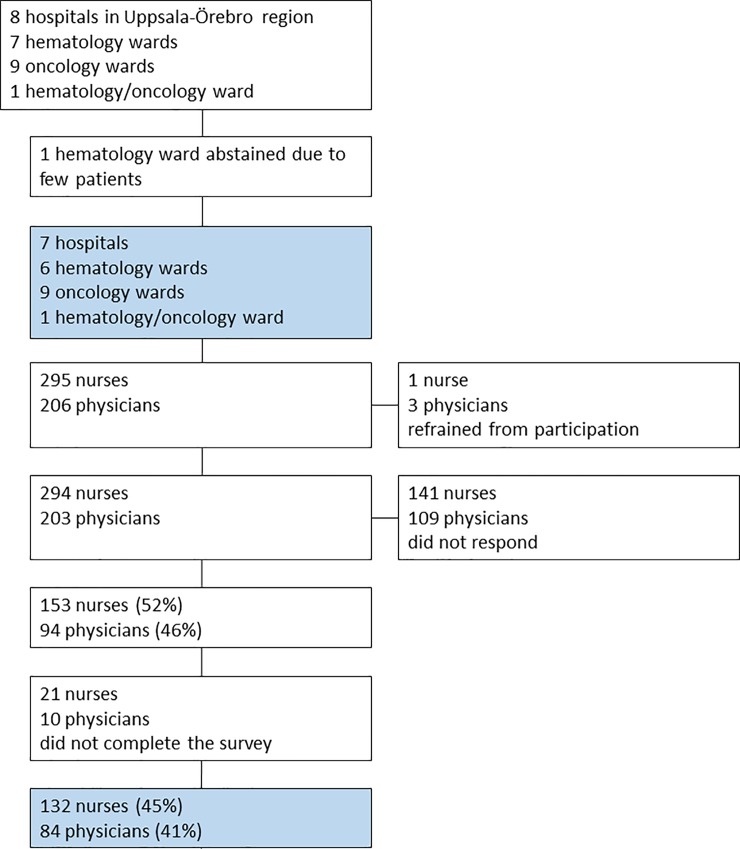
INTRODUCTION: In cancer care, do-not-resuscitate (DNR) decisions are made frequently; i.e., decisions not to start the heart in the event of a cardiac arrest. A DNR decision can be a complex process involving nurses and physicians with a wide variety of experiences and perspectives. Previous studies have shown different perceptions of the DNR decision process among nurses and physicians, e.g. concerning patient involvement and information. DNR decisions have also been reported to be unclear and documentation inconsistent. OBJECTIVE: The aim was to investigate how important and how likely to happen nurses and physicians considered various aspects of the DNR decision process, regarding participation, information and documentation, as well as which attributes they found most important in relation to DNR decisions. METHODS: A descriptive correlational study using a web survey was conducted, including 132 nurses and 84 physicians working in hematology and oncology. RESULTS: Almost half of the respondents reported it not likely that the patient would be involved in the decision on DNR, and 21% found it unimportant to inform patients of the DNR decision. Further, 57% reported that providing information to the patient was important, but only 21% stated that this was likely to happen. There were differences between nurses and physicians, especially regarding participation by and information to patients and relatives. The attributes deemed most important for both nurses and physicians pertained more to medical viewpoints than to ethical values, but a difference was found, as nurses chose patient autonomy as the most important value, while physicians rated non-maleficence as the most important value in relation to DNR decisions. CONCLUSION: Nurses and physicians need to be able to talk openly about their different perspectives on DNR decisions, so that they can develop a deeper understanding of the decisions, especially in cases where they disagree. They should also be aware that what they think is important is not always likely to happen. The organization needs to support such discussions through providing an environment that allows ethical discussions on regular basis. Patients and relatives will also benefit from receiving the same information from all caregivers.
Overview
The claims and statistics of this paper haven’t been checked yet.
Run the check — free, no account needed. It reads the open-access text and checks the sources it cites.
Integrity signals
Registry
Cites
Statistics
Figures
Verification
Claims the paper makes
The claims and statistics of this paper haven’t been checked yet.
Run the check — free, no account needed. It reads the open-access text and checks the sources it cites.
Claims other papers make about this one
Each is checked against this paper’s own text: does it say what the citing paper says it does?
The source backs part of the claim, not all of it — or backs it for a different population, condition or comparison.
In the citing paper
“Healthcare professionals thought it important that the care team would be informed of the decision and that the decision would be clearly documented46 and 87% worked in a hospital where there was a method for communicating decisions to their medical colleagues.17”
From Do not attempt cardiopulmonary resuscitation decision-making process: scoping review (2025) · cites this paper as [46]
Experimental — accuracy not yet measuredThe cited source says what the claim attributes to it.
In the citing paper
“57% of practitioners reported that providing information to the patient was important and 21% stated that this was likely to happen.46”
From Do not attempt cardiopulmonary resuscitation decision-making process: scoping review (2025) · cites this paper as [46]
The cited source says what the claim attributes to it.
In the citing paper
“Almost half of the respondents in one study reported that it was not likely that the patient would be involved in the decision on DNACPR46”
From Do not attempt cardiopulmonary resuscitation decision-making process: scoping review (2025) · cites this paper as [46]
The cited source says what the claim attributes to it.
In the citing paper
“There were differences between nurses and physicians, regarding participation by and information to patients and those close to the patient.46”
From Do not attempt cardiopulmonary resuscitation decision-making process: scoping review (2025) · cites this paper as [46]
Self-check
Percentages, sums and reported differences re-computed from the paper’s own numbers.
The self-check needs the paper’s full text.
Citations
Cites
(2016) · Andalas University Repository (Andalas University) · Cited by 8,424
Nursing Research Generating and Assessing Evidence for Nursing Practice
Timmins, F. (2013) · Nurse Education in Practice · doi:10.1016/j.nepr.2013.04.001 · Cited by 5,511
Survey response rate levels and trends in organizational research
Baruch, Y., & Holtom, B. C. (2008) · Human Relations · doi:10.1177/0018726708094863 · Cited by 3,462
Declaration of Helsinki. Ethical Principles for Medical Research Involving Human Subjects
(2014) · Jahrbuch für Wissenschaft und Ethik · doi:10.1515/jwiet-2014-0117 · Cited by 2,489
A farewell to Bonferroni: the problems of low statistical power and publication bias
Nakagawa, S. (2004) · Behavioral Ecology · doi:10.1093/beheco/arh107 · Cited by 2,097
Andrea, D., Kakuk, P., & Judit, S. (2014) · University of Debrecen Electronic Archive (University of Debrecen) · Cited by 1,954
Exploring physician specialist response rates to web-based surveys
Cunningham, C. T., Quan, H., Hemmelgarn, B., Noseworthy, T., Beck, C. A., Dixon, E., Samuel, S., Ghali, W. A., Sykes, L. L., & Jetté, N. (2015) · BMC Medical Research Methodology · doi:10.1186/s12874-015-0016-z · Cited by 995
Development and evaluation of a moral distress scale
Corley, M. C., Elswick, R. K., Gorman, M., & Clor, T. (2001) · Journal of Advanced Nursing · doi:10.1046/j.1365-2648.2001.01658.x · Cited by 801
Ebert, J. F., Huibers, L., Christensen, B., & Christensen, M. B. (2018) · Journal of Medical Internet Research · doi:10.2196/jmir.8353 · Cited by 375
Cited by
Bergenholtz, H., Timm, H. U., & Missel, M. (2019) · BMC Palliative Care · doi:10.1186/s12904-019-0448-z · Cited by 57
Almazyad, M. A., Aljofan, F., Abouammoh, N. A., Muaygil, R. A., Malki, K. H., Aljamaan, F., Alturki, A., Alayed, T. M., Alshehri, S. S., Alrbiaan, A., et al. (2023) · Cureus · doi:10.7759/cureus.38249 · Cited by 45
Chang, T., Darshani, S., Manikavasagam, P., & Arambepola, C. (2021) · BMC Medical Ethics · doi:10.1186/s12910-021-00631-5 · Cited by 33
The ethics of DNR-decisions in oncology and hematology care: a qualitative study
Pettersson, M., Hedström, M., & Höglund, A. T. (2020) · BMC Medical Ethics · doi:10.1186/s12910-020-00508-z · Cited by 31
Self-citationDNR and COVID-19: the ethical dilemma and suggested solutions
Sultan, H., Mansour, R., Shamieh, O., Al-Tabba', A., & Al-Hussaini, M. (2021) · Frontiers in Public Health · doi:10.3389/fpubh.2021.560405 · Cited by 28
Al-Shamsi, H. O., Abu-Gheida, I. H., Rana, S., Nijhawan, N. A., Abdulsamad, A. S., Alrawi, S., Abuhaleeqa, M., Almansoori, T. M., Alkasab, T., Aleassa, E. M., et al. (2020) · BMC Cancer · doi:10.1186/s12885-020-07115-6 · Cited by 24
Bremer, A., Årestedt, K., Rosengren, E., CARLSSON, J., & Sandboge, S. (2021) · BMC Medical Ethics · doi:10.1186/s12910-021-00604-8 · Cited by 23
Bertilsson, E., Semark, B., Schildmeijer, K. G. I., Bremer, A., & CARLSSON, J. (2020) · BMC Medical Ethics · doi:10.1186/s12910-020-00510-5 · Cited by 18
A cross-sectional investigation of communication in do-not-resuscitate orders in Dutch hospitals
Schluep, M., Hoeks, S. E., Endeman, H., IJmkers, S., Romijn, T. M. M., Alsma, J., Bosch, F. H., Cornet, A. D., Knook, A. H. M., Koopman-van Gemert, A. W. M. M., et al. (2020) · Resuscitation · doi:10.1016/j.resuscitation.2020.04.004 · Cited by 15
Investigating Key Factors Related to the Decision of a Do-Not-Resuscitate Consent
Lin, H.-M., Liu, C.-K., Huang, Y.-C., Ho, C.-W., & Chen, M. (2021) · International Journal of Environmental Research and Public Health · doi:10.3390/ijerph19010428 · Cited by 13
Piscator, E., Göransson, K., Forsberg, S., Herlitz, J., & Djärv, T. (2022) · Resuscitation Plus · doi:10.1016/j.resplu.2022.100209 · Cited by 10
Do not attempt cardiopulmonary resuscitation decision-making process: scoping review
Doody, O., Davidson, H., & Lombard, J. (2025) · BMJ Supportive & Palliative Care · doi:10.1136/spcare-2023-004573 · Cited by 10
“46 Among practitioners, 46.7% of respondents reported they were likely, or very likely, to share prognostic information.”
InfluentialPaddley, B., Espin, S., Indar, A., Rose, D. N., & Bookey‐Bassett, S. (2022) · Canadian Journal of Nursing Research · doi:10.1177/08445621221099117 · Cited by 10
Piscator, E., Djärv, T., Rakovic, K., Boström, E., Forsberg, S., Holzmann, M. J., Herlitz, J. D., & Göransson, K. E. (2021) · Resuscitation Plus · doi:10.1016/j.resplu.2021.100128 · Cited by 9
Wang, C., Liu, Y., Gao, Y., Li, Q.-S., Liu, Y.-C., & Chai, Y. (2023) · BMJ Open · doi:10.1136/bmjopen-2023-075714 · Cited by 8
Tsai, C., & Lai, F. (2024) · American Journal of Hospice and Palliative Medicine® · doi:10.1177/10499091241285010 · Cited by 5
The Effect of Practice toward Do-Not-Resuscitate among Taiwanese Nursing Staff Using Path Modeling
Wu, L., Chang, L., Hung, Y.-C., Lin, C. S., Tzou, S., Chou, L.-J., & Pan, H.-H. (2020) · International Journal of Environmental Research and Public Health · doi:10.3390/ijerph17176350 · Cited by 5
Çuvalci, B., Akbal, Y., & Hıntıstan, S. (2021) · OMEGA - Journal of Death and Dying · doi:10.1177/00302228211049879 · Cited by 5
Jafari, H., Amjadi, S., Kutenai, H. J., & Jafari, M. H. (2023) · Journal of Nursing Reports in Clinical Practice · doi:10.32598/jnrcp.23.30 · Cited by 4
To withhold resuscitation – The Swedish system’s rules and challenges
Piscator, E., & Djärv, T. (2023) · Resuscitation Plus · doi:10.1016/j.resplu.2023.100501 · Cited by 4
Azizi, K., Waheed, S., Barolia, R., Ahmed, N., & Ismail, M. (2020) · BMJ Open · doi:10.1136/bmjopen-2020-038915 · Cited by 4
Lin, Y., Lin, M.-H., Chen, C.-K., Yang, C., Chuang, Y.-T., Shyu, C.-H., Lin, H.-J., Chen, H.-F., Yang, W.-L., Chen, Y.-J., et al. (2021) · Journal of the Chinese Medical Association · doi:10.1097/jcma.0000000000000484 · Cited by 4
Kuusisto, H., Keränen, T., & Saranto, K. (2022) · Studies in health technology and informatics · doi:10.3233/shti210865 · Cited by 4
Khaleghparast, S., Shabani, F., Zargaz, S. E. H., Joolaee, S., Fathollahi, M. S., & Ghanbari, B. (2024) · Shiraz E-Medical Journal · doi:10.5812/semj-137476 · Cited by 3
Questionnaire design for analyzing important risk factors of cervical cancer
Purwandari, K., Sudigyo, D., Perbangsa, A. S., Irwan, A., & Pardamean, B. (2023) · AIP conference proceedings · doi:10.1063/5.0109142 · Cited by 3
Ho, K., Wang, K., Clay, A. T., & Gibbings, E. (2021) · Palliative Medicine · doi:10.1177/02692163211058607 · Cited by 3
Baliga, M. S., Chauhan, S., Kalaimathi, A. G., Madathil, L. P., George, T., D’Souza, R. F., & Palatty, P. L. (2024) · Indian Journal of Medical and Paediatric Oncology · doi:10.1055/s-0044-1790583 · Cited by 2
Fitzgerald, A., Fitzgerald, C., Anderson, L., Hussain, A. A., & Alinier, G. (2023) · Frontiers in Medicine · doi:10.3389/fmed.2023.1232954 · Cited by 1
Brain Death-Do not Resuscitate-End-of-life Care: A Literature Review
Tzenalis, A., & Vasdeki, M. (2023) · Journal of Clinical Surgery and Surgical Research · doi:10.59657/2992-9989.brs.23.015
Upoštevanje vodila »Ne oživljaj: integrativni pregled literature
Smajlović, S. K. (2024) · Slovenian Nursing Review · doi:10.14528/snr.2024.58.1.3218
Iradukunda, A., Nthusi, J., & Horn, E. (2024) · Kabarak journal of research and innovation. · doi:10.58216/kjri.v14i01.315
Müller, M. A., Gamondi, C., Truchard, E. R., & Sterie, A. (2024) · Journal of Medical Education and Curricular Development · doi:10.1177/23821205241277334
Lombard, J., Davidson, H., & Doody, O. (2025) · Health Research Policy and Systems · doi:10.1186/s12961-025-01315-x
Paul, J. S., Abinaya, P., Tiwari, S. K., Charlin, S., Joshi, M., Verma, A., & Joshi, P. (2025) · The Journal of Perinatal & Neonatal Nursing · doi:10.1097/jpn.0000000000000865
Alhassan, A. M., Aldayel, A., Aljabir, F. M., Aladhadh, K. M., Alshammari, H. A., Aziz, F., & alqahtani, Z. A. (2025) · Journal of Pioneering Medical Science · doi:10.47310/jpms2025140811
Factors in oncologists’ attitudes on do-not-attempt-resuscitation orders for patients with cancer
Kadowaki, M., Shimizu, C., Tashiro, S., Takada, Y., & Ikka, T. (2025) · International Journal of Clinical Oncology · doi:10.1007/s10147-025-02886-z
Chang, T., Darshani, S., Manikavasagam, P., & Arambepola, C. (2021) · Figshare · doi:10.6084/m9.figshare.14684470
Chang, T., Darshani, S., Manikavasagam, P., & Arambepola, C. (2021) · Figshare · doi:10.6084/m9.figshare.14684473
Bremer, A., Årestedt, K., Rosengren, E., Carlsson, J., & Sandboge, S. (2021) · Figshare · doi:10.6084/m9.figshare.14344382
«Å være, gjøre og vite» - Sykepleiers opplevelse av beslutningsprosessen mot HLR-status
Greivstad, A., Vangsøy, H. S., & Veglingsrud, M. (2020) · NORA - Norwegian Open Research Archives
Sjuksköterskans erfarenheter vid ej HLR-beslut
Olsson, I., & Frankson, S. (2024) · Lund University Publications Student Papers (Lund University)
Omvårdandens påverkan vid ett EJ-HLR beslut : En allmän litteraturöversikt
Teymouri, F., & Kehinde Adeniyi, E. (2025) · Diva portal (Dalarna University Library)
Patient and relatives´ experiences in conjunction with a DNR-decision : a literature review
Fräs, O., & Kraft Hult, J. (2023) · Dalarna University College Electronic Archive
Balagbagan, J., Bongor, R. A., Chua, T., Dimalanta, J., Dunuan, M., Gotia, K. S., Manmangon, J., Teodoro, V. G., Velasco, I. M., Tubaña, R., et al. (2025) · NURSE EDUCATORS AND PRACTITIONERS JOURNAL · doi:10.64397/nepj.v01i02.2025.a20
Kuusisto, H., Saranto, K., Huhtala, H., & Keränen, T. (2026) · Finnish Journal of eHealth and eWelfare · doi:10.23996/fjhw.178459
Piscator, E., Ekestam, C., Bremer, L., & Heilborn, U. (2026) · Resuscitation Plus · doi:10.1016/j.resplu.2026.101492
Metadata
- Authors
- Pettersson, M., Höglund, A. T., & Hedström, M.
- Affiliations
- Uppsala University (SE)
- Corresponding author
- Pettersson, Mona
- Venue
- PLOS ONE
- Publisher
- Public Library of Science (PLoS)
- Published
- 2018-11-21
- Volume
- 13
- Issue
- 11
- Pages
- e0206550
- ISSN
- 1932-6203 (ISSN-L)
- PMC
- PMC6248939
- OpenAlex
- W2894666520
- Cited by
- 43
- References
- 39
- Citations by year
- 2026: 1 · 2025: 4 · 2024: 7 · 2023: 10 · 2022: 3 · 2021: 11 · 2020: 6 · 2019: 1
- FWCI
- 4.29
- Type
- journal article
- Language
- en
- Open access
- gold
- doi.org
- Licence
- Locations
- PLoS ONE (publishedVersion, cc-by)
- Europe PMC (PubMed Central) (publishedVersion, cc-by)
- PubMed Central (publishedVersion, cc-by)
- PubMed (publishedVersion)
- Uppsala University Publications (Uppsala University) (submittedVersion, other-oa)
- RePEc: Research Papers in Economics (submittedVersion)
- DOAJ (DOAJ: Directory of Open Access Journals) (submittedVersion, cc-by-sa)
- Topics
- Health Sciences › Medicine › Public Health, Environmental and Occupational Health › Palliative Care and End-of-Life Issues
- Health Sciences › Medicine › Public Health, Environmental and Occupational Health › Palliative and Oncologic Care
- Health Sciences › Health Professions › General Health Professions › Ethics in medical practice
- Keywords
- do-not-resuscitate orders, nurses' perceptions, physicians' perspectives, patient and family information, clinical documentation, patient autonomy, non-maleficence, interprofessional differences
- MeSH terms
- Adult, Aged, Attitude of Health Personnel, Decision Making, Documentation, Family, Female, Hematology, Humans, Health Knowledge, Attitudes, Practice, Male, Medical Oncology, Middle Aged, Nurses, Physicians, Professional-Patient Relations, Specialization, Resuscitation Orders, Young Adult, Health Communication
About these checks
Registry, retraction, Cites and statistics results are computed, not judged, with one exception: a printed reference that no index lists is read once by a model before it counts as a citation error. Claims are extracted by a model and kept only when their quote appears verbatim in the text; each cited source is then checked, with a model’s help, for whether it says what the claim relies on. Those verdicts can be wrong — read the claim’s quote and the cited source before relying on one.
Statistics and arithmetic are recomputed, not judged.
Confidence bands are shown only for fields calibrated on our annotated test set. None is calibrated yet, so no band is shown.
What counts as a claim ›How we measure confidence ›How we check this ›
Are you an author, or do you see a problem with this page? Request a review
Data sources
Bibliographic data: Semantic Scholar, OpenAlex, Crossref.
Contains information from the Semantic Scholar Academic Graph Datasets, made available under the ODC Attribution License (ODC-BY 1.0).
Semantic Scholar’s data is described in: Kinney, R., et al. (2023). The Semantic Scholar Open Data Platform. arXiv:2301.10140.
