

Economic benefits of subcutaneous trastuzumab administration: A single institutional study from Karolinska University Hospital in Sweden
Open accessThe DOI matches its Crossref record; 13 of the 13 references it cites were found in a registry or an index.
Abstract
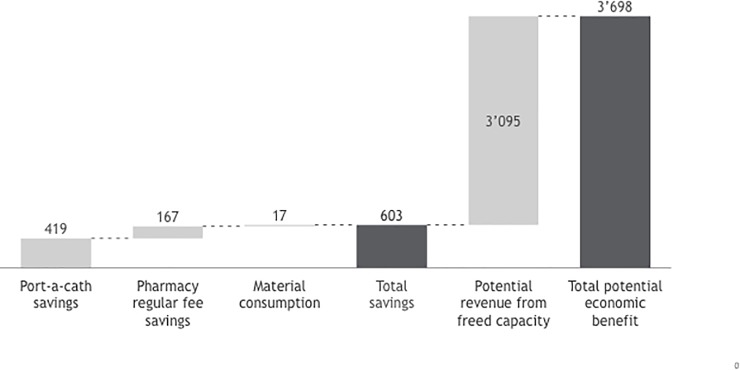
INTRODUCTION: Adjuvant trastuzumab is a standard of care in the treatment of Human Epidermal growth factor Receptor 2 (HER2) positive early breast cancer (eBC). Initially trastuzumab could only be administered intravenously (IV), however since 2013, a subcutaneous (SC) formulation with comparable efficacy and safety profile is available and preferred by patients. Trastuzumab SC does not require pharmacy preparation and has shorter administration time. The objective of this study was to estimate the economic efficiency of the SC formulation of trastuzumab by assessing the economic benefits of actual SC-driven process changes at one single Swedish healthcare institution. METHODS: This study analyzes changes in trastuzumab administration practice after the SC formulation was introduced at the Karolinska University Hospital. Process changes were identified and introduced in order to capitalize on the inherent work efficiency benefits of the SC formulation. Actual hospital data for 2015 were used to quantitatively estimate the annual economic impact of the changes. It encompassed administrative (i.e. non-medical) data of 178 newly diagnosed HER2-positive eBC patients and a total of 2,769 SC administrations. Realized economic benefits were expressed in hours saved by nurses, direct monetary cost savings and potential infusion fee revenue that could be earned through infrastructural revenue gains. RESULTS: In 2015, the replacement of IV infusion to SC administration generated total time savings of more than 1,100 hours, and led to direct monetary cost savings of 603,000 EUR. It unlocked a capacity gain of 1-2 additional administrations daily within the existing facility infrastructure. Given the current remuneration structure per administration, this revenue gain translated into an incremental revenue potential of up to 3 million EUR. CONCLUSION: Data from this study showed that the shift from trastuzumab IV to SC formulation resulted in significant economic effects in terms of departmental resources related to time, direct monetary cost savings, and infrastructural revenue gains.
Overview
The claims and statistics of this paper haven’t been checked yet.
Free: it reads the open-access text and checks the first 5 claims that cite a source we can check. Create a free account to check every claim.
Integrity signals
Registry
Cites
Statistics
Figures
Verification
Claims the paper makes
The claims and statistics of this paper haven’t been checked yet.
Free: it reads the open-access text and checks the first 5 claims that cite a source we can check. Create a free account to check every claim.
Claims other papers make about this one
Each is checked against this paper’s own text: does it say what the citing paper says it does?
The cited source doesn’t support the claim as written.
In the citing paper
“Administration time for trastuzumab was reported in five publications, of which four directly measured time [49, 53, 54, 62]; one publication reported estimated time from drug delivery software [51], which was found to be consistent with the other four publications.”
From A systematic review of time and resource use costs of subcutaneous versus intravenous administration of oncology biologics in a hospital setting (2023) · cites this paper as [54]
Checked by a reasoning model — may be wrong.
Experimental — accuracy not yet measuredThe cited source says what the claim attributes to it.
In the citing paper
“Administration times of 90 and 30 min were reported for IV trastuzumab loading and subsequent doses, respectively, in two of the publications [51, 54].”
From A systematic review of time and resource use costs of subcutaneous versus intravenous administration of oncology biologics in a hospital setting (2023) · cites this paper as [54]
The cited source says what the claim attributes to it.
In the citing paper
“SC administration costs were also lower for consumables [49, 53, 54, 57, 59, 61–64, 67], drug wastage [67], use of central venous access devices [86], overheads [87], nursing and pharmacy supplies [84], and avoiding catheter implantation surgeries [54] compared with administration costs for IV in all publications that reported such information.”
From A systematic review of time and resource use costs of subcutaneous versus intravenous administration of oncology biologics in a hospital setting (2023) · cites this paper as [54]
In the citing paper
“The differences in administration time between IV and SC were 80–85 (loading dose) and 20–25 min (subsequent doses) [51, 54]”
From A systematic review of time and resource use costs of subcutaneous versus intravenous administration of oncology biologics in a hospital setting (2023) · cites this paper as [54]
In the citing paper
“Thirteen publications covering ten countries reported total direct medical costs for IV versus SC administration [51, 53, 54, 59, 60, 63, 64, 69, 82–86], which included non-drug costs for preparation, administration, HCP time and consumables, and savings related to reduced drug wastage or administered dose.”
From A systematic review of time and resource use costs of subcutaneous versus intravenous administration of oncology biologics in a hospital setting (2023) · cites this paper as [54]
Self-check
Percentages, sums and reported differences re-computed from the paper’s own numbers.
The self-check needs the paper’s full text.
Citations
Cites
Adjuvant Trastuzumab in HER2-Positive Breast Cancer
Slamon, D., Eiermann, W., Robert, N., Pienkowski, T., Martin, M., Press, M., Mackey, J., Glaspy, J., Chan, A., Pawlicki, M., et al. (2011) · New England Journal of Medicine · doi:10.1056/nejmoa0910383 · Cited by 2,775
Gianni, L., Pienkowski, T., Im, Y.-H., Roman, L., Tseng, L.-M., Liu, M.-C., Lluch, A., Staroslawska, E., de la Haba-Rodriguez, J., Im, S.-A., et al. (2012) · The Lancet Oncology · doi:10.1016/s1470-2045(11)70336-9 · Cited by 2,374
Cameron, D., Piccart-Gebhart, M. J., Gelber, R. D., Procter, M., Goldhirsch, A., de Azambuja, E., Castro, G., Untch, M., Smith, I., Gianni, L., et al. (2017) · The Lancet · doi:10.1016/s0140-6736(16)32616-2 · Cited by 1,035
The HER-2/neu Gene and Protein in Breast Cancer 2003: Biomarker and Target of Therapy
Ross, J. S., Fletcher, J. A., Linette, G. P., Stec, J., Clark, E., Ayers, M., Symmans, W. F., Pusztai, L., & Bloom, K. J. (2003) · The Oncologist · doi:10.1634/theoncologist.8-4-307 · Cited by 610
Goldhirsch, A., Gelber, R. D., Piccart-Gebhart, M. J., de Azambuja, E., Procter, M., Suter, T. M., Jackisch, C., Cameron, D., Weber, H. A., Heinzmann, D., et al. (2013) · The Lancet · doi:10.1016/s0140-6736(13)61094-6 · Cited by 497
Ismael, G., Hegg, R., Muehlbauer, S., Heinzmann, D., Lum, B., Kim, S.-B., Pienkowski, T., Lichinitser, M., Semiglazov, V., Melichar, B., et al. (2012) · The Lancet Oncology · doi:10.1016/s1470-2045(12)70329-7 · Cited by 351
Pivot, X., Gligorov, J., Müller, V., Barrett-Lee, P., Verma, S., Knoop, A., Curigliano, G., Semiglazov, V., López-Vivanco, G., Jenkins, V., et al. (2013) · The Lancet Oncology · doi:10.1016/s1470-2045(13)70383-8 · Cited by 230
Jackisch, C., Kim, S.-B., Semiglazov, V., Melichar, B., Pivot, X., Hillenbach, C., Stroyakovskiy, D., Lum, B. L., Elliott, R., Weber, H. A., et al. (2015) · Annals of Oncology · doi:10.1093/annonc/mdu524 · Cited by 114
De Cock, E., Kritikou, P., Sandoval, M., Tao, S., Wiesner, C., Carella, A. M., Ngoh, C., & Waterboer, T. (2016) · PLOS ONE · doi:10.1371/journal.pone.0157957 · Cited by 108
Burcombe, R., Chan, S., Simcock, R., Samanta, K., Percival, F., & Barrett-Lee, P. (2013) · Advances in Breast Cancer Research · doi:10.4236/abcr.2013.24022 · Cited by 59
Cited by
Badkar, A. V., Gandhi, R. B., Davis, S. P., & LaBarre, M. J. (2021) · Drug Design Development and Therapy · doi:10.2147/dddt.s287323 · Cited by 138
Collins, D. S., Sánchez-Félix, M., Badkar, A. V., & Mrsny, R. J. (2020) · Journal of Controlled Release · doi:10.1016/j.jconrel.2020.02.036 · Cited by 117
Delgado, S. R., Faissner, S., Linker, R. A., & Rammohan, K. W. (2023) · Journal of Neurology · doi:10.1007/s00415-023-12007-3 · Cited by 76
McCloskey, C., Ortega, M. T., Nair, S., Garcia, M. J., & Manevy, F. (2023) · PharmacoEconomics - Open · doi:10.1007/s41669-022-00361-3 · Cited by 66
Direct and Indirect Costs of Breast Cancer and Associated Implications: A Systematic Review
Franklin, M. K., Pollard, D. J., Sah, J., Rayner, A., Sun, Y., Dube, F., Sutton, A., & Qin, L. (2024) · Advances in Therapy · doi:10.1007/s12325-024-02893-y · Cited by 41
“[66, 67], and Germany ( n = 1; 2”
Kim, H., Alten, R., Cummings, F. J. R., Danese, S., D’Haens, G., Emery, P., Ghosh, S., Gilletta, C., Lee, J. H., Lindsay, J. O., et al. (2021) · mAbs · doi:10.1080/19420862.2020.1868078 · Cited by 37
Subcutaneous Injection Site Pain of Formulation Matrices
Shi, G. H., Pisupati, K., Parker, J. G., Corvari, V., Payne, C. D., Xu, W., Collins, D. S., & Felippis, M. R. D. (2021) · Pharmaceutical Research · doi:10.1007/s11095-021-03047-3 · Cited by 35
Anti-ErbB2 immunotherapeutics: struggling to make better antibodies for cancer therapy
Santis, R. D. (2020) · mAbs · doi:10.1080/19420862.2020.1725346 · Cited by 35
Brandão, M., Morais, S., Lopes-Conceição, L., Fontes, F., Araújo, N., Dias, T., Pereira, D., Borges, M., Pereira, S., & Lunet, N. (2020) · ESMO Open · doi:10.1136/esmoopen-2020-000984 · Cited by 31
D’Amico, F., Solitano, V., Aletaha, D., Hart, A. L., Magro, F., Selmi, C. F., Ng, S. C., Awadhi, S. A., Choy, E., Schulze‐Koops, H., et al. (2021) · Autoimmunity Reviews · doi:10.1016/j.autrev.2021.102849 · Cited by 30
“…infrastructural profits, further studies are required to confirm a real clinical / pharmacological improvement with SC drugs and justify their use [45, 46] Statement 4: The switch to a biobetter should be individualized based on clinical need and/or a shared decision between physicians and…”
Stevenson, J., Poker, R., Schoss, J., Campbell, M., Everitt, C., Holly, B., Stones, N., Pettis, R. J., & Sánchez-Félix, M. (2024) · Advanced Drug Delivery Reviews · doi:10.1016/j.addr.2024.115322 · Cited by 26
Jackisch, C., Manevy, F., Frank, S., Roberts, N., & Shafrin, J. T. (2022) · Advances in Therapy · doi:10.1007/s12325-021-01996-0 · Cited by 27
Hsieh, P.-H., Kacew, A. J., Dreyer, M. S., Serritella, A. V., Knoebel, R. W., Strohbehn, G. W., & Ratain, M. J. (2022) · npj Breast Cancer · doi:10.1038/s41523-022-00393-2 · Cited by 24
Subcutaneous Trastuzumab: A Review in HER2-Positive Breast Cancer
Heo, Y., & Syed, Y. Y. (2019) · Targeted Oncology · doi:10.1007/s11523-019-00684-y · Cited by 21
Aguiar-Ibáñez, R., Fotheringham, I., Mittal, L., Sillah, A., & Pathak, S. (2024) · Advances in Therapy · doi:10.1007/s12325-024-02985-9 · Cited by 19
Parra, A., Hernandez, C. A., & Prieto‐Pinto, L. (2023) · Expert Review of Pharmacoeconomics & Outcomes Research · doi:10.1080/14737167.2023.2249232 · Cited by 17
“…of biotechnological drugs via SC and IV routes for patients with lymphoma and breast cancer was recorded by 11 studies [16– 19, 25 ,27,32,39, In their time and motion study of 2016, De Cock et al. [46] assessed the administration time of SC rituximab compared with that of IV…”
BackgroundLageat, C., Combedazou, A., Ramus, C., Guerrero, K., Frolet, C., & Glezer, S. (2021) · Expert Opinion on Drug Delivery · doi:10.1080/17425247.2021.1954906 · Cited by 16
Allmendinger, A. (2021) · Pharmaceutical Research · doi:10.1007/s11095-021-03037-5 · Cited by 14
Solitano, V., Vuitton, L., Peyrin‐Biroulet, L., & Danese, S. (2021) · Gastroenterology · doi:10.1053/j.gastro.2021.03.038 · Cited by 14
Ledo, A. M., Misiewicz, G., Dimke, T., Tschantz, W. R., Handel, J., Pelis, R. M., Bruin, G. J. M., Bechtold-Peters, K., Sánchez-Félix, M., Deshmukh, S. V., et al. (2025) · Lab on a Chip · doi:10.1039/d4lc00988f · Cited by 11
Monfared, A. A. T., Barrows, S., Fox, L., Herbel, B., Herring, W. L., Krumbach, A., & Zhang, Q. (2025) · Neurology and Therapy · doi:10.1007/s40120-025-00790-2 · Cited by 9
Cock, E. D., Oskar, S., Lourdudoss, C., Eiras, R., Pietanza, M. C., Arunachalam, A., Alves, G. V., Martinengo, G. L., & Felip, E. (2025) · Advances in Therapy · doi:10.1007/s12325-025-03365-7 · Cited by 9
Bo, M. D., Gambirasi, M., Vruzhaj, I., Cecchin, E., Pishdadian, A., Toffoli, G., & Safa, A. (2025) · International Journal of Molecular Sciences · doi:10.3390/ijms26114982 · Cited by 10
“Significantly, current trials of SC trastuzumab in vulnerable breast cancer patients (NCT04889282) may set new benchmarks for geriatric oncology; however, cost and access obstacles persist as considerable challenges in practical application [171,172].”
Connor, R., Nekoroski, T., & Kang, D. W. (2025) · AAPS PharmSciTech · doi:10.1208/s12249-025-03116-5 · Cited by 8
“Compared with IV administration, SC administration also results in reduced healthcare costs [12, 13] and a decrease in the HCP time needed to prepare and deliver the therapeutics [13–16], which may increase the capacity for clinics to treat more patients [17, 18].”
Landeiro, L. C. G., Martins, T. D. C., Grigolon, R. B., Monteiro, I., Balardin, J. B., Padilha, E. O., Amorim, G. L. D. S., & Stefani, S. D. (2024) · Frontiers in Pharmacology · doi:10.3389/fphar.2024.1338546 · Cited by 7
Performance characterization of spring-actuated prefilled pen devices for lebrikizumab and dupilumab
Derakhshandeh, R., Eshraghi, J., Tavakolian, M., Duffy, K. H., Veilleux, J.-C., Shi, G. H., & Vlachos, P. P. (2025) · Expert Opinion on Drug Delivery · doi:10.1080/17425247.2025.2477656 · Cited by 7
Elsamany, S. A., Elsisi, G. H., Hassanin, F., & Jafal, M. (2020) · Expert Review of Pharmacoeconomics & Outcomes Research · doi:10.1080/14737167.2021.1860024 · Cited by 8
“6 million in 2015 with a direct cost saving of 603,000 and the remainder corresponds to the maximum value of an implicit revenue gain [34].”
BackgroundMunzone, E., Fabi, A., Buono, G., Caputo, R., Montagna, E., Negri, M., Nuzzo, F., Palazzo, A., Paris, I., Conti, L., et al. (2023) · Drugs & Therapy Perspectives · doi:10.1007/s40267-023-01038-5 · Cited by 7
“Therefore, to compare the results of the PHASTER study, we searched for similar studies conducted both in Italy and in other European countries, focusing on the organizational impact of SC versus IV trastuzumab for treating BC [14, 15, 23–32].”
Derakhshandeh, R., Meyers, B., Zhang, J., Veilleux, J.-C., Shi, G. H., & Vlachos, P. P. (2025) · International Journal of Pharmaceutics · doi:10.1016/j.ijpharm.2025.125804 · Cited by 8
The effect of temperature-dependent drug viscosity on needle-free jet injection
McKeage, J. W., Full, H. J., Tan, A. Z. H., & Taberner, A. J. (2024) · International Journal of Pharmaceutics · doi:10.1016/j.ijpharm.2024.124777 · Cited by 4
Radecka, B. S., Hudała-Klecha, J., Sawka, D., Sarga, J., Noworolska, B., Susczyk, G., Sawicka, J., Duda, E., Obruśnik, N., & Zając, P. (2024) · Oncology in Clinical Practice · doi:10.5603/ocp.2023.0025 · Cited by 3
Kardel, P., Sheetz, C., Maynard, J., & Sarocco, P. W. (2025) · Journal of Medical Economics · doi:10.1080/13696998.2025.2555141 · Cited by 2
“These studies found that switching to SC delivery of biologics could reduce the costs related to surgery for central venous access, health-care resource utilization, fees for drug preparation, and the cost of consumables 5 – 8 .”
InfluentialHeng, J. E., Raman, S., Wong, Z. Y., & Beh, V. J. N. (2023) · DARU Journal of Pharmaceutical Sciences · doi:10.1007/s40199-023-00485-9 · Cited by 2
“This indirectly will further reduce congestion and patients’ waiting time for oncology treatment [4, 11, 31, 33, 37, 38].”
Allmendinger, A., Mahler, H., & Bittner, B. (2026) · Advanced Drug Delivery Reviews · doi:10.1016/j.addr.2026.115863 · Cited by 3
Otoya, I., Valdiviezo, N., Roque, K., Morante, Z., Vidaurre, T., Neciosup, S. P., Calderón, M. J., & Gómez, H. (2024) · ecancermedicalscience · doi:10.3332/ecancer.2024.1708 · Cited by 1
“For example, in Germany, trastuzumab SC administration has a significantly shorter total time of 5.4 minutes compared to 30 minutes for the IV formulation [33].”
BackgroundInfluentialOtoya, I., Valdiviezo, N., Morante, Z., Calle, C., Ferreyra, Y., Huarcaya, N., Polo-Mendoza, G., Castañeda, C. A., Vidaurre, T., Neciosup, S. P., et al. (2024) · International Journal of Breast Cancer · doi:10.1155/2024/9551710 · Cited by 2
Duyên, T. T. M., Lan, N. T. N., Dung, P. T., & Thủy, N. T. T. (2024) · TẠP CHÍ KHOA HỌC TRƯỜNG ĐẠI HỌC QUỐC TẾ HỒNG BÀNG · doi:10.59294/hiujs.vol.7.2024.686 · Cited by 1
Assessment of Flexible Dosing Volumes in an Existing Spring-Driven Autoinjector Platform
Derakhshandeh, R., Eshraghi, J., Vlachos, P. P., & Veilleux, J.-C. (2026) · Pharmaceutics · doi:10.3390/pharmaceutics18070818
Mase, J., Tsukada, M., Nakamura, T., Kinomura, H., Ishihara, K., Ohno, H., Mano, S., Ogiso, A., Matsuhashi, N., Nagao, Y., et al. (2026) · Research Square · doi:10.21203/rs.3.rs-11168431/v1
Metadata
- Authors
- Hedayati, E., Fracheboud, L., Srikant, V., Greber, D., Wallberg, S., & Linder Stragliotto, C.
- Affiliations
- Karolinska University Hospital (SE)
- Boston Consulting Group (United States) (US)
- Corresponding author
- Hedayati, Elham
- ORCID
- Hedayati, Elham
- Venue
- PLOS ONE
- Publisher
- Public Library of Science (PLoS)
- Published
- 2019-02-04
- Volume
- 14
- Issue
- 2
- Pages
- e0211783
- ISSN
- 1932-6203 (ISSN-L)
- PMC
- PMC6361452
- OpenAlex
- W2913996563
- Cited by
- 39
- References
- 13
- Citations by year
- 2026: 3 · 2025: 8 · 2024: 8 · 2023: 5 · 2022: 3 · 2021: 7 · 2020: 4 · 2019: 1
- FWCI
- 4.68
- Type
- journal article
- Language
- en
- Open access
- gold
- doi.org
- Licence
- Locations
- PLoS ONE (publishedVersion, cc-by)
- Europe PMC (PubMed Central) (publishedVersion, cc-by)
- PubMed Central (publishedVersion, cc-by)
- PubMed (publishedVersion)
- RePEc: Research Papers in Economics (submittedVersion)
- DOAJ (DOAJ: Directory of Open Access Journals) (submittedVersion, cc-by-sa)
- Figshare (submittedVersion, cc-by)
- Funders
- F. Hoffmann-La Roche (0000)
- Topics
- Social Sciences › Economics, Econometrics and Finance › Economics and Econometrics › Health Systems, Economic Evaluations, Quality of Life
- Social Sciences › Economics, Econometrics and Finance › Economics and Econometrics › Economic and Financial Impacts of Cancer
- Health Sciences › Medicine › Oncology › HER2/EGFR in Cancer Research
- Keywords
- subcutaneous trastuzumab, HER2-positive early breast cancer, adjuvant therapy, economic efficiency, cost reduction, hospital resource utilization, intravenous to subcutaneous switch
- MeSH terms
- Trastuzumab, Adult, Breast Neoplasms, Costs and Cost Analysis, Female, Hospitals, University, Humans, Injections, Subcutaneous, Middle Aged, Sweden, Erb-b2 Receptor Tyrosine Kinases
About these checks
Registry, retraction, Cites and statistics results are computed, not judged, with one exception: a printed reference that no index lists is read once by a model before it counts as a citation error. Claims are extracted by a model and kept only when their quote appears verbatim in the text; each cited source is then checked, with a model’s help, for whether it says what the claim relies on. Those verdicts can be wrong — read the claim’s quote and the cited source before relying on one.
Statistics and arithmetic are recomputed, not judged.
Confidence bands are shown only for fields calibrated on our annotated test set. None is calibrated yet, so no band is shown.
What counts as a claim ›How we measure confidence ›How we check this ›
Are you an author, or do you see a problem with this page? Request a review
Data sources
Bibliographic data: Semantic Scholar, OpenAlex, Crossref.
Contains information from the Semantic Scholar Academic Graph Datasets, made available under the ODC Attribution License (ODC-BY 1.0).
Semantic Scholar’s data is described in: Kinney, R., et al. (2023). The Semantic Scholar Open Data Platform. arXiv:2301.10140.
