

Novel mouse monoclonal antibodies specifically recognizing β-(1→3)-D-glucan antigen
Open accessThe DOI matches its Crossref record; 44 of the 45 references it cites were found in a registry or an index.
Abstract
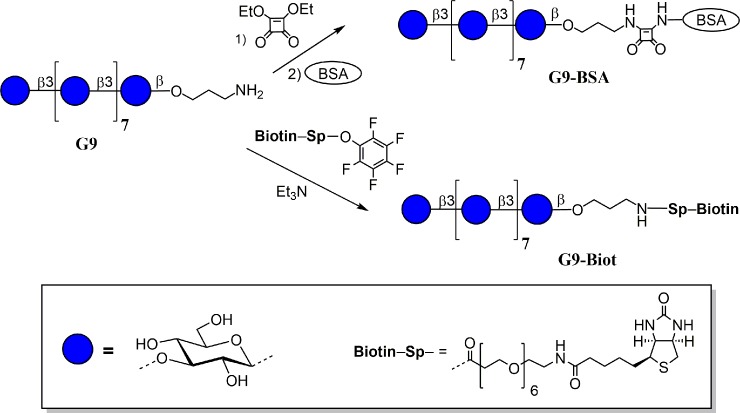
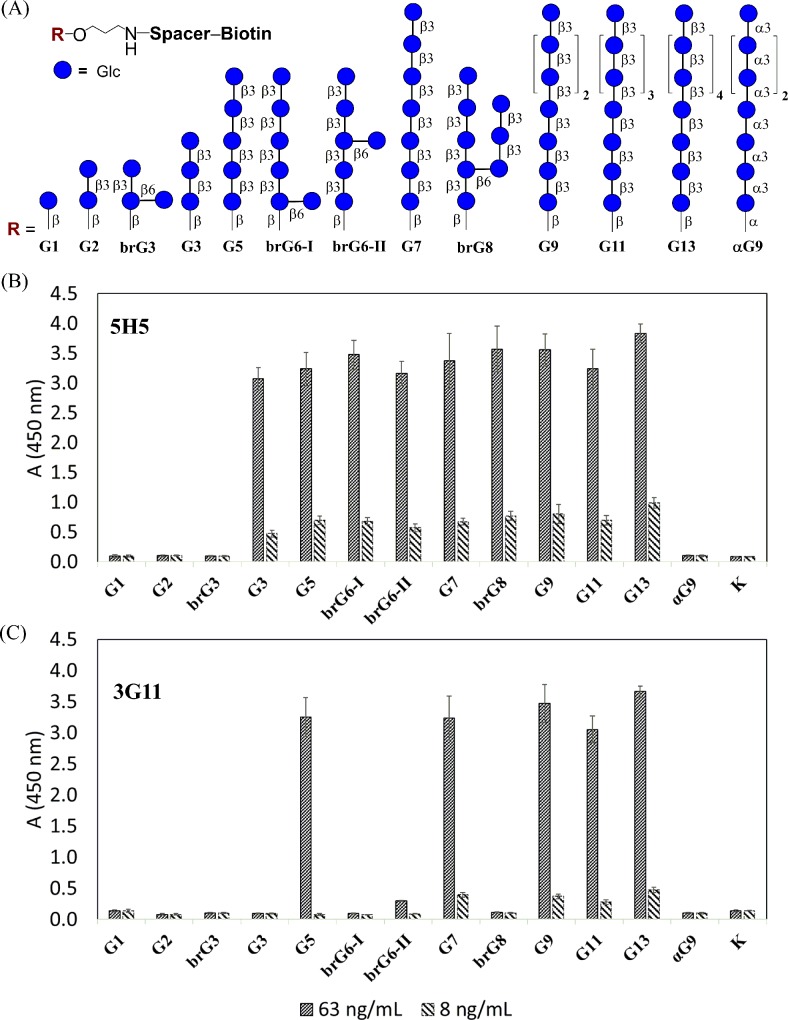
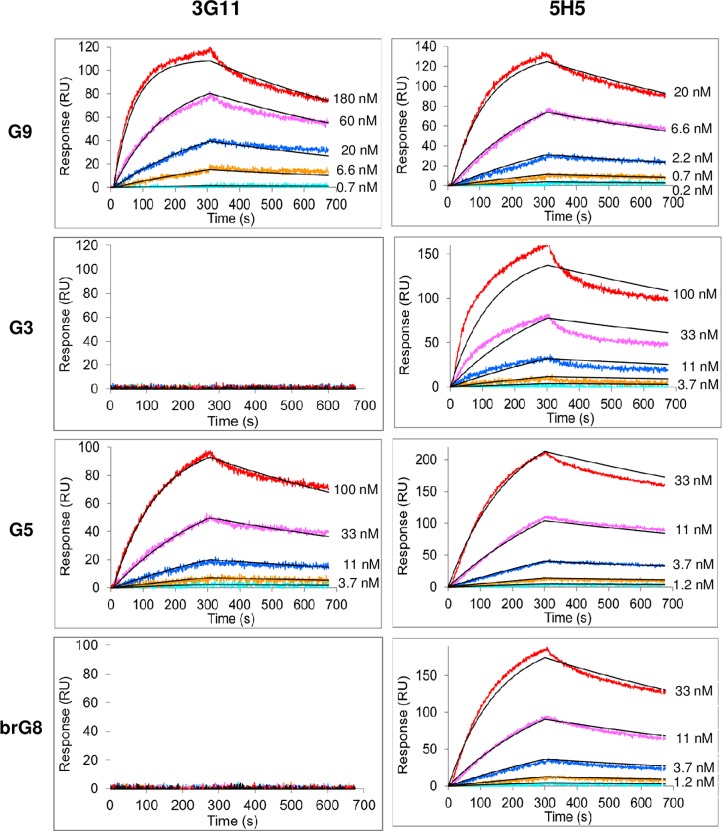
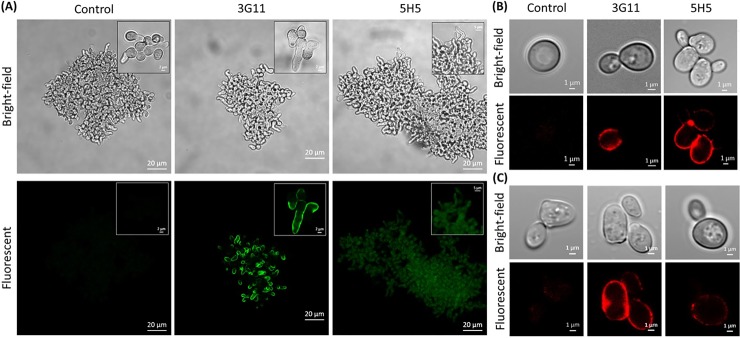
β-(1→3)-D-Glucan is an essential component of the fungal cell wall. Mouse monoclonal antibodies (mAbs) against synthetic nona-β-(1→3)-D-glucoside conjugated with bovine serum albumin (BSA) were generated using hybridoma technology. The affinity constants of two selected mAbs, 3G11 and 5H5, measured by a surface plasmon resonance biosensor assay using biotinylated nona-β-(1→3)-D-glucan as the ligand, were approximately 11 nM and 1.9 nM, respectively. The glycoarray, which included a series of synthetic oligosaccharide derivatives representing β-glucans with different lengths of oligo-β-(1→3)-D-glucoside chains, demonstrated that linear tri-, penta- and nonaglucoside, as well as a β-(1→6)-branched octasaccharide, were recognized by mAb 5H5. By contrast, only linear oligo-β-(1→3)-D-glucoside chains that were not shorter than pentaglucosides (but not the branched octaglucoside) were ligands for mAb 3G11. Immunolabelling indicated that 3G11 and 5H5 interact with both yeasts and filamentous fungi, including species from Aspergillus, Candida, Penicillium genera and Saccharomyces cerevisiae, but not bacteria. Both mAbs could inhibit the germination of Aspergillus fumigatus conidia during the initial hours and demonstrated synergy with the antifungal fluconazole in killing C. albicans in vitro. In addition, mAbs 3G11 and 5H5 demonstrated protective activity in in vivo experiments, suggesting that these β-glucan-specific mAbs could be useful in combinatorial antifungal therapy.
Overview
The claims and statistics of this paper haven’t been checked yet.
Free: it reads the open-access text and checks the first 5 claims that cite a source we can check. Create a free account to check every claim.
Integrity signals
Registry
Cites
Statistics
Figures
Verification
Claims the paper makes
The claims and statistics of this paper haven’t been checked yet.
Free: it reads the open-access text and checks the first 5 claims that cite a source we can check. Create a free account to check every claim.
Claims other papers make about this one
Each is checked against this paper’s own text: does it say what the citing paper says it does?
The cited source doesn’t support the claim as written.
In the citing paper
“These projects have not produced significant results; antigen vaccination is not applicable for immunocompromised patients (713), and the inhibitory effects of anti-β-(1,3) glucan and enolase monoclonal antibody are transitory (714–716).”
From Aspergillus fumigatus and Aspergillosis in 2019 (2019) · cites this paper as [715]
Checked by a reasoning model — may be wrong.
Experimental — accuracy not yet measuredThe cited source doesn’t support the claim as written.
In the citing paper
“These projects have not produced significant results”
From Aspergillus fumigatus and Aspergillosis in 2019 (2019) · cites this paper as [715]
Checked by a reasoning model — may be wrong.
Experimental — accuracy not yet measuredThe cited source says what the claim attributes to it.
In the citing paper
“the inhibitory effects of anti-β-(1,3) glucan and enolase monoclonal antibody are transitory (714–716)”
From Aspergillus fumigatus and Aspergillosis in 2019 (2019) · cites this paper as [715]
Self-check
Percentages, sums and reported differences re-computed from the paper’s own numbers.
The self-check needs the paper’s full text.
Citations
Cites
Varki, A. P., Cummings, R. D., Esko, J. D., Freeze, H. H., Stanley, P., Bertozzi, C. R., Hart, G. W., & Etzler, M. E. (1999) · Cited by 2,384
PEROXIDASE-LABELED ANTIBODY A NEW METHOD OF CONJUGATION
NAKANE, P. K., & KAWAOI, A. (1974) · Journal of Histochemistry & Cytochemistry · doi:10.1177/22.12.1084 · Cited by 2,340
Munro, S. (2000) · Trends in Cell Biology · doi:10.1016/s0962-8924(00)01855-9 · Cited by 957
Clancy, C. J., & Nguyen, M. H. (2013) · Clinical Infectious Diseases · doi:10.1093/cid/cit006 · Cited by 688
Interactions of fungal pathogens with phagocytes
Erwig, L. P., & Gow, N. A. R. (2016) · Nature Reviews Microbiology · doi:10.1038/nrmicro.2015.21 · Cited by 626
Curdlan and other bacterial (1→3)-β-d-glucans
McIntosh, M., Stone, B. A., & Stanisich, V. A. (2005) · Applied Microbiology and Biotechnology · doi:10.1007/s00253-005-1959-5 · Cited by 444
A novel glyco-conjugate vaccine against fungal pathogens
Torosantucci, A., Bromuro, C., Chiani, P., De Bernardis, F., Berti, F., Galli, C., Norelli, F., Bellucci, C., Polonelli, L., Costantino, P., et al. (2005) · The Journal of Experimental Medicine · doi:10.1084/jem.20050749 · Cited by 442
Chemistry, Biochemistry, and Biology of 1-3 Beta Glucans and Related Polysaccharides
(2009) · Elsevier eBooks · doi:10.1016/b978-0-12-373971-1.x0001-5 · Cited by 250
Wang, Z., Raifu, M., Howard, M., Smith, L., Hansen, D., Goldsby, R., & Ratner, D. (2000) · Journal of Immunological Methods · doi:10.1016/s0022-1759(99)00184-2 · Cited by 212
Torosantucci, A., Chiani, P., Bromuro, C., De Bernardis, F., Palma, A. S., Liu, Y., Mignogna, G., Maras, B., Colone, M., Stringaro, A., et al. (2009) · PLoS ONE · doi:10.1371/journal.pone.0005392 · Cited by 204
Research works printed but not linked: 1
- Akhapkina IG, Zheltikova TM, Antropova A., Mikhailova NA, Yashunskiy DV, Karelin AA, et al Development of methodical approaches to creation of reagents for enzyme-linked immunosorbent detection of linear β-(1→3)-glucans and their derivatives in the environment. Immunologiya. 2015; 36: 276– 279.
Cited by
Aspergillus fumigatus and Aspergillosis in 2019
Latgé, J.-P., & Chamilos, G. (2019) · Clinical Microbiology Reviews · doi:10.1128/cmr.00140-18 · Cited by 1,400
Self-citationBiosensors and Diagnostics for Fungal Detection
K. Hussain, K., Malavia, D., M. Johnson, E., Littlechild, J., Winlove, C. P., Vollmer, F., & Gow, N. A. R. (2020) · Journal of Fungi · doi:10.3390/jof6040349 · Cited by 71
“The developed antibodies interacted with species from Aspergillus, Candida, Penicillium genera and Saccharomyces cerevisiae, but not bacteria [70].”
BackgroundImmunotherapy against Systemic Fungal Infections Based on Monoclonal Antibodies
Boniche-Alfaro, C., Rossi, S. A., Kischkel, B., Barbalho, F. V., Moura, Á. N. D., Nosanchuk, J. D., Travassos, L. R., & Taborda, C. P. (2020) · Journal of Fungi · doi:10.3390/jof6010031 · Cited by 65
“The toxicity of these medications is an important limitation to their use [4,10,24] and, in order to avert the universal failure in the management of fungal infections, new therapeutic strategies to treat systemic fungal infections are urgently needed [24,25].”
BackgroundMonoclonal antibodies: From magic bullet to precision weapon
Aboul-Ella, H., Gohar, A., Ali, A. A., Ismail, L. M., Mahmoud, A. E. E.-R., Elkhatib, W. F., & Aboul-Ella, H. (2024) · Molecular Biomedicine · doi:10.1186/s43556-024-00210-1 · Cited by 75
Monoclonal Antibodies as Tools to Combat Fungal Infections
Ulrich, S., & Ebel, F. (2020) · Journal of Fungi · doi:10.3390/jof6010022 · Cited by 52
“5H5 β‐1,3‐glucan IgG3 Candida albicans Aspergillus fumigatus growth inhibition, phagocytosis unknown, osponization [32]”
BackgroundInfluential
Metadata
- Authors
- Matveev, A. L., Krylov, V. B., Khlusevich, Y. A., Baykov, I. K., Yashunsky, D. V., Emelyanova, L. A., Tsvetkov, Y. E., Karelin, A. A., Bardashova, A. V., Wong, S. S. W., Aimanianda, V., Latgé, J.-P., Tikunova, N. V., & Nifantiev, N. E.
- Affiliations
- Institute of Chemical Biology and Fundamental Medicine (RU)
- Russian Academy of Sciences (RU)
- Institut Pasteur (FR)
- Corresponding author
- Latgé, Jean-Paul
- Nifantiev, Nikolay E.
- ORCID
- Venue
- PLOS ONE
- Publisher
- Public Library of Science (PLoS)
- Published
- 2019-04-25
- Volume
- 14
- Issue
- 4
- Pages
- e0215535
- ISSN
- 1932-6203 (ISSN-L)
- PMC
- PMC6483564
- OpenAlex
- W2942256047
- Cited by
- 68
- References
- 45
- Citations by year
- 2026: 9 · 2025: 4 · 2024: 10 · 2023: 10 · 2022: 6 · 2021: 13 · 2020: 10 · 2019: 6
- FWCI
- 6.70
- Type
- journal article
- Language
- en
- Open access
- gold
- doi.org
- Licence
- Locations
- PLoS ONE (publishedVersion, cc-by)
- PubMed Central (publishedVersion, cc-by)
- PubMed (publishedVersion)
- HAL (submittedVersion, cc-by)
- DOAJ (DOAJ: Directory of Open Access Journals) (submittedVersion, cc-by-sa)
- Figshare (submittedVersion, cc-by)
- Funders
- Russian Science Foundation (14-23-00199, 16-14-00083, 14-50-00126)
- Russian Federal Agency of Scientific Organizations (0309-2017-0008)
- Franco-German ANR-DFG (ANR-16-CE92-0031-01)
- Franco-Indian CEFIPRA (5403-1)
- Topics
- Health Sciences › Medicine › Infectious Diseases › Antifungal resistance and susceptibility
- Life Sciences › Biochemistry, Genetics and Molecular Biology › Molecular Biology › Fungal and yeast genetics research
- Life Sciences › Immunology and Microbiology › Immunology › Monoclonal and Polyclonal Antibodies Research
- Keywords
- β-1,3-glucan, mouse monoclonal antibodies, fungal cell wall, hybridoma, affinity constant, Aspergillus fumigatus, Candida albicans, conidial germination inhibition, fluconazole synergy, antifungal therapy, protective immunity, Saccharomyces cerevisiae
- MeSH terms
- Animals, Antibodies, Monoclonal, Antifungal Agents, Antigens, Fungal, Aspergillus fumigatus, Candida albicans, Candidiasis, Cell Wall, Disease Models, Animal, Drug Synergism, Drug Therapy, Combination, Female, Humans, Microbial Sensitivity Tests, Fluconazole, Treatment Outcome, beta-Glucans, Mice
About these checks
Registry, retraction, Cites and statistics results are computed, not judged, with one exception: a printed reference that no index lists is read once by a model before it counts as a citation error. Claims are extracted by a model and kept only when their quote appears verbatim in the text; each cited source is then checked, with a model’s help, for whether it says what the claim relies on. Those verdicts can be wrong — read the claim’s quote and the cited source before relying on one.
Statistics and arithmetic are recomputed, not judged.
Confidence bands are shown only for fields calibrated on our annotated test set. None is calibrated yet, so no band is shown.
What counts as a claim ›How we measure confidence ›How we check this ›
Are you an author, or do you see a problem with this page? Request a review
Data sources
Bibliographic data: Semantic Scholar, OpenAlex, Crossref.
Contains information from the Semantic Scholar Academic Graph Datasets, made available under the ODC Attribution License (ODC-BY 1.0).
Semantic Scholar’s data is described in: Kinney, R., et al. (2023). The Semantic Scholar Open Data Platform. arXiv:2301.10140.
