

Post retraction citations among manuscripts reporting a radiology-imaging diagnostic method
Open accessThe DOI matches its Crossref record; 41 of the 41 references it cites were found in a registry or an index.
Abstract
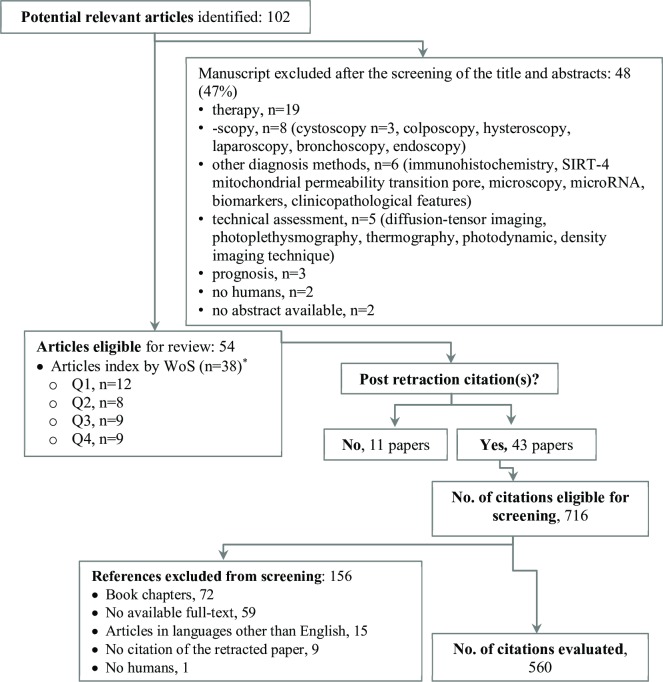
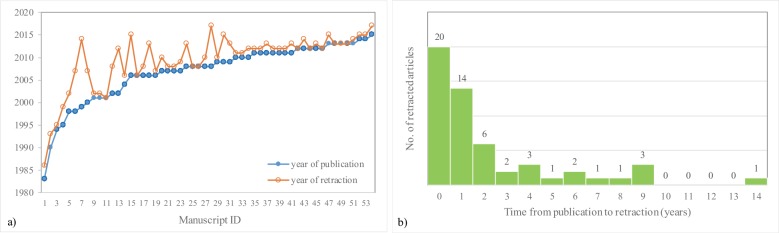
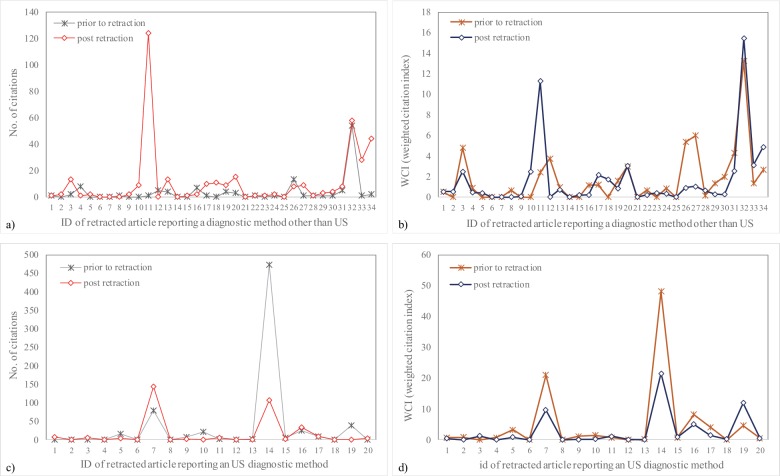
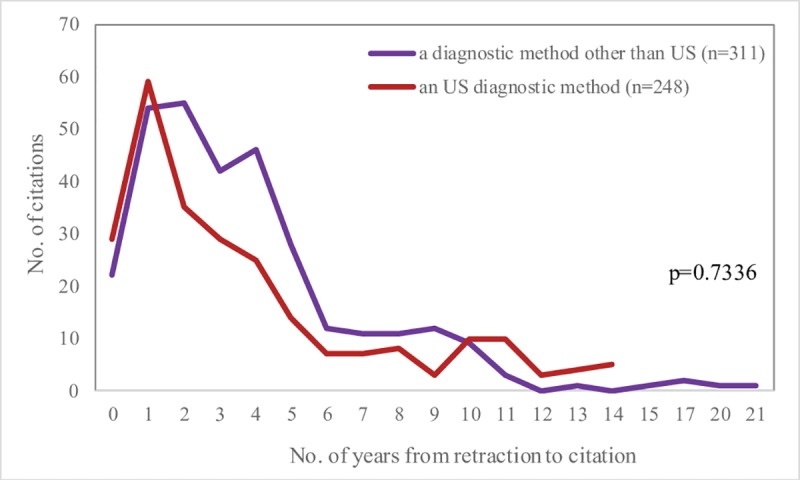
Our study aimed to evaluate the trends of post retraction citations of articles reporting a radiology-imaging diagnostic method and to find if a different pattern exists between manuscripts reporting an ultrasound method and those reporting other radiology diagnostic methods. This study reviewed retractions stored in PubMed on the subject of radiology-imaging diagnosis to identify the motivation, time from publication to retraction, and citations before and after retraction. The PubMed database was searched on June 2017 to retrieve the retracted articles, and the Scopus database was screened to identify the post-retraction citations. The full text was screened to see the type of post-retraction citation (positive/negative) and whether the cited article appears or not as retracted. One hundred and two retractions were identified, representing 3.5% of the retracted articles indexed by PubMed, out of which 54 were included in the analysis. Half of the articles were retracted in the first 24 months after publication, and the number of post retraction citations was higher than the number of citations before retraction in 30 out of 54 cases (US methods: 9/20, other diagnostic methods 21/34, P-value = 0.2312). The plagiarism was the most common reason for retraction (31%), followed by repetitive publication (26%), and errors in data/manuscript (24%). In less than 2% of cases, the retracted articles appear as retracted in the text or reference list, while the negative citation is observed in 4.84% among manuscripts reporting an US diagnostic method and 0.32% among manuscripts reporting a diagnostic method other than US (P-value = 0.0004). No significant differences were observed when post retraction weighted citation index (WCI, no. of citations weighted by citation window) was compared to WCI prior retraction (P-value = 0.5972). In light of the reported results, we enumerated some recommendations that could potentially minimize the referral to retracted studies as valid.
Overview
The claims and statistics of this paper haven’t been checked yet.
Free: it reads the open-access text and checks the first 5 claims that cite a source we can check. Create a free account to check every claim.
Integrity signals
Registry
Cites
Statistics
Figures
Verification
Claims the paper makes
The claims and statistics of this paper haven’t been checked yet.
Free: it reads the open-access text and checks the first 5 claims that cite a source we can check. Create a free account to check every claim.
Claims other papers make about this one
Each is checked against this paper’s own text: does it say what the citing paper says it does?
The cited source says what the claim attributes to it.
In the citing paper
“Five out of nine previous studies published in the last 5 years (2016–2021) reported fewer than 7% of citations acknowledging retractions (Bolboacă et al., 2019; Budd et al., 2016; Hamilton, 2019; Schneider et al., 2020; van der Vet & Nijveen, 2016).”
From Continued use of retracted papers: Temporal trends in citations and (lack of) awareness of retractions shown in citation contexts in biomedicine (2021) · cites this paper as Bolboacă et al., 2019
Self-check
Percentages, sums and reported differences re-computed from the paper’s own numbers.
The self-check needs the paper’s full text.
Citations
Cites
Misconduct accounts for the majority of retracted scientific publications
Fang, F. C., Steen, R. G., & Casadevall, A. (2012) · Proceedings of the National Academy of Sciences · doi:10.1073/pnas.1212247109 · Cited by 1,232
Factors Affecting Number of Citations: A Comprehensive Review of the Literature
Tahamtan, I., Safipour Afshar, A., & Ahamdzadeh, K. (2016) · Scientometrics · doi:10.1007/s11192-016-1889-2 · Cited by 912
A Comprehensive Survey of Retracted Articles from the Scholarly Literature
Grieneisen, M. L., & Zhang, M. (2012) · PLoS ONE · doi:10.1371/journal.pone.0044118 · Cited by 355
Titus, S. L., Wells, J. A., & Rhoades, L. J. (2008) · Nature · doi:10.1038/453980a · Cited by 300
Why and how do journals retract articles? An analysis of Medline retractions 1988–2008
Wager, E., & Williams, P. (2011) · Journal of Medical Ethics · doi:10.1136/jme.2010.040964 · Cited by 263
The Effects of Aging on Researchers' Publication and Citation Patterns
Gingras, Y., Larivière, V., Macaluso, B., & Robitaille, J.-P. (2008) · PLoS ONE · doi:10.1371/journal.pone.0004048 · Cited by 223
Peer-Review Fraud — Hacking the Scientific Publication Process
Haug, C. J. (2015) · New England Journal of Medicine · doi:10.1056/nejmp1512330 · Cited by 163
The false academy: predatory publishing in science and bioethics
Eriksson, S., & Helgesson, G. (2017) · Medicine, Health Care and Philosophy · doi:10.1007/s11019-016-9740-3 · Cited by 154
The career effects of scandal: Evidence from scientific retractions
Azoulay, P., Bonatti, A., & Krieger, J. L. (2017) · Research Policy · doi:10.1016/j.respol.2017.07.003 · Cited by 118
Retracted Publications in the Biomedical Literature from Open Access Journals
Wang, T., Xing, Q.-R., Wang, H., & Chen, W. (2018) · Science and Engineering Ethics · doi:10.1007/s11948-018-0040-6 · Cited by 107
Research works printed but not linked: 2
- Wang J, Ku JC, Alotaibi NM, Rutka JT. Retraction of Neurosurgical Publications: A Systematic Review. World Neurosurg. 2017; 103: 809– 814.e1. 10.1016/j.wneu.2017.04.014 28412480 · DOI
- Yan J, MacDonald A, Baisi LP, Evaniew N, Bhandari M, Ghert M. Retractions in orthopaedic research: A systematic review. Bone Joint Res. 2016; 5(6): 263– 268. 10.1302/2046-3758.56.BJR-2016-0047 27354716 PMC4957175 · DOI · Paper page
Cited by
Hsiao, T.-K., & Schneider, J. (2021) · Quantitative Science Studies · doi:10.1162/qss_a_00155 · Cited by 98
Citation of retracted publications: A challenging problem
Bolland, M. J., Grey, A., & Avenell, A. (2022) · Accountability in Research · doi:10.1080/08989621.2021.1886933 · Cited by 78
“…retracted articles (Pfeifer and Snodgrass 1990; Budd, Sievert, and Schultz 1998; Sox and Rennie 2006; Neale, Dailey, and Abrams 2010; BornemannCimenti, Szilagyi, and Sandner-Kiesling 2016; Bar-Ilan and Halevi 2017; Bolboaca et al. 2019; Mott, Fairhurst, and Torgerson 2019; Dal-Re and Ayuso 2020).”
BackgroundDoes retraction after misconduct have an impact on citations? A pre–post study
Candal-Pedreira, C., Ruano-Ravina, A., Fernández, E., Ramos, J., Campos-Varela, I., & Pérez-Ríos, M. (2020) · BMJ Global Health · doi:10.1136/bmjgh-2020-003719 · Cited by 67
Hwang, S. Y., Yon, D. K., Lee, S. W., Kim, M. S., Kim, J. Y., Smith, L., Koyanagi, A., Solmi, M., Carvalho, A. F., Kim, E. Y., et al. (2023) · Journal of Korean Medical Science · doi:10.3346/jkms.2023.38.e333 · Cited by 76
Frampton, G. K., Woods, L., & Scott, D. A. (2021) · PLoS ONE · doi:10.1371/journal.pone.0258935 · Cited by 58
Sharma, P., Sharma, B., Reza, A., Inampudi, K. K., & Dhamija, R. K. (2023) · Humanities and Social Sciences Communications · doi:10.1057/s41599-023-02095-x · Cited by 48
Khademizadeh, S., Danesh, F., Esmaeili, S., Lund, B. D., & Santos-d’Amorim, K. (2023) · Accountability in Research · doi:10.1080/08989621.2023.2223996 · Cited by 42
“Since then, studies about retractions have been performed in specific medical disciplines, such as obstetrics (Bennett et al. 2020) and radiology (Bolboacă et al. 2019; Kwee and Kwee 2022) have identified that most retractions in this field were related to scientific misconduct.”
Poor visibility of retracted articles: a problem that should no longer be ignored
Boudry, C., Howard, K., & Mouriaux, F. (2023) · BMJ · doi:10.1136/bmj-2022-072929 · Cited by 22
Khan, H., Gasparyan, A. Y., & Gupta, L. (2021) · Journal of Korean Medical Science · doi:10.3346/jkms.2021.36.e126 · Cited by 24
Yang, S., Qi, F., Diao, H., & Ajiferuke, I. (2022) · Journal of Information Science · doi:10.1177/01655515221097623 · Cited by 28
“Then, two reviewers assigned each citing paper two labels (positive or negative citation 5; mentioned the information of retraction or not) [25,40].”
BackgroundDoes ChatGPT Ignore Article Retractions and Other Reliability Concerns?
Thelwall, M., Lehtisaari, M., Katsirea, I., Holmberg, K., & Zheng, E. (2025) · Learned Publishing · doi:10.1002/leap.2018 · Cited by 18
Agency and responsibility: A linguistic analysis of culpable acts in retraction notices
Hu, G., & Xu, S. B. (2020) · Lingua · doi:10.1016/j.lingua.2020.102954 · Cited by 23
Jäntschi, L. (2021) · Mathematics · doi:10.3390/math9192506 · Cited by 21
Reasons and implications of retracted articles in Brazil
Santos-d’Amorim, K., Correia, A. E. G. C., Miranda, M. K. F. D. O., & Santa‐Cruz, P. A. (2021) · Transinformação · doi:10.1590/2318-0889202133e210001 · Cited by 20
Santos-d’Amorim, K., Wang, T., Lund, B. D., & dos Santos, R. N. M. (2022) · Ethics & Behavior · doi:10.1080/10508422.2022.2141747 · Cited by 22
“Some researchers read the citation of the retracted article in other articles but do not check the original one in the journal – meaning that they cited a text that has not even been read (Bolboacă et al., 2019; Budd et al., 1999) – can be stated as inducers of post-retraction citation behavior.”
BackgroundCapraș, R.-D., Bulboacă, A. E., & Bolboaca, S. D. (2020) · BMC Medical Education · doi:10.1186/s12909-020-1933-z · Cited by 17
Self-citationRetracted systematic reviews continued to be frequently cited: a citation analysis
Wang, Z., Shi, Q., Zhou, Q., Zhao, S., Hou, R., Lu, S., Gao, X., & Chen, Y. (2022) · Journal of Clinical Epidemiology · doi:10.1016/j.jclinepi.2022.05.013 · Cited by 13
RetractedThe Citation of Retracted Papers and Impact on the Integrity of the Scientific Biomedical Literature
da Silva, J. A. T., Santos-d’Amorim, K., & Bornemann‐Cimenti, H. (2025) · Learned Publishing · doi:10.1002/leap.1667 · Cited by 21
“Some retracted papers accrued more post-retraction citations than before their retraction (Bolboacă et al. 2019; Schneider et al. 2020), suggesting an imperfect mechanism of communication about retractions.”
Influence of accessibility (open and toll-based) of scholarly publications on retractions
Shah, T. A., Gul, S., Bashir, S., Ahmad, S., Huertas, A., Oliveira, A., Gulzar, F., Najar, A. H., & Chakraborty, K. (2021) · Scientometrics · doi:10.1007/s11192-021-03990-3 · Cited by 17
Houghton, F. T. (2022) · Journal of the Medical Library Association JMLA · doi:10.5195/jmla.2022.1441 · Cited by 21
Schneider, J., Woods, N. D., Proescholdt, R., Fu, Y., & The RISRS Team (2021) · MetArXiv (OSF Preprints) · doi:10.31222/osf.io/ms579 · Cited by 18
Why do some retracted articles continue to get cited?
Schmidt, M. A. (2024) · Scientometrics · doi:10.1007/s11192-024-05147-4 · Cited by 23
“More recent studies by Bolboacă et al. (2019) and Bar-Ilan and Halevi (2017) find around 5% negative citations and less than 2% that explicitly mention the retraction.”
Comprehensive Analysis of Retracted Publications in Dentistry: A 23-Year Review
Samuel, S., Cherian, J. M., & Thomas, A. M. (2020) · International Journal of Dentistry · doi:10.1155/2020/8881352 · Cited by 14
“Whilst working on the present research, we are aware that there are varied terms that can be applied to refer the retraction of a paper like “retired,” “cancelled,” “self-retraction,” or “removal” [13].”
BackgroundRetraction of Scientific Papers: Types of Retraction, Consequences, and Impacts
Candal‐Pedreira, C., Pérez‐Ríos, M., & Ruano‐Raviña, A. (2022) · Springer eBooks · doi:10.1007/978-3-030-99680-2_40 · Cited by 13
Replicability in Empirical Legal Research
Chin, J. M., & Zeiler, K. (2021) · Annual Review of Law and Social Science · doi:10.1146/annurev-lawsocsci-121620-085055 · Cited by 21
Minetto, S., Zanirato, M., Makieva, S., Marzanati, D., Esposito, S., Pisaturo, V., Costa, M., Candiani, M., Papaleo, E., & Alteri, A. (2023) · Frontiers in Public Health · doi:10.3389/fpubh.2023.1210951 · Cited by 7
Evaluation of retracted publications in Dentistry: A systematic review
Wadgave, U., & Khairnar, M. (2022) · Indian Journal of Medical Ethics · doi:10.20529/ijme.2022.021 · Cited by 8
“Several surveys have evaluated retracted publications in different specialities and the reasons for their retraction [5-7].”
Backgroundda Silva, J. A. T., & Nazarovets, S. (2023) · Scientometrics · doi:10.1007/s11192-023-04769-4 · Cited by 5
“We also wanted to appreciate the volume of pre-retraction citations relative to post-retraction citations, as suggested by Bolboacă et al. (2019).”
ResultSantos-d’Amorim, K., de Melo, R. R., Correia, A. E. G. C., Miranda, M. K. F. D. O., & da Silveira, M. A. A. (2023) · Em Questão · doi:10.19132/1808-5245.29.125494 · Cited by 9
Systematic examination of post‐ and pre‐citation of Indian‐authored retracted papers
Palla, I. A., Singson, M., & Thiyagarajan, S. (2023) · Learned Publishing · doi:10.1002/leap.1572 · Cited by 7
“Several researchers (Bolboac (cid:2) a et al., 2019; Hamilton, 2019; Suelzer et al., 2019) recommend that writers follow suitable research processes by checking their citations to decrease the impact and dissemination of fl awed and fraudulent research.”
BackgroundResultCharacteristics of correction practice and its citation in library and information science journals
Yang, S., Diao, H., Zou, Y., & Xiao, A. (2022) · Journal of Librarianship and Information Science · doi:10.1177/09610006221124623 · Cited by 3
“…showed that retracted articles continued to be cited after their retraction (da Silva and Bornemann-Cimenti, 2017; Yang et al., 2022), and the analysis of the nature of the citations revealed that most of them were positive (Bar-Ilan and Halevi, 2017; Bolboacă et al., 2019; Suelzer et al., 2019).”
BackgroundUncovering the reasons of retraction in virology: a citation and Altmetric investigation
Malla, R. A., & Wani, Z. A. (2024) · Global Knowledge, Memory and Communication · doi:10.1108/gkmc-11-2023-0415 · Cited by 4
Back to basics: Avoiding errors in scientific research and publications
Obradović, B. (2019) · Hemijska industrija · doi:10.2298/hemind190630018o · Cited by 3
An analysis of availability and implications of unlabeled retracted articles on Sci-Hub
Biju, V. V., Jose, S., Franklin, J., & Jasimudeen, S. (2025) · Accountability in Research · doi:10.1080/08989621.2024.2446558 · Cited by 3
“Numerous studies have identified that retracted articles continue to receive citations even after formal retraction (Ajiferuke and Adekannbi 2020; Bolboacă et al. 2019).”
Digital Infrastructures for Scholarly Content Objects
Schneider, J., de Waard, A., Balke, W., Wang, X., Song, N., Bolin, H., & Fu, Y. (2021) · ACM/IEEE Joint Conference on Digital Libraries · doi:10.1109/jcdl52503.2021.00069 · Cited by 3
Palla, I. A., & Singson, M. (2026) · Information Discovery and Delivery · doi:10.1108/idd-09-2025-0221 · Cited by 1
García-Romero, A., lez-Mancebo, S. G. A., Espallardo, C., & Concepción, M. A. (2026) · Scientometrics · doi:10.1007/s11192-026-05699-7 · Cited by 4
“More concerningly, retractions do not appear to significantly reduce overall citation counts (Bolboacă et al., 2019).”
Sample credibility in literature reviews: a descriptive methodological review and guidance framework
Hahn, R. (2026) · Management Review Quarterly · doi:10.1007/s11301-026-00626-9 · Cited by 1
Survey on Citations of Retracted Non-Cochrane Systematic Reviews in MedicinePreprint
Wang, Z., Shi, Q., Zhou, Q. X., Zhao, S., Hou, R., Lu, S., Gao, X., & Chen, Y. (2022) · SSRN Electronic Journal · doi:10.2139/ssrn.4014349
2nd Workshop on Digital Infrastructures for Scholarly Content Objects (DISCO'22)
Balke, W., Kroll, H., Fu, Y., Schneider, J., & de Waard, A. (2022) · ACM/IEEE Joint Conference on Digital Libraries · doi:10.1145/3529372.3530943
“Relevant problems include: retraction and inadvertent citation and reuse of retracted papers [2, 17]; propagation of errors in literature and scientific databases [6, 7]; non-reproducible papers; known domain-specific issues such as cell line contamination [3]; bias in research datasets and…”
BackgroundSharma, K., & Khurana, P. (2025) · International Conference on Scientometrics and Informetrics (ISSI) · doi:10.51408/issi2025_064 · Cited by 1
Heesen, P., Fritsak, M., Kretzschmar, L., Heusel, A. E., Ciobanu-Caraus, O., Ahmadsei, M., Thormann, M., Ehret, F., Andratschke, N. H., Zips, D., et al. (2026) · Advances in Radiation Oncology · doi:10.1016/j.adro.2026.102071
“9 10-16 Additionally, the COVID-19 pandemic from 2020 to 2022 has brought about signi fi cant disruptions to the academic and scienti fi c communities.”
Metadata
- Authors
- Bolboacă, S. D., Buhai, D.-V., Aluaș, M., & Bulboacă, A. E.
- Affiliations
- Iuliu Hațieganu University of Medicine and Pharmacy (RO)
- Venue
- PLOS ONE
- Publisher
- Public Library of Science (PLoS)
- Published
- 2019-06-13
- Volume
- 14
- Issue
- 6
- Pages
- e0217918
- ISSN
- 1932-6203 (ISSN-L)
- PMC
- PMC6563977
- OpenAlex
- W2949247270
- Cited by
- 42
- References
- 41
- Citations by year
- 2026: 4 · 2025: 4 · 2024: 2 · 2023: 8 · 2022: 9 · 2021: 10 · 2020: 4 · 2019: 1
- FWCI
- 10.47
- Type
- journal article
- Language
- en
- Open access
- gold
- doi.org
- Licence
- Locations
- PLoS ONE (publishedVersion, cc-by)
- PubMed Central (publishedVersion, cc-by)
- PubMed (publishedVersion)
- RePEc: Research Papers in Economics (submittedVersion)
- DOAJ (DOAJ: Directory of Open Access Journals) (submittedVersion, cc-by-sa)
- Topics
- Social Sciences › Education › Academic integrity and plagiarism
- Social Sciences › Library and Information Sciences › scientometrics and bibliometrics research
- Social Sciences › Library and Information Sciences › Academic Publishing and Open Access
- Keywords
- retracted article, citation patterns, plagiarism, retraction reasons
- MeSH terms
- Diagnosis, Humans, Publications, Radiology, Retraction of Publication as Topic, PubMed
About these checks
Registry, retraction, Cites and statistics results are computed, not judged, with one exception: a printed reference that no index lists is read once by a model before it counts as a citation error. Claims are extracted by a model and kept only when their quote appears verbatim in the text; each cited source is then checked, with a model’s help, for whether it says what the claim relies on. Those verdicts can be wrong — read the claim’s quote and the cited source before relying on one.
Statistics and arithmetic are recomputed, not judged.
Confidence bands are shown only for fields calibrated on our annotated test set. None is calibrated yet, so no band is shown.
What counts as a claim ›How we measure confidence ›How we check this ›
Are you an author, or do you see a problem with this page? Request a review
Data sources
Bibliographic data: Semantic Scholar, OpenAlex, Crossref.
Contains information from the Semantic Scholar Academic Graph Datasets, made available under the ODC Attribution License (ODC-BY 1.0).
Semantic Scholar’s data is described in: Kinney, R., et al. (2023). The Semantic Scholar Open Data Platform. arXiv:2301.10140.
