

Ancient Technology and Punctuated Change: Detecting the Emergence of the Edomite Kingdom in the Southern Levant.
Open accessThe DOI matches its Crossref record; 40 of the 43 references it cites were found in a registry or an index.
Abstract
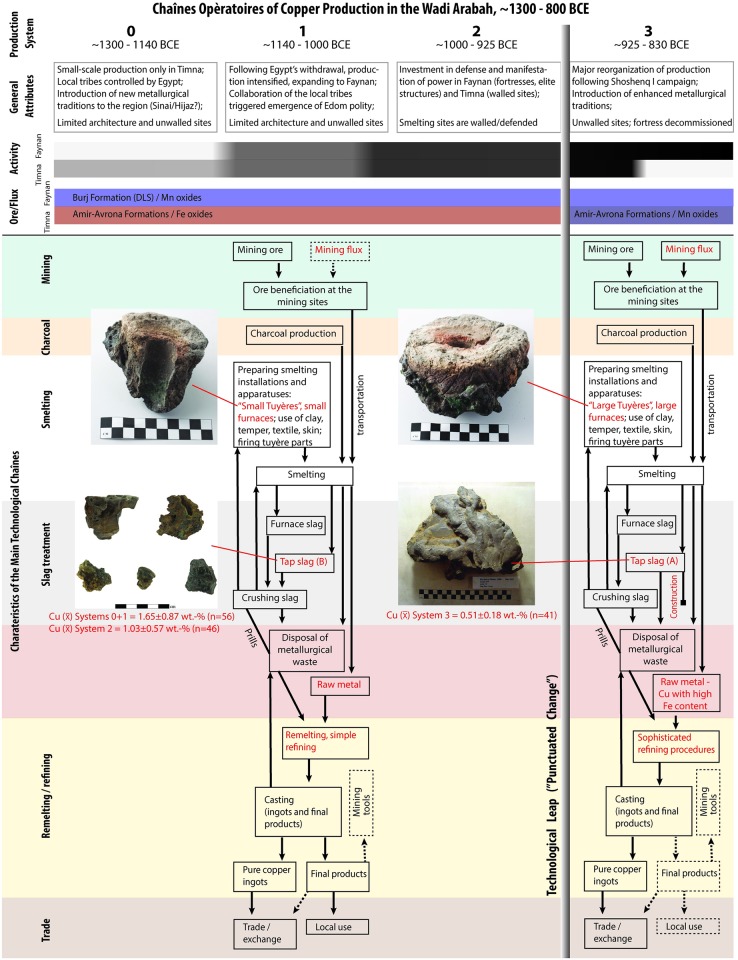
While the punctuated equilibrium model has been employed in paleontological and archaeological research, it has rarely been applied for technological and social evolution in the Holocene. Using metallurgical technologies from the Wadi Arabah (Jordan/Israel) as a case study, we demonstrate a gradual technological development (13th-10th c. BCE) followed by a human agency-triggered punctuated "leap" (late-10th c. BCE) simultaneously across the entire region (an area of ~2000 km2). Here, we present an unparalleled, diachronic archaeometallurgical dataset focusing on elemental analysis of dozens of well-dated slag samples. Based on the results, we suggest punctuated equilibrium provides an innovative theoretical model for exploring ancient technological changes in relation to larger sociopolitical conditions-in the case at hand the emergence of biblical Edom-, exemplifying its potential for more general cross-cultural applications.
Overview
The claims and statistics of this paper haven’t been checked yet.
Free: it reads the open-access text and checks the first 5 claims that cite a source we can check. Create a free account to check every claim.
Integrity signals
Registry
Cites
Statistics
Figures
Verification
Claims the paper makes
The claims and statistics of this paper haven’t been checked yet.
Free: it reads the open-access text and checks the first 5 claims that cite a source we can check. Create a free account to check every claim.
Claims other papers make about this one
Each is checked against this paper’s own text: does it say what the citing paper says it does?
The source backs part of the claim, not all of it — or backs it for a different population, condition or comparison.
In the citing paper
“which is tightly dated by radiocarbon to the late 11th–early 10th centuries BCE”
From Early evidence of royal purple dyed textile from Timna Valley (Israel) (2021) · cites this paper as [66]
Experimental — accuracy not yet measured
Self-check
Percentages, sums and reported differences re-computed from the paper’s own numbers.
The self-check needs the paper’s full text.
Citations
Cites
Punctuated equilibria: an alternative to phyletic gradualism
Eldredge, N., Gould, S. J., & Schöpf, T. J. M. (1972) · Cited by 3,257
Punctuated equilibria: the tempo and mode of evolution reconsidered
Gould, S. J., & Eldredge, N. (1977) · Paleobiology · doi:10.1017/s0094837300005224 · Cited by 2,659 · cited 1×
“Proposed as an alternative to phyletic gradualism, the Darwinian process entailing new species evolving through gradual and steady transformations, punctuated equilibrium suggests biological evolution is characterized by rare, rapid, and episodic events of speciation (cladogenesis) [12, 13].”
BackgroundPunctuated equilibrium comes of age
Gould, S. J., & Eldredge, N. (1993) · Nature · doi:10.1038/366223a0 · Cited by 957 · cited 1×
“, [14], often complementing phyletic gradualism based on the recognition of stasis as a meaningful and predominant pattern within the history of species [15].”
BackgroundSocial Anthropology of Technology
Pfaffenberger, B. (1992) · Annual Review of Anthropology · doi:10.1146/annurev.an.21.100192.002423 · Cited by 655 · cited 1×
“This assumption should be treated with caution in the study of technological trajectories in human societies [40], as discrete cases within the longue durée of a given region can easily deviate from a unilinear development model [41].”
Background1177 B.C.: The Year Civilization Collapsed
Cline, E. H. (2014) · doi:10.1515/9781400849987 · Cited by 452
Tylecote, R. F. (1977) · British Corrosion Journal · doi:10.1179/bcj.1977.12.3.137 · Cited by 386
Evolutionary Theory and Archaeology
DUNNELL, R. C. (1980) · Advances in Archaeological Method and Theory · doi:10.1016/b978-0-12-003103-0.50007-1 · Cited by 365 · cited 2×
“Traditionally, this theoretical borrowing was archaeologically applied to cultural phenomena in place of biological species, using evolutionary models to interpret/understand developments in material culture and social complexity [16].”
BackgroundInfluentialThe Archaeometallurgy of Copper: Evidence from Faynan, Jordan
(2007) · Natural Science in Archaeology · doi:10.1007/978-3-540-72238-0 · Cited by 212
Development of metallurgy in Eurasia
Roberts, B. W., Thornton, C. P., & Pigott, V. C. (2009) · Antiquity · doi:10.1017/s0003598x00099312 · Cited by 192
The Third Intermediate Period in Egypt (1100-650 BC)
Mueller, D., & Kitchen, K. A. (1975) · Journal of the American Research Center in Egypt · doi:10.2307/40000028 · Cited by 177
Research works printed but not linked: 7
- Ben-Yosef E. The Central Timna Valley Project: Research Design and Preliminary Results In: Ben-Yosef E, editor. Mining for Ancient Copper: Essays in Memory of Beno Rothenberg. Tel Aviv: The Institute of Archaeology of Tel Aviv University; 2018 p. 28– 63.
- Rothenberg B, editor. The Ancient Metallurgy of Copper: Archaeology—Experiment—Theory. London: Institute of Archaeology, University College, London; 1990.
- Charlton MF, Shennan SJ, Rehren T, Crew P. Evolutionary analysis of ironmaking slag In: Humpris J, Rehren T, editors. The World of Iron. London: Archetype; 2013 p. 288– 95.
- Ben-Yosef E, Sergi O. The Destruction of Gath by Hazael and the Arabah Copper Industry: A Reassessment In: Shai I, Chadwick JR, Hitchcock L, Dagan A, McKinny C, Uziel J, editors. Tell it in Gath Studies in the History and Archaeology of Israel Essays in Honor of Aren M Maeir on the Occasion of his Sixtieth Birthday. Ägypten und Altes Testament Münster: Zaphon; 2018 p. 461– 80.
- Ben-Yosef E. A False Contrast? On the Possibility of an Early Iron Age Nomadic Monarchy in the Arabah (Early Edom) and Its Implications to the Study of Ancient Israel In: Lipschits O, Sergi O, Koch I, editors. From Nomadism to Monarchy? “The Archaeology of the Settlement Period” Thirty Years Later. Winona Lake: Eisenbrauns; forthcoming.
- Stein GJ. Rethinking World-Systems: Diasporas, Colonies, and Interaction in Uruk Mesopotamia. Tuscon: The University of Arizona Press; 1999.
- Cavanagh M. Sustainability of an Industry on the Fringe: A Dendroarchaeological Investigation into Fuel Sources at the Iron Age Copper Smelting Sites of the Timna Valley [MA thesis]. Tel Aviv: Tel Aviv University; 2016.
Cited by
Early evidence of royal purple dyed textile from Timna Valley (Israel)
Sukenik, N., Iluz, D., Amar, Z., Varvak, A., Shamir, O., & Ben-Yosef, E. (2021) · PLOS ONE · doi:10.1371/journal.pone.0245897 · Cited by 40
“These include a dozen of radiocarbon dates from short-lived materials (mostly date seeds [64]), the study of pottery typology [65] and other considerations [66].”
BackgroundSelf-citationLiss, B., Levy, T. E., & Day, J. M. D. (2020) · Journal of Archaeological Science · doi:10.1016/j.jas.2020.105227 · Cited by 29
Self-citationDirect evidence for the co-manufacturing of early iron and copper-alloy artifacts in the Caucasus
Erb‐Satullo, N. L., Jachvliani, D., Kakhiani, K., & Newman, R. (2020) · Journal of Archaeological Science · doi:10.1016/j.jas.2020.105220 · Cited by 29
Cavanagh, M., Ben‐Yosef, E., & Langgut, D. (2022) · Scientific Reports · doi:10.1038/s41598-022-18940-z · Cited by 28
Self-citationEvian, S. B., Yagel, O. A., Harlavan, Y., Seri, H., Lewinsky, J., & Ben‐Yosef, E. (2021) · Journal of Archaeological Science Reports · doi:10.1016/j.jasrep.2021.103025 · Cited by 39
Self-citationUp the Wadi: Development of an Iron Age Industrial Landscape in Faynan, Jordan
Liss, B., Howland, M. D., Lorentzen, B., Smitheram, C., Najjar, M., & Levy, T. E. (2020) · Journal of Field Archaeology · doi:10.1080/00934690.2020.1747792 · Cited by 34
“Ultimately, the Wadi Arabah would develop into the main source of copper to the region until the end of production in the Late Iron Age (Levy, Ben-Yosef, and Najjar 2014; Ben-Yosef et al. 2019).”
BackgroundSelf-citationPunctuated equilibrium at 50: Anything there for evolutionary anthropology? Yes; definitely
O’Brien, M. J., Valverde, S., Duran‐Nebreda, S., Vidiella, B., & Bentley, R. A. (2023) · Evolutionary Anthropology Issues News and Reviews · doi:10.1002/evan.22009 · Cited by 18
“…the terms “ punctuated ” and “ punctuational ” have been used in studying aspects of cultural evolution, including language 72,73 and technological evolution, 74 – 78 most, but not all, authors are careful not to refer to PE per se but only to the fact that cultural evolution can occur in bursts.”
MethodComplexity Without Monumentality in Biblical Times
Ben‐Yosef, E., & Thomas, Z. (2023) · Journal of Archaeological Research · doi:10.1007/s10814-023-09184-0 · Cited by 12
Self-citationRecognizing technique variation in rock engravings: ArchCUT3-D for micromorphological analysis
Dubinsky, L., David, M., & Grosman, L. (2023) · Humanities and Social Sciences Communications · doi:10.1057/s41599-023-01742-7 · Cited by 14
A Reassessment of the Chronology of the Iron Age site of Khirbet en-Nahas, Southern Jordan
Tebes, J. M. (2021) · Palestine Exploration Quarterly · doi:10.1080/00310328.2021.1886489 · Cited by 13
“Ben-Yosef et al. (2019) recently identified a technological ‘leap’ in the metallurgical industry of KEN and the Arabah Valley in general, including a more efficacious control over the smelting process, a reorganization of the production process (transformation of Area A into metallurgical…”
BackgroundDavid, M., Kislev, M. E., Melamed, Y., Ben‐Yosef, E., & Weiss, E. (2022) · Tel Aviv · doi:10.1080/03344355.2022.2102110 · Cited by 11
“The Timna Valley lies in the deep desert of southern Arabah Valley in Israel, some 30 km north of Eilat.”
BackgroundMethodSelf-citationThe Formation of Edom: An Archaeological Critique of the “Early Edom” Hypothesis
Bieńkowski, P. (2022) · Bulletin of the American Society of Overseas Research · doi:10.1086/720775 · Cited by 10
Bode, M., Kiderlen, M., Mastrotheodoros, G., Jansen, M., Ben‐Yosef, E., Yagel, O. A., Renzi, M., Filippaki, E., Bassiakos, Y., Hein, A., et al. (2024) · METALLA · doi:10.46586/metalla.v27.2023.i2.167-219 · Cited by 9
Self-citationFaynan, Nomads and the Western Negev in the Early Iron Age: A Critical Reappraisal
Bieńkowski, P., & Tebes, J. M. (2024) · Palestine Exploration Quarterly · doi:10.1080/00310328.2023.2277628 · Cited by 9
“With the more recent downdating of Tel Masos (see below), Finkelstein now thinks that Sheshonq I stimulated, rather than obliterated, the prosperity of the south (Finkelstein 2014, 96; 2021; also Fantalkin and Finkelstein 2006; Ben-Yosef et al. 2019, 8-10).”
Kleiman, A., Kleiman, S., & Ben‐Yosef, E. (2024) · Oxford Journal of Archaeology · doi:10.1111/ojoa.12307 · Cited by 6
Self-citationTrade, Kingdom, and Empire: Edom and the South Arabian Trade
Danielson, A. J. (2022) · Journal of Ancient Near Eastern History · doi:10.1515/janeh-2022-0007 · Cited by 8
Edom in Judah: Trade, Migration, and Kinship in the Late Iron Age Southern Levant
Danielson, A. J. (2024) · Cambridge University Press eBooks · doi:10.1017/9781009424325 · Cited by 6
Stroth, L., Suero, A. G., Liss, B., Howland, M. D., & Guedes, J. D. (2023) · Interdisciplinary Contributions to Archaeology/Interdisciplinary contributions to archaeology · doi:10.1007/978-3-031-27330-8_48 · Cited by 5
Self-citationMaeir, A. M. (2021) · Bulletin of the American Schools of Oriental Research · doi:10.1086/714573 · Cited by 6
The emergence of a nomadic desert polity: an archaeozoological perspective
Sapir‐Hen, L., & Ben‐Yosef, E. (2022) · Archaeological and Anthropological Sciences · doi:10.1007/s12520-022-01694-0 · Cited by 5
“The above shows a shift in economic focus, from the thirteenth century BCE sites, to twelfth–eleventh century BCE sites to the late eleventh to mid tenth century BCE to late tenth to ninth century BCE, which correlates to the regional changes in the Arabah Valley, attributed to changing socio-technical systems (Ben-Yo…”
BackgroundMethodSelf-citationZubrow, E. B. W. (2023) · Elsevier eBooks · doi:10.1016/b978-0-323-90799-6.00182-8 · Cited by 5
Copper Trade Networks from the Arabah: Re-assessing the Impact on Early Iron Age Moab
Klassen, S., & Danielson, A. J. (2023) · Interdisciplinary Contributions to Archaeology/Interdisciplinary contributions to archaeology · doi:10.1007/978-3-031-27330-8_51 · Cited by 5
Life on the margins: the early Iron Age site of ʿAyun adh-Dhib, Jordan
Danielson, A. J., Foran, D., Klassen, S., Braun, G., Ginson, G., Doležálková, V., Fessler, H., & Campbell, R. A. (2024) · Levant · doi:10.1080/00758914.2024.2419202 · Cited by 4
“2012; 2019; Levy et al. 2014) has spurred on numerous discussions around the nature of social and political organizations, including new arguments that emphasize various non-sedentary ‘ nomadic ’ elements (Ben-Yosef 2019; Ben-Yosef and Thomas 2024).”
Eshel, T., Bornstein, Y., Bermatov‐Paz, G., & Bar, S. (2025) · PLoS ONE · doi:10.1371/journal.pone.0329175 · Cited by 2
“The striking technological synchronicity between Timna and Faynan suggests the existence of an overarching political entity in the region as early as the 11th century BCE [84], contemporaneous with the site of el-Ahwat [67].”
Middle Bronze Age copper smelting in the Wadi Arabah: filling the gap
Liss, B., Yahalom‐Mack, N., Avner, U., Scott-Cummings, L., Tirosh, O., & Behar, A. E. (2025) · Archaeological and Anthropological Sciences · doi:10.1007/s12520-025-02294-4 · Cited by 2
“5.9 wt.% with high variability), often an indicator of poor smelting efficiency (e.g., Bachman 1982; Ben-Yosef et al. 2019; cf. Shilstein and Shalev 2018).”
InfluentialSelf-citationLangford, B., Kutuzov, I., Frumkin, A., & Ben‐Yosef, E. (2026) · Journal of Arid Environments · doi:10.1016/j.jaridenv.2026.105557 · Cited by 2
Self-citationLuria, D. (2021) · PLoS ONE · doi:10.1371/journal.pone.0260518 · Cited by 3
“This led to the introduction of innovations in technology and production organization that resulted in a significant increase in the efficiency of copper production [11], The existing paradigm was purportedly supported by the discovery of a scarab of Sheshonq I at Faynan [12], Furthermore, the advocates of the existin…”
InfluentialIron Age Copper Metallurgy in Southeast Arabia: A Comparative Perspective
Lehner, J. W., Dumitru, I. A., Buffington, A., Dollarhide, E., Nathan, S., Paulsen, P., Young, M. L., Sivitskis, A. J., Wiig, F., & Harrower, M. J. (2023) · Interdisciplinary Contributions to Archaeology/Interdisciplinary contributions to archaeology · doi:10.1007/978-3-031-27330-8_59 · Cited by 3
Using Human Rational Behavior to Reconstruct Events of Scarce Archaeological Evidence
Luria, D. (2020) · Journal of Anthropology and Archaeology · doi:10.15640/jaa.v8n2a1 · Cited by 2
Markets, Barter, and the Origins of Money: How Archaic States and Empires Organized Their Economies
Braswell, G. E. (2023) · Interdisciplinary Contributions to Archaeology/Interdisciplinary contributions to archaeology · doi:10.1007/978-3-031-27330-8_78 · Cited by 1
Mining and metallurgical labor in Islamic period Southwest Asia
Jones, I. W. N. (2023) · World Archaeology · doi:10.1080/00438243.2024.2345633 · Cited by 1
“…production in northern Wādī ʿ Araba reconstructed from excavations at Khirbat Nuqayb al-Asaymir (Jones 2016; Levy et al. 2012), supplemented by chaînes opératoires reconstructed for earlier periods of copper exploitation in Wādī ʿ Araba (Ben-Yosef et al. 2019; Levy et al. 2002; J. F. Merkel 1990).”
Pre-Roman copper industry had no polluting impact on the global environment
Yagel, O. A., Greener, A., Ondricek, W., & Ben‐Yosef, E. (2024) · Scientific Reports · doi:10.1038/s41598-024-80939-5 · Cited by 2
“During the Iron Age, iron oxides were deliberately added to copper smelting furnaces in the Arabah as fluxing agents 22,23 .”
Self-citationAncient Edom: The Tel Masos Polity from the tenth to the mid-ninth Century bc
Na’aman, N. (2025) · Palestine Exploration Quarterly · doi:10.1080/00310328.2025.2558276 · Cited by 1
Ashkenazi, D., Klein, S., Lichtenberger, A., & Tal, O. (2026) · Metallography Microstructure and Analysis · doi:10.1007/s13632-026-01347-x · Cited by 1
A New Interpretation of the Iron Age Negev Highlands Sites
Ben‐Yosef, E. (2026) · Antiguo Oriente · doi:10.32028/antor.v23i.3463 · Cited by 1
Self-citationRidder, E., Fall, P. L., & Falconer, S. E. (2023) · Interdisciplinary Contributions to Archaeology/Interdisciplinary contributions to archaeology · doi:10.1007/978-3-031-27330-8_68 · Cited by 1
Techné of Rock Engravings—the Timna Case Study
Dubinsky, L., & Grosman, L. (2024) · Journal of Archaeological Method and Theory · doi:10.1007/s10816-024-09658-5 · Cited by 4
“1) where there is evidence for 500 years of continuous copper mining and smelting activities, from the 14th through the 9th century BCE (Ben-Yosef et al., 2010; Ben-Yosef et al., 2012; Ben-Yosef et al., 2019).”
Tebes, J. M. (2020) · Revista del Instituto de Historia Antigua Oriental · doi:10.34096/rihao.n21.8653 · Cited by 1
“» The appearance of an advanced metallurgy technology based on the extraction and processing of copper in the Arabah Valley, called “the first industrial revolution in this part of the Middle East” (Beherec et al., 2016: 70) and a “punctuated technological leap” (Ben-Yosef et al., 2019).”
BackgroundMartinón‐Torres, M. (2023) · Wiley eBooks · doi:10.1002/9781119592112.ch46 · Cited by 1
From Chalcolithic to Early Bronze Age: A view from Abu Hof Cave 22 (Israel)
Holl, A. F. C., & Dawson, L. (2023) · International Journal of Modern Anthropology · doi:10.4314/ijma.v2i19.2
Heraclitus’ Law and the Late Period Shaft Tombs of Abusir
Bárta, M. (2023) · Interdisciplinary Contributions to Archaeology/Interdisciplinary contributions to archaeology · doi:10.1007/978-3-031-27330-8_44
“Cult and Copper”: A VR Game Exploring the Intangible Heritage of Copper Smelting
Sobieralski, C. (2023) · Interdisciplinary Contributions to Archaeology/Interdisciplinary contributions to archaeology · doi:10.1007/978-3-031-27330-8_73
Maps and Models: Applications of GIS and Image-Based Modeling to Field Archaeology in Faynan, Jordan
Howland, M. D., & Liss, B. (2023) · Interdisciplinary Contributions to Archaeology/Interdisciplinary contributions to archaeology · doi:10.1007/978-3-031-27330-8_47
Self-citationBen‐Yosef, E., & Thomas, Z. (2023) · Interdisciplinary Contributions to Archaeology/Interdisciplinary contributions to archaeology · doi:10.1007/978-3-031-27330-8_22
Self-citationNew Radiocarbon Dating from Late Bronze and Iron Age Gezer and Its Implications
Levy, T. E. (2024) · Journal of Eastern Mediterranean Archaeology & Heritage Studies · doi:10.5325/jeasmedarcherstu.12.4.0448
Self-citationSugihyono, & Lukito, A. D. (2026) · TEOLOGIS-RELEVAN-APLIKATIF-CENDIKIA-KONTEKSTUAL · doi:10.61660/track.v5i1.264
Animals and Society in the Iron Age to the Persian Period: Economy, Culture and Environment
Sapir‐Hen, L. (2026) · Cambridge University Press eBooks · doi:10.1017/9781009507929
Ben‐Yosef, E., & Yagel, O. A. (2026) · SSRN Electronic Journal · doi:10.2139/ssrn.7500060
Self-citationSeasonal and multi-functional use of industrial space at Iron Age Tel Shiqmona, Israel
Ramírez, I. O., Shalvi, G., Pinsky, S., Jacobson, M., Zuckerman‐Cooper, R., Gilboa, A., & Friesem, D. E. (2026) · PLoS ONE · doi:10.1371/journal.pone.0355104 · Cited by 2
“This copper industry, however, largely predates the broader expansion of such production in the Iron Age II [24], and the political framework within which it operated remains contested [e.g., 25].”
Abbreviations and Preliminary Remarks
(2026) · Vandenhoeck & Ruprecht eBooks · doi:10.13109/9783666502873.xiii
Index of Geographic and Ethnic Names
(2026) · Vandenhoeck & Ruprecht eBooks · doi:10.13109/9783666502873.346
(2026) · Vandenhoeck & Ruprecht eBooks · doi:10.13109/9783666502873.front
5 Idumea and Idumeans in the Early Roman Period
(2026) · Vandenhoeck & Ruprecht eBooks · doi:10.13109/9783666502873.216
(2026) · Vandenhoeck & Ruprecht eBooks · doi:10.13109/9783666502873.279
(2026) · Vandenhoeck & Ruprecht eBooks · doi:10.13109/9783666502873.24
Marciak, M. (2026) · Vandenhoeck & Ruprecht eBooks · doi:10.13109/9783666502873
(2026) · Vandenhoeck & Ruprecht eBooks · doi:10.13109/9783666502873.xv
(2026) · Vandenhoeck & Ruprecht eBooks · doi:10.13109/9783666502873.343
4 Idumea and Idumeans in the Hellenistic Period
(2026) · Vandenhoeck & Ruprecht eBooks · doi:10.13109/9783666502873.105
1 Jewish Identity in the Second Temple Period
(2026) · Vandenhoeck & Ruprecht eBooks · doi:10.13109/9783666502873.8
(2026) · Vandenhoeck & Ruprecht eBooks · doi:10.13109/9783666502873.270
(2026) · Vandenhoeck & Ruprecht eBooks · doi:10.13109/9783666502873.ix
(2026) · Vandenhoeck & Ruprecht eBooks · doi:10.13109/9783666502873.1
3 Idumeans in the Persian Period
(2026) · Vandenhoeck & Ruprecht eBooks · doi:10.13109/9783666502873.46
(2026) · Vandenhoeck & Ruprecht eBooks · doi:10.13109/9783666502873.toc
(2026) · Vandenhoeck & Ruprecht eBooks · doi:10.13109/9783666502873.332
Metadata
- Authors
- Ben-Yosef, E., Liss, B., Yagel, O. A., Tirosh, O., Najjar, M., & Levy, T. E.
- Affiliations
- University of California San Diego (US)
- Tel Aviv University (IL)
- Hebrew University of Jerusalem (IL)
- Venue
- PLoS ONE
- Publisher
- Public Library of Science (PLoS)
- Published
- 2019-09-18
- Volume
- 14
- Issue
- 9
- Pages
- e0221967
- ISSN
- 1932-6203 (ISSN-L)
- PMC
- PMC6750566
- OpenAlex
- W2974465963
- Cited by
- 49
- References
- 43
- Citations by year
- 2026: 7 · 2025: 3 · 2024: 8 · 2023: 16 · 2022: 5 · 2021: 5 · 2020: 5
- FWCI
- 11.22
- Type
- journal article
- Language
- en
- Open access
- gold
- doi.org
- Licence
- Locations
- PLoS ONE (publishedVersion, cc-by)
- PubMed Central (publishedVersion, cc-by)
- PubMed (publishedVersion)
- DOAJ (DOAJ: Directory of Open Access Journals) (submittedVersion, cc-by-sa)
- eScholarship (California Digital Library) (submittedVersion)
- Figshare (submittedVersion, cc-by)
- Funders
- Israel Science Foundation (1880/17)
- Topics
- Social Sciences › Archeology › Metallurgy and Cultural Artifacts
- Social Sciences › Arts and Humanities › Religious studies › Biblical Studies and Interpretation
- Social Sciences › Archeology › Archaeology and ancient environmental studies
- Keywords
- punctuated equilibrium, ancient metallurgy, slag analysis, archaeometallurgy, technological change, social and political change, human agency, Bronze Age, Southern Levant, elemental analysis
- MeSH terms
- Archaeology, Copper, Humans, Israel, Jordan, Metallurgy, Models, Theoretical, Paleontology, History, Ancient
About these checks
Registry, retraction, Cites and statistics results are computed, not judged, with one exception: a printed reference that no index lists is read once by a model before it counts as a citation error. Claims are extracted by a model and kept only when their quote appears verbatim in the text; each cited source is then checked, with a model’s help, for whether it says what the claim relies on. Those verdicts can be wrong — read the claim’s quote and the cited source before relying on one.
Statistics and arithmetic are recomputed, not judged.
Confidence bands are shown only for fields calibrated on our annotated test set. None is calibrated yet, so no band is shown.
What counts as a claim ›How we measure confidence ›How we check this ›
Are you an author, or do you see a problem with this page? Request a review
Data sources
Bibliographic data: Semantic Scholar, OpenAlex, Crossref.
Contains information from the Semantic Scholar Academic Graph Datasets, made available under the ODC Attribution License (ODC-BY 1.0).
Semantic Scholar’s data is described in: Kinney, R., et al. (2023). The Semantic Scholar Open Data Platform. arXiv:2301.10140.
