

Video abstracts and plain language summaries are more effective than graphical abstracts and published abstracts
Open accessThe DOI matches its Crossref record; 13 of the 13 references it cites were found in a registry or an index.
Abstract
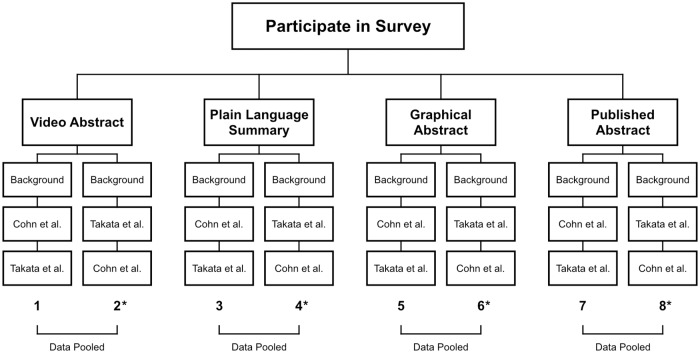
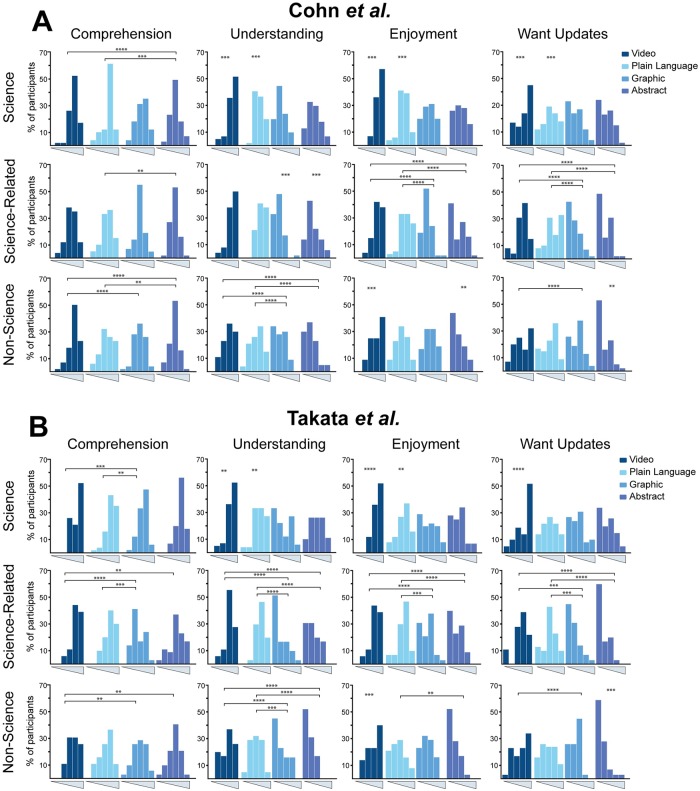
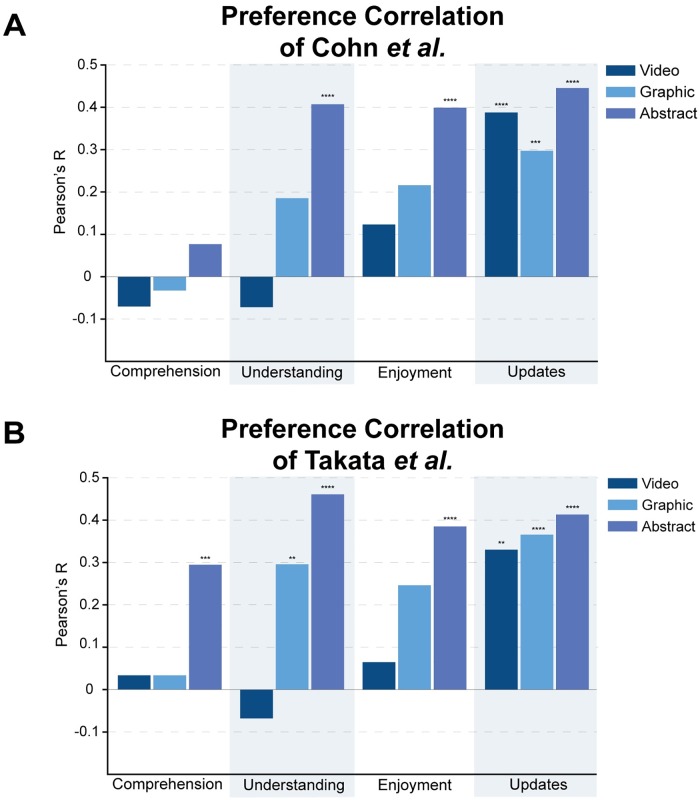
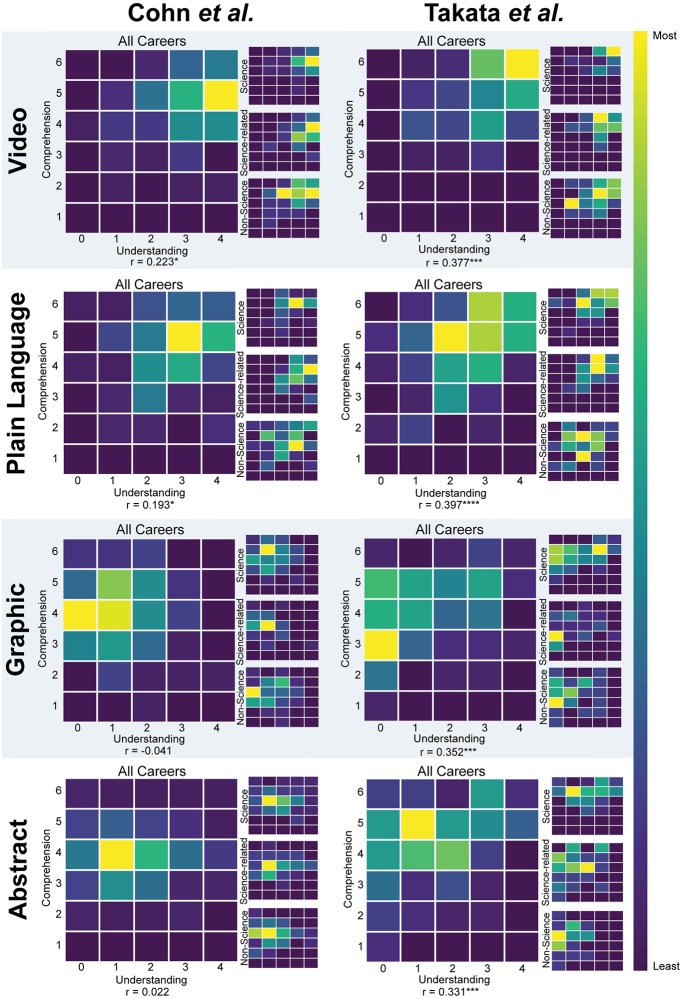
BACKGROUND: Journals are trying to make their papers more accessible by creating a variety of research summaries including graphical abstracts, video abstracts, and plain language summaries. It is unknown if individuals with science, science-related, or non-science careers prefer different summaries, which approach is most effective, or even what criteria should be used for judging which approach is most effective. A survey was created to address this gap in our knowledge. Two papers from Nature on similar research topics were chosen, and different kinds of research summaries were created for each one. Questions to measure comprehension of the research, as well as self-evaluation of enjoyment of the summary, perceived understanding after viewing the summary, and the desire for more updates of that summary type were asked to determine the relative merits of each of the summaries. RESULTS: Participants (n = 538) were randomly assigned to one of the summary types. The response of adults with science, science-related, and non-science careers were slightly different, but they show similar trends. All groups performed well on a post-summary test, but participants reported higher perceived understanding when presented with a video or plain language summary (p<0.0025). All groups enjoyed video abstracts the most followed by plain language summaries, and then graphical abstracts and published abstracts. The reported preference for different summary types was generally not correlated to the comprehension of the summaries. Here we show that original abstracts and graphical abstracts are not as successful as video abstracts and plain language summaries at producing comprehension, a feeling of understanding, and enjoyment. Our results indicate the value of relaxing the word counts in the abstract to allow for more plain language or including a plain language summary section along with the abstract.
Overview
The claims and statistics of this paper haven’t been checked yet.
Free: it reads the open-access text and checks the first 5 claims that cite a source we can check. Create a free account to check every claim.
Integrity signals
Registry
Cites
Statistics
Figures
Verification
Claims the paper makes
The claims and statistics of this paper haven’t been checked yet.
Free: it reads the open-access text and checks the first 5 claims that cite a source we can check. Create a free account to check every claim.
Self-check
Percentages, sums and reported differences re-computed from the paper’s own numbers.
The self-check needs the paper’s full text.
Citations
Cites
CG dinucleotide suppression enables antiviral defence targeting non-self RNA
Takata, M. A., Gonçalves-Carneiro, D., Zang, T. M., Soll, S. J., York, A., Blanco-Melo, D., & Bieniasz, P. D. (2017) · Nature · doi:10.1038/nature24039 · Cited by 398
Estrada, F. C. R., & Davis, L. S. (2014) · Science Communication · doi:10.1177/1075547014562914 · Cited by 157 · cited 1×
“They also require specialized equipment and skills to be effective [7,8].”
BackgroundClonal CD4+ T cells in the HIV-1 latent reservoir display a distinct gene profile upon reactivation
Cohn, L. B., da Silva, I. T., Valieris, R., Huang, A. S., Lorenzi, J. C. C., Cohen, Y. Z., Pai, J. A., Butler, A. L., Caskey, M., Jankovic, M., et al. (2018) · Nature Medicine · doi:10.1038/s41591-018-0017-7 · Cited by 136 · cited 2×
“paper outlines a method for recovering latent cells from HIV-1 + patient blood in order to study them for a possible future cure [14].”
BackgroundMethodRakedzon, T., Segev, E., Chapnik, N., Yosef, R., & Baram-Tsabari, A. (2017) · PLOS ONE · doi:10.1371/journal.pone.0181742 · Cited by 115 · cited 1×
“Also, we recommend editing the summaries at least once, hopefully after getting feedback from a member of the intended audience and possibly using a jargon detection program to make sure the summary is accessible [22,25].”
MethodBucchi, M., & Saracino, B. (2016) · Science Communication · doi:10.1177/1075547016677833 · Cited by 65 · cited 1×
“We also know that people tend to be able to recognize science images better than they can answer science questions [12].”
BackgroundKirkpatrick, E., Gaisford, W., Williams, E., Brindley, E., Tembo, D., & Wright, D. (2017) · Research Involvement and Engagement · doi:10.1186/s40900-017-0064-0 · Cited by 39
Good Sound, Good Research: How Audio Quality Influences Perceptions of the Research and Researcher
Newman, E. J., & Schwarz, N. (2018) · Science Communication · doi:10.1177/1075547018759345 · Cited by 37
An inside guide to eLife digests
King, S. R. F., Pewsey, E., & Shailes, S. (2017) · eLife · doi:10.7554/elife.25410 · Cited by 27
Barnfield, S., Pitts, A. C., Kalaria, R. N., Allan, L. M., & Tullo, E. (2017) · Research Involvement and Engagement · doi:10.1186/s40900-017-0066-y · Cited by 24
Who Are You Writing for? Differences in Response to Blog Design Between Scientists and Nonscientists
Gardiner, A., Sullivan, M., & Grand, A. (2018) · Science Communication · doi:10.1177/1075547017747608 · Cited by 19 · cited 2×
“Previous research on blogs which combined a written article with videos or graphics concluded that scientists had better recall and enjoyed the blog post more when a video was combined with the text whereas non-scientists had better recall and enjoyed the blog post more with an image included [10].”
BackgroundMethod
Research works printed but not linked: 4
- Cell Press Graphical Abstract Guidelines. Cell Press [Internet]. 2019; https://www.cell.com/pb/assets/raw/shared/figureguidelines/GA_guide.pdf
- Plain-language Summaries: Results of the 2016 eLife digest reader survey. Inside eLife [Internet]. 2017 Mar; https://elifesciences.org/inside-elife/19c97b89/plain-language-summaries-results-of-the-2016-elife-digest-reader-survey
- Plain-language Summaries: How to write an eLife digest. Inside eLife [Internet]. 2017 Mar; https://elifesciences.org/inside-elife/85518309/plain-language-summaries-how-to-write-an-elife-digest
- Video Abstract Guidelines [Internet]. Cell Press. 2019 [cited 2019 Jun 10]. https://www.cell.com/video-abstract-guidelines
Cited by
Plain language summaries: A systematic review of theory, guidelines and empirical research
Stoll, M., Kerwer, M., Lieb, K., & Chasiotis, A. (2022) · PLOS ONE · doi:10.1371/journal.pone.0268789 · Cited by 89
Silvagnoli, L. M., Shepherd, C., Pritchett, J. P., & Gardner, J. D. (2021) · Journal of Medical Internet Research · doi:10.2196/22122 · Cited by 61
“Furthermore, other research has identified that, in addition to PLS, video abstracts may be preferable than published text or graphical abstracts [42].”
Bougioukas, K. I., Bouras, E., Avgerinos, K. I., Dardavessis, T., & Haidich, A. (2020) · Health Information & Libraries Journal · doi:10.1111/hir.12318 · Cited by 57
Dormer, L., Schindler, T., Williams, L. A., Lobban, D., Khawaja, S., Hunn, A., Ubilla, D. L., Sargeant, I., & Hamoir, A.-M. (2022) · Research Involvement and Engagement · doi:10.1186/s40900-022-00358-6 · Cited by 41
“They are emerging as a valuable addition to scientific publications because they have the potential to increase the understanding of scientific data, by making complex information more accessible to wider audiences than they would otherwise reach [3].”
BackgroundHerman, E., Akeroyd, J., Béquet, G., Nicholas, D., & Watkinson, A. (2020) · Learned Publishing · doi:10.1002/leap.1288 · Cited by 46
“As another recent study established, from amongst traditional abstracts, graphical abstracts, video abstracts, and plain-language summaries, the latter two most successfully produced comprehension, a feeling of understanding, and enjoyment (Bredbenner & Simon, 2019).”
BackgroundLobban, D., Gardner, J. D., & Matheis, R. J. (2021) · Current Medical Research and Opinion · doi:10.1080/03007995.2021.1997221 · Cited by 46
Rosenberg, A., Walker, J., Griffiths, S., & Jenkins, R. (2023) · Learned Publishing · doi:10.1002/leap.1524 · Cited by 43
Bonnevie, T., Repel, A., Gravier, F.-E., Ladner, J., Sibert, L., Muir, J.-F., Cuvelier, A., & Fischer, M.-O. (2023) · Scientometrics · doi:10.1007/s11192-023-04675-9 · Cited by 20
“…is no video abstract 1 3 previous research found that video abstracts were equally or more understandable and enjoyable than plain language summaries (Bredbenner & Simon, 2019) but further studies are still required to assess the level of information retention among healthcare consumers and how…”
BackgroundMethodInfluentialAhmed, S., & Gupta, L. (2020) · Indian Journal of Rheumatology · doi:10.4103/injr.injr_15_20 · Cited by 25
“[13] It is important to note that WhatsApp ® is a popular platform among the Indian rheumatologists for the dissemination of scientific information, as was Facebook ® .”
Ten simple rules for designing graphical abstracts
Jambor, H. K., & Bornhäuser, M. (2024) · PLoS Computational Biology · doi:10.1371/journal.pcbi.1011789 · Cited by 32
“A study confirmed graphical abstracts by themselves are insufficient to comprehend the key message of a paper [3].”
BackgroundPlain‐language summaries: An essential component to promote knowledge translation
Gudi, S. K., Tiwari, K. K., & Panjwani, K. (2021) · International Journal of Clinical Practice · doi:10.1111/ijcp.14140 · Cited by 21
Sharp, M. K., Baki, D. A. B. A., Quigley, J. M., Tyner, B., Devane, D., Mahtani, K. R., Smith, S. M., O’Neill, M., Ryan, M., & Clyne, B. (2022) · Implementation Science · doi:10.1186/s13012-022-01243-2 · Cited by 19
“There is some evidence that video abstracts are more effective than graphical abstracts and traditional abstracts in comprehension, understanding, and reading experience [68].”
BackgroundPal, A., Arnet, I., Elger, B. S., & Wangmo, T. (2024) · Patient · doi:10.1007/s40271-024-00700-y · Cited by 22
“Other comparisons included text PLRs with news reports [66]; five compared text PLRs versus visual formats such as infographics, visual abstracts, infographics, or comics [12, 49, 68, 70, 89]; and one study compared PLRs in different webpage formats [82].”
BackgroundInfluentialAggarwal, V. (2021) · Health Information & Libraries Journal · doi:10.1111/hir.12376 · Cited by 14
The potential for graphical abstracts to enhance science communication
Krukowski, R. A., & Goldstein, C. M. (2023) · Translational Behavioral Medicine · doi:10.1093/tbm/ibad069 · Cited by 20
Schafer, R., & Phillippi, J. C. (2025) · International Journal of Qualitative Methods · doi:10.1177/16094069251315395 · Cited by 46
“Engagement with online video content has skyrocketed in recent years (Faverio, 2022), and video and graphical summaries of research have demonstrated potential to improve uptake and comprehension of fi ndings in viewers (Bredbenner & Simon, 2019; Jeyaraman et al., 2023).”
Banić, A., Fidahic, M., Šuto, J., Roje, R., Vuka, I., Puljak, L., & Buljan, I. (2022) · BMC Medical Research Methodology · doi:10.1186/s12874-022-01721-7 · Cited by 10
“In line with the studies which previously analyzed the readability of PLSs [32], we recommend PLS authors to use readability calculators as a tool in the process of writing PLSs.”
MethodLang, I., King, A., Boddy, K., Stein, K., Asare, L., Day, J., & Liabo, K. (2025) · Journal of Medical Internet Research · doi:10.2196/50862 · Cited by 23
“…have been mixed: one recent study found that PLSs of published research were more effective than scientific abstracts or graphical abstracts in terms of comprehension and understanding [84], whereas another study concluded that graphical summaries were one of the most preferred formats [85].”
Parameters of poor prognosis in preimplantation genetic testing for monogenic disorders
Kelen, A. V. D., Santos‐Ribeiro, S., Vos, A. D., Verdyck, P., Rycke, M. D., Berckmoes, V., Tournaye, H. J., Blockeel, C., Vos, M. D., Hes, F. J., et al. (2021) · Human Reproduction · doi:10.1093/humrep/deab136 · Cited by 11
Coon, J. T., Orr, N., Shaw, L., Hunt, H. A., Garside, R., Nunns, M., Gröppel-Wegener, A., & Whear, B. (2022) · Systematic Reviews · doi:10.1186/s13643-022-01935-2 · Cited by 13
Video or perish? An analysis of video abstract author guidelines
Liu, J. (2021) · Journal of Librarianship and Information Science · doi:10.1177/09610006211006774 · Cited by 11
“Several recent publications (Bredbenner and Simon, 2019; Copiello, 2020; Liu, 2020) have cast doubt on this optimism; for instance, academic publishers lack articulated VA review criteria and often use video and graphic abstracts as alternative marketing avenues rather than as novel knowledge…”
BackgroundWhy and how to publish aphasia-friendly research summaries
Hinckley, J. J., & Khouri, C. E. (2023) · Journal of Communication Disorders · doi:10.1016/j.jcomdis.2023.106338 · Cited by 12
Comparing lay summaries to scientific abstracts for readability and jargon use: a case report
Wen, J., & Yi, L. (2023) · Scientometrics · doi:10.1007/s11192-023-04807-1 · Cited by 11
Villanueva, I. I., Li, N., Jilk, T., Renner, J., Matre, B. R. V., & Brossard, D. (2024) · Science Communication · doi:10.1177/10755470241228279 · Cited by 16
“In addition, social media posts evoking high-arousal emotions (e.g., anger, awe) are more likely to go viral than posts evoking low-arousal emotions, irrespective of the emotional valence (Bredbenner & Simon, 2019).”
BackgroundSalzmann, S., Walther, C. M., & Kaspar, K. (2025) · Frontiers in Psychology · doi:10.3389/fpsyg.2025.1584695 · Cited by 13
Wen, J., & Yi, L. (2024) · Public Understanding of Science · doi:10.1177/09636625241252565 · Cited by 12
“…for writing and disseminating plain language summaries, including writing guidelines/strategies, the use of language, and appropriate formatting (Bredbenner and Simon, 2019; Buljan et al., 2018; Dormer et al., 2022; Dubé and Lapane, 2014; Gainey et al., 2023; Kirkpatrick et al., 2017; Lobban et…”
Hwang, H., Coss, M. D., Sato, M., Cárcamo, B., Nguyen, M. X. N. C., Dao, P., Iwashita, N., Marsden, E. J., Hawkes, R., Loewen, S., et al. (2024) · Language Teaching · doi:10.1017/s0261444824000181 · Cited by 7
“This can be done on various platforms by various multilingual and multimodal means, including via OASIS (see Alferink & Marsden, 2024), Multi ’ Ō lelo (see Phung et al., 2020), and/or video abstracts (see Bredbenner & Simon, 2019). b.”
George, C., Sutcliffe, S., Scheinmann, D., Mizara, A., & McBride, S. R. (2021) · Clinical and Experimental Dermatology · doi:10.1111/ced.14594 · Cited by 7
Gupta, R., Joshi, M. M., & Gupta, L. (2021) · Journal of Korean Medical Science · doi:10.3346/jkms.2021.36.e66 · Cited by 7
Original Abstracts from the 2022 European Meeting of ISMPP
(2022) · Current Medical Research and Opinion · doi:10.1080/03007995.2022.2044117 · Cited by 9
Democratization of Point-of-Care Viral Biosensors: Bridging the Gap from Academia to the Clinic
Zant, W. V., & Ray, P. (2025) · Biosensors · doi:10.3390/bios15070436 · Cited by 5
“There have also been additions like definitions of terms, lists of acronyms, bulleted key points, and video or audio abstracts to accompany paper graphics [162–164].”
Kapitány‐Fövény, M. (2022) · Developments in Health Sciences · doi:10.1556/2066.2022.00053 · Cited by 7
Patients at the Heart of the Scientific Dialogue: An Industry Perspective
Habr, D., Gianares, B. W., Schuler, K. W., & Chari, D. (2023) · Oncology and Therapy · doi:10.1007/s40487-023-00220-z · Cited by 6
“As mentioned earlier, to ensure scientific manuscripts and their data are comprehensible to patients, PLS have emerged as a tool that offers a suitable reading level for patients, especially as it comes to complex content such as statistics, which eventually saves time and burden of reading advanced scientific data [1…”
BackgroundVisualizing medicine: The case for implementing graphical abstracts in clinical reporting
Jeyaraman, N., Jeyaraman, M., Ramasubramanian, S., Balaji, S., & Nallakumarasamy, A. (2024) · World Journal of Methodology · doi:10.5662/wjm.v15.i2.95966 · Cited by 6
Nav, S. N., & Link, S. (2024) · English for Specific Purposes · doi:10.1016/j.esp.2024.11.002 · Cited by 9
Varela, A. R., SERRANO, N. H., Mejía-Grueso, J., Nguyen, A., Salvo, D., Brownson, R. C., Bauman, A. E., Reis, R. S., Hallal, P. C., & Pratt, M. (2023) · Journal of Physical Activity and Health · doi:10.1123/jpah.2023-0185 · Cited by 7
Editorial: Geoscience communication – planning to make it publishable
Hillier, J. K., Welsh, K., Stiller-Reeve, M. A., Priestley, R., Roop, H., Lanza, T., & Illingworth, S. (2021) · Geoscience Communication · doi:10.5194/gc-4-493-2021 · Cited by 9
Analyzing Second Language Written Summaries at University Level
Zamborová, K., & Klímová, B. (2021) · Emerging Science Journal · doi:10.28991/esj-2021-01322 · Cited by 4
Improving access to oncology publications for advocates and people with cancer
Tabernero, J. M., Bowling, T. E., Rivers, J., Chari, D., Ghith, J., Ferdinand, R., Shanahan, K., & Shore, N. D. (2022) · Cancer · doi:10.1002/cncr.34447 · Cited by 5
“Research has suggested that visual approaches, including infographic- style PLS and video abstracts, may enhance engagement(31,33) and that PLS and video abstracts offer better understanding than traditional abstracts, regardless of the reader’s scientific background.(31) However, few oncology journals invite PLS: res…”
BackgroundPrevalence and characteristics of graphical abstracts in a specialist pharmacology journal
Gilling, R., Scandlyn, M., & Hesp, B. R. (2024) · Scientometrics · doi:10.1007/s11192-024-05146-5 · Cited by 5
“…relatively recently in an attempt to make content more accessible to a broader audience, including patients, non-specialists and other potential readers, often via social media channels (Bredbenner & Simon, 2019; DeTora et al., 2022; Hesp et al., 2023; Ibrahim et al., 2017; Misiak & Kurpas, 2023).”
Ferreira, M., Granado, A., Lopes, B., & Loureiro, J. (2023) · Journal of Science Communication · doi:10.22323/2.22040207 · Cited by 3
Ethical Considerations in Co-Authoring Research with Music Therapy Stakeholders
Devlin, K., Meadows, A., Johnston, M., & Johnston, C. (2024) · Music Therapy Perspectives · doi:10.1093/mtp/miae009 · Cited by 4
The effect of research video abstract presentation style on viewer comprehension and engagement
Li, A., O'Brien, H. L., & Sinnamon, L. S. (2023) · Conference on Human Information Interaction and Retrieval · doi:10.1145/3576840.3578326 · Cited by 5
“Existing research on viewers’ perceptions of VAs is situated in science disciplines [5, 38], which contributes to understanding how viewers interact with research about the physical world and phenomena within it.”
BackgroundResultInfluentialThe Benefits of the Video Abstract as a Newly Emerging Academic Genre (English version)
Accastello, L., & Quinteros, L. (2023) · Ñawi · doi:10.37785/nw.v7n2.a1 · Cited by 4
“After exploring all these definitions, it could be stated that initially any accessible research summary (Bredbenner & Simon, 2019) in the format of a video, which combined a variety of semiotic resources was considered a video abstract.”
BackgroundRacial, Gender, and Size Bias in a Medical Graphical Abstract Gallery: A Content Analysis
Cerdeña, J. P., Tsai, J. W., Warpinski, C., Rosencrans, R. F., & Gravlee, C. C. (2023) · Health Equity · doi:10.1089/heq.2023.0026 · Cited by 3
“3,8,9 These effects allow deeper engagement, retention, and recall of information that may improve application of new scientific data.”
BackgroundDisseminating implementation science: Describing the impact of animations shared via social media
Sykes, M. J., Cerda, L., Cerda, J., & Finch, T. L. (2022) · PLoS ONE · doi:10.1371/journal.pone.0270605 · Cited by 4
Editorial: Geoscience communication – Planning to make it publishablePreprint
Hillier, J. K., Welsh, K., Stiller-Reeve, M. A., Priestley, R., Roop, H., Lanza, T., & Illingworth, S. (2021) · doi:10.5194/gc-2021-13 · Cited by 2
“There is an age-old debate on the use of plain language in scientific journals, with at least some consensus on the utility of plain language summaries to accompany papers (Bredbenner and Simon, 2019; Hauck, 2019).”
BackgroundOriginal Abstracts from the 2023 European Meeting of ISMPP
Cutteridge, J., & Wager, K. (2023) · Current Medical Research and Opinion · doi:10.1080/03007995.2023.2184562 · Cited by 3
Fonseca, P. (2021) · AMWA Journal · doi:10.55752/amwa.2021.46 · Cited by 2
Vídeos como herramientas de diseminación y transferencia de conocimiento
Gómez-Domínguez, D., Hernán, M., Negrín, M. Á., Bermúdez‐Tamayo, C., & Álvarez‐Dardet, C. (2020) · Gaceta Sanitaria · doi:10.1016/j.gaceta.2020.05.001 · Cited by 2
Visualising Medical Research: Exploring the Influence of Infographics on Professional Dissemination
Butdisuwan, S., Annamma, L. M., Subaveerapandiyan, A., George, B. T., & Kataria, S. (2024) · The Scientific World JOURNAL · doi:10.1155/2024/5422121 · Cited by 10
The new VBC: creating a video-based culture in general surgery residency
Barter, S. M., Tan, W. H., Giorgi, M., Shah, K. N., Deal, S. B., Greenberg, J. A., & Higgins, R. M. (2025) · Surgical Endoscopy · doi:10.1007/s00464-025-11825-y · Cited by 1
“It can also function as an “advertising tool” to attract reader interest [34, 35].”
Hesp, B. R., Chen, B. Y.-H., Ganesan, S., Lee, J. H. Y., Lee, S. W. L., Onuma, A., Wang, S., Wei, A., Yuan, J., & Stentiford, T. (2025) · BMC Research Notes · doi:10.1186/s13104-025-07433-7 · Cited by 1
Using media to transform education and public health messaging in the neonatal intensive care unit
Parga-Belinkie, J., Courchia, B., & Barbeau, D. Y. (2025) · Seminars in Perinatology · doi:10.1016/j.semperi.2025.152150 · Cited by 4
Mills, S. M. A., Maher, K., D’Angelo, S., & Riosa, P. B. (2025) · Current Developmental Disorders Reports · doi:10.1007/s40474-025-00335-0 · Cited by 1
Chen, Y., Liang, J., Errey, N., Zowghi, D., Bano, M., Chan, K., & Hogan, J. (2026) · Information Visualization · doi:10.1177/14738716261435103 · Cited by 4
“62 63–65 This dissociation highlights the need to distinguish experiential and analytical pathways.”
Huang, Y., Li, K., & Li, D. (2026) · Learned Publishing · doi:10.1002/leap.2069 · Cited by 1
“Such practices aim to promote knowledge dissemination, as plain English summaries have been shown to be more effective than graphical abstracts and conventionally published abstracts (Bredbenner and Simon 2019).”
Digital Education Research: Advantages, Disadvantages, and Video Illustrations
Shaner, P., & Donmoyer, R. (2022) · LEARNing Landscapes · doi:10.36510/learnland.v15i1.1068 · Cited by 1
“In other fields, video is sometimes used to report the results of research studies (Bredbenner & Simon, 2019).”
BackgroundMethodDreher, K. (2023) · Studies in corpus linguistics · doi:10.1075/scl.109.10dre · Cited by 2
Nelinson, D. S., Ko, L., & Bass, B. (2023) · Advances in Medical Education and Practice · doi:10.2147/amep.s427663 · Cited by 1
Nachman, S., Barron, L., Ottosen, T., Burrows, H., Jones, E. P., & Moreton, E. (2024) · Medical Reference Services Quarterly · doi:10.1080/02763869.2024.2395228 · Cited by 1
“14 One major difference between scientific communication and plain language is that there is no particular tool or objective to use to see how ‘well’ scientific communication best practices are followed or how much better the material is understood.”
Science Communication at Historical Biology
Cooper, J. A. (2025) · Historical Biology · doi:10.1080/08912963.2025.2471234 · Cited by 1
“…a video abstract or a plain language summary would also be accepted in place of a graphical abstract, as they have also been found to be effective in increasing understanding of a scientific work to members of the public of both science and non-science career backgrounds (Bredbenner et al., 2019).”
WITHDRAWN: Los vídeos como herramienta de difusión científica y transferencia de conocimiento
Gómez-Domínguez, D., Hernán, M., Hernández, M. N., Bermúdez‐Tamayo, C., & Álvarez‐Dardet, C. (2021) · Gaceta Sanitaria · doi:10.1016/j.gaceta.2020.06.003
Retracted(2021) · Geoscience Communication · doi:10.5194/gc-2021-13-rc1
I wish I had read this editorial at the start of my SciArt career
(2021) · Geoscience Communication · doi:10.5194/gc-2021-13-rc2
Hillier, J. K. (2021) · Geoscience Communication · doi:10.5194/gc-2021-13-ac3
(2021) · Geoscience Communication · doi:10.5194/gc-2021-13-cc1
Hillier, J. K. (2021) · Geoscience Communication · doi:10.5194/gc-2021-13-ac1
Hillier, J. K. (2021) · Geoscience Communication · doi:10.5194/gc-2021-13-ac2
Using blogs to make peer-reviewed research more accessible
Young, N. T., Lewis, B. L., Kerr, E., & Nair, P. H. (2022) · Physics Education Research Conference (PERC) · doi:10.1119/perc.2022.pr.young_n · Cited by 1
“Additionally, plain language summaries of new research have been shown to be more effective at producing comprehension, a feeling of understanding, and enjoyment than the original abstracts do [10].”
BackgroundNav, S. N., & Link, S. (2024) · SSRN Electronic Journal · doi:10.2139/ssrn.4902432
Linertová, R., Hernández-Yumar, A., Guirado-Fuentes, C., Rodriguez-Díaz, B., Valcárcel‐Nazco, C., Imaz-Iglesia, I., Carmona, M., & García‐Pérez, L. (2024) · Archives of Public Health · doi:10.1186/s13690-024-01453-8
Digital Information Exchange Between the Public and Researchers in Health Studies: Scoping Review
Soltani, N., Dietz, T., Ochterbeck, D., Dierkes, J., Restel, K., Christianson, L., Santis, K. K. D., & Zeeb, H. (2025) · Journal of Medical Internet Research · doi:10.2196/63373 · Cited by 7
“As suggested by others [67], if the research findings are of public relevance, researchers might consider investing time and money into creating a video of their results, as videos make viewers feel confident and positive about the presented research.”
Some Tips for Visual Communication
Bergman, O., Park, S., & Bagniewska, J. (2025) · Springer eBooks · doi:10.1007/978-3-031-84173-6_12
Dreher, K. (2025) · IEEE International Professional Communication Conference (ProComm) · doi:10.1109/procomm64814.2025.00069
(Un-)scientifically Spun: Narratives, Belief Updating, and Pro-Environmental Behavior
Banerjee, A., & Momsen, K. (2025) · Environmental and Resource Economics · doi:10.1007/s10640-025-01045-2
“…are more readable and understandable than traditional scientific abstracts for disciplines such as psychology (Stricker et al. 2020) and medicine (Bredbenner and Simon 2019 ), IPCC plain language summaries of scientific arti - cles may not be perceived as very readable (Barkemeyer et al. 2016).”
Videos in chemistry research articles
Ciriminna, R., Pina, C. D., Luque, R., & Pagliaro, M. (2025) · ChemTexts · doi:10.1007/s40828-025-00213-7
“Empirical evidence from numerous recent studies suggests that videos in research articles substantially improve readers’ attention [35, 36].”
Dormer, L., Schindler, T. M., Williams, L. A., Lobban, D., Khawaja, S., Hunn, A., Ubilla, D. L., Sargeant, I., & Hamoir, A.-M. (2022) · Figshare · doi:10.6084/m9.figshare.19980447
Dormer, L., Schindler, T. M., Williams, L. A., Lobban, D., Khawaja, S., Hunn, A., Ubilla, D. L., Sargeant, I., & Hamoir, A.-M. (2022) · Figshare · doi:10.6084/m9.figshare.19980450
Dormer, L., Schindler, T. M., Williams, L. A., Lobban, D., Khawaja, S., Hunn, A., Ubilla, D. L., Sargeant, I., & Hamoir, A.-M. (2022) · Figshare · doi:10.6084/m9.figshare.19980438
Dormer, L., Schindler, T. M., Williams, L. A., Lobban, D., Khawaja, S., Hunn, A., Ubilla, D. L., Sargeant, I., & Hamoir, A.-M. (2022) · Figshare · doi:10.6084/m9.figshare.19980453
Banić, A., Fidahić, M., Šuto, J., Roje, R., Vuka, I., Puljak, L., & Buljan, I. (2022) · Figshare · doi:10.6084/m9.figshare.21077640
Dormer, L., Schindler, T. M., Williams, L. A., Lobban, D., Khawaja, S., Hunn, A., Ubilla, D. L., Sargeant, I., & Hamoir, A.-M. (2022) · Figshare · doi:10.6084/m9.figshare.19980441
Gildernew, N., Clarke, M. J., Brazzelli, M. G., Imamura, M., Robertson, C. M., Virgili, G., & Duggan, S. N. (2025) · Research Square · doi:10.21203/rs.3.rs-8251143/v1
Gainey, K. M., McCaffery, K. J., & Muscat, D. M. (2026) · PLoS ONE · doi:10.1371/journal.pone.0343058
Beyond Words: Designing Effective Graphical Abstracts for Research Articles
Gürsoy, A. (2026) · Journal of Comprehensive Nursing Research and Care · doi:10.33790/jcnrc1100225
Alonso, M. I. (2026) · Journal of Documentation · doi:10.1108/jd-03-2026-0165
Liang, Z., Huang, S., Wu, L., Cheng, Q., & Lü, W. (2026) · Journal of Informetrics · doi:10.1016/j.joi.2026.101873
Metadata
- Authors
- Bredbenner, K., & Simon, S. M.
- Affiliations
- Rockefeller University (US)
- Corresponding author
- Bredbenner, Kate
- Simon, Sanford M.
- Venue
- PLOS ONE
- Publisher
- Public Library of Science (PLoS)
- Published
- 2019-11-19
- Volume
- 14
- Issue
- 11
- Pages
- e0224697
- ISSN
- 1932-6203 (ISSN-L)
- PMC
- PMC6863540
- OpenAlex
- W2991373555
- Cited by
- 88
- References
- 13
- Citations by year
- 2026: 6 · 2025: 14 · 2024: 14 · 2023: 14 · 2022: 17 · 2021: 19 · 2020: 4
- FWCI
- 11.84
- Type
- journal article
- Language
- en
- Open access
- gold
- doi.org
- Licence
- Locations
- PLoS ONE (publishedVersion, cc-by)
- PubMed Central (publishedVersion, cc-by)
- PubMed (publishedVersion)
- RePEc: Research Papers in Economics (submittedVersion)
- DOAJ (DOAJ: Directory of Open Access Journals) (submittedVersion, cc-by-sa)
- Figshare (submittedVersion, cc-by)
- Funders
- National Institutes of Health (5R01GM119585)
- Topics
- Social Sciences › Library and Information Sciences › Academic Publishing and Open Access
- Social Sciences › Library and Information Sciences › Academic Writing and Publishing
- Social Sciences › Linguistics and Language › Text Readability and Simplification
- Keywords
- video abstracts, plain language summaries, graphical abstracts, scientific abstracts, science communication, reader enjoyment, audience preferences, science journalism
- MeSH terms
- Adult, Female, Humans, Language, Male, Publications, Publishing, Surveys and Questionnaires, Video Recording, Comprehension
About these checks
Registry, retraction, Cites and statistics results are computed, not judged, with one exception: a printed reference that no index lists is read once by a model before it counts as a citation error. Claims are extracted by a model and kept only when their quote appears verbatim in the text; each cited source is then checked, with a model’s help, for whether it says what the claim relies on. Those verdicts can be wrong — read the claim’s quote and the cited source before relying on one.
Statistics and arithmetic are recomputed, not judged.
Confidence bands are shown only for fields calibrated on our annotated test set. None is calibrated yet, so no band is shown.
What counts as a claim ›How we measure confidence ›How we check this ›
Are you an author, or do you see a problem with this page? Request a review
Data sources
Bibliographic data: Semantic Scholar, OpenAlex, Crossref.
Contains information from the Semantic Scholar Academic Graph Datasets, made available under the ODC Attribution License (ODC-BY 1.0).
Semantic Scholar’s data is described in: Kinney, R., et al. (2023). The Semantic Scholar Open Data Platform. arXiv:2301.10140.
