

Outcomes in a digital weight management intervention with one-on-one health coaching
Open accessThe DOI matches its Crossref record; 24 of the 24 references it cites were found in a registry or an index.
Abstract
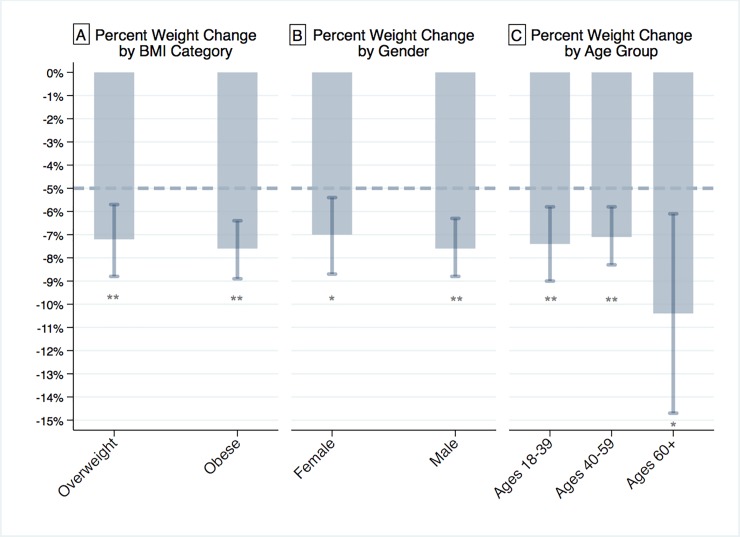
BACKGROUND: Some guidelines state that in-person weight management interventions are more efficacious than those delivered digitally. However, digital programs are more scalable and accessible. We hypothesized that one-on-one health coaching via app-based video chat would simulate an in-person experience and help achieve outcomes comparable to those of in-person interventions. METHODS: A 12-month digital weight management intervention was provided to overweight or obese adults recruited from a large technology company. One-on-one health coaching sessions were offered during a 24-week intensive phase as well as subsequent maintenance phase. Focused on sustainable changes in activity and diet, the intervention incorporates SMART goals, in-app food and activity logs, Fitbit integration, as well as optional sleep and stress modules. Self-Determination Theory and the Transtheoretical Model are incorporated to drive behavior change. Multilevel mixed-effects models were used to analyze weight changes retrospectively. RESULTS: Six hundred eighty-three participants reported 29,051 weights. At 12 months, mean percent changes in body weight were -7.2% and -7.6% for overweight and obese groups, respectively. A weight change of -5% is commonly targeted for in-person weight management interventions. Observed weight loss exceeded this target by 2.2% (95% CI, 0.7% to 3.8%; P < .01) for the overweight group and 2.6% (95% CI, 1.4% to 3.9%; P < .01) for the obese group. CONCLUSIONS: Further research is needed with randomization to in-person or digital interventions. Though limited by an observational, retrospective design, preliminary results suggest that some digital weight management programs with one-on-one coaching may achieve outcomes comparable to those of robust, in-person interventions.
Overview
The claims and statistics of this paper haven’t been checked yet.
Free: it reads the open-access text and checks the first 5 claims that cite a source we can check. Create a free account to check every claim.
Integrity signals
Registry
Cites
Statistics
Figures
Verification
Claims the paper makes
The claims and statistics of this paper haven’t been checked yet.
Free: it reads the open-access text and checks the first 5 claims that cite a source we can check. Create a free account to check every claim.
Claims other papers make about this one
Each is checked against this paper’s own text: does it say what the citing paper says it does?
The source backs part of the claim, not all of it — or backs it for a different population, condition or comparison.
In the citing paper
“Observational retrospective studies suggest digital eHealth intervention incorporating personal coaching and BCTs may promote weight loss better over a 12-month period compared to studies with either face-to-face coaching or eHealth alone [29,30].”
From Long-term Weight Loss in a Primary Care-Anchored eHealth Lifestyle Coaching Program: Randomized Controlled Trial (2022) · cites this paper as [29]
Experimental — accuracy not yet measuredThe source backs part of the claim, not all of it — or backs it for a different population, condition or comparison.
In the citing paper
“Studies have shown that health coaching for obesity is mixed, but there have been some promising results [310,311,312,313,314] and future literature should focus on facilitators of improved outcomes within specific interventions.”
From Lifestyle Medicine for Obesity in the Era of Highly Effective Anti-Obesity Treatment (2025) · cites this paper as [310]
Experimental — accuracy not yet measured
Self-check
Percentages, sums and reported differences re-computed from the paper’s own numbers.
The self-check needs the paper’s full text.
Citations
Cites
Ryan, R. M., & Deci, E. L. (2000) · American Psychologist · doi:10.1037//0003-066x.55.1.68 · Cited by 54,599
Multilevel analysis : an introduction to basic and advanced multilevel modeling
Snijders, T. A. B., & Bosker, R. (1999) · Cited by 13,957
Prevalence of Obesity Among Adults and Youth: United States, 2015-2016.
Hales, C. M., Carroll, M. D., Fryar, C. D., & Ogden, C. L. (2017) · PubMed · Cited by 4,554
Multilevel and Longitudinal Modeling Using Stata
(2006) · Biometrics · doi:10.1111/j.1541-0420.2006.00588_16.x · Cited by 4,236
2013 AHA/ACC/TOS Guideline for the Management of Overweight and Obesity in Adults
Jensen, M. D., Ryan, D. H., Apovian, C. M., Ard, J. D., Comuzzie, A. G., Donato, K. A., Hu, F. B., Hubbard, V. S., Jakicic, J. M., Kushner, R. F., et al. (2014) · Journal of the American College of Cardiology · doi:10.1016/j.jacc.2013.11.004 · Cited by 4,058
Moral Identity and Developmental Theory
Lapsley, D. (2015) · Human Development · doi:10.1159/000435926 · Cited by 3,819
Jensen, M. D., Ryan, D. H., Apovian, C. M., Ard, J. D., Comuzzie, A. G., Donato, K. A., Hu, F. B., Hubbard, V. S., Jakicic, J. M., Kushner, R. F., et al. (2014) · Circulation · doi:10.1161/01.cir.0000437739.71477.ee · Cited by 2,735
Garvey, W. T., Mechanick, J. I., Brett, E. M., Garber, A. J., Hurley, D. L., Jastreboff, A. M., Nadolsky, K., Pessah-Pollack, R., & Plodkowski, R. (2016) · Endocrine Practice · doi:10.4158/ep161365.gl · Cited by 1,914 · cited 1×
“Weight reduction of 5% is often targeted because it has been shown to produce clinically meaningful benefits, including reductions in hemoglobin A1c, blood pressure, and LDL [9,22].”
BackgroundUsing Internet technology to deliver a behavioral weight loss program
Tate, D. F. (2001) · JAMA · doi:10.1001/jama.285.9.1172 · Cited by 925 · cited 1×
“Guidelines [8,9] and evidence [10,12] do suggest, however, that remotely delivered programs can provide clinically meaningful weight loss benefits, and may be worth considering for some patients.”
BackgroundThe science of obesity management: an endocrine society scientific statement
Bray, G. A., Heisel, W. E., Afshin, A., Jensen, M. D., Dietz, W. H., Long, M., Kushner, R. F., Daniels, S. R., Wadden, T. A., Tsai, A. G., et al. (2018) · Endocrine Reviews · doi:10.1210/er.2017-00253 · Cited by 812 · cited 3×
“Recent guidelines [8,9] recommend in-person lifestyle modification programs, when possible, over digital health interventions or other remotely-delivered programs.”
Background
Research works printed but not linked: 2
- Bays HE, Seger JC, Primack C, McCarthy W, Long J, Schmidt SL, et al Obesity Algorithm[Internet]. Obesity Medicine Association; 2017 [cited 2019 Nov 8]. Available from: www.obesityalgorithm.org. 2016–2017.
- StataCorp. sktest—Skewness and kurtosis test for normality [Internet]. College Station, TX: StataCorp; 2013 [cited 2019 Nov 8]. Available from: https://www.stata.com/manuals13/rsktest.pdf.
Cited by
Patel, M. L., Wakayama, L. N., & Bennett, G. G. (2021) · Obesity · doi:10.1002/oby.23088 · Cited by 196
“, actively) by entering values collected from a traditional scale into an app; interestingly, however, only manual tracking of weight appeared to be associated with weight loss (85).”
BackgroundDigital Health Coaching for Type 2 Diabetes: Randomized Controlled Trial of Healthy at Home
Azelton, K. R., Crowley, A. P., Vence, N., Underwood, K., Morris, G., Kelly, J., & Landry, M. J. (2021) · Frontiers in Digital Health · doi:10.3389/fdgth.2021.764735 · Cited by 49
Hesseldal, L., Christensen, J. R., Olesen, T. B., Olsen, M. H., Jakobsen, P. R., Laursen, D. H., Lauridsen, J. T., Nielsen, J. B., Søndergaard, J., & Brandt, C. J. (2022) · Journal of Medical Internet Research · doi:10.2196/39741 · Cited by 31
“Observational retrospective studies suggest digital eHealth intervention incorporating personal coaching and BCTs may promote weight loss better over a 12-month period compared to studies with either face-to-face coaching or eHealth alone [29,30].”
Taylor, K., Indulkar, T., Thompson, B., Pinkard, C., Barron, E., Frost, T., Jayawardane, P., Davies, N., Bakhai, C., Forouhi, N. G., et al. (2024) · Obesity · doi:10.1002/oby.24024 · Cited by 27
“…coaching in engaging patients to take an active role in managing their health and empowering them to make change is known to be effective [23 – 26] and is the core differentiating service characteristic across the Programme ’ s three intervention levels, purposefully designed to improve…”
BackgroundLifestyle Medicine for Obesity in the Era of Highly Effective Anti-Obesity Treatment
Sannidhi, D., Abeles, R., Andrew, W., Bonnet, J. P., Vitale, K., Niranjan, V., Gulati, M., Pauly, K., Moran, R., Alexander, L., et al. (2025) · Nutrients · doi:10.3390/nu17142382 · Cited by 29
“Studies have shown that health coaching for obesity is mixed, but there have been some promising results [310–314] and future literature should focus on facilitators of improved outcomes within specific interventions.”
Leveraging Genomic Associations in Precision Digital Care for Weight Loss: Cohort Study
Sinha, R., Kachru, D., Ricchetti, R. R., Singh-Rambiritch, S., Muthukumar, K., Singaravel, V., Irudayanathan, C., Reddy-Sinha, C., Junaid, I., Sharma, G., et al. (2021) · Journal of Medical Internet Research · doi:10.2196/25401 · Cited by 30
“Digital health coaching, for example, allows participants to discuss their weight loss journey via any number of communication platforms [75].”
Carpenter, C. A., Eastman, A., & Ross, K. M. (2022) · JMIR Formative Research · doi:10.2196/33603 · Cited by 27
Salahshoornezhad, S., Sohrabi, Z., Mani, A., Abdelbasset, W. K., Mehrabi, M., Zare, M., Mehrabani, S., Gerami, S., Haghighat, N., Akbarzadeh, M., et al. (2022) · Nutrition Metabolism and Cardiovascular Diseases · doi:10.1016/j.numecd.2022.04.014 · Cited by 20
Ju, H., Kang, E., Kim, Y., Ko, H., & Cho, B. (2022) · JMIR mhealth and uhealth · doi:10.2196/34531 · Cited by 31
An addiction‐based digital weight loss intervention: A multi‐centre randomized controlled trial
Vidmar, A. P., Salvy, S., Wee, C. P., Pretlow, R. A., Fox, D. S., Yee, J. K., Garell, C. L., Glasner, S. V., & Mittelman, S. D. (2022) · Pediatric Obesity · doi:10.1111/ijpo.12990 · Cited by 19
(2023) · doi:10.2196/47350 · Cited by 18
“The coach interaction component was previously demonstrated as a factor simulating an in-person experience and helped achieve positive outcomes and behavioral change in various conditions such as weight loss and diabetes [78,80].”
(2023) · doi:10.2196/preprints.47350 · Cited by 18
Venkatesan, A., Forster, B., Rao, P., Miller, M., & Scahill, M. D. (2022) · JMIR Formative Research · doi:10.2196/38005 · Cited by 19
Self-citationVenkatesan, A., Krymis, H., Scharff, J., & Waber, A. (2021) · JMIR Formative Research · doi:10.2196/25078 · Cited by 11
“As described in an earlier paper [39], to adjust for a significant right skew, the number of completed lessons and the number of messages sent were right Winsorized at the 99th percentile.”
BackgroundSelf-citationDesign of a Planner-Based Intervention to Facilitate Diet Behaviour Change in Type 2 Diabetes
Cradock, K. A., Quinlan, L. R., Finucane, F. M., Gainforth, H. L., Ginis, K. A. M., Sanders, E., & OLaighin, G. M. (2022) · Sensors · doi:10.3390/s22072795 · Cited by 10
“The use of digital approaches to diet behaviour change, such as the use of a digital planning and purchasing platform [59] and digital weight management interventions, with one-to-one health coaching [12], have resulted in sustainable weight loss in obese populations.”
BackgroundAziz, A. F. A., & Ong, T. (2024) · JMIR mhealth and uhealth · doi:10.2196/50356 · Cited by 13
Hanson, P., Summers, C., Panesar, A., Liarakos, A. L., Oduro‐Donkor, D., Oshodi, D. W., Hailston, L., Randeva, H. S., Menon, V., de la Fosse, M., et al. (2023) · JMIR Human Factors · doi:10.2196/41256 · Cited by 9
“Poor uptake and engagement with digital tools remain common challenges with digital health interventions [3,6].”
BackgroundMethodInfluentialDevelopment and Rasch Analysis of the 18-Item Health Resilience Profile (HRP)
Papini, N. M., Jung, M., Kang, M., Lopez, N. V., & Herrmann, S. D. (2023) · Nutrients · doi:10.3390/nu15040807 · Cited by 6
“Given that the reported attrition estimates for both mobile health “mHealth” and in-person delivered treatments are between 20% and 70%, it is essential for health coaching programs to adequately identify, measure, and cultivate protective factors that minimize rates of attrition [5,6].”
BackgroundEngagement and Use of a Blended mHealth Intervention for Health Behavior Change
Zimmermann, M., Greenberg, L., & Breland, J. Y. (2023) · International Journal of Behavioral Medicine · doi:10.1007/s12529-023-10182-1 · Cited by 6
“Vida Health is an mHealth platform that includes Vida , an app focused on sustainable health behavior changes [12, 24].”
InfluentialKönig, L. M., Forbes, C. C., Busse, H., DeSmet, A., Szinay, D., Wan, J., Guo, Z., & Smit, E. S. (2025) · Obesity Reviews · doi:10.1111/obr.70057 · Cited by 7
“Calorie intake was lower in older age groups [62], vegetable intake higher [100], and levels of physical activity higher [91], and older age groups were found to be more successful in losing weight compared to younger age groups [57].”
InfluentialAldhamin, R. A., Al-Ghareeb, G., Saif, A. A., & Alahmed, Z. (2023) · Cureus · doi:10.7759/cureus.41658 · Cited by 5
Gannamani, R., Forte, J. C., Folkertsma, P., Hermans, S., Kumaraswamy, S., van Dam, S., Chavannes, N. H., van Os, H. J. A., Pijl, H., & Wolffenbuttel, B. H. R. (2024) · JMIR Formative Research · doi:10.2196/38891 · Cited by 3
“Only one of these interventions reported follow-up data at 2 years, where participants lost an average of only 1.5 kilograms [47].”
BackgroundInfluentialBrammall, B. R., Garad, R. M., Teede, H. J., Baker, S., & Harrison, C. L. (2024) · Nutrients · doi:10.3390/nu16050572 · Cited by 2
Hesseldal, L., Christensen, J. R., Olesen, T. B., Olsen, M. H., Jakobsen, P. R., Laursen, D. H., Lauridsen, J. T., Nielsen, J. B., Søndergaard, J., & Brandt, C. J. (2022) · doi:10.2196/preprints.39741 · Cited by 2
The Walking and Lifestyle Coaching (WALC) Program for University Students: A Pilot Study
Cole, A., Corrales, F., Stone, E., & Biber, D. (2024) · American Journal of Lifestyle Medicine · doi:10.1177/15598276241266783 · Cited by 2
“32,55 In addition to walking, participants were asked to wear a pedometer for the duration of the 21-day program to track total steps each day.”
Hanson, P., Abdelhameed, F., Sahir, M., Parsons, N., Panesar, A., de la Fosse, M., Summers, C., Kaura, A., Randeva, H. S., Menon, V., et al. (2025) · Journal of Medical Internet Research · doi:10.2196/62661 · Cited by 3
“…of digital tools (without additional weight loss medication) for weight management outside of NHS services varies from 13% weight lost at 4 months using an entirely remote program with meal replacements [24] to 7.6% weight loss at 12 months in a digital intervention with one-to-one coaching [25].”
InfluentialLeitão, M., Pérez-López, F. R., Marôco, J. P., & Pimenta, F. (2025) · Psychology and Health · doi:10.1080/08870446.2025.2546592 · Cited by 2
“Some results discussed were marginally significant; while common in intervention studies (e.g. Silberman et al., 2020), these should be interpreted with caution.”
Følling, I. S., Eikil, M. W., & Ødegård, R. A. (2026) · BMC Health Services Research · doi:10.1186/s12913-026-14155-4 · Cited by 1
“Integrating digital solutions into healthcare provides an opportunity to support lifestyle change [12], potentially improving weight-loss outcomes through increased accessibility [13, 14].”
Digital support for physical activity
Colberg, S. R., & Scheiner, G. (2022) · Elsevier eBooks · doi:10.1016/b978-0-323-90557-2.00009-1 · Cited by 1
Valentina, M.-S. L., Muñoz-Uscátegui, A. M., Hortúa, L. M. R., & Palencia-Sánchez, F. (2021) · doi:10.31219/osf.io/fqdg8
Suhaimi, T., Wafa, S. W., Rasdi, H. F. M., & Talib, R. A. (2022) · Malaysian Journal of Nutrition · doi:10.31246/mjn-2021-0126 · Cited by 3
Folorunsho, S. A. (2025) · Research Square · doi:10.21203/rs.3.rs-5754136/v1 · Cited by 1
Personalized Chronic Care for Diabetes Management in Pakistan: A Report of Two Cases
Mehmood, S., Kazmi, N., & Khan, S. (2025) · Cureus · doi:10.7759/cureus.80577
“…with multiple comorbidities due to the implementation of strategies such as self-monitoring of behaviors and mobile health applications, web-based interventions, patient-centered care for self-management, lifestyle modifications, online one-on-one health coaching, and telemedicine [7-11].”
Summers, C., Curtis, K., Taylor, A., Kaura, A., & Panesar, A. (2025) · doi:10.2196/preprints.78315
Zahed, E., & Afrooz, G. A. (2025) · Research Square · doi:10.21203/rs.3.rs-8093051/v1
On, A., Seguin‐Fowler, R. A., Githinji, P., Szeszulski, J., Uribe, A. L. M., Benner, L., Rodriguez, J., & Rethorst, C. D. (2026) · Digital Health · doi:10.1177/20552076261455915
“30,31 Furthermore, adapted digital health interventions have shown equivalent efficacy to their in-person modality, 32,33 and are perceived as similarly useful by participants.”
Digital Weight Management Interventions: A Review of Commercial Solutions and Survey of User Needs
Hadžidedić, S., Wang, J., Adeyemo, V. E., Sanders, G., & Westermann, G. (2026) · Smart innovation, systems and technologies · doi:10.1007/978-3-032-21376-1_19
Bashir, Y. Y., AL-Huneiti, R., Al-Dalaeen, A. M., & Azzeh, F. S. (2026) · Diseases · doi:10.3390/diseases14080295
Metadata
- Authors
- Silberman, J. M., Kaur, M., Sletteland, J., & Venkatesan, A.
- Corresponding author
- Silberman, Jordan M.
- Venue
- PLOS ONE
- Publisher
- Public Library of Science (PLoS)
- Published
- 2020-04-30
- Volume
- 15
- Issue
- 4
- Pages
- e0232221
- ISSN
- 1932-6203 (ISSN-L)
- PMC
- PMC7192477
- OpenAlex
- W3022506792
- Cited by
- 37
- References
- 24
- Citations by year
- 2026: 4 · 2025: 8 · 2024: 4 · 2023: 6 · 2022: 10 · 2021: 5
- FWCI
- 5.48
- Type
- journal article
- Language
- en
- Open access
- gold
- doi.org
- Licence
- Locations
- PLoS ONE (publishedVersion, cc-by)
- PubMed Central (publishedVersion, cc-by)
- PubMed (publishedVersion)
- DOAJ (DOAJ: Directory of Open Access Journals) (submittedVersion, cc-by-sa)
- Funders
- Vida Health
- Topics
- Health Sciences › Health Professions › General Health Professions › Mobile Health and mHealth Applications
- Social Sciences › Psychology › Applied Psychology › Digital Mental Health Interventions
- Health Sciences › Medicine › Public Health, Environmental and Occupational Health › Obesity, Physical Activity, Diet
- Keywords
- obesity, overweight adults, weight loss, behavior change, self-determination theory, transtheoretical model, SMART goals, workplace health promotion
- MeSH terms
- Mentoring, Adult, Body Weight, Diet, Female, Humans, Male, Obesity, Retrospective Studies, Exercise, Mobile Applications
About these checks
Registry, retraction, Cites and statistics results are computed, not judged, with one exception: a printed reference that no index lists is read once by a model before it counts as a citation error. Claims are extracted by a model and kept only when their quote appears verbatim in the text; each cited source is then checked, with a model’s help, for whether it says what the claim relies on. Those verdicts can be wrong — read the claim’s quote and the cited source before relying on one.
Statistics and arithmetic are recomputed, not judged.
Confidence bands are shown only for fields calibrated on our annotated test set. None is calibrated yet, so no band is shown.
What counts as a claim ›How we measure confidence ›How we check this ›
Are you an author, or do you see a problem with this page? Request a review
Data sources
Bibliographic data: Semantic Scholar, OpenAlex, Crossref.
Contains information from the Semantic Scholar Academic Graph Datasets, made available under the ODC Attribution License (ODC-BY 1.0).
Semantic Scholar’s data is described in: Kinney, R., et al. (2023). The Semantic Scholar Open Data Platform. arXiv:2301.10140.
