

Barriers and facilitating factors in the prevention of diabetes type 2 and gestational diabetes in vulnerable groups: A scoping review
Open accessThe DOI matches its Crossref record; 47 of the 48 references it cites were found in a registry or an index.
Abstract
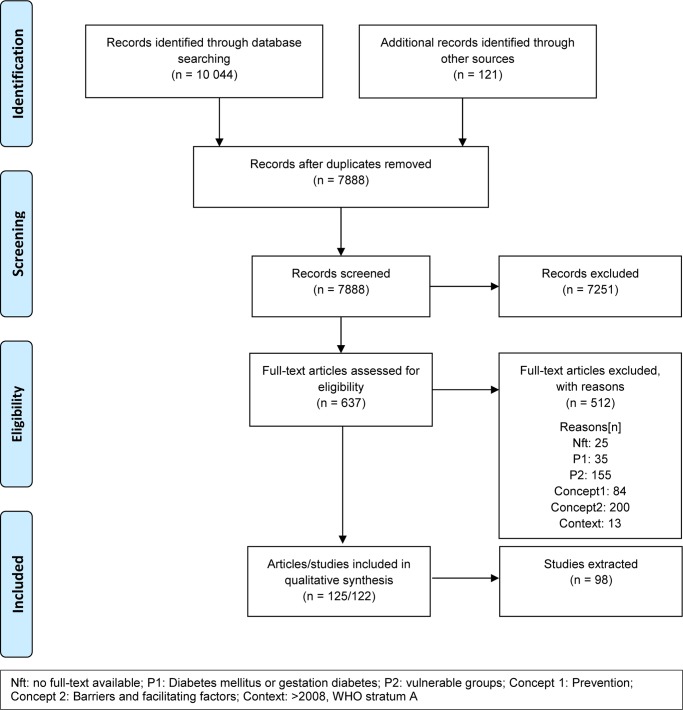
AIMS: Type 2 diabetes mellitus (T2DM) and gestational diabetes (GDM) are globally on the rise, accompanied by comorbidities and associated health costs. Increased physical activity, healthy nutrition, and weight loss have shown the potential to prevent T2DM/GDM. Despite this, reaching vulnerable groups remains a key challenge. The aim of this scoping review was to identify barriers and facilitating factors in the prevention of T2DM/GDM in vulnerable groups. METHODS: We conducted a systematic literature search in May 2018, updated in September 2019, in several databases (e.g. PubMed, Embase) to identify barriers and facilitating factors in the prevention of T2DM/GDM in vulnerable groups. Two reviewers independently screened the results. Extracted data was charted, categorized, and summarized. RESULTS: We included 125 articles. Ninety-eight studies were extracted, and eight categories of barriers and facilitating factors were formed. The most common categories of barriers were limited knowledge, family/friends, and economic factors, and the most common categories of facilitating factors were family/friends, social support, and knowledge. CONCLUSION: This scoping review identified various barriers and facilitating factors in vulnerable groups. Preventive interventions should consider these barriers and facilitating factors in developing preventive interventions or in adapting existing ones.
Overview
The claims and statistics of this paper haven’t been checked yet.
Free: it reads the open-access text and checks the first 5 claims that cite a source we can check. Create a free account to check every claim.
Integrity signals
Registry
Cites
Statistics
Figures
Verification
Claims the paper makes
The claims and statistics of this paper haven’t been checked yet.
Free: it reads the open-access text and checks the first 5 claims that cite a source we can check. Create a free account to check every claim.
Self-check
Percentages, sums and reported differences re-computed from the paper’s own numbers.
The self-check needs the paper’s full text.
Citations
Cites
PRISMA Extension for Scoping Reviews (PRISMA-ScR): Checklist and Explanation
Tricco, A. C., Lillie, E., Zarin, W., O'Brien, K. K., Colquhoun, H., Levac, D., Moher, D., Peters, M. D. J., Horsley, T., Weeks, L., et al. (2018) · Annals of Internal Medicine · doi:10.7326/m18-0850 · Cited by 43,565 · cited 1×
“It is reported based on the Preferred Reporting Items for Systematic reviews and Meta-Analyses extension for Scoping Reviews (PRISMA-ScR) Checklist [13].”
MethodScoping studies: towards a methodological framework
Arksey, H., & O'Malley, L. (2005) · International Journal of Social Research Methodology · doi:10.1080/1364557032000119616 · Cited by 36,742 · cited 3×
“The scoping review was conducted following the Arksey and O ́Malleys framework [11] and the Joanna Briggs Institute Reviewers’ Manual 2015 [12].”
MethodInfluentialReduction in the incidence of type 2 diabetes with lifestyle intervention or metformin
(2002) · New England Journal of Medicine · doi:10.1056/nejmoa012512 · Cited by 19,011 · cited 1×
“Lifestyle interventions like the Diabetes Prevention Program (DDP) may reduce the risk of T2DM more effectively than antidiabetic drugs such as metformin [5].”
BackgroundIDF Diabetes Atlas: Global estimates for the prevalence of diabetes for 2015 and 2040
Ogurtsova, K., da Rocha Fernandes, J. D., Huang, Y., Linnenkamp, U., Guariguata, L., Cho, N. H., Cavan, D., Shaw, J. E., & Makaroff, L. E. (2017) · Diabetes Research and Clinical Practice · doi:10.1016/j.diabres.2017.03.024 · Cited by 6,966 · cited 1×
“Background The prevalence of type 2 diabetes mellitus (T2DM) and gestational diabetes (GDM) is rising worldwide, and so are the associated health consequences and healthcare costs [1].”
BackgroundPRESS Peer Review of Electronic Search Strategies: 2015 Guideline Statement
McGowan, J., Sampson, M., Salzwedel, D. M., Cogo, E., Foerster, V., & Lefebvre, C. (2016) · Journal of Clinical Epidemiology · doi:10.1016/j.jclinepi.2016.01.021 · Cited by 5,700
From best evidence to best practice: effective implementation of change in patients' care
Grol, R., & Grimshaw, J. (2003) · The Lancet · doi:10.1016/s0140-6736(03)14546-1 · Cited by 4,531
The Joanna Briggs Institute reviewers' manual 2015: methodology for JBI scoping reviews
Peters, M. D. J., Godfrey, C. M., McInerney, P. A., Soares, C. B., Khalil, H., & Parker, D. (2015) · Cited by 1,135
Connolly, V, Unwin, N., Sherriff, P., Bilous, R., & Kelly, W. (2000) · Journal of Epidemiology and Community Health · doi:10.1136/jech.54.3.173 · Cited by 516 · cited 1×
“Such patients are disproportionally affected by T2DM/GDM and diabetes-related complications [6, 7].”
BackgroundSullivan, P. W., Morrato, E. H., Ghushchyan, V., Wyatt, H. R., & Hill, J. O. (2005) · Diabetes Care · doi:10.2337/diacare.28.7.1599 · Cited by 400
Schwartz, N., Nachum, Z., & Green, M. S. (2015) · American Journal of Obstetrics and Gynecology · doi:10.1016/j.ajog.2015.03.011 · Cited by 229 · cited 1×
“Such patients are disproportionally affected by T2DM/GDM and diabetes-related complications [6, 7].”
Background
Cited by
Recommendations for the Extraction, Analysis, and Presentation of Results in Scoping Reviews
Pollock, D., Peters, M. D. J., Khalil, H., McInerney, P., Alexander, L., Tricco, A. C., Evans, C., de Moraes, É. B., Godfrey, C. M., Pieper, D., et al. (2023) · JBI Evidence Synthesis · doi:10.11124/jbies-22-00123 · Cited by 1,975
Self-citationHealthy Eating and Active Lifestyles: Best Practices in Public Health
OECD (2022) · OECD eBooks · doi:10.1787/40f65568-en · Cited by 276
Breuing, J., Joisten, C., Neuhaus, A. L., Heß, S., Kusche, L., Haas, F., Spiller, M., & Pieper, D. (2021) · Systematic Reviews · doi:10.1186/s13643-021-01846-8 · Cited by 20
“In conjunction with recently described barriers and facilitating factors in diabetes prevention in vulnerable groups [50]; therefore, future preventive programs can benefit from these findings or already existing programs could be adapted.”
BackgroundSelf-citationDubois, N., & Giroux, I. (2025) · Healthcare · doi:10.3390/healthcare13182261 · Cited by 15
“Conversely, common barriers involved inadequate knowledge, financial constraints, low motivation to adopt lifestyle changes, the high cost of healthy foods, and cultural or religious food practices [28].”
InfluentialHart, K. J., Kubilius, A., & Clark, M. (2023) · PLoS ONE · doi:10.1371/journal.pone.0294344 · Cited by 8
Gjertsen, T. I., Helvik, A., & Følling, I. S. (2021) · BMC Public Health · doi:10.1186/s12889-021-11374-8 · Cited by 5
Are Diabetes Prevention Programs Reaching Those Most at Risk? A Scoping Review
Johnston, C., MacPherson, M., & Jung, M. E. (2024) · Canadian Journal of Diabetes · doi:10.1016/j.jcjd.2024.11.006 · Cited by 4
Connecting patients with clinical trials using patient navigation: a scoping review protocol
Hilal, O., Gupta, P., Luginaah, A., Moshref, L. H., Askin, N., Epp, C., Nassar, R., Hirmiz, R., Paunic, M., Hossami, M., et al. (2025) · BMJ Open · doi:10.1136/bmjopen-2024-088828 · Cited by 2
“21 The patient navigation interventions will be classified based on Chan et al ’s domains of patient navigation (see online supplemental appendix III).”
Thylefors, J., Gershater, M. A., Mangrio, E., & Zdravkovic, S. (2025) · Frontiers in Public Health · doi:10.3389/fpubh.2025.1583817 · Cited by 2
Takele, W. W., Lim, S. S., Adhinugraha, K. M., Taniar, D., Dalli, L. L., & Boyle, J. A. (2025) · BMJ Open · doi:10.1136/bmjopen-2025-101272 · Cited by 2
“…spot areas in our study are located in inner areas of major cities where the representation of women in the NDSS programme is expected to be higher, cold spot determinations in some areas (eg, outer regions and areas of high percentage of non-European migrant women) may be impacted by the…”
Stern, C., Valenzuela, C., Whitehorn, A., Pollock, D., Minooee, S., Gohil, D. A., Zhu, Z., Kirkpatrick, P., Loureiro, R. L., Davies, E., et al. (2026) · JBI Evidence Synthesis · doi:10.11124/jbies-25-00265 · Cited by 6
Self-citationPsychosocial Risk Factors Associated with Gestational Diabetes Mellitus a Scoping Review
Mena, S. C. M. (2022) · Journal of Quality in Health Care & Economics · doi:10.23880/jqhe-16000299 · Cited by 2
Romo, J. F. M., & Bazán-Riverón, G. E. (2023) · Psicología y Salud · doi:10.25009/pys.v34i1.2840 · Cited by 1
Shao, K., Lei, H., Zhu, J., Chen, X., Sina, Y., & Yao, R. (2026) · Frontiers in Public Health · doi:10.3389/fpubh.2026.1870603
“…the systematic review by Ghammari et al. on T2DM management in slum residents (127), evidence on prevention in vulnerable groups by Breuing et al. (128), and qualitative research on dietary self-management in Ghana by Hushie (129), further confirm the universality of the “core contradiction…”
Tratamento nutricional do Diabetes Mellitus: foco na Nutrigenômica
Santos, G., Bispo, A., dos Santos, C., & Gomes, T. (2021) · LUMEN · doi:10.24024/23579897v30n2a2021p1000117 · Cited by 4
Sala, D. C. P., da Costa, P. C. P., Baumann, A. A., Cardoso, M. M. D. A., Horta, A. L. D. M., & Okuno, M. F. P. (2024) · Revista gaúcha de enfermagem · doi:10.1590/1983-1447.2024.20240045.en
Sala, D. C. P., da Costa, P. C. P., Baumann, A. A., Cardoso, M. M. D. A., Horta, A. L. D. M., & Okuno, M. F. P. (2024) · Revista gaúcha de enfermagem · doi:10.1590/1983-1447.2024.20240045.pt
Vergauwen, J., Monnet, F., van Olmen, J., Wouters, E., Danhieux, K., Desmet, L., Martens, M., Verdegem, R., Vanhaecke, J., Lampaert, A., et al. (2025) · BMC Public Health · doi:10.1186/s12889-025-24462-w
“Additionally, the lifestyle intervention adopts a one-size-fits-all approach, overlooking the specific needs of individuals or population groups [55].”
Gjertsen, T. I., Helvik, A.-S., & Følling, I. S. (2021) · Figshare · doi:10.6084/m9.figshare.14913842
Zeraattalab-Motlagh, S., Henriquez, C. E. I. L., Cantu, M., & Ledoux, T. A. (2026) · Advances in Nutrition · doi:10.1016/j.advnut.2026.100699
“T2D is a metabolic disorder characterized by unusually elevated blood glucose concentrations and is one of the main drivers of mortality and morbidity [2].”
Metadata
- Authors
- Breuing, J., Pieper, D., Neuhaus, A. L., Heß, S., Lütkemeier, L., Haas, F., Spiller, M., & Graf, C.
- Affiliations
- Witten/Herdecke University (DE)
- German Sport University Cologne (DE)
- Corresponding author
- Breuing, Jessica
- Venue
- PLoS ONE
- Publisher
- Public Library of Science (PLoS)
- Published
- 2020-05-13
- Volume
- 15
- Issue
- 5
- Pages
- e0232250
- ISSN
- 1932-6203 (ISSN-L)
- PMC
- PMC7219729
- OpenAlex
- W3024814131
- Cited by
- 20
- References
- 48
- Citations by year
- 2026: 3 · 2025: 5 · 2024: 3 · 2023: 2 · 2022: 3 · 2021: 4
- FWCI
- 1.70
- Type
- journal article
- Language
- en
- Open access
- gold
- doi.org
- Licence
- Locations
- PLoS ONE (publishedVersion, cc-by)
- PubMed Central (publishedVersion, cc-by)
- PubMed (publishedVersion)
- RePEc: Research Papers in Economics (submittedVersion)
- DOAJ (DOAJ: Directory of Open Access Journals) (submittedVersion, cc-by-sa)
- Funders
- Bundeszentrale für gesundheitliche Aufklärung
- Topics
- Health Sciences › Medicine › Endocrinology, Diabetes and Metabolism › Diabetes Management and Education
- Health Sciences › Medicine › Endocrinology, Diabetes and Metabolism › Diabetes, Cardiovascular Risks, and Lipoproteins
- Health Sciences › Medicine › Obstetrics and Gynecology › Gestational Diabetes Research and Management
- Keywords
- type 2 diabetes prevention, gestational diabetes prevention, vulnerable populations, barriers to prevention, enabling factors, social support, health knowledge, economic barriers, preventive interventions, physical activity, nutrition, weight loss
- MeSH terms
- Diabetes Mellitus, Type 2, Female, Humans, Pregnancy, Primary Prevention, Diabetes, Gestational
About these checks
Registry, retraction, Cites and statistics results are computed, not judged, with one exception: a printed reference that no index lists is read once by a model before it counts as a citation error. Claims are extracted by a model and kept only when their quote appears verbatim in the text; each cited source is then checked, with a model’s help, for whether it says what the claim relies on. Those verdicts can be wrong — read the claim’s quote and the cited source before relying on one.
Statistics and arithmetic are recomputed, not judged.
Confidence bands are shown only for fields calibrated on our annotated test set. None is calibrated yet, so no band is shown.
What counts as a claim ›How we measure confidence ›How we check this ›
Are you an author, or do you see a problem with this page? Request a review
Data sources
Bibliographic data: Semantic Scholar, OpenAlex, Crossref.
Contains information from the Semantic Scholar Academic Graph Datasets, made available under the ODC Attribution License (ODC-BY 1.0).
Semantic Scholar’s data is described in: Kinney, R., et al. (2023). The Semantic Scholar Open Data Platform. arXiv:2301.10140.
