

Improved balance in middle-aged adults after 8 weeks of a modified version of Otago Exercise Program: A randomized controlled trial
Open accessThe DOI matches its Crossref record; 22 of the 22 references it cites were found in a registry or an index.
Abstract
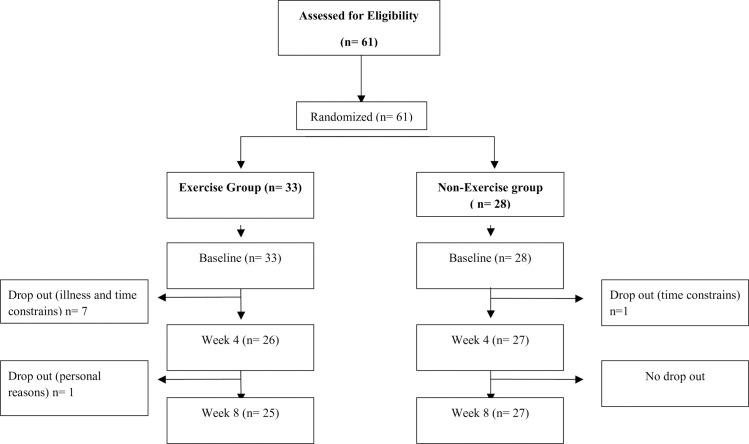
OBJECTIVE: The objective of this randomized controlled trial was to examine dynamic balance changes (reach distance) in middle-aged adults using the Y Balance Test (YBT) following 8 weeks of home-based exercise program adapted from the Otago Exercise Program (OEP). METHODS: Fifty-two healthy middle-aged adults with mean age of 54.4±5.4 years and body mass index of 27.7±5.7 kg/m2 were randomly assigned into either the exercise group (a modification of the Otago Exercise Program, that consisted of home-based balance and strength exercises) or the non-exercise group (continuation of usual lifestyle) by having the participants select a paper from a sealed envelope. The YBT was used to measure participants' dynamic balance in the right and left anterior (RA, LA), posteromedial (RPM, LPM), and posterolateral (RPL, LPL) directions. RESULTS: The outcome in this trial was reach distance (cm). There was a significant group by time interaction in terms of reach distance for all directions (p<0.05, η2 ranged from 0.06 to 0.20). In the exercise group, results of the repeated measures analysis of variance (ANOVA) showed significant improvements in the reach distance in all the directions (p<0.001). In contrast, the non-exercise group had significant difference only in the left posterolateral direction (p = 0.009). Participants in the exercise group achieved significantly greater reach distance (cm) (95% confidence interval (CI)) for RA[(2.8, 0.4 to 5.2), p = 0.023]; LA[(3.2, 0.9 to 5.6), p = 0.008]; RPM[(4.0, 1.0 to 7.9), p = 0.046]; LPM[(5.8,1.3 to 10.3), p = 0.013]; RPL[(7.6, 2.6 to 12.6), p = 0.003]; and LPL[(4.2, 0.3 to 8.2), p = 0.035]. CONCLUSION: The modified version of OEP appears to be effective in improving parameters of dynamic balance in the middle-aged adult population. The improvements in YBT reach distance in the exercise group are indicative of the significance of performing balance and strength exercises regularly for this population.
Overview
The claims and statistics of this paper haven’t been checked yet.
Free: it reads the open-access text and checks the first 5 claims that cite a source we can check. Create a free account to check every claim.
Integrity signals
Registry
Cites
Statistics
Figures
Verification
Claims the paper makes
The claims and statistics of this paper haven’t been checked yet.
Free: it reads the open-access text and checks the first 5 claims that cite a source we can check. Create a free account to check every claim.
Claims other papers make about this one
Each is checked against this paper’s own text: does it say what the citing paper says it does?
The source backs part of the claim, not all of it — or backs it for a different population, condition or comparison.
In the citing paper
“Additionally, it can delay or reverse the frailty status, bolster cognitive function, and promote the overall health status of residents [254,257].”
From Global consensus on optimal exercise recommendations for enhancing healthy longevity in older adults (ICFSR) (2025) · cites this paper as [257]
Experimental — accuracy not yet measuredIn the citing paper
“Additionally, it can delay or reverse the frailty status, bolster cognitive function, and promote the overall health status of residents [254,257].”
From Global consensus on optimal exercise recommendations for enhancing healthy longevity in older adults (ICFSR) (2025) · cites this paper as [257]
Self-check
Percentages, sums and reported differences re-computed from the paper’s own numbers.
The self-check needs the paper’s full text.
Citations
Cites
Plisky, P. J., Gorman, P. P., Butler, R. J., Kiesel, K. B., Underwood, F. B., & Elkins, B. (2009) · Europe PMC (PubMed Central) · Cited by 844
Understanding the Intention-to-treat Principle in Randomized Controlled Trials
McCoy, E. (2017) · Western Journal of Emergency Medicine · doi:10.5811/westjem.2017.8.35985 · Cited by 767
Talbot, L. A., Musiol, R. J., Witham, E. K., & Metter, E. J. (2005) · BMC Public Health · doi:10.1186/1471-2458-5-86 · Cited by 654
Association of Y Balance Test Reach Asymmetry and Injury in Division I Athletes
SMITH, C. A., CHIMERA, N. J., & WARREN, M. (2015) · Medicine & Science in Sports & Exercise · doi:10.1249/mss.0000000000000380 · Cited by 328
Liu‐Ambrose, T., Donaldson, M. G., Ahamed, Y., Graf, P., Cook, W. L., Close, J., Lord, S. R., & Khan, K. M. (2008) · Journal of the American Geriatrics Society · doi:10.1111/j.1532-5415.2008.01931.x · Cited by 322
Aging effects on joint proprioception: the role of physical activity in proprioception preservation
Ribeiro, F., & Oliveira, J. (2007) · European Review of Aging and Physical Activity · doi:10.1007/s11556-007-0026-x · Cited by 257
Daly, R. M., Rosengren, B. E., Alwis, G., Ahlborg, H. G., Sernbo, I., & Karlsson, M. K. (2013) · BMC Geriatrics · doi:10.1186/1471-2318-13-71 · Cited by 191
The falling risk and physical fitness in older people
KARAGÜLMEZ, A. T., & Yıldırım, N. Ü. (2009) · Archives of Gerontology and Geriatrics · doi:10.1016/j.archger.2009.10.012 · Cited by 169
Cadore, E. L., Izquierdo, M., Pinto, S. S., Alberton, C. L., Pinto, R. S., Baroni, B. M., Vaz, M. A., Lanferdini, F. J., Radaelli, R., González-Izal, M., et al. (2013) · AGE · doi:10.1007/s11357-012-9405-y · Cited by 166
The effect of exercise on physical fitness and quality of life in postmenopausal women
Teoman, N., Özcan, A., & Acar, B. (2003) · Maturitas · doi:10.1016/s0378-5122(03)00241-x · Cited by 143
Research works printed but not linked: 1
- Campbell A, Robertson MC. Otago exercise programme to prevent falls in older adults. Wellington: ACC Thinksafe 2003.
Cited by
Izquierdo, M., de Souto Barreto, P., Arai, H., Bischoff-Ferrari, H. A., Cadore, E. L., Cesari, M., Chen, L.-K., Coen, P. M., Courneya, K. S., Duque, G., et al. (2025) · The Journal of nutrition, health and aging · doi:10.1016/j.jnha.2024.100401 · Cited by 273
Chen, X., Zhao, L., Liu, Y., Zhou, Z., Zhang, H., Wei, D., Chen, J., Li, Y., Ou, J., Huang, J., et al. (2021) · Journal of Clinical Nursing · doi:10.1111/jocn.15964 · Cited by 76
Peng, Y., Yi, J., Zhang, Y., Sha, L., Jin, S., & Liu, Y. (2022) · Geriatric Nursing · doi:10.1016/j.gerinurse.2022.10.014 · Cited by 42
The Effect of a Handball Warm-Up Program on Dynamic Balance among Elite Adolescent Handball Players
Daneshjoo, A., Hoseinpour, A. N., Sadeghi, H., Kalantari, A., & Behm, D. G. (2022) · Sports · doi:10.3390/sports10020018 · Cited by 22
“It was reported that exercises such as plyometric and single-leg standing enhance central nervous system (CNS) plasticity and improve the function of the balance feedback loop over other balance systems [33].”
BackgroundOtago Exercises Monitoring for Older Adults by a Single IMU and Hierarchical Machine Learning Models
Shang, M., Dedeyne, L., Dupont, J., Vercauteren, L., Amini, N., Lapauw, L., Gielen, E., Verschueren, S., Varon, C., De Raedt, W., et al. (2024) · IEEE Transactions on Neural Systems and Rehabilitation Engineering · doi:10.1109/tnsre.2024.3355299 · Cited by 21
“Older adults participating in the OEP are requested to perform the exercises twice or three times a week within some consecutive weeks and their compliance with performing OEP is monitored by means of self-reports (diaries) [5], [6].”
MethodLee, J.-W., Yu, J.-H., Hong, J., Lee, D.-Y., Kim, J., & Kim, S. (2022) · Healthcare · doi:10.3390/healthcare10071202 · Cited by 18
“This indicates that the performance of AR-based strengthening and balance exercises is not different from the results of previous exercises performed by therapists [30].”
ResultDS-MS-TCN: Otago Exercises Recognition With a Dual-Scale Multi-Stage Temporal Convolutional Network
Shang, M., Dedeyne, L., Dupont, J., Vercauteren, L., Amini, N., Lapauw, L., Gielen, E., Verschueren, S., Varon, C., De Raedt, W., et al. (2024) · IEEE Journal of Biomedical and Health Informatics · doi:10.1109/jbhi.2024.3455426 · Cited by 5
“Participants are instructed to engage in these exercises two or three times a week over consecutive weeks [5], [6].”
BackgroundSong, H. W., & Yu, J.-H. (2024) · Journal of Wireless Mobile Networks Ubiquitous Computing and Dependable Applications · doi:10.58346/jowua.2024.i1.007 · Cited by 4
Alsaleh, H. M., Alsaad, S. M., AlAbdulwahab, S. S., Vennu, V. S., & Bindawas, S. M. (2024) · Risk Management and Healthcare Policy · doi:10.2147/rmhp.s495695 · Cited by 3
Effect of otago exercise on falls in patients with osteoarthritis
Xie, C., Wang, W., Pei, J., Wang, H., & Lv, H. (2020) · Medicine · doi:10.1097/md.0000000000023559 · Cited by 3
A Masked Multi-Task Learning Approach for Otago Micro Labels Recognition
Shang, M., Dedeyne, L., Dupont, J., Vercauteren, L., Amini, N., Lapauw, L., Gielen, E., Verschueren, S., Varon, C., Raedt, W. D., et al. (2025) · IEEE Transactions on Neural Systems and Rehabilitation Engineering · doi:10.1109/tnsre.2025.3615625 · Cited by 2
“Consisting of over 17 strength and balance exercises and a walking plan, the program targets various functions of the body [2], [3].”
EFFECTS OF BOBATH APPROACH WITH CORE STABILITY TO IMPROVE BALANCE IN STROKE
Ashraf, S. (2024) · doi:10.53555/jptcp.v31i8.7317 · Cited by 2
“Reduced balance function is another consequence of all these deficits the patient is unable to keep his center of gravity within his support base, whether or not external forces are at play (8).”
A graded personalized exercise program’s effect on muscle and body fat: randomized controlled trial
Son, J. Y., Jung, J., Son, J. E., Park, S., Park, E. J., Lee, J., & Yoo, S. D. (2025) · BMC Public Health · doi:10.1186/s12889-025-22453-5 · Cited by 4
Joshi, M. V., & Phansopkar, P. A. (2022) · Medical Science · doi:10.54905/disssi/v26i123/ms167e2142 · Cited by 1
“Modified forms of Otago exercises are used for the rehabilitation in the case report (Almarzouki et al., 2020).”
MethodOtago exercises adapted to balance to manage the risk of falls in the elderly
Guzmán, M. A. P., Chacón, L. J. R., Soto, G. F. F., Villacís, R. I. V., & Barroso, S. A. Q. (2024) · Ibero-American Journal of Health Science Research · doi:10.56183/iberojhr.v4is.693 · Cited by 1
Efektivitas Otago Exercise Program terhadap Keseimbangan Lansia
Setiani, R., Afrianti Wahyu, W., & Nurul Fithriati, H. (2025) · Jurnal Terapi Wicara dan Bahasa · doi:10.59686/jtwb.v4i1.212
“Adapun penelitian yang dilakukan oleh (Almarzouki et al., 2020) menunjukkan bahwa kelompok dengan otago exercise program yang dimodifikasi efektif meningkatkan parameter keseimbangan dinamis pada pra-lansia dari pada kelompok tidak berolahraga.”
Özdinçler, A. R., Yiğit, Ş., Umut, G. U., Ekşi, B. Ü., & GÜNEY, İ. (2026) · Journal of Aging and Physical Activity · doi:10.1123/japa.2025-0400
Wahyundari, D., Naufal, A. F., & Wijayaningsih, A. (2022) · Academic Physiotherapy Conference Proceeding
Yu, J. (2025) · International Journal of Environmental Sciences · doi:10.64252/fjgrwr94
Metadata
- Authors
- Almarzouki, R., Bains, G., Lohman, E., Bradley, B., Nelson, T., Alqabbani, S., Alonazi, A., & Daher, N.
- Affiliations
- Loma Linda University (US)
- Princess Nourah bint Abdulrahman University (SA)
- Majmaah University (SA)
- Venue
- PLOS ONE
- Publisher
- Public Library of Science (PLoS)
- Published
- 2020-07-15
- Volume
- 15
- Issue
- 7
- Pages
- e0235734
- ISSN
- 1932-6203 (ISSN-L)
- PMC
- PMC7363097
- OpenAlex
- W3184300765
- Cited by
- 16
- References
- 22
- Citations by year
- 2026: 1 · 2025: 1 · 2024: 7 · 2022: 5 · 2021: 1 · 2020: 1
- FWCI
- 3.18
- Type
- journal article
- Language
- en
- Open access
- gold
- doi.org
- Licence
- Locations
- PLoS ONE (publishedVersion, cc-by)
- PubMed Central (publishedVersion, cc-by)
- PubMed (publishedVersion)
- DOAJ (DOAJ: Directory of Open Access Journals) (submittedVersion, cc-by-sa)
- Topics
- Health Sciences › Health Professions › Physical Therapy, Sports Therapy and Rehabilitation › Balance, Gait, and Falls Prevention
- Health Sciences › Medicine › Public Health, Environmental and Occupational Health › Physical Activity and Health
- Health Sciences › Medicine › Rehabilitation › Stroke Rehabilitation and Recovery
- Keywords
- dynamic balance, middle-aged adults, home-based exercise, Y-balance test, reach distance, balance training, resistance training, fall prevention, older adults
- MeSH terms
- Accidental Falls, Adult, Postural Balance, Female, Humans, Male, Middle Aged, Exercise, Muscle Strength
About these checks
Registry, retraction, Cites and statistics results are computed, not judged, with one exception: a printed reference that no index lists is read once by a model before it counts as a citation error. Claims are extracted by a model and kept only when their quote appears verbatim in the text; each cited source is then checked, with a model’s help, for whether it says what the claim relies on. Those verdicts can be wrong — read the claim’s quote and the cited source before relying on one.
Statistics and arithmetic are recomputed, not judged.
Confidence bands are shown only for fields calibrated on our annotated test set. None is calibrated yet, so no band is shown.
What counts as a claim ›How we measure confidence ›How we check this ›
Are you an author, or do you see a problem with this page? Request a review
Data sources
Bibliographic data: Semantic Scholar, OpenAlex, Crossref.
Contains information from the Semantic Scholar Academic Graph Datasets, made available under the ODC Attribution License (ODC-BY 1.0).
Semantic Scholar’s data is described in: Kinney, R., et al. (2023). The Semantic Scholar Open Data Platform. arXiv:2301.10140.
