

Transitive inference in cleaner wrasses (Labroides dimidiatus)
Open accessThe DOI matches its Crossref record; 39 of the 39 references it cites were found in a registry or an index.
Abstract
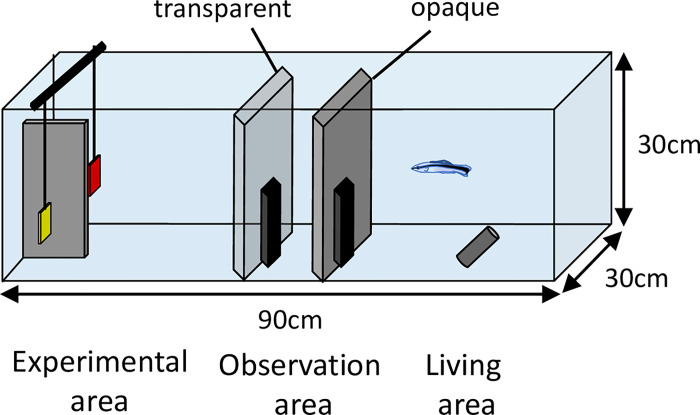
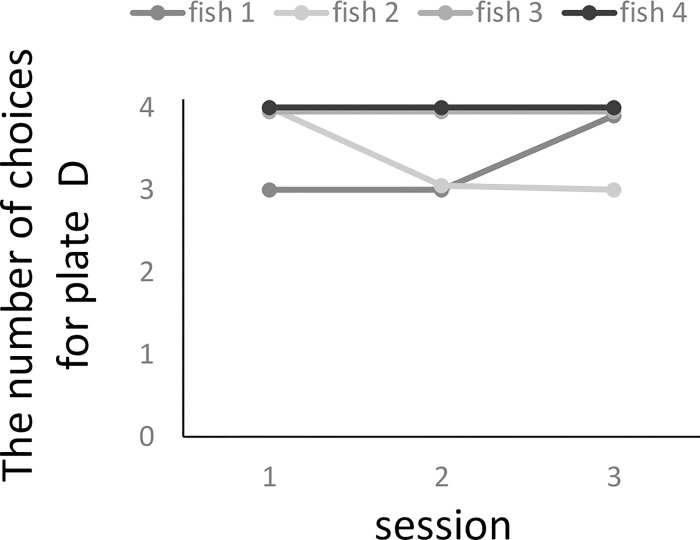
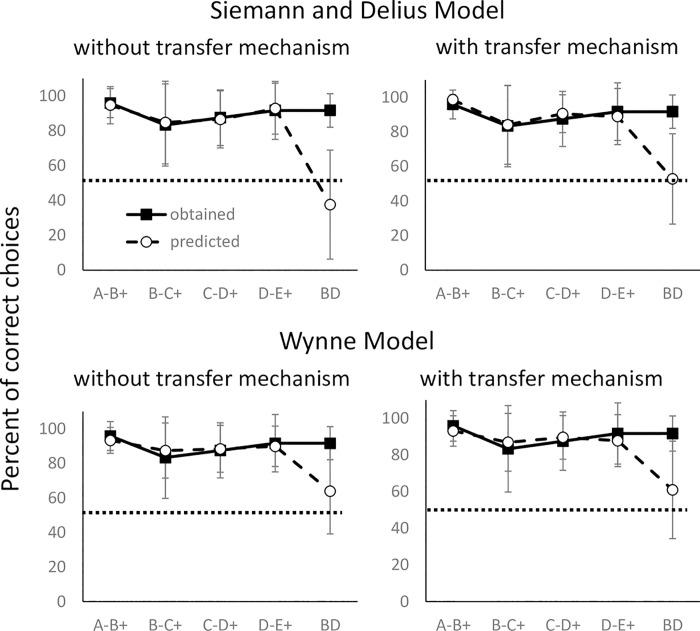
Transitive inference (TI) is the ability to infer unknown relationships from previous information. To test TI in non-human animals, transitive responding has been examined in a TI task where non-adjacent pairs were presented after premise pair training. Some mammals, birds and paper wasps can pass TI tasks. Although previous studies showed that some fish are capable of TI in the social context, it remains unclear whether fish can pass TI task. Here, we conducted a TI task in cleaner wrasses (Labroides dimidiatus), which interact with various client fishes and conspecifics. Because they make decisions based on previous direct and indirect interactions in the context of cleaning interactions, we predicted that the ability of TI is beneficial for cleaner fish. Four tested fish were trained with four pairs of visual stimuli in a 5-term series: A-B+, B-C+, C-D+, and D-E+ (plus and minus denote rewards and non-rewards, respectively). After training, a novel pair, BD (BD test), was presented wherein the fish chose D more frequently than B. In contrast, reinforcement history did not predict the choice D. Our results suggest that cleaner fish passed the TI task, similar to mammals and birds. Although the mechanism underlying transitive responding in cleaner fish remains unclear, this work contributes to understanding cognitive abilities in fish.
Overview
The claims and statistics of this paper haven’t been checked yet.
Free: it reads the open-access text and checks the first 5 claims that cite a source we can check. Create a free account to check every claim.
Integrity signals
Registry
Cites
Statistics
Figures
Verification
Claims the paper makes
The claims and statistics of this paper haven’t been checked yet.
Free: it reads the open-access text and checks the first 5 claims that cite a source we can check. Create a free account to check every claim.
Claims other papers make about this one
Each is checked against this paper’s own text: does it say what the citing paper says it does?
The check wasn’t confident either way, so it gives no verdict — never disputed.
In the citing paper
“The ability to exploit individual-specific differences in faces appears to occur widely across social fishes, to distinguish between familiar and unfamiliar individuals, and to identify specific familiar individuals (22–24, 29, 35, 36).”
From Cleaner fish recognize self in a mirror via self-face recognition like humans (2023) · cites this paper as [36]
Experimental — accuracy not yet measured
Self-check
Percentages, sums and reported differences re-computed from the paper’s own numbers.
The self-check needs the paper’s full text.
Citations
Cites
Fish can infer social rank by observation alone
Grosenick, L., Clement, T. S., & Fernald, R. D. (2007) · Nature · doi:10.1038/nature05511 · Cited by 552 · cited 1×
“[21] are the first to examine the ability of TI in fish in the social context, using an African cichlid fish, Astatotilapia burtoni.”
BackgroundMCGONIGLE, B. O., & CHALMERS, M. (1977) · Nature · doi:10.1038/267694a0 · Cited by 427
Pinyon jays use transitive inference to predict social dominance
Paz-y-Miño C, G., Bond, A. B., Kamil, A. C., & Balda, R. P. (2004) · Nature · doi:10.1038/nature02723 · Cited by 415
Reasoning in the chimpanzee: II. Transitive inference.
Gillan, D. J. (1981) · Journal of Experimental Psychology: Animal Behavior Processes · doi:10.1037//0097-7403.7.2.150 · Cited by 408 · cited 2×
“For this study, we referred to the procedures used for chimpanzees and rats [10,14].”
BackgroundMethodTransitive inference formation in pigeons.
von Fersen, L., Wynne, C. D., Delius, J. D., & Staddon, J. E. (1991) · Journal of Experimental Psychology: Animal Behavior Processes · doi:10.1037//0097-7403.17.3.334 · Cited by 397
Image scoring and cooperation in a cleaner fish mutualism
Bshary, R., & Grutter, A. S. (2006) · Nature · doi:10.1038/nature04755 · Cited by 385 · cited 1×
“Cleaner fish could discriminate between plates with two different colour patterns within 20 or 30 trials [28].”
BackgroundSocial complexity and transitive inference in corvids
Bond, A. B., Kamil, A. C., & Balda, R. P. (2003) · Animal Behaviour · doi:10.1006/anbe.2003.2101 · Cited by 312 · cited 4×
“[15] tested this hypothesis to compare performance in a BD test between highly social pinyon jays and less social scrub jays.”
BackgroundMethodInfluentialTransitive inference in rats (Rattus norvegicus).
Davis, H. (1992) · Journal of Comparative Psychology · doi:10.1037//0735-7036.106.4.342 · Cited by 276 · cited 3×
“For this study, we referred to the procedures used for chimpanzees and rats [10,14].”
BackgroundMethodKohda, M., Hotta, T., Takeyama, T., Awata, S., Tanaka, H., Asai, J.-Y., & Jordan, A. L. (2019) · PLOS Biology · doi:10.1371/journal.pbio.3000021 · Cited by 249
Self-citationParasite removal rates by the cleaner wrasse Labroides dimidiatus
Grutter, A. (1996) · Marine Ecology Progress Series · doi:10.3354/meps130061 · Cited by 241 · cited 2×
“Cleaner wrasses, a coral reef fish, are known as the most common cleaner fish that remove ectoparasites from the body surface of other fish (called ‘clients’) [25].”
Background
Cited by
Kohda, M., Sogawa, S., Jordan, A. L., Kubo, N., Awata, S., Satoh, S., Kobayashi, T., Fujita, A., & Bshary, R. (2022) · PLOS Biology · doi:10.1371/journal.pbio.3001529 · Cited by 99
“This fish is a model species for the study of fish cognition [52–54], and many aspects of fish social cognitive capacities have been reported from this fish, for example, the strategic use of tactical deception [55], transitive inference [56], a strong ability to delay gratification [57], a base for theory of mind [43…”
BackgroundSelf-citationCleaner fish recognize self in a mirror via self-face recognition like humans
Kohda, M., Bshary, R., Kubo, N., Awata, S., Sowersby, W., Kawasaka, K., Kobayashi, T., & Sogawa, S. (2023) · Proceedings of the National Academy of Sciences · doi:10.1073/pnas.2208420120 · Cited by 90
“Cleaner fish have become a model species for the study of fish cognition (52, 53), yielding evidence for generalized rule learning (54), the strategic use of tactical deception (55), transitive inference (36), one-trial long-term memory (56), a strong ability to delay gratification (57), and MSR (18, 19).”
Self-citationNo evidence for general intelligence in a fish
Aellen, M., Burkart, J. M., & Bshary, R. (2022) · Ethology · doi:10.1111/eth.13275 · Cited by 50
Thinking about order: a review of common processing of magnitude and learned orders in animals
Gazes, R. P., Templer, V. L., & Lazareva, O. F. (2022) · Animal Cognition · doi:10.1007/s10071-022-01713-6 · Cited by 26
Kobayashi, T., Kohda, M., Awata, S., Bshary, R., & Sogawa, S. (2024) · Scientific Reports · doi:10.1038/s41598-024-70138-7 · Cited by 21
“Such complex social interactions are considered to develop various sophisticated cognitive capacities in addition to MSR 21,22,33 , such as tactical deception 58,59 and transitive inference 60,61 .”
Self-citationThe fish challenge to vertebrate cognitive evolution
Triki, Z., van Schaik, C. P., & Bshary, R. (2025) · Philosophical Transactions of the Royal Society B Biological Sciences · doi:10.1098/rstb.2024.0124 · Cited by 16
Fish can infer relations between colour cues in a non-social learning task
Loggia, O. L., Rüfenacht, A., & Taborsky, B. (2022) · Biology Letters · doi:10.1098/rsbl.2022.0321 · Cited by 11
“While TI in a non-social context was shown in a number of mammals andbirds [14,16,34–36], there has been onlyone such studyaiming to test TI in a fish thus far [37].”
BackgroundMethodKohda, M., Sogawa, S., & Sowersby, W. (2024) · Frontiers in Psychology · doi:10.3389/fpsyg.2024.1497386 · Cited by 12
Self-citationFishes: From Social Learning to Culture
Brown, C. (2023) · Oxford University Press eBooks · doi:10.1093/oxfordhb/9780198869252.013.27 · Cited by 15
Positional inference in rhesus macaques
Jensen, G., Ferrera, V. P., & Terrace, H. S. (2021) · Animal Cognition · doi:10.1007/s10071-021-01536-x · Cited by 8
Sakai, Y. (2022) · Springer eBooks · doi:10.1007/978-981-19-6095-6_4 · Cited by 12
Cleaner wrasse failed in early testing stages of both visual and spatial working memory paradigms
Bonin, L., Manrique, H. M., & Bshary, R. (2025) · Animal Cognition · doi:10.1007/s10071-025-01959-w · Cited by 9
“…2022) that includes basic perspective-taking (McAuliffe et al. 2021), transitive inference (under certain circumstances, Bonin and Bshary 2023; Hotta et al. 2020), generalized rule learning (Wismer et al. 2016), chaining and configurational learning (Prat et al. 2022; Quiñones et al. 2020),…”
Hippocampal Pallium Lesion Impairs Transitive Inference in Goldfish
Sotelo‐Parrilla, G., Vera, B. Q., Trujillo, I., Rodríguez, F., Salas, C., & Gómez, A. (2025) · Hippocampus · doi:10.1002/hipo.70007 · Cited by 4
“…capabilities in the context of assessing social dominance hierarchies (Grosenick et al. 2007; Hotta, Jordan, et al. 2015; Hotta, Takeyama, et al. 2015; White and Gowan 2013), and more recently also using standard general transitive inference procedures (Hotta et al. 2020; La Loggia et al. 2022).”
InfluentialBonin, L., & Bshary, R. (2023) · PLoS ONE · doi:10.1371/journal.pone.0287402 · Cited by 7
“[17], who proposed that the ecology of cleaner wrasse predicts the presence of TI.”
BackgroundMethodResultInfluentialTransitive inference and transitivity: Two sides of the same coin?
Lazareva, O. F. (2025) · Journal of the Experimental Analysis of Behavior · doi:10.1002/jeab.70031 · Cited by 3
Rapid self-recognition ability in the cleaner fish
Sogawa, S., Kobayashi, T., Bshary, R., Sowersby, W., Awata, S., Kubo, N., Nakai, Y., & Kohda, M. (2025) · Scientific Reports · doi:10.1038/s41598-025-25837-0 · Cited by 3
“…cognitive abilities 22 and the cleaner fish is a well-researched model species for the study of fish cognition, demonstrating the strategic use of tactical deception 23 , transitive inference 24 , a strong ability to delay gratification 25 , key elements of theory of mind 26 and MSR-capability 12 .”
Self-citationA visual signal to achieve joint attention in wild plains zebras, Equus quagga
Hex, S. B. S. W., & Rubenstein, D. I. (2024) · Animal Behaviour · doi:10.1016/j.anbehav.2024.02.019 · Cited by 2
Transitive reasoning in the adult domestic hen in a six-term series task
Degrande, R., Amichaud, O., Piégu, B., Cornilleau, F., Jardat, P., Ferreira, V. H. B., Colson, V., Lansade, L., & Calandreau, L. (2024) · Animal Cognition · doi:10.1007/s10071-024-01914-1 · Cited by 3
“We controlled for an effect of the reinforcement history and the reinforcement ratio of the items during training (Daisley et al. 2010, 2021; Hotta et al. 2020; Okouchi and Lattal 2006; Lazareva et al. 2004) and of the configuration of premise pair trials which were presented just before the test…”
Kubo, N. (2023) · The Psychological Record · doi:10.1007/s40732-023-00551-3 · Cited by 1
Prefrontal and Premotor Cortices Encode Inference Judgements
Mercado, K., & de Lafuente, V. (2022) · Neuroscience · doi:10.1016/j.neuroscience.2022.01.011 · Cited by 1
Cleaner wrasse can reach Piagetian stage 4 of object permanence when primarily exposed to stage 3Preprint
Bonin, L., Sophie, D. U. C., & Bshary, R. (2024) · Research Square · doi:10.21203/rs.3.rs-5117879/v1 · Cited by 3
Transitive Inference in a Clinical Childhood SamplePreprint
Kao, T., Michaelcheck, C., Ferrera, V. P., Terrace, H. S., & Jensen, G. (2023) · doi:10.31234/osf.io/w8rtx
Transitive inference in a clinical childhood sample with a focus on autism spectrum disorder
Kao, T., Michaelcheck, C., Ferrera, V. P., Terrace, H. S., & Jensen, G. (2024) · Autism Research · doi:10.1002/aur.3225 · Cited by 1
“The range of species that have demonstrated at least some capacity for TI includes monkeys (McGonigle & Chalmers, 1977; Jensen et al., 2017; Jensen et al., 2022), fish (Hotta et al., 2020), and even wasps (Tibbetts et al., 2019).”
Fishes’ Meta Self-awareness and Issues Related to MSR
Kohda, M., & Sogawa, S. (2025) · Springer eBooks · doi:10.1007/978-981-96-7163-2_7
Self-citationHumans and animals can both think logically − but testing what kind of logic they’re using is tricky
Lazareva, O. F. (2025) · The Conversation · doi:10.64628/aai.73gs46qf7
A fishy perspective on the social brain hypothesis
Bshary, R., & Triki, Z. (2025) · Behavioral and Brain Sciences · doi:10.1017/s0140525x25101453
Manusia dan hewan sama-sama bisa berpikir logis, tapi pengukuran kemampuannya tidak sesederhana itu
Lazareva, O. F. (2026) · The Conversation · doi:10.64628/aan.6tdeghccx
Metadata
- Authors
- Hotta, T., Ueno, K., Hataji, Y., Kuroshima, H., Fujita, K., & Kohda, M.
- Affiliations
- Japan Society for the Promotion of Science (JP)
- Osaka City University (JP)
- Kyoto University (JP)
- Corresponding author
- Hotta, Takashi
- Venue
- PLOS ONE
- Publisher
- Public Library of Science (PLoS)
- Published
- 2020-08-18
- Volume
- 15
- Issue
- 8
- Pages
- e0237817
- ISSN
- 1932-6203 (ISSN-L)
- PMC
- PMC7433877
- OpenAlex
- W3051951036
- Cited by
- 27
- References
- 38
- Citations by year
- 2026: 1 · 2025: 8 · 2024: 6 · 2023: 5 · 2022: 6 · 2021: 1
- FWCI
- 1.91
- Type
- journal article
- Language
- en
- Open access
- gold
- doi.org
- Licence
- Locations
- PLoS ONE (publishedVersion, cc-by)
- PubMed Central (publishedVersion, cc-by)
- PubMed (publishedVersion)
- RePEc: Research Papers in Economics (submittedVersion)
- DOAJ (DOAJ: Directory of Open Access Journals) (submittedVersion, cc-by-sa)
- Funders
- Japan Society for the Promotion of Science (25304017; 26540070; 26118511, H16J09486; 18J01293)
- Topics
- Physical Sciences › Environmental Science › Nature and Landscape Conservation › Fish biology, ecology, and behavior
- Life Sciences › Agricultural and Biological Sciences › Ecology, Evolution, Behavior and Systematics › Primate Behavior and Ecology
- Social Sciences › Psychology › Developmental and Educational Psychology › Child and Animal Learning Development
- Keywords
- transitive inference, cleaner wrasse, Labroides dimidiatus, fish cognition, cleaning symbiosis, social learning, reinforcement history
- MeSH terms
- Animals, Choice Behavior, Female, Learning, Male, Perciformes, Reward
About these checks
Registry, retraction, Cites and statistics results are computed, not judged, with one exception: a printed reference that no index lists is read once by a model before it counts as a citation error. Claims are extracted by a model and kept only when their quote appears verbatim in the text; each cited source is then checked, with a model’s help, for whether it says what the claim relies on. Those verdicts can be wrong — read the claim’s quote and the cited source before relying on one.
Statistics and arithmetic are recomputed, not judged.
Confidence bands are shown only for fields calibrated on our annotated test set. None is calibrated yet, so no band is shown.
What counts as a claim ›How we measure confidence ›How we check this ›
Are you an author, or do you see a problem with this page? Request a review
Data sources
Bibliographic data: Semantic Scholar, OpenAlex, Crossref.
Contains information from the Semantic Scholar Academic Graph Datasets, made available under the ODC Attribution License (ODC-BY 1.0).
Semantic Scholar’s data is described in: Kinney, R., et al. (2023). The Semantic Scholar Open Data Platform. arXiv:2301.10140.
