

Prevalence, patterns and correlates of smokeless tobacco use in Nigerian adults: An analysis of the Global Adult Tobacco Survey
Open accessThe DOI matches its Crossref record; 27 of the 27 references it cites were found in a registry or an index.
Abstract
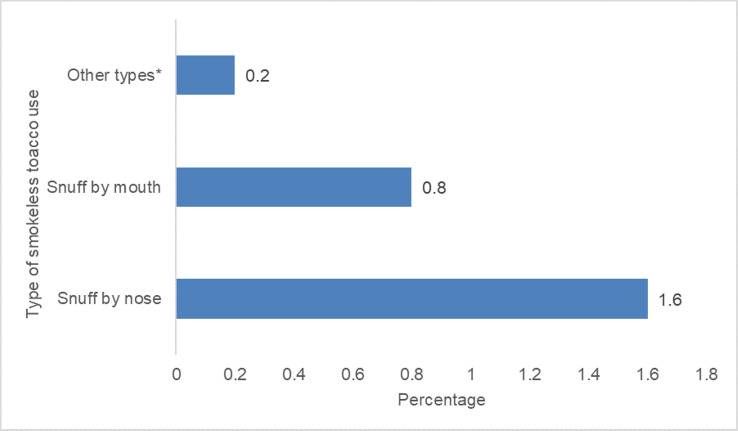
Introduction: The global tobacco epidemic contributes to more than 8 million deaths annually. However, most tobacco control interventions have been driven by an emphasis on smoked tobacco. Globally and more so in Nigeria, less attention has been paid to the similarly harmful smokeless tobacco (SLT) whose use appeals to a different demography. We examined the prevalence, patterns of use and correlates of SLT in Nigerian adults to guide targeted control efforts. Methods: We conducted a secondary analysis of the 2012 Global Adult Tobacco Survey (GATS) data. We obtained data on 9,765 non-institutionalised adults aged 15 years and older. Variables included current SLT use, sociodemographic characteristics and perceived harm of SLT use. We used Chi-square test to examine associations and binary logistic regression to assess predictors of current SLT use. All analyses were conducted with sample-weighted data. Results: The prevalence of current SLT use was 1.9% of all adults. About 1.4% were daily users. The main types were snuff by nose (1.6%) and snuff by mouth (0.8%). There were higher odds of current SLT use for those in the South-East region (aOR = 13.99; 95% CI: 4.45–43.95), rural area residents (aOR = 1.56; 95% CI: 1.04–2.35), males (aOR = 4.43; 95% CI: 2.75–7.11), the 45–64 years age-group (aOR = 10.00; 95% CI: 4.12–24.29), those with no formal education (aOR = 2.67; 95% CI: 1.01–7.05), and those with no perception of harm from SLT use (aOR = 3.81, 95% CI: 2.61–5.56). Conclusion: The prevalence of SLT use among Nigerian adults was low with clearly identified predictors. While a majority were aware of harm from SLT use, an unacceptably high proportion remain unaware. We recommended targeted interventions to increase awareness of the harmful effects of SLT use especially among residents of the South-East, those in rural areas, males, and individuals with no formal education. We also recommended a follow-up survey.
Overview
The claims and statistics of this paper haven’t been checked yet.
Free: it reads the open-access text and checks the first 5 claims that cite a source we can check. Create a free account to check every claim.
Integrity signals
Registry
Cites
Statistics
Figures
Verification
Claims the paper makes
The claims and statistics of this paper haven’t been checked yet.
Free: it reads the open-access text and checks the first 5 claims that cite a source we can check. Create a free account to check every claim.
Claims other papers make about this one
Each is checked against this paper’s own text: does it say what the citing paper says it does?
The source backs part of the claim, not all of it — or backs it for a different population, condition or comparison.
In the citing paper
“This finding is supported by the Global Adult Tobacco Survey (GATS) conducted in Nigeria, which reported a prevalence of 10.1% for current tobacco smoking among adults [48].”
From Prevalence and patterns of substance use in West Africa: A systematic review and meta-analysis (2024) · cites this paper as [48]
Experimental — accuracy not yet measured
Self-check
Percentages, sums and reported differences re-computed from the paper’s own numbers.
The self-check needs the paper’s full text.
Citations
Cites
International Agency for Research on Cancer
National Cancer Institute (2020) · Definitions · doi:10.32388/pfg7jq · Cited by 9,435
Nigeria Demographic and Health Survey 2008
Macro, I. (2009) · Cited by 2,063
Shibuya, K., Ciecierski, C., Guindon, E., Bettcher, D. W., Evans, D. B., & Murray, C. J. L. (2003) · BMJ · doi:10.1136/bmj.327.7407.154 · Cited by 1,239
Personal habits and indoor combustions.
(2012) · PubMed Central · Cited by 775
Smokeless tobacco and some tobacco-specific N-nitrosamines.
(2007) · PubMed Central · Cited by 517
Ellard, D. R., Thorogood, M., Underwood, M., Seale, C., & Taylor, S. J. (2014) · BMC Medicine · doi:10.1186/1741-7015-12-1 · Cited by 256
Singh, A., & Ladusingh, L. (2014) · PLoS ONE · doi:10.1371/journal.pone.0114073 · Cited by 201 · cited 1×
“Regional differences have been shown in other countries [16, 33], but since this is the first detailed national-level study of SLT use in Nigeria, there are no similar study results to compare it to.”
ResultSreeramareddy, C. T., Pradhan, P. M. S., Mir, I. A., & Sin, S. (2014) · Population Health Metrics · doi:10.1186/s12963-014-0022-0 · Cited by 198 · cited 1×
“Our findings are also consistent with a widely documented [7, 14, 15] inverse relationship between educational attainment and SLT use.”
ResultSmokeless tobacco and public health : a global perspective
Hatsukami, D. K., Zeller, M., Gupta, P. C., Parascandola, M. J., & Asma, S. (2014) · Cited by 179
WHO: Framework Convention on Tobacco Control 2003
(2005) · International Documents on Corporate Responsibility · doi:10.4337/9781845428297.00140 · Cited by 146
Research works printed but not linked: 3
- World Health Organisation (WHO). WHO Report on the global Tobacco epidemic, 2019: Offer help to quit tobacco use. Geneva, Switzerland; 2019.
- World Health Organisation (WHO). WHO global report on trends in prevalence of tobacco use 2000–2025, third edition. Geneva, Switzerland; 2019.
- Hau K, Olsheski K, Katwala P, Wiley R. Oral and Systemic Effects of Smokeless Tobacco from the African, Asian, Latin American, European, and Middle Eastern Regions. J Dent Oral Heal. 2017; 3(1): 1– 6.
Cited by
Gupta, A., Kanaan, M. N., Siddiqi, K., Sinha, D. N., & Mehrotra, R. (2022) · Cancer Prevention Research · doi:10.1158/1940-6207.capr-21-0567 · Cited by 55
Prevalence and patterns of substance use in West Africa: A systematic review and meta-analysis
Emmanuel, G. O., Akinsolu, F. T., Abodunrin, O. R., & Ezechi, O. C. (2024) · PLOS Global Public Health · doi:10.1371/journal.pgph.0004019 · Cited by 24
Zubair, F., Husnain, M. I. U., Zhao, T., Ahmad, H., & Khanam, R. (2022) · BMC Public Health · doi:10.1186/s12889-022-13574-2 · Cited by 39
Need for Gender Focused Policies Addressing Smokeless Tobacco Use among Women in India: A Review
Radhika, A. G., Preetha, G. S., & Neogi, S. B. (2021) · Asian Pacific Journal of Cancer Prevention · doi:10.31557/apjcp.2021.22.s2.7 · Cited by 16
“The deleterious effects of SLT have been well documented, however it has received much less attention in policies or programmes (Onoh et al., 2021).”
BackgroundInfluentialOgbodo, S. C., & Onyekwum, C. A. (2023) · Journal of Public Health · doi:10.1007/s10389-023-01882-9 · Cited by 13
“In SSA, national and regional studies among adults in Nigeria (Onoh et al. 2021), Uganda (Basaza et al. 2017), South Africa (Peltzer 2001), Ghana (Yawson et al. 2013), Gambia (Cham et al. 2019), and Ethiopia (Lakew and Haile 2015) have found significantly higher odds of tobacco use among men, the…”
InfluentialBasu, S., Maheshwari, V., Malik, M., Chowdhury, S. S. A., & Kundu, S. (2024) · Journal of Public Health · doi:10.1007/s10389-024-02200-7 · Cited by 8
“…in the body, resulting in oropharyngeal, esophageal, and pancreatic cancers; pre-malignant and malignant lesions in the oral cavity; DM; cardiovascular diseases; osteopenia; mental illness; low birth weight; pre-term births; small for gestational age babies and stillbirths (Onoh et al. 2021).”
Melaku, M. S., Baykemagn, N. D., Yohannes, L., & Zegeye, A. (2025) · Scientific Reports · doi:10.1038/s41598-025-09380-6 · Cited by 3
Non-cigarette Tobacco Use and Stroke Among West Africans: Evidence From the SIREN Study
Fakunle, A. G., Okekunle, A. P., Asowata, O. J., Akpa, O. M., Sarfo, F. S., Akpalu, A. K., Wahab, K., Obiako, R., Komolafe, M. A., Owolabi, L. F., et al. (2023) · Nicotine & Tobacco Research · doi:10.1093/ntr/ntad239 · Cited by 2
Exploring factors associated with the use of tobacco and smokeless tobacco in Timor-Leste
Foon, L. W., & Cheah, Y. K. (2021) · Journal of Substance Use · doi:10.1080/14659891.2021.1952491 · Cited by 1
“These variables were selected in light of the findings of previous studies related to tobacco and smokeless tobacco consumption (Bilgic et al., 2010; Cheah et al., 2019; Cheah & Naidu, 2012; Gupta et al., 2020; Islam et al., 2020; Lim et al., 2013; Lin, 2010; Masjedi et al., 2020; Onoh et al., 2021; Sreeramareddy et a…”
BackgroundMethodResultInfluentialAns, M., Abbas, S., Ali, K., Sana, A., Shahid, S., & Bibi, A. (2023) · Science Journal of Public Health · doi:10.11648/j.sjph.20231103.14
“…Tobacco” [14], study carried out by Ikenna Onoh, et al about “the Prevalence, patterns and correlates of smokeless tobacco use in Nigerian adults” [10] and the study conducted by Sreeramareddy et al. about: “Smoking and smokeless tobacco use in nine South and Southeast Asian countries” [4].”
BackgroundResultImpact of Smokeless Tobacco on Cardiovascular Disease Risk in a Nigerian Metropolitan City
Oguanobi, N. I., Chijioke, C. P., Ghasi, S. I., Nubila, N. I., Nwoke, O. C., & Okolo, C. C. (2024) · Cardiovascular Toxicology · doi:10.1007/s12012-024-09862-5 · Cited by 2
“These smokeless tobacco products are manufactured through a wide variety of processes that usually involve blending and addition of several chemical agents [10, 11].”
InfluentialSnuff use: Motivations, tips to quit, and readiness to quit in a South African township
Bongongo, T., Jeewa, Y., Govender, I., Nzaumvila, D. K., Okeke, S. O., & Steyn, C. (2024) · Journal of the Colleges of Medicine of South Africa · doi:10.4102/jcmsa.v2i1.70
Senthilkumar, S., Subramanian, S. S., Thangavel, L., Noah, Ganesan, P., Jannani., T. P., & Greeshma.D (2025) · doi:10.56984/8zg00e163gk
The Burden and Factors Associated With Smokeless Tobacco Use Among Adults in Nikki, Benin
Efio, M., Adè, S., Babio, I. A., Togan, R. M., & Harries, A. D. (2025) · Tobacco Use Insights · doi:10.1177/1179173x251377631
“For instance, Zhao et al 16 and Onoh et al 17 in their studies considered current users to be those using SLT at the time of the survey.”
InfluentialZubair, F., Husnain, M. I. U., Zhao, T., Ahmad, H., & Khanam, R. (2022) · Figshare · doi:10.6084/m9.figshare.20012892
Yohannes, L., Sharew, B., Alhur, A., & Melaku, M. S. (2026) · BMC Public Health · doi:10.1186/s12889-026-27758-7
“In SSA, tobacco use varies widely across countries and cultures, with a range of products including cigarettes, pipes, chewing tobacco, snuff (nasal and oral), kreteks, cigars, cheroots, cigarillos, and water pipes [18].”
Smoking and selected social problems among household heads in Jos Nigeria
Uchendu, O. C., Daloek, K. N., & Oyewole, E. A. (2026) · Discover Public Health · doi:10.1186/s12982-026-02221-5
“The Global Adult Tobacco Survey (GATS) had been established to have high survey reliability through high response rates of 90.3% (household) and 98.6% (individual), suitable for this context [35].”
Influential
Metadata
- Authors
- Onoh, I., Owopetu, O., Olorukooba, A. A., Umeokonkwo, C. D., Dahiru, T., & Balogun, M. S.
- Affiliations
- African Field Epidemiology Network (NG)
- University College Hospital, Ibadan (NG)
- Ahmadu Bello University (NG)
- Federal Teaching Hospital Abakaliki (NG)
- Corresponding author
- Onoh, Ikenna
- ORCID
- Venue
- PLOS ONE
- Publisher
- Public Library of Science (PLoS)
- Published
- 2021-01-06
- Volume
- 16
- Issue
- 1
- Pages
- e0245114
- ISSN
- 1932-6203 (ISSN-L)
- PMC
- PMC7787524
- OpenAlex
- W3119335223
- Cited by
- 17
- References
- 27
- Citations by year
- 2026: 2 · 2025: 3 · 2024: 4 · 2023: 3 · 2022: 3 · 2021: 2
- FWCI
- 1.89
- Type
- journal article
- Language
- en
- Open access
- gold
- doi.org
- Licence
- Locations
- PLoS ONE (publishedVersion, cc-by)
- PubMed Central (publishedVersion, cc-by)
- PubMed (publishedVersion)
- RePEc: Research Papers in Economics (submittedVersion)
- DOAJ (DOAJ: Directory of Open Access Journals) (submittedVersion, cc-by-sa)
- Topics
- Health Sciences › Medicine › Public Health, Environmental and Occupational Health › Smoking Behavior and Cessation
- Health Sciences › Medicine › Public Health, Environmental and Occupational Health › Global Public Health Policies and Epidemiology
- Health Sciences › Medicine › Oncology › Global Cancer Incidence and Screening
- Keywords
- smokeless tobacco, snuff, tobacco use prevalence, tobacco control, urban-rural differences, educational attainment, sex differences, regional disparities, Nigeria, Global Adult Tobacco Survey, oral cancer risk, oral submucous fibrosis, oral lichen planus, oral leukoplakia, oral cancer
- MeSH terms
- Adolescent, Adult, Aged, Female, Humans, Male, Middle Aged, Nigeria, Tobacco, Smokeless, Prevalence, Tobacco Use
About these checks
Registry, retraction, Cites and statistics results are computed, not judged, with one exception: a printed reference that no index lists is read once by a model before it counts as a citation error. Claims are extracted by a model and kept only when their quote appears verbatim in the text; each cited source is then checked, with a model’s help, for whether it says what the claim relies on. Those verdicts can be wrong — read the claim’s quote and the cited source before relying on one.
Statistics and arithmetic are recomputed, not judged.
Confidence bands are shown only for fields calibrated on our annotated test set. None is calibrated yet, so no band is shown.
What counts as a claim ›How we measure confidence ›How we check this ›
Are you an author, or do you see a problem with this page? Request a review
Data sources
Bibliographic data: Semantic Scholar, OpenAlex, Crossref.
Contains information from the Semantic Scholar Academic Graph Datasets, made available under the ODC Attribution License (ODC-BY 1.0).
Semantic Scholar’s data is described in: Kinney, R., et al. (2023). The Semantic Scholar Open Data Platform. arXiv:2301.10140.
