

The effectiveness of behaviour change interventions delivered by non-dental health workers in promoting children’s oral health: A systematic review and meta-analysis
Open accessThe DOI matches its Crossref record; 86 of the 86 references it cites were found in a registry or an index.
Abstract
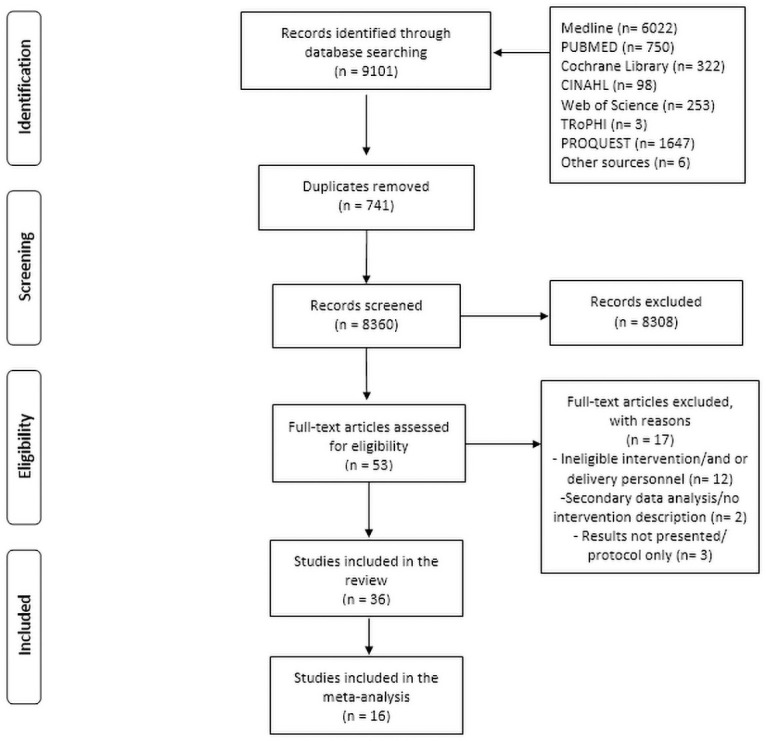
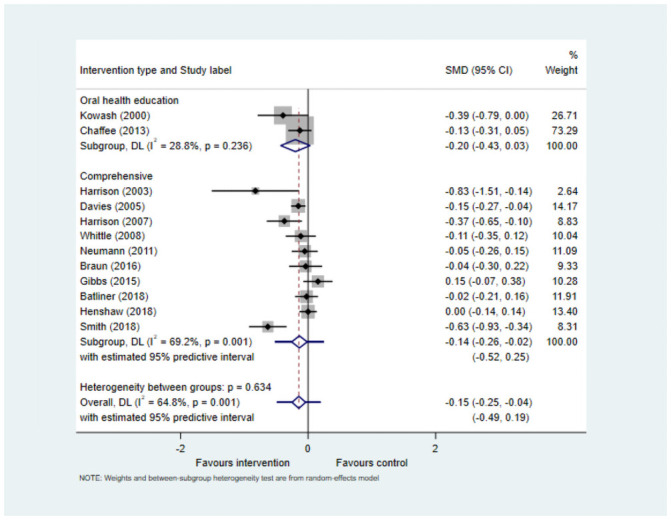
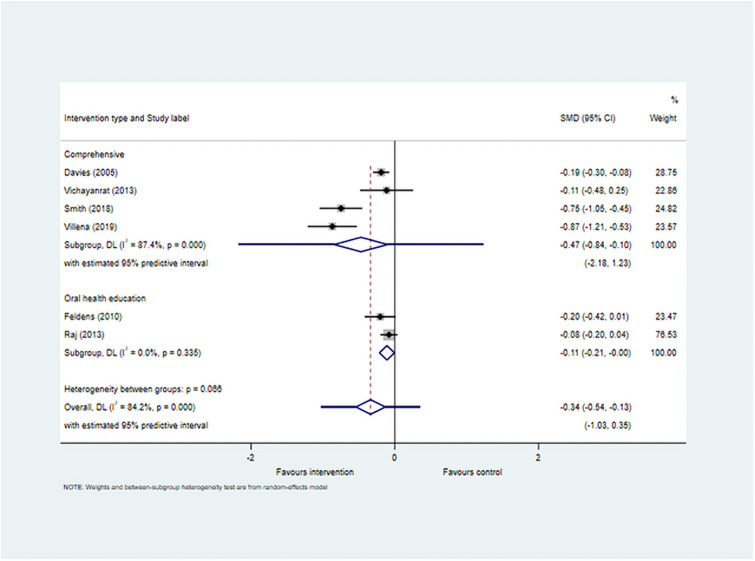
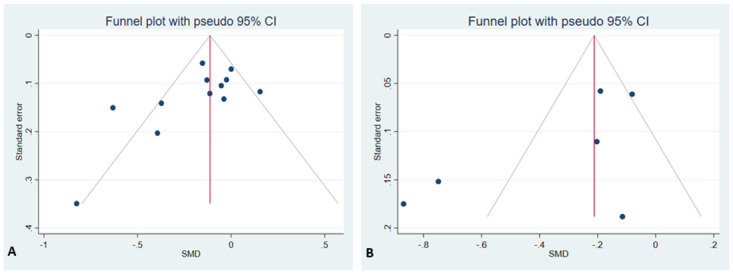
Objectives: Dental caries is the most common preventable childhood condition. Non-dental professionals and health workers are often well placed to support parents in adopting positive oral health behaviours for their children. The aim of this study was to determine the effectiveness of behaviour change interventions and their individual component behaviour change techniques (BCTs), that were delivered by non-dental professionals and health workers. Methods: A systematic search of Ovid MEDLINE, PubMed, CINAHL, Cochrane Library, Web of Science, TRoPHI and PROQUEST from inception until March 2021 was conducted. Randomised controlled trials and quasi-experimental studies for improving oral health outcomes in children were included. Quality assessment was carried out using Cochrane Risk of Bias tool and ROBINS-I tool. Publication bias was assessed using funnel plots and Egger’s regression intercept. Effect sizes were estimated as standardised mean difference (SMD) and odds ratio/risk ratio for proportions. Meta-analyses were performed for studies reporting mean decayed, missing, filled surfaces (dmfs) and mean decayed, missing, filled, teeth (dmft) indices. Behaviour change technique coding was performed using behaviour change technique taxonomy v1 (BCTTv1). Results: Out of the 9,101 records retrieved, 36 studies were included with 28 showing a significant effect either in clinical and/or behavioural/knowledge outcomes. Most studies (n = 21) were of poor methodological quality. The pooled SMD for caries experience showed statistically significant result for caries prevention at surface level -0.15 (95% CI -0.25, -0.04) and at the tooth level -0.24 (95% CI -0.42, -0.07). In 28 effective interventions, 27 individual BCTs were identified and the most frequently used were: “Instructions on how to perform the behaviour” and “Information about health consequences” . Conclusion: There is low quality of evidence suggesting non-dental professionals and health workers may help improve oral health outcomes for children. To confirm these findings, further high-quality studies incorporating a variety of BCTs in their interventions for adoption of good oral health behaviours are needed.
Overview
The claims and statistics of this paper haven’t been checked yet.
Free: it reads the open-access text and checks the first 5 claims that cite a source we can check. Create a free account to check every claim.
Integrity signals
Registry
Cites
Statistics
Figures
Verification
Claims the paper makes
The claims and statistics of this paper haven’t been checked yet.
Free: it reads the open-access text and checks the first 5 claims that cite a source we can check. Create a free account to check every claim.
Claims other papers make about this one
Each is checked against this paper’s own text: does it say what the citing paper says it does?
The source backs part of the claim, not all of it — or backs it for a different population, condition or comparison.
In the citing paper
“This study also did not seek to alter other oral hygiene practices, which likely led to a more real-world implementation of novel dentifrice use that better approximates the behavior patterns of patients, who may be unlikely to substantively change oral home care routines in the long term without ongoing intensive interventions.52,53”
From Better living through chemistry? A randomized, double-blind controlled study evaluating the efficacy of plaque control and gingival health impacts of a novel stannous fluoride-containing gel (2023) · cites this paper as [52]
Experimental — accuracy not yet measured
Self-check
Percentages, sums and reported differences re-computed from the paper’s own numbers.
The self-check needs the paper’s full text.
Citations
Cites
Statistical Power Analysis for the Behavioral Sciences
Muller, K. (1989) · Technometrics · doi:10.1080/00401706.1989.10488618 · Cited by 99,167
Bias in meta-analysis detected by a simple, graphical test
Egger, M., Smith, G. D., Schneider, M., & Minder, C. (1997) · BMJ · doi:10.1136/bmj.315.7109.629 · Cited by 56,722
The Cochrane Collaboration's tool for assessing risk of bias in randomised trials
Higgins, J. P. T., Altman, D. G., Gotzsche, P. C., Juni, P., Moher, D., Oxman, A. D., Savovic, J., Schulz, K. F., Weeks, L., Sterne, J. A. C., et al. (2011) · BMJ · doi:10.1136/bmj.d5928 · Cited by 33,817
Dermyshi, E., Wang, Y., Yan, C., Hong, W., Qiu, G., Gong, X., & Zhang, T. (2017) · Neonatology · doi:10.1159/000454668 · Cited by 24,451
ROBINS-I: a tool for assessing risk of bias in non-randomised studies of interventions
Sterne, J. A., Hernán, M. A., Reeves, B. C., Savović, J., Berkman, N. D., Viswanathan, M., Henry, D., Altman, D. G., Ansari, M. T., Boutron, I., et al. (2016) · BMJ · doi:10.1136/bmj.i4919 · Cited by 20,329 · cited 1×
“The risk of bias in non-randomised studies-of intervention (ROBINS-I) tool was used for quasiexperiments’ assessment on four domains: confounding bias, selection bias, information bias and reporting bias [31].”
MethodDeveloping and evaluating complex interventions: the new Medical Research Council guidance
Craig, P., Dieppe, P., Macintyre, S., Michie, S., Nazareth, I., & Petticrew, M. (2008) · BMJ · doi:10.1136/bmj.a1655 · Cited by 10,995
Hoffmann, T. C., Glasziou, P. P., Boutron, I., Milne, R., Perera, R., Moher, D., Altman, D. G., Barbour, V., Macdonald, H., Johnston, M., et al. (2014) · BMJ · doi:10.1136/bmj.g1687 · Cited by 10,548 · cited 1×
“For each study, data was extracted for: the study title, design, setting, eligibility criteria of participants, sample size, and baseline characteristics of participants and intervention details based on the template for intervention description and replication (TIDieR) checklist [29].”
MethodMichie, S., Richardson, M., Johnston, M., Abraham, C., Francis, J., Hardeman, W., Eccles, M. P., Cane, J., & Wood, C. E. (2013) · Annals of Behavioral Medicine · doi:10.1007/s12160-013-9486-6 · Cited by 7,629 · cited 5×
“Use of BCTTv1 taxonomy and coding guidelines ensured systematic and consistent coding of intervention descriptions.”
MethodInfluentialA basic introduction to fixed-effect and random-effects models for meta-analysis
Borenstein, M., Hedges, L. V., Higgins, J. P. T., & Rothstein, H. R. (2010) · Research Synthesis Methods · doi:10.1002/jrsm.12 · Cited by 6,793
Plea for routinely presenting prediction intervals in meta-analysis.
IntHout, J., Ioannidis, J. P. A., Rovers, M. M., & Goeman, J. J. (2016) · BMJ Open · doi:10.1136/bmjopen-2015-010247 · Cited by 2,264
Research works printed but not linked: 1
- Petersen P, Kwan S. The 7(th) WHO Global Conference on Health Promotion-towards integration of oral health (Nairobi, Kenya 2009). Community dental health. 2010; 27.
Cited by
Fisher, J., Berman, R., Buse, K., Doll, B. A., Glick, M., Metzl, J. M., & Touger-Decker, R. E. (2023) · NAM Perspectives · doi:10.31478/202302b · Cited by 86
Cost-effectiveness of dental caries prevention strategies in South African schools
Boachie, M. K., Molete, M. M., Hofman, K. J., & Thsehla, E. (2023) · BMC Oral Health · doi:10.1186/s12903-023-03474-1 · Cited by 25
Foláyan, M. O., Ishola, A. G., Abodunrin, O. R., Ndembi, N., & Tantawi, M. E. (2025) · Frontiers in Oral Health · doi:10.3389/froh.2025.1546747 · Cited by 19
The role of community health workers in promoting oral health at school settings: A scoping review
Molete, M. M., Malele‐Kolisa, Y., Thekiso, M. D., Lang, A. Y., Kong, A., & George, A. (2024) · Journal of Public Health Dentistry · doi:10.1111/jphd.12612 · Cited by 20
The Public Health Approach to Oral Health: A Literature Review
Cabrera, M., Bedi, R., & Lomazzi, M. (2024) · Oral · doi:10.3390/oral4020019 · Cited by 16
“Non-dental health workers in school-and community-based interventions targeting adolescents and children have shown promise [18,33].”
BackgroundWang, L., Gao, H., Chen, J., Shi, Y., Ma, D., Fan, J., & Xia, X. (2025) · BMJ Open · doi:10.1136/bmjopen-2024-089404 · Cited by 9
Taheri, A. M., Hidarnia, A. A., Zarei, F., & Tavousi, M. (2025) · Frontiers in Oral Health · doi:10.3389/froh.2025.1533519 · Cited by 8
Factors predicting oral health behaviors among students age 13–15 years in Shushtar city, Iran
Marashi, S. Z., Hidarnia, A. A., Kazemi, S. S., & Zarei, F. (2023) · BMC Oral Health · doi:10.1186/s12903-023-03363-7 · Cited by 6
Takesh, T., Goshtasbi, A., Lin, K., Yang, S. M., Wink, C., Geisinger, M. L., & Wilder‐Smith, P. (2023) · Journal of Periodontology · doi:10.1002/jper.22-0254 · Cited by 4
Balla, S. B., Angelakopoulos, N., Tadakamadla, J., & Tadakamadla, S. K. (2024) · Journal of Immigrant and Minority Health · doi:10.1007/s10903-024-01650-1 · Cited by 7
Geisinger, M. L., Geurs, N. C., Novy, B., Otomo‐Corgel, J., Cobb, C. M., Jacobsen, P. L., Takesh, T., & Wilder‐Smith, P. (2023) · Journal of Periodontology · doi:10.1002/jper.22-0675 · Cited by 3
Optimizing mHealth Interventions for Children’s Oral Hygiene: A Factorial Trial
Ihab, M., Elsherif, Y., Yassin, R., Nabil, N., Quritum, M., Balbaa, N. M., & Tantawi, M. E. (2024) · Journal of Dental Research · doi:10.1177/00220345241291985 · Cited by 3
“However, oral health education interventions often suffer from poor reporting of theoretical bases and limited assessment of intervention fidelity (Faisal et al. 2022), underscoring the need for evidence-based interventions.”
Kuppusamy, K., Murugappan, S., Kumar, R. S., Hebbal, M. I., & Kangusamy, B. (2024) · Special Care in Dentistry · doi:10.1111/scd.13092 · Cited by 3
Nzabonimana, E., Malele‐Kolisa, Y., & Hlongwa, P. (2024) · PLoS ONE · doi:10.1371/journal.pone.0309127 · Cited by 4
Tse, M. N., Coxon, K., Chandio, N., Nair, S., George, A., Bye, R. A., Wong, G. K. M., Tran, C., OʼReilly, M., Ekanayake, K., et al. (2025) · Healthcare · doi:10.3390/healthcare13040416 · Cited by 2
“The World Health Organization’s (WHO) Global Oral Health Strategy (2024–2030) emphasizes the importance of interdisciplinary approaches to improving access to oral health services, reducing health inequities, and integrating oral health into universal health coverage (UHC) frameworks [18,21,22].”
Eriksson, L., Olsson, K., Hasson, H., Bergström, A., Costea, V.-A., Holm, E., & Bäck, A. (2026) · BMC Family Practice · doi:10.1186/s12875-026-03337-y · Cited by 2
Thapa, P. P. (2024) · Advances in medical technologies and clinical practice book series · doi:10.4018/979-8-3693-3872-8.ch008 · Cited by 7
Sánchez, M. M. C., & Sáenz, J. R. V. (2024) · Universitas Odontologica · doi:10.11144/javeriana.uo43.ckoh · Cited by 3
Rana, K., Ekanayake, K., Chimoriya, R., Palu, E., Do, L., Silva, M., Tadakamadla, S. K., Bhole, S., Leshargie, C. T., Wen, L. M., et al. (2022) · doi:10.57022/oiik8302 · Cited by 2
Silva, G. A. O., Besseler, M. D. O., Pedrón, I. G., Shitsuka, C., & Cordeschi, T. (2023) · E-Acadêmica · doi:10.52076/eacad-v4i2.500
(2023) · Journal of Nursing & Healthcare · doi:10.33140/jnh.08.04.03
Wainukaeo, Y., Tanthanapanyakorn, P., Thawronsuk, S., Tamtakhob, K., Intra, I., Khantikulanon, N., Praserttai, C., Mungkhunthod, S., & Weschasat, T. (2025) · Malaysian Journal of Medicine and Health Sciences · doi:10.47836/mjmhs.21.1.27
Boachie, M. K., Molete, M. M., Hofman, K., & Thsehla, E. (2024) · Figshare · doi:10.6084/m9.figshare.26633643
Universidad, C. E. S., Zuluaga, M. C. G., Lopera-Escobar, A., Universidad, C. E. S., Sepúlveda-Drosos, L. D., & Universidad, C. E. S. (2025) · Revista Facultad de Odontología Universidad de Antioquia · doi:10.17533/udea.rfo.v37n1e359961
Yasuoka, J., Okada, S., & Takeshita, Y. (2026) · BMC Public Health · doi:10.1186/s12889-026-27276-6 · Cited by 2
“Although several reviews have examined CHW-supported oral health promotion, most have focused on high-income countries such as the United States, Canada, and Australia [20–22], providing comparatively little coverage of the unique challenges and opportunities in resource-limited contexts.”
Madden, A. M., Fallaize, R., Nowson, G. K., Satoh, S., & Chadwick, P. (2026) · Journal of Human Nutrition and Dietetics · doi:10.1111/jhn.70285
“The BCTTv1 taxonomy [13] describes 93 BCTs in a structured, hierarchical classification and, since its publication, has been used in systematic reviews to identify BCTs used in effective health interventions [15–17].”
Chen, R., Irving, M. J., Kumar, H., Prabhu, N. T., Christian, B., Sohn, W., Spallek, H., Marschner, S. L., & Chow, C. K. (2026) · JMIR mhealth and uhealth · doi:10.2196/91720
The Positive Impact of School Dental Prevention Programs: A Systematic Review and Meta-Analysis
Tábi, D., Mlinkó, É., Cavalcante, B. G. N., Uhrin, E., Nagy, R., Szabó, B., Hegyi, P., Varga, G., & Németh, O. (2026) · Health Education & Behavior · doi:10.1177/10901981261474902
Metadata
- Authors
- Faisal, M. R., Mishu, M. P., Jahangir, F., Younes, S., Dogar, O., Siddiqi, K., & Torgerson, D. J.
- Affiliations
- University of York (GB)
- University of Lancashire (GB)
- Corresponding author
- Faisal, Mehreen Riaz
- Venue
- PLOS ONE
- Publisher
- Public Library of Science (PLoS)
- Published
- 2022-01-11
- Volume
- 17
- Issue
- 1
- Pages
- e0262118
- ISSN
- 1932-6203 (ISSN-L)
- PMC
- PMC8751985
- OpenAlex
- W4206424918
- Cited by
- 28
- References
- 85
- Citations by year
- 2026: 5 · 2025: 6 · 2024: 9 · 2023: 6 · 2022: 2
- FWCI
- 1.07
- Type
- journal article
- Language
- en
- Open access
- gold
- doi.org
- Licence
- Locations
- PLoS ONE (publishedVersion, cc-by)
- PubMed Central (publishedVersion, cc-by)
- PubMed (publishedVersion)
- CLOK (University of Central Lancashire) (acceptedVersion)
- RePEc: Research Papers in Economics (submittedVersion)
- DOAJ (DOAJ: Directory of Open Access Journals) (submittedVersion, cc-by-sa)
- Topics
- Health Sciences › Dentistry › General Dentistry › Dental Health and Care Utilization
- Social Sciences › Psychology › Applied Psychology › Behavioral Health and Interventions
- Health Sciences › Dentistry › Periodontics › Oral microbiology and periodontitis research
- Keywords
- behaviour change interventions, children's oral health, dental caries prevention, behaviour change techniques, DMFS index, DMFT index, caries experience, parental involvement, oral health behavior
- MeSH terms
- Child Health, Child, Dental Caries, Health Education, Dental, Health Personnel, Health Promotion, Humans, Oral Health
About these checks
Registry, retraction, Cites and statistics results are computed, not judged, with one exception: a printed reference that no index lists is read once by a model before it counts as a citation error. Claims are extracted by a model and kept only when their quote appears verbatim in the text; each cited source is then checked, with a model’s help, for whether it says what the claim relies on. Those verdicts can be wrong — read the claim’s quote and the cited source before relying on one.
Statistics and arithmetic are recomputed, not judged.
Confidence bands are shown only for fields calibrated on our annotated test set. None is calibrated yet, so no band is shown.
What counts as a claim ›How we measure confidence ›How we check this ›
Are you an author, or do you see a problem with this page? Request a review
Data sources
Bibliographic data: Semantic Scholar, OpenAlex, Crossref.
Contains information from the Semantic Scholar Academic Graph Datasets, made available under the ODC Attribution License (ODC-BY 1.0).
Semantic Scholar’s data is described in: Kinney, R., et al. (2023). The Semantic Scholar Open Data Platform. arXiv:2301.10140.
