

The DOI matches its Crossref record.
Factors associated with female age at first marriage: An analysis using all waves of the Pakistan Demographic and Health Survey
Open accessAbstract
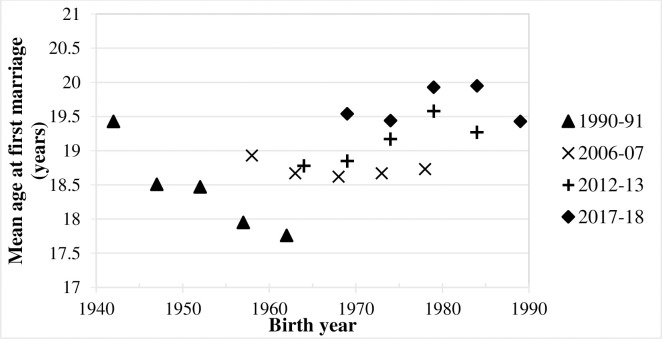
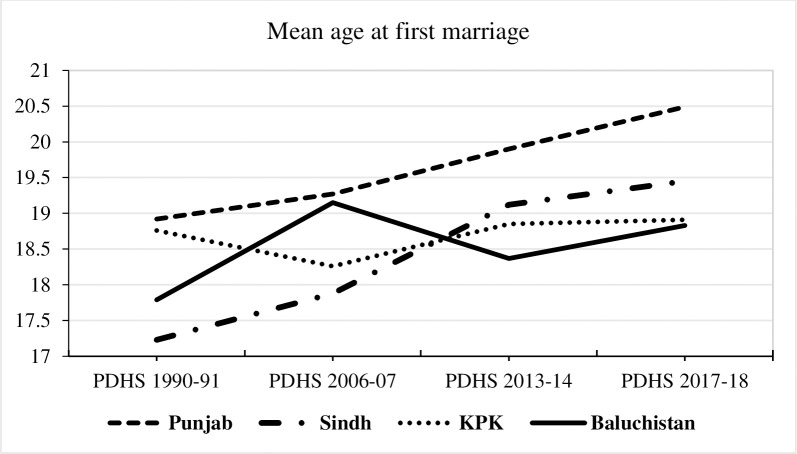
In conventional Muslim societies, fertility occurs within the marital union. Therefore, fertility outcomes depend on females’ age at first marriage (AFM). The present study explores the pattern of AFM in Pakistan, analyses of which are scarce in the literature. We aim to identify the factors associated with the AFM among currently married women in Pakistan. Demographic factors like birth cohort, and socioeconomic and cultural factors such as province and place of residence, education level, whether or not a woman had ever worked before marriage, ethnicity, and husband’s education were studied to explore the pattern of female AFM. Data were taken from the Pakistan Demographic and Health Surveys (PDHSs) of 2012–13 and 2017–18, and a comparison was made with the findings from the earlier PDHSs of 1990–91 and 2006–07. The analysis concentrates on women born between 1941 and 1992, aged between 25 and 49 years during the data collection periods. One-way analysis of variance (ANOVA) was used to assess the difference between the mean AFM for different sub-groups of the population. To identify the covariates that are associated with AFM multiple linear regression models were estimated. We observed a gradually increasing trend in female AFM over time among women born after 1950. The ANOVA results revealed that birth cohort, province, and place of residence, female education level, whether or not a woman had ever worked before marriage, ethnicity, and husband’s education were significantly associated with AFM ( p -values < 0.05). In a multiple regression model, we found that the birth cohort significantly affects the AFM ( p -value < 0.05). Having worked before marriage is associated with a statistically significant one-year rise in the AFM. Interestingly, all other ethnic groups have lower AFM compared with women whose mother language was Punjabi. Education has a highly significant effect on the AFM: the regression results revealed that uneducated females have a mean AFM 4 to 5 years lower than highly educated women. The results also revealed that educated men marry older women as compared to uneducated men. We conclude that the education of females and even males in Pakistan could lead to a rise in the female AFM.
Overview
The claims and statistics of this paper haven’t been checked yet.
Run the check — free, no account needed. It reads the open-access text and checks the sources it cites.
Integrity signals
Registry
Cites
Statistics
Figures
Verification
Claims the paper makes
The claims and statistics of this paper haven’t been checked yet.
Run the check — free, no account needed. It reads the open-access text and checks the sources it cites.
Self-check
Percentages, sums and reported differences re-computed from the paper’s own numbers.
The self-check needs the paper’s full text.
Citations
Cites
No references could be resolved yet.
Research works printed but not linked: 36
- RD Smith, 2019, Marital fertility patterns and nonmarital birth ratios: an integrated approach., Genus, 75, 9, 10.1186/s41118-019-0056-z · DOI
- M. Eslami, 2016, Decreasing Total Fertility Rate in Developing Countries., J Family Reprod Health., 10, 163
- M Kaboudi, 2013, Relationship between Age of Marriage, Womens Education and Fertility 1954–93: A Study in the West of Iran., Biosci, Biotechnol Res Asia., 10, 855, 10.13005/bbra/1207 · DOI
- P Ariho, 2020, Age at first marriage, age at first sex, family size preferences, contraception and change in fertility among women in Uganda: analysis of the 2006–2016 period., BMC Womens Health., 20, 10.1186/s12905-020-0881-4 · DOI
- MZ Nahar, 2013, Age at first marriage and its relation to fertility in Bangladesh., Chinese Journal of Population Resources and Environment, 11, 227, 10.1080/10042857.2013.835539 · DOI
- A. Harwood-Lejeune, 2001, Rising Age at Marriage and Fertility in Southern and Eastern Africa., European Journal of Population / Revue Européenne de Démographie., 17, 261, 10.1023/A:1011845127339 · DOI
- J Bongaarts, 1983, Fertility, biology, and behavior: An analysis of the proximate determinants
- AJ Coale, 1971, Age patterns of marriage., Population studies., 25, 193, 10.1080/00324728.1971.10405798 · DOI
- MA Islam, 2020, Age at first marriage and fertility in developing countries: A meta analytical view of 15 Demographic and Health Surveys., Clinical Epidemiology and Global Health, 8, 775, 10.1016/j.cegh.2020.01.018 · DOI
- AA Marphatia, 2017, Women’s marriage age matters for public health: a review of the broader health and social implications in South Asia., Frontiers in public health., 5, 269, 10.3389/fpubh.2017.00269 · DOI
- S Farooq, 1990, Trends Of Early Marriages In Pakistan; Quantitative Analysis Of Pakistan Demographic And Health Survey (Pakistan Health & Demographic Survey, 2006
- Nasir JA. Fertility transition in Pakistan: neglected dimensions and policy implications [PhD Thesis]: University of Southampton; 2013.
- S Aktar, 2017, Socio-economic determinants of age at first marriage of rural women: a statistical analysis, International Journal of Engineering and Computer Science, 6, 22255
- M Saadati, 2017, Determinants of Iranian youths’ marriage age: A parametric survival analysis approach., Social Determinants of Health, 3, 177
- O Faroque, 2016, Demographic and socio-economic determinants of age at first marriage of women in Bangladesh: An analysis., Advances in Social Psychology, 1, 1
- MT Hossain, 2015, Modelling Age at First Marriage of Female Adolescents in Bangladesh., Asian Journal of Applied Sciences, 3
- L Gangadharan, 2003, The effect of education on the timing of marriage and first birth in Pakistan., Journal of Quantitative Economics, 1, 114, 10.1007/BF03404653 · DOI
- Das NP, Dey D. Das, NP; Dey, Devamoni.: Female Age at Marriage in India: Trends and Determinants. Demography India. 27 (1). Jan-June 1998.(Sp. Issue on the Golden Jublee Years of India’s Independence). p. 91–115. Demography India. 1998;27:1.
- AU Ahmed, 1986, Socioeconomic determinants of age at first marriage in Bangladesh, Journal of biosocial science, 18, 35, 10.1017/S0021932000006477 · DOI
- OJ Baruwa, Socio-demographic changes in age at first marriage in Malawi: evidence from Malawi Demographic and Health Survey data, 1992–2016., Journal of Biosocial Science, 2019, 1
- H Mahdaviazad, 2019, Trends in age at first marriage in women and related factors: A population-based study in southwestern Iran., Women & health., 59, 171, 10.1080/03630242.2018.1449776 · DOI
- B Tessema, 2015, Modeling the Determinants of Time-to-age at First Marriage in Ethiopian Women: A Comparison of Various Parametric Shared Frailty Models., Sci J Public Health., 3, 707, 10.11648/j.sjph.20150305.27 · DOI
- MYA Parh, 2015, Determine the Factors of Female Early Age at First Cohabitation: A Case Study of Bangladesh., Open Journal of Statistics, 5, 494, 10.4236/ojs.2015.56051 · DOI
- SA Adebowale, 2012, Survival analysis of timing of first marriage among women of reproductive age in Nigeria: regional differences., African journal of reproductive health, 16, 95
- ME Palamuleni, 2011, Socioeconomic determinants of age at marriage in Malawi., International Journal of Sociology and Anthropology, 3, 224
- TR Aryal, 2007, Age at first marriage in Nepal: differentials and determinants, Journal of Biosocial Science, 39, 693, 10.1017/S0021932006001775 · DOI
- A Schuster, 2021, Missing marriage: changing marriage patterns amid social transition in Myanmar., Asian Population Studies., 15, 1
- OI Adeniyi, 2014, Variation in Age at First Marriage among Women in Nigeria: A Multilevel Logistic Analysis., The J Math Theory and Modeling., 4, 121
- H. Booth, 2010, Ethnic differentials in the timing of family formation: A case study of the complex interaction between ethnicity, socioeconomic level, and marriage market pressure., DemRes., 23, 153, 10.4054/DemRes.2010.23.7 · DOI
- SMM Kamal, 2011, Socio-economic determinants of age at first marriage of the ethnic tribal women in Bangladesh., Asian Population Studies, 7, 69, 10.1080/17441730.2011.544906 · DOI
- M. Ezra, 2003, Factors associated with marriage and family formation processes in Southern Ethiopia., Journal of Comparative Family Studies, 34, 509, 10.3138/jcfs.34.4.509 · DOI
- RH Aryal, 1991, Socioeconomic and cultural differentials in age at marriage and the effect on fertility in Nepal, Journal of biosocial science, 23, 167, 10.1017/S0021932000019192 · DOI
- National Institute of Population Studies [Pakistan] and Macro International Inc, 1992, Pakistan Demographic and Health Survey 1990–91.
- National Institute of Population Studies [Pakistan] and Macro International Inc, 2008, Pakistan Demographic and Health Survey 2006–07.
- National Institute of Population Studies [Pakistan] and Macro International Inc., 2014, Pakistan Demographic and Health Survey 2012–13.
- National Institute of Population Studies [Pakistan] and Macro International Inc., 2019, Pakistan Demographic and Health Survey 2017–18
Cited by
Sorted by citations
Gelchu, S., & Wirtu, D. (2025) · Ethiopian Journal of Reproductive Health · doi:10.69614/ejrh.v17i01.846
Metadata
- Authors
- Rasul, A., Nasir, J. A., Akhtar, S., & Hinde, A.
- Affiliations
- Lahore College for Women University (PK)
- Government College University, Lahore (PK)
- University of Haripur (PK)
- University of Southampton (GB)
- Corresponding author
- Nasir, Jamal Abdul
- Venue
- PLOS ONE
- Publisher
- Public Library of Science (PLoS)
- Published
- 2022-03-15
- Volume
- 17
- Issue
- 3
- Pages
- e0264505
- ISSN
- 1932-6203 (ISSN-L)
- PMC
- PMC8923498
- OpenAlex
- W4221054938
- Cited by
- 14
- References
- 0
- Citations by year
- 2026: 2 · 2025: 4 · 2024: 5 · 2023: 1 · 2022: 2
- FWCI
- 4.32
- Type
- journal article
- Language
- en
- Open access
- gold
- doi.org
- Licence
- Locations
- PLoS ONE (publishedVersion, cc-by)
- PubMed Central (publishedVersion, cc-by)
- PubMed (publishedVersion)
- DOAJ (DOAJ: Directory of Open Access Journals) (submittedVersion, cc-by-sa)
- Greater South Information System
- Topics
- Social Sciences › Sociology and Political Science › Marriage and Family Dynamics
- Social Sciences › Demography › Family Dynamics and Relationships
- Social Sciences › Gender Studies › Demographic Trends and Gender Preferences
- Keywords
- age at marriage, birth cohort effects, women's education, husband education, ethnicity, Punjabi women, place of residence, provincial differences, fertility timing, Pakistan
- MeSH terms
- Adult, Age Factors, Aged, Educational Status, Female, Fertility, Humans, Male, Marriage, Middle Aged, Pakistan, Population Dynamics, Socioeconomic Factors
About these checks
Registry, retraction, Cites and statistics results are computed, not judged, with one exception: a printed reference that no index lists is read once by a model before it counts as a citation error. Claims are extracted by a model and kept only when their quote appears verbatim in the text; each cited source is then checked, with a model’s help, for whether it says what the claim relies on. Those verdicts can be wrong — read the claim’s quote and the cited source before relying on one.
Statistics and arithmetic are recomputed, not judged.
Confidence bands are shown only for fields calibrated on our annotated test set. None is calibrated yet, so no band is shown.
What counts as a claim ›How we measure confidence ›How we check this ›
Are you an author, or do you see a problem with this page? Request a review
