

Is biomass fuel smoke exposure associated with anemia in non-pregnant reproductive-aged women?
Open accessThe DOI matches its Crossref record; 13 of the 13 references it cites were found in a registry or an index.
Abstract
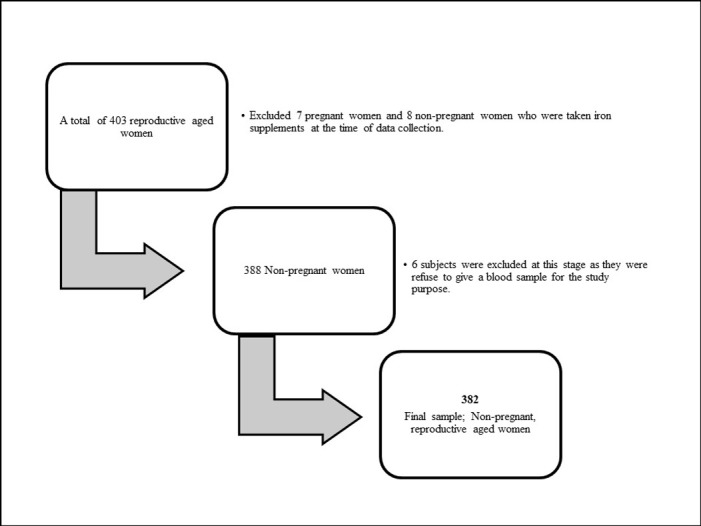
Objectives: Sri Lanka is a developing country where the majority of households still rely on firewood for cooking. Furthermore, the prevalence of anemia among reproductive-aged women is of moderate public health importance, according the classification of World Health Organization. Despite the researchers’ ongoing efforts to investigate a link between solid fuel smoke exposure and anemia, the veracity of their findings remains uncertain. As a result, the purpose of this study was to examine the relationship between biomass fuel smoke exposure and anemia in non-pregnant reproductive-aged women in Sri Lanka. Methods: A descriptive cross-sectional study was conducted among 382 non-pregnant reproductive-aged (15 to 49 years) women in Central Province, Sri Lanka. Data was collected using a standardized interviewer-administered questionnaire, and exposure was assessed using a breath carbon monoxide monitor. Drabkin’s cynomethhemoglobin technique was used to determine blood hemoglobin concentration. Results: The overall prevalence of anemia was 36.1%. The logistic regression model revealed no effect of cooking fuel type on anemic or non-anemic status after adjusting for potential confounding factors (p > 0.05). The multivariate regression analysis also discovered that cooking fuel type had no effect on women’s blood hemoglobin concentration. Conclusions: The study results suggest no impact of solid fuel smoke exposure on anemia among non-pregnant, reproductive-aged women. Larger scale prospective cohort studies are recommended. The reasons behind the high prevalence of anemia among reproductive-aged women should be further investigated, and corrective measures should be implemented urgently.
Overview
The claims and statistics of this paper haven’t been checked yet.
Free: it reads the open-access text and checks the first 5 claims that cite a source we can check. Create a free account to check every claim.
Integrity signals
Registry
Cites
Statistics
Figures
Verification
Claims the paper makes
The claims and statistics of this paper haven’t been checked yet.
Free: it reads the open-access text and checks the first 5 claims that cite a source we can check. Create a free account to check every claim.
Claims other papers make about this one
Each is checked against this paper’s own text: does it say what the citing paper says it does?
The cited source says what the claim attributes to it.
In the citing paper
“one survey conducted among nonpregnant women did not suggest any correlation between cooking fuel type and anemia or blood hemoglobin [55].”
From Environmental Contaminants, Iron Deficiency, and Iron‐Deficiency Anemia: A Review of the Literature (2025) · cites this paper as [55]
The cited source says what the claim attributes to it.
In the citing paper
“One found no association, and one found that hemoglobin was elevated [55, 56].”
From Environmental Contaminants, Iron Deficiency, and Iron‐Deficiency Anemia: A Review of the Literature (2025) · cites this paper as [55]
Self-check
Percentages, sums and reported differences re-computed from the paper’s own numbers.
The self-check needs the paper’s full text.
Citations
Cites
Weiss, G., & Goodnough, L. T. (2005) · New England Journal of Medicine · doi:10.1056/nejmra041809 · Cited by 3,800 · cited 1×
“Systemic inflammation, mediated by inflammatory cytokines such as tumor necrosis factor-alpha (TNF-α), interleukin-1 (IL-1), interleukin-6 (IL-6), and interferon- (IFN- γ), is a well-known cause of anemia [7].”
BackgroundWoodsmoke Health Effects: A Review
Naeher, L. P., Brauer, M., Lipsett, M., Zelikoff, J. T., Simpson, C. D., Koenig, J. Q., & Smith, K. R. (2007) · Inhalation Toxicology · doi:10.1080/08958370600985875 · Cited by 1,530
Blumenthal, I. (2001) · Journal of the Royal Society of Medicine · doi:10.1177/014107680109400604 · Cited by 223
Dutta, A., Ray, M. R., & Banerjee, A. (2012) · Toxicology and Applied Pharmacology · doi:10.1016/j.taap.2012.04.004 · Cited by 148
Scherer, G. (2006) · Experimental and Toxicologic Pathology · doi:10.1016/j.etp.2006.07.001 · Cited by 145
Effect of Intensity of Cigarette Smoking on Haematological and Lipid Parameters
Anandha Lakshmi, S. (2014) · JOURNAL OF CLINICAL AND DIAGNOSTIC RESEARCH · doi:10.7860/jcdr/2014/9545.4612 · Cited by 110
Whitehead, T. P., Robinson, D., Allaway, S. L., & HALE, A. C. (1995) · PubMed · Cited by 68
Smoking-a Major Cause of Polycythaemia
Aitchison, R., & Russell, N. (1988) · Journal of the Royal Society of Medicine · doi:10.1177/014107688808100212 · Cited by 54
Page, C. M., Patel, A., & Hibberd, P. L. (2015) · PLOS ONE · doi:10.1371/journal.pone.0127890 · Cited by 36
Amadu, I., Seidu, A.-A., Afitiri, A.-R., Ahinkorah, B. O., & Yaya, S. (2021) · BMJ Open · doi:10.1136/bmjopen-2021-048724 · Cited by 27
Cited by
Tirore, L. L., Areba, A. S., Habte, A., Desalegn, M., & Kebede, A. S. (2024) · Frontiers in Public Health · doi:10.3389/fpubh.2023.1349174 · Cited by 24
Exposure to air pollution as a risk factor for anaemia: a global scoping review
Khan, Y., & Banerjee, R. (2024) · International Journal of Environmental Health Research · doi:10.1080/09603123.2024.2327532 · Cited by 13
Adarkwa, S. A., Oduro, M. S., Morgan, A. K., & Arhin-Donkor, S. (2024) · Scientific Reports · doi:10.1038/s41598-024-66602-z · Cited by 11
Environmental Contaminants, Iron Deficiency, and Iron‐Deficiency Anemia: A Review of the Literature
Lichtler, R., & Cowley, M. (2025) · Scientifica · doi:10.1155/sci5/5007983 · Cited by 6
“However, one survey conducted among nonpregnant women did not suggest any correlation between cooking fuel type and anemia or blood hemoglobin [55].”
Assessing the impact of air pollution on anemia: a comprehensive review and meta-analysis
Dinh, C.-T., Lee, Y., Chang, L.-T., Chang, T.-Y., Chung, K. F., Lee, K.-Y., Chang, J., & Chuang, H. (2026) · Expert Review of Hematology · doi:10.1080/17474086.2026.2643325 · Cited by 4
Ruíz-Leyva, L., Salguero, A., Virgolini, M. B., Romero, V. L., Marengo, L., Fabio, M. C., Morón, I., Cendán, C. M., & Pautassi, R. M. (2022) · Drug and Alcohol Dependence · doi:10.1016/j.drugalcdep.2022.109737 · Cited by 4
Sinharoy, S. S., Ye, W., Pillarisetti, A., Pasricha, S., Thompson, L. M., Díaz-Artiga, A., Ramakrishnan, U., Rosa, G., Clark, M. L., Barr, D. B., et al. (2026) · Nature Communications · doi:10.1038/s41467-026-74114-9
Taye, E. A., Hailie, G. Y., & Kassaw, A. T. (2026) · Journal of Public Health Research · doi:10.1177/22799036261480284
Metadata
- Authors
- Pathirathna, M. L., Samarasekara, B. P. P., Mendis, C., Dematawewa, C. M. B., Sekijima, K., Sadakata, M., Muramatsu, Y., & Fujiwara, N.
- Affiliations
- University of Peradeniya (LK)
- Niigata University (JP)
- Corresponding author
- Pathirathna, Malshani Lakshika
- Venue
- PLOS ONE
- Publisher
- Public Library of Science (PLoS)
- Published
- 2022-08-19
- Volume
- 17
- Issue
- 8
- Pages
- e0272641
- ISSN
- 1932-6203 (ISSN-L)
- PMC
- PMC9390888
- OpenAlex
- W4292385863
- Cited by
- 6
- References
- 13
- Citations by year
- 2026: 1 · 2025: 1 · 2024: 3 · 2022: 1
- FWCI
- 0.30
- Type
- journal article
- Language
- en
- Open access
- gold
- doi.org
- Licence
- Locations
- PLoS ONE (publishedVersion, cc-by)
- PubMed Central (publishedVersion, cc-by)
- PubMed (publishedVersion)
- RePEc: Research Papers in Economics (submittedVersion)
- DOAJ (DOAJ: Directory of Open Access Journals) (submittedVersion, cc-by-sa)
- Funders
- University of Peradeniya (URG/2018/AHS/06)
- Topics
- Physical Sciences › Environmental Science › Pollution › Energy and Environment Impacts
- Health Sciences › Medicine › Hematology › Iron Metabolism and Disorders
- Physical Sciences › Environmental Science › Health, Toxicology and Mutagenesis › Air Quality and Health Impacts
- Keywords
- anemia, women of reproductive age, solid fuel cooking, firewood, hemoglobin levels, indoor air pollution, Sri Lanka
- MeSH terms
- Adult, Anemia, Cooking, Cross-Sectional Studies, Female, Hemoglobins, Humans, Prospective Studies, Smoke, Air Pollution, Indoor, Biomass
About these checks
Registry, retraction, Cites and statistics results are computed, not judged, with one exception: a printed reference that no index lists is read once by a model before it counts as a citation error. Claims are extracted by a model and kept only when their quote appears verbatim in the text; each cited source is then checked, with a model’s help, for whether it says what the claim relies on. Those verdicts can be wrong — read the claim’s quote and the cited source before relying on one.
Statistics and arithmetic are recomputed, not judged.
Confidence bands are shown only for fields calibrated on our annotated test set. None is calibrated yet, so no band is shown.
What counts as a claim ›How we measure confidence ›How we check this ›
Are you an author, or do you see a problem with this page? Request a review
Data sources
Bibliographic data: Semantic Scholar, OpenAlex, Crossref.
Contains information from the Semantic Scholar Academic Graph Datasets, made available under the ODC Attribution License (ODC-BY 1.0).
Semantic Scholar’s data is described in: Kinney, R., et al. (2023). The Semantic Scholar Open Data Platform. arXiv:2301.10140.
