

The DOI matches its Crossref record; 27 of the 27 references it cites were found in a registry or an index; none of the 44 sources its claims cite is checked for support yet.
Y-Chromosomal insights into the paternal genealogy of the Kerey tribe have called into question their descent from the Stepfather of Genghis Khan
Open accessAbstract
The Kerey is one of the prominent Kazakh tribes and has long been a subject of ethnographic scrutiny, with a lack of consensus on its origin and traditional genealogy. Their historical significance, intertwined with the emergence of the empire established by Genghis Khan, necessitates a comprehensive understanding of their genetic history. This study focuses on unraveling the genetic heritage of the Kerey tribe. We conducted a comprehensive analysis of Y-chromosome data from genetic genealogy as citizen science and genetic screening of 23 Y-STRs and 37 Y-SNPs on 207 males from the Kerey tribe within academic science. Our results reveal two prevalent phylogenetic lineages within the C2a1a3a-F3796 haplogroup, also known as the C2*-Star Cluster (C2*-ST), which is one of the founding paternal lineages of the ancient Niru’un clan of the Mongols: C2-FT411734 and C2-FT224144, corresponding to the Abak and Ashamaily clans. While indicating a common male ancestry for them, our findings challenge the notion that they are full siblings. Additionally, genetic diversity analysis of the Y-chromosomes in the Kerey tribe and Kazakhs confirms their kinship with the Uissun tribe but refutes the claim of the Abak clan’s progenitor originating from this tribe. Furthermore, genetic evidence fails to support popular historical and ethnographic hypotheses regarding the Kerey tribe’s kinship with the Uak, Sirgeli, Adai, Törtkara, Karakerey, and Kereyit Kazakh tribes. The absence of a genetic paternal connection with the Kereyt tribe raises doubts about the genealogical link between the Kerey tribe and the stepfather of Genghis Khan.
Overview
CoChat Summary
Written by AI from the paper’s full text.
TL;DR
Y-chromosome analysis of 207 Kerey tribe males identifies two prevalent paternal lineages, C2-FT411734 in the Abak clan and C2-FT224144 in the Ashamaily clan, indicating common ancestry but not full sibling status. The genetic evidence supports Kerey kinship with the Uissun tribe while refuting several ethnographic hypotheses, including descent from Genghis Khan’s stepfather.
Key findings
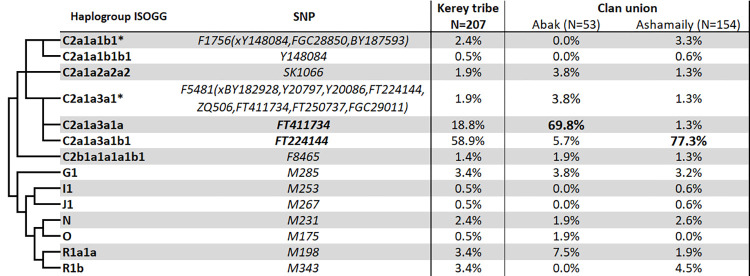
- Among 207 Kerey males, C2-M217 was the most prevalent haplogroup at 85.8%; the two dominant lineages within C2a1a3a-F3796/C2*-Star Cluster were C2-FT411734 in Abak (69.8%) and C2-FT224144 in Ashamaily (77.3%).
- TMRCA estimates were ~1337 CE (95% CI: 1072–1540 CE) for C2-FT411734 and ~1139 CE (95% CI: 845–1369 CE) for C2-FT224144, with a common ancestor C-F5481 around the mid-9th century, not supporting Abak and Ashamaily as brothers in traditional genealogy.
- Genetic diversity was low: 104 unique haplotypes among 207 males, HD = 0.068, DC = 50.2%, HMP = 0.096; rapid-mutating Y-STRs did not sufficiently differentiate lineages within Abak and Ashamaily.
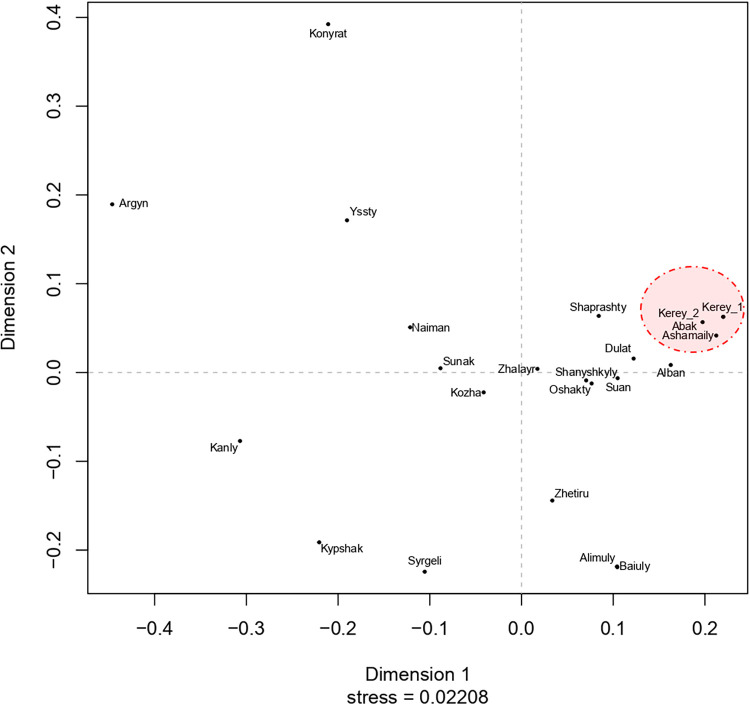
- Kinship with the Uissun tribe was supported, with closest average RST values to Alban (0.0592), Dulat (0.0832), Suan (0.09852), and Shapyrashty (0.1297), but the claim that Abak originated from Uissun was refuted because C2-Y12782 sub-lineage C2-FT224144 marks Ashamaily. Hypotheses linking Kerey with Uak, Sirgeli, Adai, Törtkara, Karakerey, and Kereyit were not supported.
Methods
- The study analyzed 207 healthy Kazakh males from the Kerey tribe, including Ashamaily (N = 154) and Abak (N = 53), with ancestors three generations prior from Kazakhstan (N = 158), Mongolia (N = 21), China (N = 19), and Russia (N = 9); venous blood samples were collected from 15 November 2020 to 15 November 2021.
- DNA was extracted and genotyped for 23 Y-STRs using the PowerPlex Y23 kit and 37 Y-SNPs using TaqMan assays; haplogroups were assigned with Nevgen and FamilyTreeDNA Discover, supplemented by citizen science BigY data.
- Statistical analyses used STRAF 1.0.5 for haplotype/allele frequencies, HD, HMP, DC, and forensic parameters; Haplomatch for haplotype comparison; a compiled dataset of 3856 published 17-Y-STR Kazakh haplotypes; and median-joining networks built with Network/Network Publisher using 15 or 21 Y-STRs, Reduced-Median algorithms, DYS389I subtracted from DYS389II, and DYS385a/b excluded.
Limitations
- The paper states that the Uak tribe sample size of 11 was insufficient for RST calculation and was not shown on the MDS graph, and that available material on the Uak clan level was insufficient to substantiate ethnographic accounts.
- The paper states that knowledge of Y-chromosome variants in the Kereyit clan is limited, based on only four individuals, and that further investigation is necessary to confirm any association with the medieval Kereyit tribe.
- Evident from the text: the PowerPlex Y23 panel showed insufficient power to differentiate close paternal clan members in the Kerey tribe, and rapid-mutating Y-STRs did not differentiate lineages within Abak and Ashamaily.
Model-written summary. Check it against the paper before relying on it.
Integrity signals
Registry
Cites
Statistics
Figures
Verification
Claims the paper makes
77 Own result · 27 Not checked yet · 14 Own interpretation · 4 Check pending · 3 Sources not found · 2 No full text of the sources · 2 Own method
A result the paper reports from its own data — it cites no other source for it, so there is none to check. The quote shows it is in the paper.
In the paper
“Additionally, lineage C2-FT411734 was identified as a common lineage in the Abak clan, with a prevalence of 69.8%.”
§ Y-Chromosomal insights into the paternal genealogy of the Kerey tribe have called into question their descent from the Stepfather of Genghis Khan > Results and discussion > Genetic lineages of Abak and Ashamaily
plain- Asserted: passes — The authors put it forward as true.
- Checkable: passes — It can be checked against evidence.
- Load-bearing: unclear — It is unclear whether the paper’s conclusions depend on it.
- Based: passes — The paper gives a reason why it holds.
A result the paper reports from its own data — it cites no other source for it, so there is none to check. The quote shows it is in the paper.
In the paper
“The haplogroup C2-M217 is the most prevalent, accounting for 85.8% of the population.”
§ Y-Chromosomal insights into the paternal genealogy of the Kerey tribe have called into question their descent from the Stepfather of Genghis Khan > Results and discussion > Paternal genetic portraits of Kerey tribe
plainn = 207- Asserted: passes — The authors put it forward as true.
- Checkable: passes — It can be checked against evidence.
- Load-bearing: passes — The paper’s conclusions depend on it.
- Based: passes — The paper gives a reason why it holds.
A result the paper states — it cites no source for it, so there is none to check. The quote shows it is in the paper.
In the paper
“Additionally, there is a strong founder effect within the C2-M217 haplogroup.”
§ Y-Chromosomal insights into the paternal genealogy of the Kerey tribe have called into question their descent from the Stepfather of Genghis Khan > Results and discussion > Paternal genetic portraits of Kerey tribe
boostedn = 207- Asserted: passes — The authors put it forward as true.
- Checkable: passes — It can be checked against evidence.
- Load-bearing: unclear — It is unclear whether the paper’s conclusions depend on it.
- Based: passes — The paper gives a reason why it holds.
A result the paper reports from its own data — it cites no other source for it, so there is none to check. The quote shows it is in the paper.
In the paper
“Additionally, genetic diversity analysis of the Y-chromosomes in the Kerey tribe and Kazakhs confirms their kinship with the Uissun tribe but refutes the claim of the Abak clan’s progenitor originating from this tribe.”
§ Y-Chromosomal insights into the paternal genealogy of the Kerey tribe have called into question their descent from the Stepfather of Genghis Khan > Abstract
plain- Asserted: passes — The authors put it forward as true.
- Checkable: passes — It can be checked against evidence.
- Load-bearing: passes — The paper’s conclusions depend on it.
- Based: passes — The paper gives a reason why it holds.
A result the paper reports from its own data — it cites no other source for it, so there is none to check. The quote shows it is in the paper.
In the paper
“C2-F4002, alternatively referred to as F3796, exhibits the highest prevalence (79.7%) within the Abak and Ashamaily clans.”
§ Y-Chromosomal insights into the paternal genealogy of the Kerey tribe have called into question their descent from the Stepfather of Genghis Khan > Results and discussion > Genetic lineages of Abak and Ashamaily
plainstates an association- Asserted: passes — The authors put it forward as true.
- Checkable: passes — It can be checked against evidence.
- Load-bearing: passes — The paper’s conclusions depend on it.
- Based: passes — The paper gives a reason why it holds.
- It may state two separate claims as one. 19
- Probably not a substantial claim. 28
- The quote only partly states this claim. 1
Create a free account to see these claims.
Create a free account to see these assumptions.
79 more claims
Create a free account to see all 129 claims and to verify the 34 references still open.
Self-check
Percentages, sums and reported differences re-computed from the paper’s own numbers.
Each contradiction between two passages listed here was confirmed by an independent check.
Rated minor: it would not touch a result — a value no result rests on, a p-value that stays on the same side of the significance level, or a conflict that is clerical, resolved elsewhere in the paper, or outside its own findings.
In the paper
“The parameters haplotype diversity (HD = 0.068), discrimination capacity (DC = 50.2%), and haplotype match probability (HMP = 0.096) were determined.”
§ Y-Chromosomal insights into the paternal genealogy of the Kerey tribe have called into question their descent from the Stepfather of Genghis Khan > Results and discussion > Paternal genetic portraits of Kerey tribe
Reported 0.068 · recomputed 0.904
Rated minor: it would not touch a result — a value no result rests on, a p-value that stays on the same side of the significance level, or a conflict that is clerical, resolved elsewhere in the paper, or outside its own findings.
In the paper
§ Y-Chromosomal insights into the paternal genealogy of the Kerey tribe have called into question their descent from the Stepfather of Genghis Khan > Results and discussion > Genetic lineages of Abak and Ashamaily
“the remaining five lineages are associated with individuals from Kazakhstan.”
§ Y-Chromosomal insights into the paternal genealogy of the Kerey tribe have called into question their descent from the Stepfather of Genghis Khan > Results and discussion > Genetic lineages of Abak and Ashamaily
“The sub-lineage F18202 is the most diversified and comprises descendant lineages known as C2-ZQ31, C2-ZQ506, C2-FT411734, C2-MPB401, C2-FT250737, C2-FGC29011. With the exception of C2-ZQ31, identified within the Kyrgyz population, and C2-MPB401, present in the Afghan-Pakistani population”
Citations
Cites
Mitochondrial portraits of human populations using median networks.
Bandelt, H. J., Forster, P., Sykes, B. C., & Richards, M. B. (1995) · Genetics · doi:10.1093/genetics/141.2.743 · Cited by 1,071
The Genetic Legacy of the Mongols
Zerjal, T., Xue, Y., Bertorelle, G., Wells, R. S., Bao, W., Zhu, S., Qamar, R., Ayub, Q., Mohyuddin, A., Fu, S., et al. (2003) · The American Journal of Human Genetics · doi:10.1086/367774 · Cited by 563
Ballantyne, K. N., Goedbloed, M., Fang, R., Schaap, O., Lao, Ó., Wollstein, A., Choi, Y., van Duijn, K., Vermeulen, M., Brauer, S., et al. (2010) · The American Journal of Human Genetics · doi:10.1016/j.ajhg.2010.08.006 · Cited by 403
STRAF—A convenient online tool for STR data evaluation in forensic genetics
Gouy, A., & Zieger, M. (2017) · Forensic Science International Genetics · doi:10.1016/j.fsigen.2017.07.007 · Cited by 343
Human Y-chromosome variation in the genome-sequencing era
Jobling, M. A., & Tyler‐Smith, C. (2017) · Nature Reviews Genetics · doi:10.1038/nrg.2017.36 · Cited by 247
The Y chromosome as the most popular marker in genetic genealogy benefits interdisciplinary research
Calafell, F., & Larmuseau, M. (2016) · Human Genetics · doi:10.1007/s00439-016-1740-0 · Cited by 134
Esenova, S. (2002) · Journal of Muslim Minority Affairs · doi:10.1080/13602000220124818 · Cited by 66
A Historical-Genetic Reconstruction of Human Extra-Pair Paternity
Larmuseau, M., van den Berg, P., Claerhout, S., Calafell, F., Boattini, A., Gruyters, L., Vandenbosch, M., Nivelle, K., Decorte, R., & Wenseleers, T. (2019) · Current Biology · doi:10.1016/j.cub.2019.09.075 · Cited by 61
Wei, L.-H., Yan, S., Lu, Y., Wen, S.-Q., Huang, Y.-Z., Wang, L.-X., Li, S.-L., Yang, Y.-J., Wang, X.-F., Zhang, C., et al. (2018) · European Journal of Human Genetics · doi:10.1038/s41431-017-0012-3 · Cited by 57
Abilev, S., Malyarchuk, B., Derenko, M., Wozniak, M., Grzybowski, T., & Zakharov, I. (2012) · Human Biology · doi:10.3378/027.084.0106 · Cited by 56
Research works printed but not linked: 16
- M. Tynyshpaev, 2006, History, Ethnography and Archeology of the Kazakh People.
- a-D Rashid, 1952, Collection of Histories., Moscow-Leningrad: Publishing House of the Academy of Sciences of the USSR
- NE Massanov, 2011, Nomadic civilization of Kazakhs: the basics migratory habits of life of society.
- R. Rakishev, 2015, Placement of the main clans of the Kazakhs by region and their approximate number., Reports of the National Academy of Sciences of the Republic of Kazakhstan, 3, 193
- 2020, 2020 Population and Housing Census of Mongolia: National Report
- VV Vostrov, 1968, Tribal composition and settlement of the Kazakhs (late XIX—early XX centuries).
- Y. Bregel, 2003, Handbuch der Orientalistik, Section Eight: Central Asia.
- Z. Beysenbayuly, 1994, Kazakh shezhire.
- Z. Sadibekov, Kazakh Shezhiresi. Tashkent1994
- M. Mukanov, 1974, Ethnic composition and settlement of the Kazakhs of the Middle Zhuz
- S. Amanzholov, 1959, Questions of dialectology and history of the Kazakh language.
- K. Shakarim, 1990, Genealogy of the Turks, Kyrgyz, Kazakhs and Khan dynasties (Translation by B. Kairbekov).
- V. Petrov, 2003, The rebellious “heart” of Asia: Xinjiang, a brief history of popular movements and memories
- B Wang, 2023, Y chromosome evidence confirms northeast Asian origin of Xinjiang Kazakhs and genetic influence from 18th century expansion of, Kerey clan. Frontiers in Ecology and Evolution, 11
- C Davis, 2019, Big Y-700 White Paper: Powering discovery in the field of paternal ancestry
- NA Aristov, 2005, Ethnogenesis and ethnic history of the Kazakh people., Pavlodar
Cited by
Turganbekova, A., Abdrakhmanova, S. A., Masalimov, Z. K., & Almawi, W. Y. (2025) · Genes · doi:10.3390/genes16030342 · Cited by 10
Genetic genealogy of Y-chromosome in the Zhetiru tribe of the Kazakh population from Kazakhstan
Zhunussova, A., Tayshanova, S., Bukayev, A., Mailenova, A., Aidarov, B., Temirgaliev, R., Sabitov, Z. M., & Zhabagin, M. K. (2025) · Frontiers in Genetics · doi:10.3389/fgene.2025.1516130 · Cited by 2
Self-citationUniparental analysis of Deep Maniot Greeks reveals genetic continuity from the pre-Medieval era
Davranoglou, L., Kofinakos, A. P., Mariolis, A., Runfeldt, G., Maier, P. A., Sager, M., Soulioti, P., Sapsakos, T. M., & Heraclides, A. (2026) · Communications Biology · doi:10.1038/s42003-026-09597-9 · Cited by 2
What Can Y-DNA Analysis Reveal About the Scottish Hay Noble Lineage?
Stead, P., Haddrill, P. R., & Macdonald, A. F. (2025) · Genealogy · doi:10.3390/genealogy9040132
Zhabagin, M. K., Bukayev, A., Mailenova, A., Zhunussova, A., Dyussenova, Z., Toxanbayev, A., & Sabitov, Z. (2026) · International Journal of Molecular Sciences · doi:10.3390/ijms27198641
Self-citation
Metadata
- Authors
- Zhabagin, M., Bukayev, A., Dyussenova, Z., Zhuraliyeva, A., Tashkarayeva, A., Zhunussova, A., Aidarov, B., Darmenov, A., Akilzhanova, A., Schamiloglu, U., & Sabitov, Z.
- Affiliations
- National Center for Biotechnology (KZ)
- Nazarbayev University (KZ)
- Astana International University (KZ)
- Ministry of Internal Affairs of the Republic of Kazakhstan (KZ)
- L. N. Gumilyov Eurasian National University (KZ)
- Corresponding author
- Zhabagin, Maxat
- ORCID
- Venue
- PLOS ONE
- Publisher
- Public Library of Science (PLoS)
- Published
- 2024-09-04
- Volume
- 19
- Issue
- 9
- Pages
- e0309080
- ISSN
- 1932-6203 (ISSN-L)
- PMC
- PMC11373838
- OpenAlex
- W4402220525
- Semantic Scholar
- 7aff92294cf625687396831e5c6172cd63018d4b
- Cited by
- 5
- References
- 27
- Citations by year
- 2026: 2 · 2025: 3
- FWCI
- 1.01
- Type
- journal article
- Language
- en
- Open access
- gold
- doi.org
- Licence
- Locations
- PLoS ONE (publishedVersion, cc-by)
- PubMed Central (publishedVersion, cc-by)
- PubMed (publishedVersion)
- Nazarbayev University Repository (Nazarbayev University) (submittedVersion)
- DOAJ (DOAJ: Directory of Open Access Journals) (submittedVersion, cc-by-sa)
- Funders
- Science Committee of the Ministry of Education and Science of the Republic of Kazakhstan (BR21882225, AP19677968)
- Collaborative Research Program of Nazarbayev University (091019CRP2119)
- Topics
- Life Sciences › Biochemistry, Genetics and Molecular Biology › Genetics › Forensic and Genetic Research
- Life Sciences › Biochemistry, Genetics and Molecular Biology › Genetics › Genetic diversity and population structure
- Social Sciences › Arts and Humanities › History › Eurasian Exchange Networks
- Keywords
- Y chromosome, Y-chromosome short tandem repeats, Y-SNPs, Genghis Khan, Mongol origins, genetic diversity
- MeSH terms
- Ethnicity, Genealogy and Heraldry, Haplotypes, Humans, Kazakhstan, Male, Pedigree, Phylogeny, Microsatellite Repeats, Polymorphism, Single Nucleotide, Chromosomes, Human, Y
About these checks
Registry, retraction, Cites and statistics results are computed, not judged, with one exception: a printed reference that no index lists is read once by a model before it counts as a citation error. Claims are extracted by a model and kept only when their quote appears verbatim in the text; each cited source is then checked, with a model’s help, for whether it says what the claim relies on. Those verdicts can be wrong — read the claim’s quote and the cited source before relying on one.
A language model drew the claims from the paper on 2026-11-12, under version 3 of the claim definition (model deepseek-v4.1-flash, prompt extract-v3).
A second model labelled each claim on 2026-11-12 (model jev-1.13-20260917, definition revision gold-guideline-v0.2).
Statistics and arithmetic are recomputed, not judged.
Confidence bands are shown only for fields calibrated on our annotated test set. None is calibrated yet, so no band is shown.
What counts as a claim ›How we measure confidence ›How we check this ›
Are you an author, or do you see a problem with this page? Request a review
How to cite
Cite CoChat for the checks on this page, and the paper for its own findings.
- This page
- CoChat. (2026). Citation check: Y-Chromosomal insights into the paternal genealogy of the Kerey tribe have called into question their descent from the Stepfather of Genghis Khan. https://app.cochat.ai/papers/10.1371/journal.pone.0309080
- The paper
- Zhabagin, M., Bukayev, A., Dyussenova, Z., Zhuraliyeva, A., Tashkarayeva, A., Zhunussova, A., Aidarov, B., Darmenov, A., Akilzhanova, A., Schamiloglu, U., & Sabitov, Z. (2024). Y-Chromosomal insights into the paternal genealogy of the Kerey tribe have called into question their descent from the Stepfather of Genghis Khan. PLOS ONE. https://doi.org/10.1371/journal.pone.0309080
