

Development and testing of a deep learning algorithm to detect lung consolidation among children with pneumonia using hand-held ultrasound
Open accessThe DOI matches its Crossref record; 33 of the 33 references it cites were found in a registry or an index.
Abstract
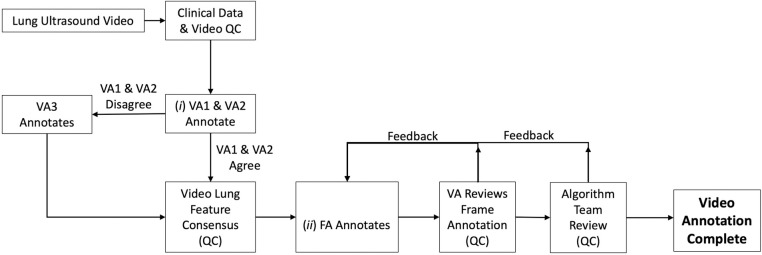
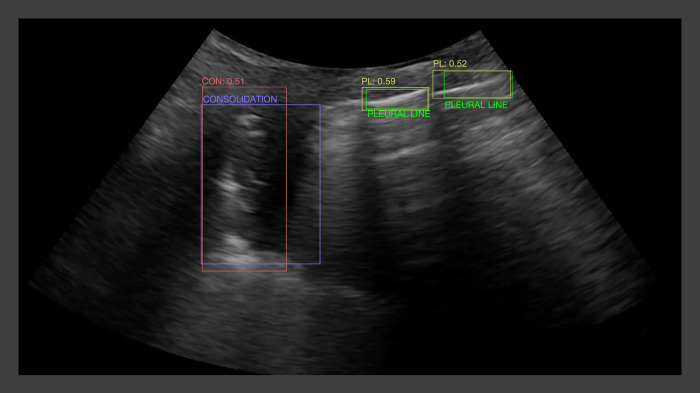
Background and objectives: Severe pneumonia is the leading cause of death among young children worldwide, disproportionately impacting children who lack access to advanced diagnostic imaging. Here our objectives were to develop and test the accuracy of an artificial intelligence algorithm for detecting features of pulmonary consolidation on point-of-care lung ultrasounds among hospitalized children. Methods: This was a prospective, multicenter center study conducted at academic Emergency Department and Pediatric inpatient or intensive care units between 2018–2020. Pediatric participants from 18 months to 17 years old with suspicion of lower respiratory tract infection were enrolled. Bedside lung ultrasounds were performed using a Philips handheld Lumify C5-2 transducer and standardized protocol to collect video loops from twelve lung zones, and lung features at both the video and frame levels annotated. Data from both affected and unaffected lung fields were split at the participant level into training, tuning, and holdout sets used to train, tune hyperparameters, and test an algorithm for detection of consolidation features. Data collected from adults with lower respiratory tract disease were added to enrich the training set. Algorithm performance at the video level to detect consolidation on lung ultrasound was determined using reference standard diagnosis of positive or negative pneumonia derived from clinical data. Results: Data from 107 pediatric participants yielded 117 unique exams and contributed 604 positive and 589 negative videos for consolidation that were utilized for the algorithm development process. Overall accuracy for the model for identification and localization of consolidation was 88.5%, with sensitivity 88%, specificity 89%, positive predictive value 89%, and negative predictive value 87%. Conclusions: Our algorithm demonstrated high accuracy for identification of consolidation features on pediatric chest ultrasound in children with pneumonia. Automated diagnostic support on an ultraportable point-of-care device has important implications for global health, particularly in austere settings.
Overview
The claims and statistics of this paper haven’t been checked yet.
Free: it reads the open-access text and checks the first 5 claims that cite a source we can check. Create a free account to check every claim.
Integrity signals
Registry
Cites
Statistics
Figures
Verification
Claims the paper makes
The claims and statistics of this paper haven’t been checked yet.
Free: it reads the open-access text and checks the first 5 claims that cite a source we can check. Create a free account to check every claim.
Self-check
Percentages, sums and reported differences re-computed from the paper’s own numbers.
The self-check needs the paper’s full text.
Citations
Cites
Very Deep Convolutional Networks for Large-Scale Image Recognition
Simonyan, K., & Zisserman, A. (2014) · arXiv · doi:10.48550/arxiv.1409.1556 · Cited by 114,148
(2016) · Cited by 31,590
International evidence-based recommendations for point-of-care lung ultrasound
International Liaison Committee on Lung Ultrasound (ILC-LUS) for the International Consensus Conference on Lung Ultrasound (ICC-LUS), Volpicelli, G., Elbarbary, M., Blaivas, M., Lichtenstein, D. A., Mathis, G., Kirkpatrick, A. W., Melniker, L., Gargani, L., Noble, V. E., et al. (2012) · Intensive Care Medicine · doi:10.1007/s00134-012-2513-4 · Cited by 2,874
Lung Ultrasound for the Diagnosis of Pneumonia in Children: A Meta-analysis
Pereda, M. A., Chavez, M. A., Hooper-Miele, C. C., Gilman, R. H., Steinhoff, M. C., Ellington, L. E., Gross, M., Price, C., Tielsch, J. M., & Checkley, W. (2015) · Pediatrics · doi:10.1542/peds.2014-2833 · Cited by 480
Sazawal, S., & Black, R. E. (2003) · The Lancet Infectious Diseases · doi:10.1016/s1473-3099(03)00737-0 · Cited by 444
Does This Child Have Pneumonia?: The Rational Clinical Examination Systematic Review
Shah, S. N., Bachur, R. G., Simel, D. L., & Neuman, M. I. (2017) · JAMA · doi:10.1001/jama.2017.9039 · Cited by 231
Jones, B. P., Tay, E. T., Elikashvili, I., Sanders, J. E., Paul, A. Z., Nelson, B. P., Spina, L. A., & Tsung, J. W. (2016) · Chest · doi:10.1016/j.chest.2016.02.643 · Cited by 204
Lung ultrasound compared to chest X‐ray for diagnosis of pediatric pneumonia: A meta‐analysis
Balk, D. S., Lee, C., Schafer, J. M., Welwarth, J., Hardin, J. W., Novack, V., Yarza, S., & Hoffmann, B. (2018) · Pediatric Pulmonology · doi:10.1002/ppul.24020 · Cited by 166
A Systematic Review on the Diagnosis of Pediatric Bacterial Pneumonia: When Gold Is Bronze
LYNCH, T. P., Bialy, L. M., Kellner, J. D., Osmond, M. H., Klassen, T. P., Durec, T., Leicht, R., & Johnson, D. W. (2010) · PLoS ONE · doi:10.1371/journal.pone.0011989 · Cited by 160
Lung ultrasound for the diagnosis of pneumonia in children with acute bronchiolitis
Biagi, C., Pierantoni, L., Baldazzi, M., Greco, L., Dormi, A., Dondi, A., Faldella, G., & Lanari, M. (2018) · BMC Pulmonary Medicine · doi:10.1186/s12890-018-0750-1 · Cited by 158
Research works printed but not linked: 3
- Exploratory meeting to review new evidence for Integrated Management of Childhood Illness danger signs,, 2019, Geneva, Switzerland, 4–5 September 2018.
- World Health Organization, 2012, Recommendations for Management of Common Childhood Conditions: Evidence for Technical Update of Pocket Book Recommendations: Newborn Conditions, Dysentery, Pneumonia, Oxygen Use and Delivery, Common Causes of Fever, Severe Acute Malnutrition and Supportive Care, Geneva
- A Howard, 2019, Searching for MobileNetV3, IEEE ICCV, 1314
Cited by
Yu, Y., Gomez-Cabello, C. A., Haider, S. A., Genovese, A., Prabha, S., Trabilsy, M., Collaco, B. G., Wood, N. G., Bagaria, S., Tao, C., et al. (2025) · Diagnostics · doi:10.3390/diagnostics15172204 · Cited by 32
“Studies have successfully employed AI to diagnose pneumonia and COVID-19 using lung ultrasound imagery [11,12], detect diabetic retinopathy from retinal fundus images [13], and correctly classify benign versus malignant skin lesions [14], highlighting significant potential in diagnostic…”
Medical imaging-based artificial intelligence in pneumonia: A narrative review
Yang, Y., Xing, W., Liu, Y., Li, Y., Ta, D., Song, Y., & Hou, D. (2025) · Neurocomputing · doi:10.1016/j.neucom.2025.129731 · Cited by 10
Bedside thoracic echography in ICU: new insights for acute circulatory and respiratory failure
Muller, L., Volpicelli, G., Mongodi, S., Girard, M., Fraccalini, T., Gargani, L., Vieillard‐Baron, A., Slama, M., Wu, D., Arntfield, R. T., et al. (2025) · Intensive Care Medicine · doi:10.1007/s00134-025-08189-1 · Cited by 5
Artificial Intelligence in Pediatric Ultrasound: An Update and Future Applications
Kuang, C., Jiang, Z., Wang, Y., Fang, A., Zhang, H., Liu, H., & Ye, Z. (2025) · BIO Integration · doi:10.15212/bioi-2025-0130 · Cited by 5
Phan, H. V., Spottiswoode, N., Lydon, E., Chu, V. T., Cuesta, A., Kazberouk, A. D., Richmond, N. L., Deosthale, P. J., Calfee, C. S., & Langelier, C. (2025) · Nature Communications · doi:10.1038/s41467-025-66218-5 · Cited by 5
Metadata
- Authors
- Kessler, D., Zhu, M., Gregory, C. R., Mehanian, C., Avila, J., Avitable, N., Coneybeare, D., Das, D., Dessie, A., Kennedy, T. M., Rabiner, J., Malia, L., Ng, L., Nye, M., Vindas, M., Weimersheimer, P., Kulhare, S., Millin, R., Gregory, K., Zheng, X., Horning, M. P., Stone, M., Wang, F., & Lancioni, C.
- Affiliations
- Morgan Stanley Children's Hospital (US)
- Oregon Health & Science University (US)
- University of Kentucky (US)
- University of Vermont (US)
- Legacy Emanuel Medical Center (US)
- Corresponding author
- Kessler, David
- ORCID
- Venue
- PLOS ONE
- Publisher
- Public Library of Science (PLoS)
- Published
- 2024-08-27
- Volume
- 19
- Issue
- 8
- Pages
- e0309109
- ISSN
- 1932-6203 (ISSN-L)
- PMC
- PMC11349203
- OpenAlex
- W4401905446
- Cited by
- 20
- References
- 33
- Citations by year
- 2026: 10 · 2025: 9 · 2024: 1
- FWCI
- 7.56
- Type
- journal article
- Language
- en
- Open access
- gold
- doi.org
- Licence
- Locations
- PLoS ONE (publishedVersion, cc-by)
- PubMed Central (publishedVersion, cc-by-nc-sa)
- PubMed (publishedVersion)
- RePEc: Research Papers in Economics (submittedVersion)
- DOAJ (DOAJ: Directory of Open Access Journals) (submittedVersion, cc-by-sa)
- Funders
- Defense Sciences Office, DARPA (HR0011-17-3-0001)
- Bill and Melinda Gates Foundation
- Topics
- Health Sciences › Medicine › Critical Care and Intensive Care Medicine › Ultrasound in Clinical Applications
- Health Sciences › Medicine › Health Informatics › Artificial Intelligence in Healthcare and Education
- Health Sciences › Medicine › Radiology, Nuclear Medicine and Imaging › COVID-19 diagnosis using AI
- Keywords
- lung consolidation, pneumonia, pediatric pneumonia, handheld ultrasound, point-of-care ultrasound, deep learning, artificial intelligence, lower respiratory tract infection, automated diagnosis, emergency department, pediatric intensive care, resource-limited settings
- MeSH terms
- Deep Learning, Adolescent, Algorithms, Child, Child, Preschool, Female, Humans, Infant, Lung, Male, Pneumonia, Prospective Studies, Ultrasonography, Point-of-Care Systems
About these checks
Registry, retraction, Cites and statistics results are computed, not judged, with one exception: a printed reference that no index lists is read once by a model before it counts as a citation error. Claims are extracted by a model and kept only when their quote appears verbatim in the text; each cited source is then checked, with a model’s help, for whether it says what the claim relies on. Those verdicts can be wrong — read the claim’s quote and the cited source before relying on one.
Statistics and arithmetic are recomputed, not judged.
Confidence bands are shown only for fields calibrated on our annotated test set. None is calibrated yet, so no band is shown.
What counts as a claim ›How we measure confidence ›How we check this ›
Are you an author, or do you see a problem with this page? Request a review
How to cite
Cite CoChat for the checks on this page, and the paper for its own findings.
- This page
- CoChat. (2026). Citation check: Development and testing of a deep learning algorithm to detect lung consolidation among children with pneumonia using hand-held ultrasound. https://app.cochat.ai/papers/10.1371/journal.pone.0309109
- The paper
- Kessler, D., Zhu, M., Gregory, C. R., Mehanian, C., Avila, J., Avitable, N., Coneybeare, D., Das, D., Dessie, A., Kennedy, T. M., Rabiner, J., Malia, L., Ng, L., Nye, M., Vindas, M., Weimersheimer, P., Kulhare, S., Millin, R., Gregory, K., . . . Lancioni, C. (2024). Development and testing of a deep learning algorithm to detect lung consolidation among children with pneumonia using hand-held ultrasound. PLOS ONE. https://doi.org/10.1371/journal.pone.0309109
Data sources
Bibliographic data: Semantic Scholar, OpenAlex, Crossref.
Contains information from the Semantic Scholar Academic Graph Datasets, made available under the ODC Attribution License (ODC-BY 1.0).
Semantic Scholar’s data is described in: Kinney, R., et al. (2023). The Semantic Scholar Open Data Platform. arXiv:2301.10140.
