

The DOI matches its Crossref record; 50 of the 50 references it cites were found in a registry or an index; 25 of the 60 sources its claims cite were checked for support.
An internet-delivered acceptance and commitment therapy program for anxious affect, depression, and wellbeing: A randomized, parallel, two-group, waitlist-controlled trial in a Middle Eastern sample of college students
Open accessAbstract
Background College students during the young adult years are at elevated risk for the development of anxiety and depressive difficulties. Moreover, a preliminary body of evidence suggests that, for those who reside in Middle Eastern contexts, despite an established need, sociocultural impediments prevent active psychological help-seeking. Internet-delivered, self-directed mental health programs may hold significant promise to alleviate these difficulties in contexts where individuals would otherwise not enlist the support of a mental health practitioner. Method The present study developed a bespoke, 4-module, internet-delivered program based upon acceptance and commitment therapy (ACT) principles and tested its feasibility and efficacy within the context a randomized controlled trial. A total of 129 participants were randomized to receive either the ACT program or to a waitlist control condition. Assessments of generalized anxiety, social anxiety, depressive affect, and wellbeing were administered at baseline and at post-intervention. Results Analyses indicated that the intervention was efficacious in mitigating both generalized and social anxiety and in improving wellbeing. Conclusion These results provide preliminary evidence of the feasibility and efficacy of internet-delivered ACT in a Middle Eastern context. © 2024 Vally et al. This is an open access article distributed under the terms of the Creative Commons Attribution License, which permits unrestricted use, distribution, and reproduction in any medium, provided the original author and source are credited.
Overview
CoChat Summary
## TL;DR
This randomized waitlist-controlled trial tested a 4-module internet-delivered ACT program in 129 college students in the UAE and Oman and found it improved generalized anxiety, social anxiety, and wellbeing. Effects on depression, disability, and values-based living were not statistically significant.
## Key findings
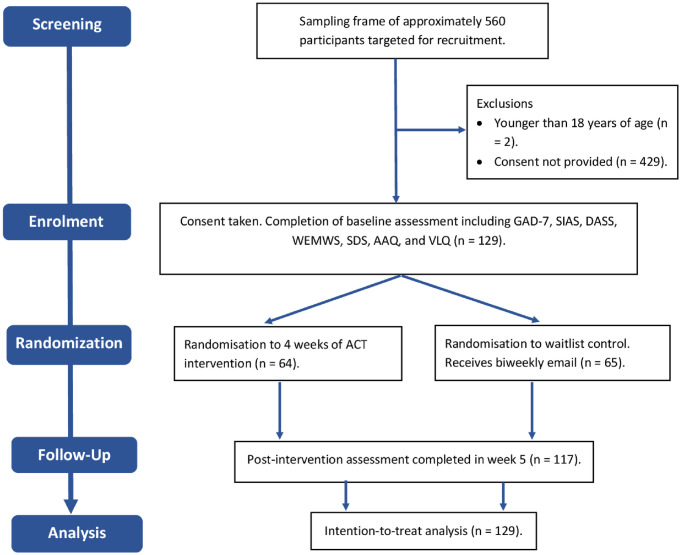
- Sample and feasibility: 129 students completed baseline; 82 (63.6%) were from the UAE and 47 (36.4%) from Oman. The authors report that about 23% of the sampling frame was included in the trial, and 12 participants (9.3%) were untraceable at post-intervention.
- Anxiety outcomes improved: Post-intervention, the intervention group scored lower than controls on GAD-7 (6.45 vs 9.14; F(1,126)=23.95, p<.001, ηp2=.16) and SIAS (28.03 vs 34.69; F(1,126)=6.681, p=.011, ηp2=.05).
- Wellbeing improved: Post-intervention WEMWBS scores were higher in the intervention group than controls (24.03 vs 22.06; F(1,126)=16.81, p<.001, ηp2=.12).
- No significant effects for several secondary outcomes: Depression on the DASS was not significant (F(1,126)=20.543, p>.05, ηp2=.006), disability on the SDS was not significant (F(1,126)=.434, p>.05, ηp2=.003), and values-based living on the VLQ was not significant (F(1,126)=2.052, p>.05, ηp2=.016). Experiential avoidance decreased significantly (AAQ-II: F(1,126)=5.138, p=.025, ηp2=.039).
## Methods
- Design: Two-group, parallel, randomized, waitlist-controlled trial with baseline and post-intervention assessment after 4 weeks.
- Sample/data: 129 registered college students aged 18+ from university campuses in the United Arab Emirates and Oman; no elevated anxiety or depression was required for inclusion.
- Analysis: ANCOVA was used to compare post-intervention group means while controlling for baseline scores; missing data were handled with mean replacement at baseline and multiple imputation for missing post-intervention data, with an intention-to-treat analysis. An a priori power calculation suggested a minimum sample of 84 for detecting a large effect (f=.4) at α=.05 and power=.95.
## Limitations
- Stated in the paper: No follow-up assessments were conducted, so persistence of effects over time is unknown; the authors also note no reliable engagement/completion metrics were collected, and there was no multiplicity adjustment for multiple secondary analyses.
- Stated in the paper: The comparator was a waitlist control, and the authors note an active control might have produced different results.
- Evident from the text: Outcomes were measured primarily by self-report, and the study did not include structured diagnostic tools; the intervention was tested in a specific bilingual Middle Eastern university sample, which may limit broader generalizability.
Model-written summary. Check it against the paper before relying on it.
Integrity signals
Registry
Cites
Statistics
Figures
Verification
Claims the paper makes
15 Valid · 2 Not valid · 19 Not checked · 59 Own results and interpretations
Some cited sources support this claim and some don’t — read each source’s verdict below.
In the paper
“The consistent improvements in the intervention group on both measures of anxiety, the generalized and social anxiety variants, as well as wellbeing are in concurrence with the preceding literature”
§ An internet-delivered acceptance and commitment therapy program for anxious affect, depression, and wellbeing: A randomized, parallel, two-group, waitlist-controlled trial in a Middle Eastern sample of college students > Discussion
What the sources say
- Disputedcites [26] E. Karyotaki, 2022, Guided internet-based transdiagnostic individually tailored Cognitive Behavioral Therapy for symptoms of depression and/or anxiety in college students: A randomized controlled trial, Behav Res Ther sourceExperimental — accuracy not yet measured
The Discussion reports that prior findings did not show significant improvements in quality of life from internet-based interventions, contrary to the claimed agreement with improvements in wellbeing. The Main and Secondary Outcomes sections also report no significant advantage of this iCBT intervention over treatment as usual for anxiety or quality of life. The paper does not discuss internet-delivered ACT or mindfulness programs as the claimed preceding literature. (LLM, conf=0.87)
Checked by a reasoning model — may be wrong.
- Partly supportedcites [27] E.B. Davies, 2014, Computer-delivered and web-based interventions to improve depression, anxiety, and psychological well-being of university students: a systematic review and meta-analysis, J Med Internet Res sourceExperimental — accuracy not yet measured
In Results > Web-Based or Computer-Delivered Intervention Compared to Inactive Control (page unavailable), the review reports improved anxiety outcomes for web-based or computer-delivered interventions overall. Results > Intervention Characteristics and Participant Satisfaction/Evaluation (pages unavailable) identify a mindfulness intervention and report perceived personal benefit, but do not establish improvements in both generalized and social anxiety or well-being from internet-delivered ACT and mindfulness programs. (LLM, conf=0.84)
- Not matchedcites [31] N.T.P. Pang, 2023, Efficacy of a single-session online ACT-based mindfulness intervention among undergraduates in lockdown during the COVID-19 pandemic, Trends Psychiatry Psychother
Couldn’t be matched to a paper in Crossref, so it can’t be checked.
- Partly supportedcites [34] P. Carlbring, 2018, Internet-based vs. face-to-face cognitive behavior therapy for psychiatric and somatic disorders: an updated systematic review and meta-analysis, Cogn Behav Ther sourceExperimental — accuracy not yet measured
The KEYWORDS passage (p. 3) says internet-delivered CBT has shown promising clinical effectiveness for conditions including anxiety disorders, and the Discussion (p. 16) finds it as effective as face-to-face CBT for social anxiety disorder. Those passages offer broad support for the anxiety comparison, but they do not establish improvements in generalized anxiety and wellbeing from internet-delivered ACT or mindfulness programs. (LLM, conf=0.82)
plainstates an association- Asserted: passes — The authors put it forward as true.
- Checkable: passes — It can be checked against evidence.
- Load-bearing: passes — The paper’s conclusions depend on it.
- Based: passes — The paper gives a reason why it holds.
- Disputed
The sources with a verdict support this claim; the rest weren’t checked yet, have no full text we could read, or their verdicts aren’t rated yet.
In the paper
“College students during the young adult years are at elevated risk for the development of anxiety and depressive difficulties.”
- Also stated in: § Introduction · boosted
“research consistently finds high prevalence rates for these disorders among college-aged students [1, 2, 6].”
§ An internet-delivered acceptance and commitment therapy program for anxious affect, depression, and wellbeing: A randomized, parallel, two-group, waitlist-controlled trial in a Middle Eastern sample of college students > Abstract > Background
What the sources say
- Not checked — no full text of the sourcecites [1] R.C. Kessler, 2005, Lifetime prevalence and age-of-onset distributions of DSM-IV disorders in the National Comorbidity Survey Replication, Arch Gen Psychiatry source
- Supportedcites [2] R.P. Auerbach, 2018, WHO World Mental Health Surveys International College Student Project: Prevalence and distribution of mental disorders, J Abnorm Psychol source
The Introduction describes the college years as a peak period for onset of common mental disorders, particularly mood and anxiety disorders, and reports high prevalence among college students. This supports the broad claim about risk of developing depressive and anxiety difficulties during those years. (LLM, conf=0.90)
- Supportedcites [6] P. Pedrelli, 2015, College Students: Mental Health Problems and Treatment Considerations, Acad Psychiatry source
The “Prevalence of Mental Health Disorders” section says most disorders have their peak onset during young adulthood and identifies anxiety disorders and depression as common among college students. The “Implications of Age of Onset” section also says many mental health problems first occur during this transitional period. Page numbers were not provided in our copy. (LLM, conf=0.92)
boostedstates an association- Asserted: passes — The authors put it forward as true.
- Checkable: passes — It can be checked against evidence.
- Load-bearing: passes — The paper’s conclusions depend on it.
- Based: passes — The paper gives a reason why it holds.
- Also stated in: § Introduction · boosted
The cited sources support only part of this claim — read each source’s verdict below.
In the paper
“Research has also shown its deleterious impact on overall functioning and, in particular, academic performance [2, 7].”
§ An internet-delivered acceptance and commitment therapy program for anxious affect, depression, and wellbeing: A randomized, parallel, two-group, waitlist-controlled trial in a Middle Eastern sample of college students > Introduction
What the sources say
- Supportedcites [2] R.P. Auerbach, 2018, WHO World Mental Health Surveys International College Student Project: Prevalence and distribution of mental disorders, J Abnorm Psychol source
The Introduction states that common mental disorders among college students cause distress and are associated with substantial impairment in academic performance. The Methods (Measures) also describes the surveyed disorders as those associated with the highest levels of role impairment among college students, supporting the broader functioning claim. (LLM, conf=0.88)
- Partly supportedcites [7] R. Bruffaerts, 2018, Mental health problems in college freshmen: Prevalence and academic functioning, J Affect Disord sourceExperimental — accuracy not yet measured
The Measures section includes depression and anxiety among the internalizing problems studied, and Results §3.3 associates internalizing problems with lower academic functioning in college freshmen. The paper does not assess overall functioning or isolate the effects of depression and anxiety; its academic findings are associations, not evidence of a causal impact. (LLM, conf=0.86)
boostedstates a cause- Asserted: passes — The authors put it forward as true.
- Checkable: passes — It can be checked against evidence.
- Load-bearing: passes — The paper’s conclusions depend on it.
- Based: passes — The paper gives a reason why it holds.
- Supported
The cited sources that could be checked couldn’t confirm or dispute this claim.
In the paper
“Internet-delivered CBT has demonstrated effectiveness in addressing anxiety disorders and depression in both the general population [23–25] and in college samples [26, 27].”
§ An internet-delivered acceptance and commitment therapy program for anxious affect, depression, and wellbeing: A randomized, parallel, two-group, waitlist-controlled trial in a Middle Eastern sample of college students > Introduction
What the sources say
- Not checked — no full text of the sourcecites [23] G. Andersson, 2009, Internet-based and other computerized psychological treatments for adult depression: a meta-analysis, Cogn Behav Ther source
- Not checked — no full text of the sourcecites [24] D. Richards, 2012, Computer-based psychological treatments for depression: a systematic review and meta-analysis, Clin Psychol Rev source
- Could not verifycites [25] V. Spek, 2007, Internet-based cognitive behaviour therapy for symptoms of depression and anxiety: a meta-analysis, Psychol Med sourceExperimental — accuracy not yet measured
The available passages labeled Abstract contain bibliographic information identifying a meta-analysis about internet-based CBT for symptoms of depression and anxiety, but no findings. Searches for effectiveness, effect sizes, and the general population found no passage establishing the attributed claim. (LLM, conf=0.72)
boostedstates a cause- Asserted: passes — The authors put it forward as true.
- Checkable: passes — It can be checked against evidence.
- Load-bearing: unclear — It is unclear whether the paper’s conclusions depend on it.
- Based: passes — The paper gives a reason why it holds.
The cited sources support only part of this claim — read each source’s verdict below.
In the paper
“Internet-delivered CBT has demonstrated effectiveness in addressing anxiety disorders and depression in both the general population [23–25] and in college samples [26, 27].”
§ An internet-delivered acceptance and commitment therapy program for anxious affect, depression, and wellbeing: A randomized, parallel, two-group, waitlist-controlled trial in a Middle Eastern sample of college students > Introduction
What the sources say
- Partly supportedcites [26] E. Karyotaki, 2022, Guided internet-based transdiagnostic individually tailored Cognitive Behavioral Therapy for symptoms of depression and/or anxiety in college students: A randomized controlled trial, Behav Res Ther sourceExperimental — accuracy not yet measured
The Introduction reports earlier college-student trials with reductions in anxiety and, in one trial, depression symptoms. But the Discussion reports that this paper’s own trial found no advantage over treatment as usual for either outcome, and the cited findings concern symptoms rather than diagnosed anxiety disorders. The broad effectiveness claim omits these qualifications; page numbers are unavailable in our copy. (LLM, conf=0.85)
- Partly supportedcites [27] E.B. Davies, 2014, Computer-delivered and web-based interventions to improve depression, anxiety, and psychological well-being of university students: a systematic review and meta-analysis, J Med Internet Res sourceExperimental — accuracy not yet measured
The Results section reports improved anxiety and depression outcomes in university students compared with inactive controls, and the Conclusions say the findings support self-guided Internet-delivered CBT. The review measures anxiety outcomes rather than establishing effectiveness for diagnosed anxiety disorders, and it cautions that the findings are methodologically limited and show no significant advantage over active controls. (LLM, conf=0.85)
boostedstates a cause- Asserted: passes — The authors put it forward as true.
- Checkable: passes — It can be checked against evidence.
- Load-bearing: unclear — It is unclear whether the paper’s conclusions depend on it.
- Based: passes — The paper gives a reason why it holds.
- Partly supported
40 more claims · 2 with their cited sources checked
Create a free account to see all 95 claims and every source verdict.
- It may state two separate claims as one. 19
- Probably not a substantial claim. 35
Statistics that don’t add up
Each reported p-value recomputed from its test statistic and degrees of freedom.
Rated major: it would touch a result — a value a result rests on, reported and recomputed p-values on opposite sides of the significance level, two passages that conflict with no sign which is right, or a cited work retracted before this paper was published.
In the paper
“F(1, 126) = 20.543, p >.05”
§ An internet-delivered acceptance and commitment therapy program for anxious affect, depression, and wellbeing: A randomized, parallel, two-group, waitlist-controlled trial in a Middle Eastern sample of college students > Results > Depression
Reported p > .05 · recomputed p < .001
Rated minor: it would not touch a result — a value no result rests on, a p-value that stays on the same side of the significance level, or a conflict that is clerical, resolved elsewhere in the paper, or outside its own findings.
In the paper
“t(63) = -1.91, p < .05”
§ An internet-delivered acceptance and commitment therapy program for anxious affect, depression, and wellbeing: A randomized, parallel, two-group, waitlist-controlled trial in a Middle Eastern sample of college students > Results > Anxiety
Reported p < .05 · recomputed p = .061
Statistics recomputed
Every reported test result, recomputed from its test statistic and degrees of freedom. A result shows as not adding up only once an independent check has confirmed it.
- Doesn’t add upF(1, 126) = 20.543reported p > .05 · recomputed p < .001The two fall on opposite sides of .05
“F(1, 126) = 20.543, p > .05”
- Doesn’t add upt(63) = -1.91reported p < .05 · recomputed p = .061
“t(63) = -1.91, p < .05”
- ConsistentF(1, 126) = 23.95reported p < .001 · recomputed p < .001
“F(1, 126) = 23.95, p < .001”
- Consistentt(63) = 5.51reported p < .001 · recomputed p < .001
“t(63) = 5.51, p < .001”
- ConsistentF(1, 126) = 6.681reported p = .011 · recomputed p = .011
“F(1, 126) = 6.681, p = .011”
6 more recomputed tests
Create a free account to see every test the Stats check recomputed.
Self-check
Percentages, sums and reported differences re-computed from the paper’s own numbers.
Self-check results appear here once an independent check has confirmed them.
Citations
Cites
Statistical Power Analysis for the Behavioral Sciences
Muller, K. (1989) · Technometrics · doi:10.1080/00401706.1989.10488618 · Cited by 99,167
A Brief Measure for Assessing Generalized Anxiety Disorder: The GAD-7
Spitzer, R. L., Kroenke, K., Williams, J. B. W., & Löwe, B. (2006) · Archives of Internal Medicine · doi:10.1001/archinte.166.10.1092 · Cited by 31,765
Kessler, R. C., Berglund, P., Demler, O., Jin, R., Merikangas, K. R., & Walters, E. E. (2005) · Archives of General Psychiatry · doi:10.1001/archpsyc.62.6.593 · Cited by 20,391
Lovibond, P. F., & Lovibond, S. H. (1995) · Behaviour Research and Therapy · doi:10.1016/0005-7967(94)00075-u · Cited by 14,523
The Warwick-Edinburgh Mental Well-being Scale (WEMWBS): development and UK validation
Tennant, R., Hiller, L., Fishwick, R., Platt, S., Joseph, S., Weich, S., Parkinson, J., Secker, J., & Stewart-Brown, S. (2007) · Health and Quality of Life Outcomes · doi:10.1186/1477-7525-5-63 · Cited by 5,031
Bond, F. W., Hayes, S. C., Baer, R. A., Carpenter, K. M., Guenole, N., Orcutt, H. K., Waltz, T., & Zettle, R. D. (2011) · Behavior Therapy · doi:10.1016/j.beth.2011.03.007 · Cited by 3,950
Age of onset of mental disorders: a review of recent literature
Kessler, R. C., Amminger, G. P., Aguilar-Gaxiola, S., Alonso, J., Lee, S., & ??st??n, T. B. (2007) · Current Opinion in Psychiatry · doi:10.1097/yco.0b013e32816ebc8c · Cited by 3,457
Mattick, R. P., & Clarke, J. C. (1998) · Behaviour Research and Therapy · doi:10.1016/s0005-7967(97)10031-6 · Cited by 3,367
Auerbach, R. P., Collaborators, W. W.-I., Mortier, P., Bruffaerts, R., Alonso, J., Benjet, C., Cuijpers, P., Demyttenaere, K., Ebert, D. D., Green, J. G., et al. (2018) · Journal of Abnormal Psychology · doi:10.1037/abn0000362 · Cited by 2,522
Internet-based cognitive behaviour therapy for symptoms of depression and anxiety: A meta-analysis
SPEK, V., CUIJPERS, P., NYKLÍČEK, I., RIPER, H., KEYZER, J., & POP, V. (2007) · Psychological Medicine · doi:10.1017/s0033291706008944 · Cited by 1,586
Cited by
Xiong, Y., Xiao, N., Ding, X., Zhang, J., & Luo, H.-S. (2026) · Frontiers in Psychology · doi:10.3389/fpsyg.2026.1787151 · Cited by 1
Self-as-Context as an Autonomous Mechanism for Anxiety Reduction
Verkoeyen, N. V. (2026) · Психология и Психотехника · doi:10.7256/2454-0722.2026.1.78606
Metadata
- Authors
- Vally, Z., Shah, H., Varga, S.-I., Hassan, W., Kashakesh, M., Albreiki, W., & Helmy, M.
- Affiliations
- United Arab Emirates University (AE)
- Sultan Qaboos University (OM)
- Corresponding author
- Vally, Zahir
- Venue
- PLoS ONE
- Publisher
- Public Library of Science (PLoS)
- Published
- 2024-12-05
- Volume
- 19
- Issue
- 12
- Pages
- e0313243
- ISSN
- 1932-6203 (ISSN-L)
- PMC
- PMC11620599
- OpenAlex
- W4405056063
- Cited by
- 5
- References
- 49
- Citations by year
- 2026: 4 · 2025: 1
- FWCI
- 1.63
- Type
- journal article
- Language
- en
- Open access
- gold
- doi.org
- Licence
- Locations
- PLoS ONE (publishedVersion, cc-by)
- PubMed Central (publishedVersion, cc-by)
- PubMed (publishedVersion)
- DOAJ (DOAJ: Directory of Open Access Journals) (submittedVersion, cc-by-sa)
- Topics
- Social Sciences › Psychology › Applied Psychology › Digital Mental Health Interventions
- Social Sciences › Psychology › Clinical Psychology › Mindfulness and Compassion Interventions
- Social Sciences › Psychology › Experimental and Cognitive Psychology › Anxiety, Depression, Psychometrics, Treatment, Cognitive Processes
- Keywords
- acceptance and commitment therapy, online intervention, generalized anxiety disorder, social anxiety, depressive affect, well-being, university students, help-seeking barriers, feasibility and efficacy
- MeSH terms
- Internet-Based Intervention, Adolescent, Adult, Anxiety, Depression, Female, Humans, Male, Middle East, Students, Universities, Waiting Lists, Internet, Young Adult, Acceptance and Commitment Therapy
About these checks
Registry, retraction, Cites and statistics results are computed, not judged, with one exception: a printed reference that no index lists is read once by a model before it counts as a citation error. Claims are extracted by a model and kept only when their quote appears verbatim in the text; each cited source is then checked, with a model’s help, for whether it says what the claim relies on. Those verdicts can be wrong — read the claim’s quote and the cited source before relying on one.
The claim verdicts this report counts are experimental: their accuracy is not yet measured.
A language model drew the claims from the paper on 2026-10-11, under version 3 of the claim definition (model deepseek-v4.1-flash, prompt extract-v3).
A second model labelled each claim on 2026-10-11 (model jev-1.13-20260917, definition revision gold-guideline-v0.2).
Cited sources are checked with a language model’s help (gpt-6-sol).
Statistics and arithmetic are recomputed, not judged.
Confidence bands are shown only for fields calibrated on our annotated test set. None is calibrated yet, so no band is shown.
What counts as a claim ›How we measure confidence ›How we check this ›
Are you an author, or do you see a problem with this page? Request a review
How to cite
Cite CoChat for the checks on this page, and the paper for its own findings.
- This page
- CoChat. (2026). Citation check: An internet-delivered acceptance and commitment therapy program for anxious affect, depression, and wellbeing: A randomized, parallel, two-group, waitlist-controlled trial in a Middle Eastern sample of college students. https://app.cochat.ai/papers/10.1371/journal.pone.0313243
- The paper
- Vally, Z., Shah, H., Varga, S.-I., Hassan, W., Kashakesh, M., Albreiki, W., & Helmy, M. (2024). An internet-delivered acceptance and commitment therapy program for anxious affect, depression, and wellbeing: A randomized, parallel, two-group, waitlist-controlled trial in a Middle Eastern sample of college students. PLoS ONE. https://doi.org/10.1371/journal.pone.0313243
Data sources
Bibliographic data: Semantic Scholar, OpenAlex, Crossref.
Contains information from the Semantic Scholar Academic Graph Datasets, made available under the ODC Attribution License (ODC-BY 1.0).
Semantic Scholar’s data is described in: Kinney, R., et al. (2023). The Semantic Scholar Open Data Platform. arXiv:2301.10140.
