

Disorientation patterns of loggerhead sea turtle (Caretta caretta) hatchlings in Pinellas County, Florida, USA
Open accessThe DOI matches its Crossref record; 53 of the 53 references it cites were found in a registry or an index; none of the 101 sources its claims cite is checked for support yet.
Abstract
The disorientation of loggerhead sea turtle ( Caretta caretta ) hatchlings, primarily caused by artificial lighting, poses a significant threat to their survival, as they rely on environmental cues to reach the ocean. In this study, we analyzed data from nesting surveys and disorientation reports to identify factors contributing to disorientation events, including position on the beach and spatial location. Between 2018 and 2023, 1048 nests successfully had hatchlings emerge, with 377 (36%) of these emergences resulting in disorientation events. Nests located in the upper portion of the beach were significantly less likely to result in disoriented hatchlings compared to the middle portion. Spatiotemporal analysis identified areas of hot and cold spots of disoriented hatchlings across different beaches in Pinellas County, Florida, USA, with significant spatial variations of disorientations across years, with 2022 having peaks in spatial clustering and 2021 and 2023 having no clustering. Moonlight was found to play a mitigating role, with significantly more disorientation events occurring on nights with lower moonlight exposure. These findings underscore the need for improved lighting regulations and beach management strategies, such as enhancing natural dunes and beach profiles to reduce artificial light exposure in Pinellas County.
Overview
CoChat Summary
TL;DR
This study analyzed 2018–2023 loggerhead hatchling disorientation in Pinellas County, Florida, finding that 36% of emerged nests produced disorientation events and that disorientation clustered spatially in some years. Upper-beach nests and brighter moonlit nights were associated with lower disorientation, while wider beaches and later years were associated with higher disorientation.
Key findings
- Of 1479 recorded loggerhead nests, 1048 had hatchlings emerge, and 377 (36%) of those emergences resulted in disorientation events; annual mean disoriented nests was 35 ± 10% (range 26–50%).
- Among disorientation events, 54 ± 31% of emerged hatchlings were disoriented (range 4–100%); 39% of disoriented hatchlings reached the water, averaging 15 ± 16% per nest, and 6% reached roads or parking lots, averaging 2 ± 8 hatchlings per event.
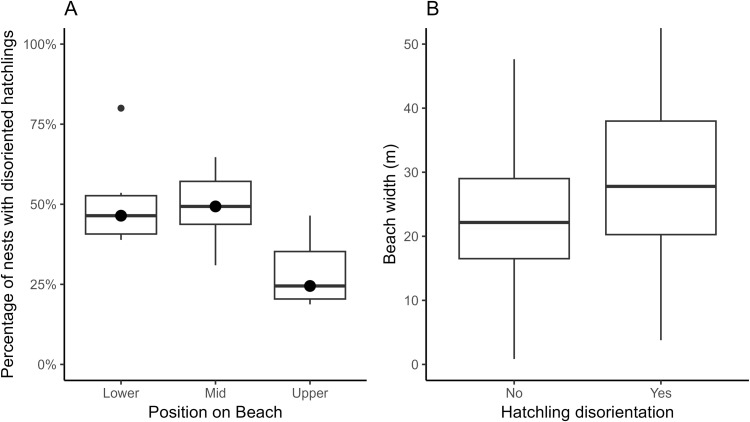
- Nests in the upper beach position were significantly less likely to disorient than mid-beach nests (estimate = 0.83, Z = 4.29, p < 0.001), and had lower disorientation severity (estimate = 0.78, Z = 4.77, p < 0.001); wider beaches were associated with higher disorientation probability (estimate = 0.04, Z = 4.34, p < 0.001) and severity (estimate = 0.03, Z = 4.11, p < 0.001).
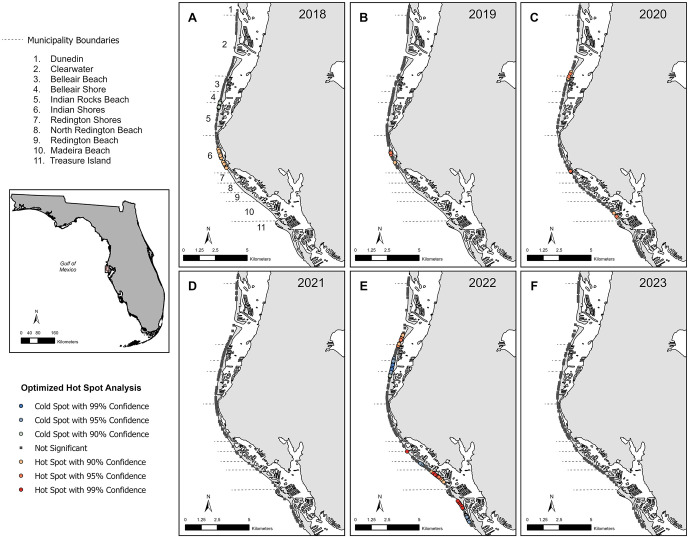
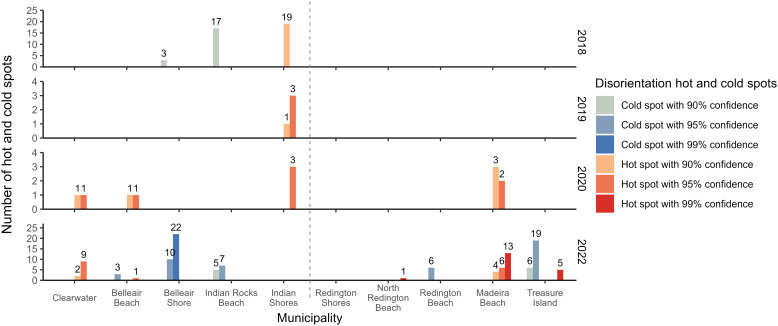
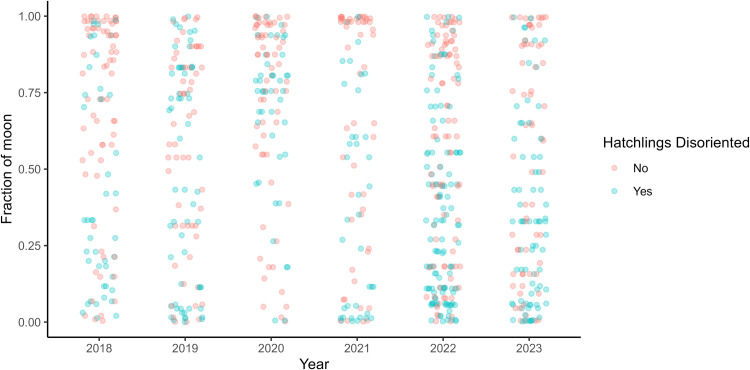
- Disorientation increased over the six-year period when year was continuous (probability estimate = 0.26, Z = 5.89, p < 0.001; severity estimate = 0.27, Z = 7.08, p < 0.001), and disorientation was more common on darker nights: mean lunar fraction was 0.6 ± 0.3 for non-disorientation events versus 0.4 ± 0.3 for disorientation events (W = 98700, p < 0.001), with severity increasing as moonlight decreased (ρ = −0.27, S = 944304, p < 0.001). Hot spot clustering peaked in 2022, while 2021 and 2023 had no significant hot or cold spots.
Methods
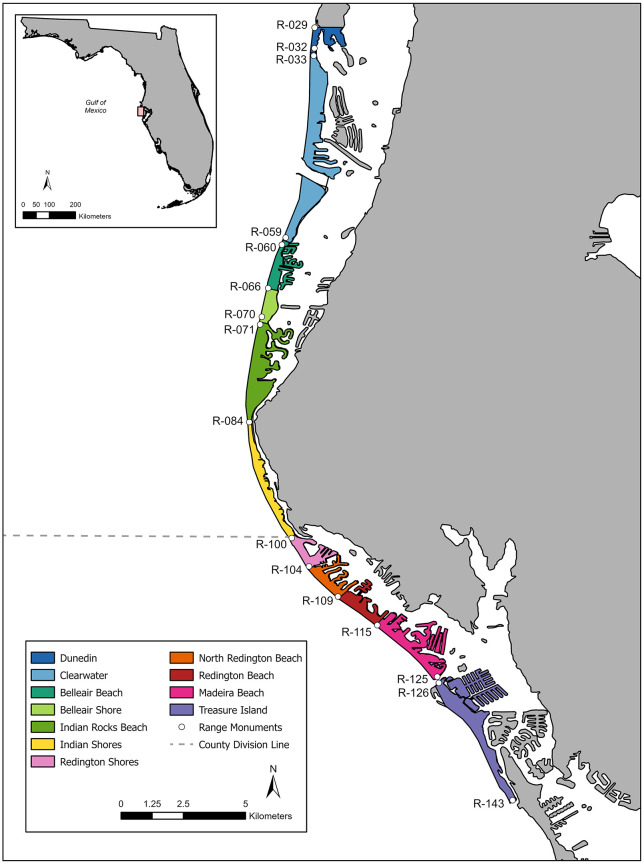
- Nesting surveys were conducted daily from April 15 to October 31, 2018–2023, by Clearwater Marine Aquarium across 33.59 km of barrier island beaches in north and central Pinellas County, Florida, using FWC nest and disorientation data; central Pinellas County was not surveyed in 2018 and 2019 because Permit #013 was not held.
- Disorientation occurrence was modeled with binomial GLMMs and severity, defined as the proportion of emerged hatchlings disoriented, with beta-binomial GLMMs; predictors included beach width, distance from the upland barrier, beach position, month, and year, with five nests excluded from severity analysis because the percentage disoriented was unknown.
- Spatial clustering was assessed with Optimized Hot Spot Analysis (Getis-Ord Gi*) independently by year for 1043 nests with known percentage emerged hatchlings; moonlight analyses used the moonlit R package, Wilcoxon rank-sum tests, and Spearman correlation.
Limitations
- Stated in the paper: disoriented hatchling counts are estimated from tracks that can be obscured by human traffic or weather, so the number reaching the water is likely underestimated; the small sample size of lower-beach nests limits inference for that position and may bias comparisons; light barriers were used on only 23 nests, with 5 of 377 disorientation events on barrier-equipped nests, so their effectiveness could not be concluded.
- Stated in the paper: municipality was initially evaluated as a random effect but excluded because several municipalities had very few nests, producing unstable estimates; 2021 and 2023 had the smallest samples and no significant hot or cold spots, and storm-related nest loss may have reduced statistical power and spatial autocorrelation for OHSA; the six-year period cannot support long-term trend inference.
- Evident from the text: the study is observational and does not directly measure artificial light type, wavelength, or brightness at individual nest sites; the authors note future data collection could include dune characteristics and site-level artificial light information, and OHSA identifies spatial clustering rather than overall disorientation rates, so years without hot spots may still have high disorientation.
Model-written summary. Check it against the paper before relying on it.
Integrity signals
Registry
Cites
Statistics
Figures
Verification
Claims the paper makes
0 Valid · 0 Not valid · 47 Not checked · 111 Own results and interpretations
A result the paper reports from its own data — it cites no other source for it, so there is none to check. The quote shows it is in the paper.
In the paper
“Nests located in the upper portion of the beach were significantly less likely to result in disoriented hatchlings compared to the middle portion.”
§ Disorientation patterns of loggerhead sea turtle (Caretta caretta) hatchlings in Pinellas County, Florida, USA > Abstract
plainstates an association- Asserted: passes — The authors put it forward as true.
- Checkable: passes — It can be checked against evidence.
- Load-bearing: passes — The paper’s conclusions depend on it.
- Based: passes — The paper gives a reason why it holds.
A result the paper reports from its own data — it cites no other source for it, so there is none to check. The quote shows it is in the paper.
In the paper
“Spatiotemporal analysis identified areas of hot and cold spots of disoriented hatchlings across different beaches in Pinellas County, Florida, USA, with significant spatial variations of disorientations across years, with 2022 having peaks in spatial clustering and 2021 and 2023 having no clustering.”
§ Disorientation patterns of loggerhead sea turtle (Caretta caretta) hatchlings in Pinellas County, Florida, USA > Abstract
plain- Asserted: passes — The authors put it forward as true.
- Checkable: passes — It can be checked against evidence.
- Load-bearing: unclear — It is unclear whether the paper’s conclusions depend on it.
- Based: passes — The paper gives a reason why it holds.
A result the paper reports from its own data — it cites no other source for it, so there is none to check. The quote shows it is in the paper.
In the paper
“Moonlight was found to play a mitigating role, with significantly more disorientation events occurring on nights with lower moonlight exposure.”
§ Disorientation patterns of loggerhead sea turtle (Caretta caretta) hatchlings in Pinellas County, Florida, USA > Abstract
plainstates an association- Asserted: passes — The authors put it forward as true.
- Checkable: passes — It can be checked against evidence.
- Load-bearing: passes — The paper’s conclusions depend on it.
- Based: passes — The paper gives a reason why it holds.
A result the paper reports from its own data — it cites no other source for it, so there is none to check. The quote shows it is in the paper.
In the paper
“Spatiotemporal analysis identified areas of hot and cold spots of disoriented hatchlings across different beaches in Pinellas County, Florida, USA, with significant spatial variations of disorientations across years, with 2022 having peaks in spatial clustering and 2021 and 2023 having no clustering.”
§ Disorientation patterns of loggerhead sea turtle (Caretta caretta) hatchlings in Pinellas County, Florida, USA > Abstract
plain- Asserted: passes — The authors put it forward as true.
- Checkable: passes — It can be checked against evidence.
- Load-bearing: unclear — It is unclear whether the paper’s conclusions depend on it.
- Based: passes — The paper gives a reason why it holds.
92 more claims
Create a free account to see all 158 claims and to verify the 95 references still open.
- It may state two separate claims as one. 37
- Probably not a substantial claim. 30
Statistics that don’t add up
Each reported p-value recomputed from its test statistic and degrees of freedom, each partial η² from its F, and each ratio, mean difference or B printed with a p checked against its own confidence interval.
Rated minor: it would not touch a result — a value no result rests on, a p-value that stays on the same side of the significance level, or a conflict that is clerical, resolved elsewhere in the paper, or outside its own findings.
In the paper
“Z = 1.32, p = 0.18”
§ Disorientation patterns of loggerhead sea turtle (Caretta caretta) hatchlings in Pinellas County, Florida, USA > Results > Disorientation data
Reported p = .18 · recomputed p = .187
Statistics recomputed
Every reported test result, recomputed from its test statistic and degrees of freedom. A result shows as not adding up only once an independent check has confirmed it.
- Doesn’t add upz = 1.32reported p = .18 · recomputed p = .187
“Z = 1.32, p = .18”
- Consistentz = 4.29reported p < .001 · recomputed p < .001
“Z = 4.29, p < .001”
- Consistentz = 4.77reported p < .001 · recomputed p < .001
“Z = 4.77, p < .001”
- Consistentz = 4.34reported p < .001 · recomputed p < .001
“Z = 4.34, p < .001”
- Consistentz = 4.11reported p < .001 · recomputed p < .001
“Z = 4.11, p < .001”
4 more recomputed tests
Create a free account to see every test the Stats check recomputed.
Self-check
Percentages, sums and reported differences re-computed from the paper’s own numbers.
Each contradiction between two passages listed here was confirmed by an independent check.
Rated minor: it would not touch a result — a value no result rests on, a p-value that stays on the same side of the significance level, or a conflict that is clerical, resolved elsewhere in the paper, or outside its own findings.
In the paper
§ Disorientation patterns of loggerhead sea turtle (Caretta caretta) hatchlings in Pinellas County, Florida, USA > Results > Hot spot analysis
“Belleair Shore, Indian Rocks Beach, and Redington Beach consistently exhibited only cold spots”
§ Disorientation patterns of loggerhead sea turtle (Caretta caretta) hatchlings in Pinellas County, Florida, USA > Discussion
“Redington Beach had no hot or cold spots in any year”
Citations
Cites
Controlling the False Discovery Rate: A Practical and Powerful Approach to Multiple Testing
Benjamini, Y., & Hochberg, Y. (1995) · Journal of the Royal Statistical Society Series B: Statistical Methodology · doi:10.1111/j.2517-6161.1995.tb02031.x · Cited by 109,482
The Analysis of Spatial Association by Use of Distance Statistics
Getis, A., & Ord, J. K. (1992) · Geographical Analysis · doi:10.1111/j.1538-4632.1992.tb00261.x · Cited by 6,276
Orientation and Open-Sea Navigation in Sea Turtles
Lohmann, K. J., & Lohmann, C. M. F. (1996) · Journal of Experimental Biology · doi:10.1242/jeb.199.1.73 · Cited by 173
Tuxbury, S. M., & Salmon, M. (2005) · Biological Conservation · doi:10.1016/j.biocon.2004.04.022 · Cited by 162
Lorne, J., & Salmon, M. (2007) · Endangered Species Research · doi:10.3354/esr003023 · Cited by 138
Coastal light pollution and marine turtles: assessing the magnitude of the problem
Kamrowski, R., Limpus, C., Moloney, J., & Hamann, M. (2012) · Endangered Species Research · doi:10.3354/esr00462 · Cited by 104
Geomagnetic Orientation of Loggerhead Sea Turtles: Evidence for an Inclination Compass
Light, P., Salmon, M., & Lohmann, K. J. (1993) · Journal of Experimental Biology · doi:10.1242/jeb.182.1.1 · Cited by 102
Ceriani, S. A., Casale, P., Brost, M., Leone, E. H., & Witherington, B. E. (2019) · Ecosphere · doi:10.1002/ecs2.2936 · Cited by 101
Biologically meaningful moonlight measures and their application in ecological research
Śmielak, M. K. (2023) · Behavioral Ecology and Sociobiology · doi:10.1007/s00265-022-03287-2 · Cited by 85
Artificial light on water attracts turtle hatchlings during their near shore transit
Thums, M., Whiting, S. D., Reisser, J., Pendoley, K. L., Pattiaratchi, C. B., Proietti, M., Hetzel, Y., Fisher, R., & Meekan, M. G. (2016) · Royal Society Open Science · doi:10.1098/rsos.160142 · Cited by 81
Dimitriadis, C., Fournari – Konstantinidou, I., Sourbès, L., Koutsoubas, D., & Mazaris, A. D. (2018) · Ocean & Coastal Management · doi:10.1016/j.ocecoaman.2017.12.013 · Cited by 76
Behavior of loggerhead sea turtles on an urban beach. II. Hatchling orientation
Salmon, M., Tolbert, M. G., Painter, D. P., Goff, M., & Reiners, R. (1995) · Journal of Herpetology · doi:10.2307/1564740 · Cited by 76
Salmon, M., Wyneken, J., Fritz, E., & Lucas, M. (1992) · Behaviour · doi:10.1163/156853992x00309 · Cited by 74
Witherington, B. E., & Bjorndal, K. A. (1991) · Copeia · doi:10.2307/1446101 · Cited by 62
Artificial lighting and seafinding by loggerhead hatchlings: Evidence for lunar modulation.
Salmon, M., & Witherington, B. E. (1995) · Copeia · doi:10.2307/1447042 · Cited by 58
Wavelength preferences and brightness cues in the water-finding behaviour of sea turtles.
Osovsky, N., & Shettleworth, S. J. (1968) · Behaviour · doi:10.1163/156853968x00216 · Cited by 58
Conservation hotspots for marine turtle nesting in the United States based on coastal development
Fuentes, M. M. P. B., Gredzens, C., Bateman, B. L., Boettcher, R., Ceriani, S. A., Godfrey, M. H., Helmers, D., Ingram, D. K., Kamrowski, R. L., Pate, M., et al. (2016) · Ecological Applications · doi:10.1002/eap.1386 · Cited by 57
Rivas, M. L., Santidrián Tomillo, P., Diéguez Uribeondo, J., & Marco, A. (2015) · Journal of Experimental Marine Biology and Ecology · doi:10.1016/j.jembe.2014.12.001 · Cited by 51
Bourgeois, S., Gilot-Fromont, E., Viallefont, A., Boussamba, F., & Deem, S. L. (2009) · Biological Conservation · doi:10.1016/j.biocon.2008.09.028 · Cited by 51
Predation of leatherback turtle hatchlings during the crawl to the water
Tomillo, P. S., Paladino, F. V., Suss, J. S., & Spotila, J. R. (2010) · Chelonian Conservation and Biology · doi:10.2744/ccb-0789.1 · Cited by 51
Disorientation of loggerhead hatchlings by artificial road lighting
McFarlane, R. W. (1963) · Copeia · doi:10.2307/1441283 · Cited by 49
Influence of industrial light pollution on the sea-finding behaviour of flatback turtle hatchlings
Kamrowski, R. L., Limpus, C., Pendoley, K., & Hamann, M. (2015) · Wildlife Research · doi:10.1071/wr14155 · Cited by 47
Nest-to-surf mortality of loggerhead sea turtle (Caretta caretta) hatchlings on Florida’s east coast
Erb, V., & Wyneken, J. (2019) · Frontiers in Marine Science · doi:10.3389/fmars.2019.00271 · Cited by 43
Ocean-finding in marine turtles: The importance of low horizon elevation as an orientation cue
Limpus, C., & Kamrowski, R. L. (2013) · Behaviour · doi:10.1163/1568539x-00003083 · Cited by 39
Ehrhart, L., Redfoot, W., Bagley, D., & Mansfield, K. (2014) · Chelonian Conservation and Biology · doi:10.2744/ccb-1100.1 · Cited by 38
Orientation by hatchling loggerhead sea turtles Caretta caretta L. in a wave tank
Wyneken, J., Salmon, M., & Lohmann, K. J. (1990) · Journal of Experimental Marine Biology and Ecology · doi:10.1016/0022-0981(90)90037-d · Cited by 38
Berry, M., Booth, D. T., & Limpus, C. J. (2013) · Australian Journal of Zoology · doi:10.1071/zo13028 · Cited by 37
Photopic spectral sensitivity of green and loggerhead sea turtles
Levenson, D. H., Eckert, S. A., Crognale, M. A., Deegan, J. F., & Jacobs, G. H. (2004) · Copeia · doi:10.1643/cp-03-217r1 · Cited by 35
Cruz, L., Shillinger, G. L., Robinson, N. J., Tomillo, P. S., & Paladino, F. V. (2018) · Journal of Experimental Marine Biology and Ecology · doi:10.1016/j.jembe.2018.05.002 · Cited by 35
Robertson, K., Booth, D. T., & Limpus, C. J. (2016) · Wildlife Research · doi:10.1071/wr15138 · Cited by 28
Karnad, D., Isvaran, K., Kar, C. S., & Shanker, K. (2009) · Biological Conservation · doi:10.1016/j.biocon.2009.04.004 · Cited by 28
Nordstrom, B., James, M. C., & Worm, B. (2020) · PLoS ONE · doi:10.1371/journal.pone.0232628 · Cited by 26
Zerbe, K., Polit, C., McClain, S., & Cook, T. (2022) · International Journal of Disaster Risk Science · doi:10.1007/s13753-022-00396-4 · Cited by 25
Stanley, T. R., White, J. M., Teel, S., & Nicholas, M. (2020) · Frontiers in Marine Science · doi:10.3389/fmars.2020.00221 · Cited by 20
Jun, C., & Wang, P. (2022) · Journal of Coastal Research · doi:10.2112/jcoastres-d-21-00083.1 · Cited by 18
Kawamura, G., Naohara, T., Tanaka, Y., Nishi, T., & Anraku, K. (2009) · Marine and Freshwater Behaviour and Physiology · doi:10.1080/10236240802663580 · Cited by 18
Long, T. M., Eldridge, J., Hancock, J., Hirama, S., Kiltie, R., Koperski, M., & Trindell, R. N. (2022) · Coastal Management · doi:10.1080/08920753.2022.2022974 · Cited by 16
Pendoley, K., & Kamrowski, R. (2015) · Marine Ecology Progress Series · doi:10.3354/meps11305 · Cited by 15
Van Rhijn, F. A. (1979) · Marine Behaviour and Physiology · doi:10.1080/10236247909378558 · Cited by 15
Harsh, S., Lonsinger, R. C., & Gregory, A. J. (2022) · PLOS ONE · doi:10.1371/journal.pone.0274808 · Cited by 14
Forty years of monitoring increasing sea turtle relative abundance in the Gulf of Mexico
Lasala, J. A., Macksey, M. C., Mazzarella, K. T., Main, K. L., Foote, J. J., & Tucker, A. D. (2023) · Scientific Reports · doi:10.1038/s41598-023-43651-4 · Cited by 14
LaDue, C. A., Farinelli, S. M., Eranda, I., Jayasinghe, C., & Vandercone, R. P. G. (2021) · Sustainability · doi:10.3390/su132413707 · Cited by 13
Self-citationPankaew, K., & Milton, S. L. (2017) · Journal of Experimental Biology · doi:10.1242/jeb.165225 · Cited by 13
Cheng, J., Toledo Cossu, F., & Wang, P. (2021) · Shore & Beach · doi:10.34237/1008929 · Cited by 12
Hirama, S., Witherington, B., Kneifl, K., Sylvia, A., Wideroff, M., & Carthy, R. (2021) · Journal of Experimental Marine Biology and Ecology · doi:10.1016/j.jembe.2021.151568 · Cited by 11
Filtered Streetlights Attract Hatchling Marine Turtles
Sella, K. N., Salmon, M., & Witherington, B. E. (2006) · Chelonian Conservation and Biology · doi:10.2744/1071-8443(2006)5[255:fsahmt]2.0.co;2 · Cited by 11
Seafinding revisited: how hatchling marine turtles respond to natural lighting at a nesting beach
Celano, L., Sullivan, C., Field, A., & Salmon, M. (2018) · Journal of Comparative Physiology A · doi:10.1007/s00359-018-1299-4 · Cited by 11
Modeling Artificial Light Exposure after Vegetation Trimming at a Marine Turtle Nesting Beach
Barrett, M. A., & Nelson Sella, K. (2022) · Remote Sensing · doi:10.3390/rs14112702 · Cited by 8
Antonio, K. M. S., Burow, D., Cho, H. J., McCarthy, M. J., Medeiros, S. C., Zhou, Y., & Herrero, H. V. (2024) · Remote Sensing · doi:10.3390/rs16091557 · Cited by 8
Wang, P., Royer, E. L., & Gutierrez, S. M. (2024) · Shore & Beach · doi:10.34237/1009242 · Cited by 4
Fuentes-Farias, A. L., Gutiérrez-Ospina, G., Herrera, E. M., Camarena-Ramírez, V., Ochoa-Tovar, G., Mendoza-Torreblanca, J., Martínez-Méndez, R., Urrutia-Fucugauchi, J., Báez-Saldaña, A., & Zepeda, M. L. G. (2011) · Advances in Bioscience and Biotechnology · doi:10.4236/abb.2011.22008 · Cited by 4
Hirama, S., Witherington, B., Hirsch, S., Sylvia, A., & Carthy, R. (2023) · Marine and Freshwater Research · doi:10.1071/mf23052 · Cited by 1
Witherington, B. E., & Martin, R. E. (2014) · Florida Fish and Wildlife Conservation Commission · doi:10.6095/h6pq-3k22
Research works printed but not linked: 6
- Witherington BE, Martin RE, Trindell RN. Understanding, assessing, and resolving light-pollution problems on sea turtle nesting beaches. 2nd ed.rev. Florida Marine Research Institute Technical Report TR-2; 2014.
- FWC - Florida Fish and Wildlife Conservation Commission. Chapter 62B-55: Model Lighting Ordinance for Marine Turtle Protection. Florida Administrative Code; 2025. Available from: www.flrules.org
- FWC - Florida Fish and Wildlife Conservation Commission. Marine turtle conservation handbook. Tallahassee, USA: Florida Fish and Wildlife Conservation Commission; 2016
- McNally K, Flynn L, Davila M, Oakley C, Vorbroker D, Lasala J. Nesting trends of sea turtles in north and mid Pinellas County, Florida, USA, over three decades. Herpetol Conserv Biol. 2024; 19(3): 440– 53.
- ESRI. ArcGIS Pro, Version 3.3.0. Redlands (CA): Environmental Systems Research Institute; 2024.
- Mitchell A, Griffin LS. The Esri guide to GIS analysis: spatial measurements and statistics. 2nd ed. Redlands (CA): Esri Press; 2021.
Cited by
Vanleynseele, C., de Montgolfier, B., & Fournier, D. (2026) · SSRN Electronic Journal · doi:10.2139/ssrn.7067429
Metadata
- Authors
- McNally, K. L., Oakley, C., Davila, M., & Farinelli, S.
- Corresponding author
- McNally, Kerry L.
- Venue
- PLOS One
- Publisher
- Public Library of Science (PLoS)
- Published
- 2026-04-15
- Volume
- 21
- Issue
- 4
- Pages
- e0347104
- ISSN
- 1932-6203 (ISSN-L)
- PMC
- PMC13082619
- OpenAlex
- W7154534328
- Cited by
- 1
- References
- 53
- Citations by year
- 2026: 1
- FWCI
- 2.05
- Type
- journal article
- Language
- en
- Open access
- gold
- doi.org
- Licence
- Locations
- PLoS ONE (publishedVersion, cc-by)
- PubMed Central (publishedVersion, cc-by)
- PubMed (publishedVersion)
- DOAJ (DOAJ: Directory of Open Access Journals) (submittedVersion)
- Funders
- Knopf Foundation (N/A)
- Topics
- Physical Sciences › Environmental Science › Nature and Landscape Conservation › Turtle Biology and Conservation
- Physical Sciences › Environmental Science › Global and Planetary Change › Impact of Light on Environment and Health
- Physical Sciences › Environmental Science › Pollution › Microplastics and Plastic Pollution
- Keywords
- Caretta caretta, artificial light at night, moonlight, beach management, lighting regulations, Pinellas County, Florida
- MeSH terms
- Animals, Florida, Lighting, Nesting Behavior, Orientation, Turtles
About these checks
Registry, retraction, Cites and statistics results are computed, not judged, with one exception: a printed reference that no index lists is read once by a model before it counts as a citation error. Claims are extracted by a model and kept only when their quote appears verbatim in the text; each cited source is then checked, with a model’s help, for whether it says what the claim relies on. Those verdicts can be wrong — read the claim’s quote and the cited source before relying on one.
A language model drew the claims from the paper on 2026-11-24, under version 3 of the claim definition (model deepseek-v4.1-flash, prompt extract-v3).
A second model labelled each claim on 2026-11-24 (model jev-1.13-20260917, definition revision gold-guideline-v0.2).
Statistics and arithmetic are recomputed, not judged.
Confidence bands are shown only for fields calibrated on our annotated test set. None is calibrated yet, so no band is shown.
What counts as a claim ›How we measure confidence ›How we check this ›
Are you an author, or do you see a problem with this page? Request a review
Data sources
Bibliographic data: Semantic Scholar, OpenAlex, Crossref.
Contains information from the Semantic Scholar Academic Graph Datasets, made available under the ODC Attribution License (ODC-BY 1.0).
Semantic Scholar’s data is described in: Kinney, R., et al. (2023). The Semantic Scholar Open Data Platform. arXiv:2301.10140.
