

Comparative Assessment of the Quality Control Measurements of Multisource Ofloxacin Tablets Marketed in Nigeria
Open accessThe DOI matches its Crossref record; 12 of the 12 references it cites were found in a registry or an index; none of the 12 sources its claims cite is checked for support yet.
Abstract
This study aimed at evaluating some quality control parameters to compare the quality, safety, and efficacy of nine brands of ofloxacin tablets available in the Nigerian market. The physicochemical parameters and assay of the nine brands of ofloxacin tablets were assessed through the evaluation of uniformity of tablet weight, friability, hardness, disintegration, and assay of active ingredients according to established methods. The dissolution rate and disintegration time were determined in simulated gastric fluid (SGF) and simulated intestinal fluid (SIF) without enzymes. The concepts of dissolution efficiency (DE) and predicted availability equivalence (PAE) were used to estimate the likely in vivo bioavailability. All brands complied with the official specification for uniformity of weight, friability, and disintegration. The disintegration test revealed that the drugs had higher disintegration times in SGF (7.0 0.95) relative to those in SIF (5.0 2.55). The dissolution profiles in SGF showed that only one sample attained 70% dissolution in less than 45 min and the other 5 samples in 1 h, while in SIF, four samples attained 70% dissolution in 45 min and all samples in 1 h. The UV spectrophotometric assay of ofloxacin tablets revealed that three samples contained over 95% (w/w) of labeled chemical content. The PAE in SGF indicated over 90% release from five samples, while it revealed over 70% release in SIF from three samples out of the aforementioned. Only four of the brands considered in this study demonstrated comparable quality standards. The method is simple and rugged for both routine analysis and evaluation of the dissolution pattern of ofloxacin tablets as in vitro tests for batch-to-batch quality control assessment.
Overview
CoChat Summary
## TL;DR
This study compared nine 200 mg ofloxacin tablet brands marketed in Nigeria using quality-control tests and dissolution in simulated gastric and intestinal fluids. All brands passed weight uniformity, friability, and disintegration, but only four brands were judged to have comparable overall quality and interchangeability based on dissolution and predicted availability equivalence.
## Key findings
- All nine brands complied with official specifications for uniformity of weight, friability, and disintegration; disintegration times were shorter in SIF than SGF, with mean times of 7.0 ± 0.95 min in SGF and 5.0 ± 2.55 min in SIF.
- Tablet content assay gave chemical contents of 90.27–98.65% (w/w) across the nine brands; the paper notes that all were chemically equivalent because content was not less than 90% and not more than 100% (w/w).
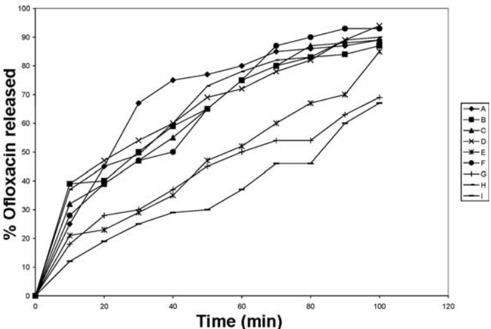
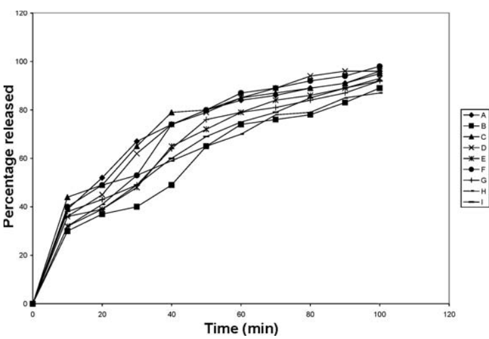
- Dissolution differed by medium: in SGF only one sample reached 70% dissolution in less than 45 min, while in SIF four samples reached 70% dissolution in 45 min and all samples did so in 1 h.
- The paper reports PAE values of 54.3–100% in SGF and 86.20–102.1% in SIF; brands B, C, and D were described as interchangeable with innovator product A based on PAE, while H and I were not comparable.
## Methods
- Nine brands of ofloxacin 200 mg tablets were purchased from a retail pharmacy in Uyo, Akwa Ibom State, Nigeria and tested before expiry.
- Quality-control tests included visual inspection, friability, hardness, uniformity of weight, disintegration, dissolution in simulated gastric fluid (SGF) and simulated intestinal fluid (SIF), and UV spectrophotometric assay at 315 nm.
- Dissolution was measured with 900 mL medium at 37 ± 0.5 °C and 100 rpm; analysis used F-test with P < 0.2 considered significant, plus dissolution efficiency (DE) and predicted availability equivalence (PAE) calculations.
## Limitations
- The paper states that therapeutic equivalence must still be investigated by challenging susceptible microorganisms; thus, the study is limited to in vitro quality-control measures.
- It does not report a full bioequivalence or in vivo pharmacokinetic study, which is evident from the text’s reliance on in vitro dissolution and PAE as predictors.
- The text provided is incomplete in places (for example, one abstract sentence and some formulas/tables are truncated), so some details of the analysis are not fully stated in the paper text here.
Model-written summary. Check it against the paper before relying on it.
Integrity signals
Registry
Cites
Statistics
Figures
Verification
Claims the paper makes
0 Valid · 0 Not valid · 10 Not checked · 33 Own results and interpretations
A result the paper reports from its own data — it cites no other source for it, so there is none to check. The quote shows it is in the paper.
In the paper
“Brands A, C, D, F, and G, however, had ≥ 70% release in SIF”
plain- Asserted: passes — The authors put it forward as true.
- Checkable: passes — It can be checked against evidence.
- Load-bearing: passes — The paper’s conclusions depend on it.
- Based: passes — The paper gives a reason why it holds.
A result the paper reports from its own data — it cites no other source for it, so there is none to check. The quote shows it is in the paper.
In the paper
“Brands E, G, and I had ≤ 70% dissolution in one hour in simulated gastric fluid”
plain- Asserted: passes — The authors put it forward as true.
- Checkable: passes — It can be checked against evidence.
- Load-bearing: passes — The paper’s conclusions depend on it.
- Based: passes — The paper gives a reason why it holds.
A result the paper reports from its own data — it cites no other source for it, so there is none to check. The quote shows it is in the paper.
In the paper
“Four brands (i.e., B, E, H, and I) did not achieve 70% dissolution in 45 min in simulated gastric fluid and simulated intestinal fluid”
plain- Asserted: passes — The authors put it forward as true.
- Checkable: passes — It can be checked against evidence.
- Load-bearing: passes — The paper’s conclusions depend on it.
- Based: passes — The paper gives a reason why it holds.
A result the paper reports from its own data — it cites no other source for it, so there is none to check. The quote shows it is in the paper.
In the paper
“and that of product I was 54.3% and 86.2%”
plain- Asserted: passes — The authors put it forward as true.
- Checkable: passes — It can be checked against evidence.
- Load-bearing: passes — The paper’s conclusions depend on it.
- Based: passes — The paper gives a reason why it holds.
A result the paper reports from its own data — it cites no other source for it, so there is none to check. The quote shows it is in the paper.
In the paper
“The observed disintegration times for all the brands of ofloxacin investigated were less than the 15-min limit prescribed by the official compendium (Table 2).”
plain- Asserted: passes — The authors put it forward as true.
- Checkable: passes — It can be checked against evidence.
- Load-bearing: unclear — It is unclear whether the paper’s conclusions depend on it.
- Based: passes — The paper gives a reason why it holds.
25 more claims
Create a free account to see all 43 claims and every source verdict.
- It may state two separate claims as one. 7
- Probably not a substantial claim. 8
Self-check
Percentages, sums and reported differences re-computed from the paper’s own numbers.
Each contradiction between two passages listed here was confirmed by an independent check.
Rated minor: it would not touch a result — a value no result rests on, a p-value that stays on the same side of the significance level, or a conflict that is clerical, resolved elsewhere in the paper, or outside its own findings.
In the paper
§ ABSTRACT
“The disintegration test revealed that the drugs had higher disintegration times in SGF (7.0 ± 0.95) relative to those in SIF (5.0 ± 2.55).”
§ Dissolution Rate Determination
“| A | 5.0 ± 2.3 | 7.0 ±0.9 | 4.6 ± 0.2 | 232.30 ± 0.01 | 0.025 | 97.3 ± 1.2 | | B | 5.0 ± 0.2 | 6.0 ± 0.9 | 6.8 ± 0.5 | 220.50 ± 0.01 | 0.035 | 92.5 ± 0.5 |”
Citations
Cites
Abramson, M. H. (1996) · The Endocrinologist · doi:10.1097/00019616-199603000-00014 · Cited by 1,400
(1996) · Pharmaceutical technology · Cited by 1,115
Dissolution Testing as a Prognostic Tool for Oral Drug Absorption: Immediate Release Dosage Forms
Dressman, J. B., Amidon, G. L., Reppas, C., & Shah, V. P. (1998) · Pharmaceutical Research · doi:10.1023/a:1011984216775 · Cited by 1,097
Dissolution Media Simulating Conditions in the Proximal Human Gastrointestinal Tract: An Update
Jantratid, E., Janssen, N., Reppas, C., & Dressman, J. B. (2008) · Pharmaceutical Research · doi:10.1007/s11095-008-9569-4 · Cited by 764
United States Pharmacopeia and National Formulary (USP-NF)
(2008) · Encyclopedia of Global Health · doi:10.4135/9781412963855.n1200 · Cited by 463
Effects of Food on Drug Absorption
Welling, P. G. (1996) · Annual Review of Nutrition · doi:10.1146/annurev.nu.16.070196.002123 · Cited by 200
(1995) · doi:10.1016/0924-8579(94)00064-2 · Cited by 37 · cited 1×
“Such unacceptable trends were exhibited in some drug products including metronidazole and metformin tablets (3).”
BackgroundClinical Overview of the Newer 4-Quinolone Antibacterial Agents
ANDRIOLE, V. T. (1988) · The Quinolones · doi:10.1016/b978-0-12-059515-0.50009-3 · Cited by 33
Osadebe, P. O., & Akabogu, I. C. (2004) · PubMed · Cited by 14
Effects of Food on Drug Absorption
Welling, P. G. (1996) · Annual Review of Nutrition · doi:10.1146/annurev.nutr.16.1.383 · Cited by 11
Research works printed but not linked: 4
- [1]1. Olaniyi, A. A.; Babalola, C. P .; Oladehinde, F. O.; Adegoke, A. O. Towards Better Quality Assurance of Drugs. Proceedings of 4th National Workshop, Department of Pharmaceutical Chemistry, University of Ibadan, Ibadan, Nigeria, 2001; pp 59-60.
- [2]2. Remington : the Science and Practice of Pharmacy , 20th ed.; Troy, D. B., Ed.; Lippincott Williams & Wilkins: Philadelphia, 2001; pp 473-474.
- [4]4. Babalola, C. P . Bioavailability and Bioequivalence (BA/ BE) Assessment. In Towards Better Quality Assurance of Drugs in the 3rd Millennium. Biopharmaceutical Methods in Drug Quality Assurance, 1st ed.; Olaniyi, A. A., Babalola, C. P ., Oladehinde, F. O., Adegoke, A. O., Eds.; Omoadade Printing Press: Ibadan, Nigeria, 2004 ; p 79.
- [11]11. Voegele, D. Drug release in vitro: An aid in clinical trials? Met. Find. Exp. Clin. Pharmacol . 1992 , 21 (1), 55-62.
Cited by
Karmakar, P., & Kibria, M. G. (2012) · International Current Pharmaceutical Journal · doi:10.3329/icpj.v1i5.10282 · Cited by 39
“All of these parameters are closely related to each other and have effect on drug absorption, bioavailability etc. (Awofisayo et al., 2010; Jain et al., 2012).”
BackgroundAkinleye, M. O., Adelaja, I. A., & Odulaja, J. O. (2012) · Cited by 18
Review of the Quality of Pediatric Medications in Developing Countries
Conway, J., Bero, L. A., Ondari, C. O., & Wasan, K. M. (2013) · Journal of Pharmaceutical Sciences · doi:10.1002/jps.23474 · Cited by 16
Opuntia ficus-indica L. Mill Residues—Properties and Application Possibilities in Food Supplements
Manzur-Valdespino, S., Ramírez‐Moreno, E., Arias‐Rico, J., et al. (2020) · Applied Sciences · doi:10.3390/app10093260 · Cited by 14
“In the pharmaceutical manufacturing process, quality evaluations (of uniformity, hardness, friability, and disintegration, among others) are performed to avoid variation from the pharmacopoeia limits [37].”
BackgroundShraim, N. Y., Hamawi, T., Hummaid, S., et al. (2018) · Palestinian medical and pharmaceutical journal/Palestinian medical & pharmaceutical journal · doi:10.59049/2790-0231.1024 · Cited by 8
“Dissolution testing of drug products plays an important role as a QC tool to monitor batchto-batch consistency of drug release from a dosage form and as an in vitro surrogate for in vivo performance (27).”
Metadata
- Authors
- Awofisayo, S. O., Awofisayo, O. A., Eyen, N., & Udoh, I. E.
- Affiliations
- University of Uyo (NG)
- Akwa Ibom State Polytechnic (NG)
- Venue
- Dissolution Technologies
- Publisher
- Dissolution Technologies
- Published
- 2010
- Volume
- 17
- Issue
- 2
- Pages
- 20-25
- ISSN
- 1521-298X (ISSN-L)
- OpenAlex
- W2326954628
- Semantic Scholar
- 0e57d0c30a8f0b3446bb68af1794a24435ff63d3
- Cited by
- 20
- References
- 8
- Citations by year
- 2023: 1 · 2021: 2 · 2020: 4 · 2018: 4 · 2017: 1 · 2014: 2 · 2013: 2 · 2012: 3
- FWCI
- 1.90
- Type
- journal article
- Language
- en
- Open access
- bronze
- doi.org
- Locations
- Dissolution Technologies (publishedVersion)
- Topics
- Health Sciences › Medicine › Public Health, Environmental and Occupational Health › Pharmaceutical Quality and Counterfeiting
- Physical Sciences › Chemistry › Analytical Chemistry › Analytical Methods in Pharmaceuticals
- Social Sciences › Economics, Econometrics and Finance › Economics and Econometrics › Pharmaceutical Economics and Policy
- Keywords
- pharmaceutical quality control, tablet disintegration, dissolution rate, simulated gastric fluid, simulated intestinal fluid, dissolution efficiency, bioavailability prediction, tablet weight uniformity, friability, hardness, UV spectrophotometric assay
About these checks
Registry, retraction, Cites and statistics results are computed, not judged, with one exception: a printed reference that no index lists is read once by a model before it counts as a citation error. Claims are extracted by a model and kept only when their quote appears verbatim in the text; each cited source is then checked, with a model’s help, for whether it says what the claim relies on. Those verdicts can be wrong — read the claim’s quote and the cited source before relying on one.
A language model drew the claims from the paper on 2026-10-10, under version 3 of the claim definition (model deepseek-v4.1-flash, prompt extract-v3).
A second model labelled each claim on 2026-10-10 (model jev-1.13-20260917, definition revision gold-guideline-v0.2).
Statistics and arithmetic are recomputed, not judged.
Confidence bands are shown only for fields calibrated on our annotated test set. None is calibrated yet, so no band is shown.
What counts as a claim ›How we measure confidence ›How we check this ›
Are you an author, or do you see a problem with this page? Request a review
How to cite
Cite CoChat for the checks on this page, and the paper for its own findings.
- This page
- CoChat. (2026). Citation check: Comparative Assessment of the Quality Control Measurements of Multisource Ofloxacin Tablets Marketed in Nigeria. https://app.cochat.ai/papers/10.14227/dt170210p20
- The paper
- Awofisayo, S. O., Awofisayo, O. A., Eyen, N., & Udoh, I. E. (2010). Comparative Assessment of the Quality Control Measurements of Multisource Ofloxacin Tablets Marketed in Nigeria. Dissolution Technologies. https://doi.org/10.14227/dt170210p20
Data sources
Bibliographic data: Semantic Scholar, OpenAlex, Crossref.
Contains information from the Semantic Scholar Academic Graph Datasets, made available under the ODC Attribution License (ODC-BY 1.0).
Semantic Scholar’s data is described in: Kinney, R., et al. (2023). The Semantic Scholar Open Data Platform. arXiv:2301.10140.
