

The DOI matches its Crossref record; 2 of the 2 references it cites were found in a registry or an index.
Progressive Cholestasis and Biliary Cirrhosis After Initiating Oral Semaglutide: Report From the Drug-Induced Liver Injury Network
Abstract
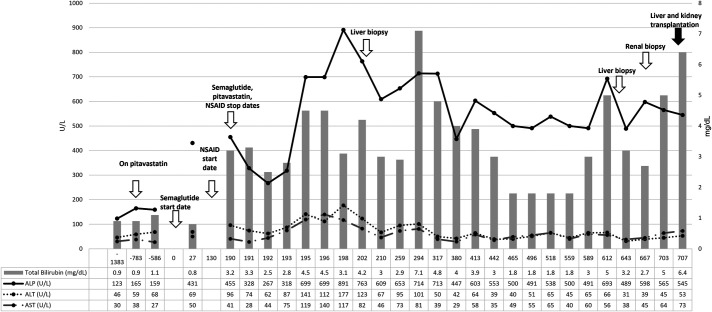
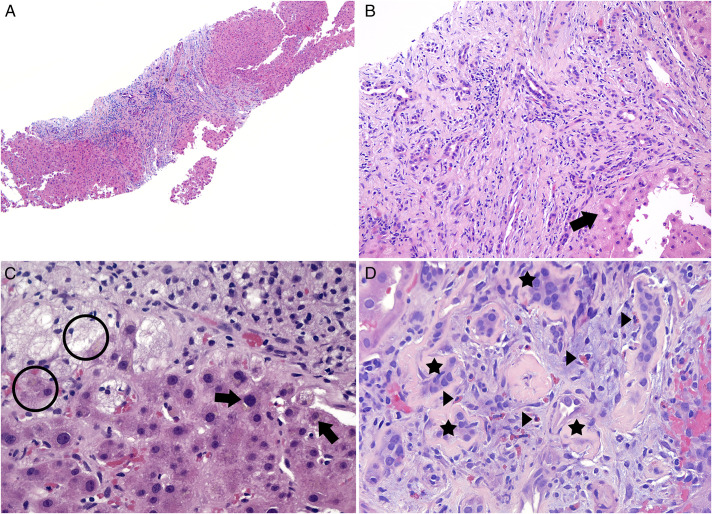
Semaglutide has little hepatic metabolism and is deemed low risk for causing drug-induced liver injury (DILI). We present a case of DILI from the US DILI Network. The case involved a 51-year-old man with type 2 diabetes who presented with jaundice and acute-on-chronic kidney disease 6 months after starting oral semaglutide. His liver injury progressed to biliary cirrhosis, accompanied by nephritis that led to end-stage renal disease. Extensive evaluations including liver and kidney biopsies revealed no alternative etiologies. Cholestatic gene sequencing revealed heterozygosity for ABCC2 and DHCR7 . He eventually underwent combined liver and kidney transplantation.
Overview
The claims and statistics of this paper haven’t been checked yet.
Run the check — free, no account needed. It reads the open-access text and checks the sources it cites.
Integrity signals
Registry
Cites
Statistics
Figures
Verification
Claims the paper makes
The claims and statistics of this paper haven’t been checked yet.
Run the check — free, no account needed. It reads the open-access text and checks the sources it cites.
Claims other papers make about this one
Each is checked against this paper’s own text: does it say what the citing paper says it does?
In the citing paper
“Despite their widespread use by millions of patients, there have only been a handful of DILI cases attributed to glucagon-like peptide-1 (GLP-1) receptor agonists, although cholecystitis is more frequent compared with placebo-treated patients.66–68”
From The contemporary epidemiology, causes, and management of drug-induced liver injury (2026) · cites this paper as [67]
Self-check
Percentages, sums and reported differences re-computed from the paper’s own numbers.
The self-check needs the paper’s full text.
Citations
Cites
Efficacy and safety of once-weekly semaglutide in adults with overweight or obesity: a meta-analysis
Zhong, P., Zeng, H., Huang, M., Fu, W., & Chen, Z. (2022) · Endocrine · doi:10.1007/s12020-021-02945-1 · Cited by 74
Yabe, D., Deenadayalan, S., Horio, H., Kaneto, H., Jensen, T. B., Terauchi, Y., Yamada, Y., & Inagaki, N. (2022) · Journal of Diabetes Investigation · doi:10.1111/jdi.13764 · Cited by 23
Research works printed but not linked: 14
- Warren, 2018, Semaglutide as a therapeutic option for elderly patients with type 2 diabetes: Pooled analysis of the SUSTAIN 1-5 trials, Diabetes Obes Metab., 20, 2291, 10.1111/dom.13331 · DOI
- Dhillon, 2018, Semaglutide: First global approval, Drugs., 78, 275, 10.1007/s40265-018-0871-0 · DOI · Paper page
- Powell, 2020, Oral semaglutide: The first-available noninjectable glucagon-like peptide 1 receptor agonist, Clin Ther., 42, 2100, 10.1016/j.clinthera.2020.07.017 · DOI
- 2019, Oral semaglutide (Rybelsus) for type 2 diabetes, Med Lett Drugs Ther, 61, 166
- Yin, 2021, Comprehensive analysis of the safety of semaglutide in type 2 diabetes: A meta-analysis of the SUSTAIN and PIONEER trials, Endocr J., 68, 739, 10.1507/endocrj.EJ21-0129 · DOI
- Leehey, 2021, Acute kidney injury associated with semaglutide, Kidney Med., 3, 282, 10.1016/j.xkme.2020.10.008 · DOI
- Chalasani, 2015, Features and outcomes of 899 patients with drug-induced liver injury: The DILIN prospective study, Gastroenterology., 148, 1340, 10.1053/j.gastro.2015.03.006 · DOI · Paper page
- Chalasani, 2008, Causes, clinical features, and outcomes from a prospective study of drug-induced liver injury in the United States, Gastroenterology., 135, 1924, 10.1053/j.gastro.2008.09.011 · DOI · Paper page
- Fontana, 2009, Drug-induced liver injury Network (DILIN) prospective study: Rationale, design and conduct, Drug Saf., 32, 55, 10.2165/00002018-200932010-00005 · DOI · Paper page
- Twarog, 2019, Intestinal permeation enhancers for oral delivery of macromolecules: A comparison between salcaprozate sodium (SNAC) and sodium caprate (C10), Pharmaceutics., 11, 78, 10.3390/pharmaceutics11020078 · DOI
- Ieiri, 2009, Genetic polymorphisms of uptake (OATP1B1, 1B3) and efflux (MRP2, BCRP) transporters: Implications for inter-individual differences in the pharmacokinetics and pharmacodynamics of statins and other clinically relevant drugs, Expert Opin Drug Metab Toxicol., 5, 703, 10.1517/17425250902976854 · DOI
- Keppler, 2017, Progress in the molecular characterization of hepatobiliary transporters, Dig Dis., 35, 197, 10.1159/000450911 · DOI · Paper page
- Witsch-Baumgartner, 2001, Mutations in the human DHCR7 gene, Hum Mutat., 17, 172, 10.1002/humu.2 · DOI
- Fitzky, 1998, Mutations in the Δ7-sterol reductase gene in patients with the Smith–Lemli–Opitz syndrome, Proc Natl Acad Sci U S A., 95, 8181, 10.1073/pnas.95.14.8181 · DOI · Paper page
Cited by
Semaglutide-Induced Liver Injury
Kalsi, H., Arora, S. S., Essilfie-Quaye, K., Bassi, R., Akhavan, N., Perbtani, Y., & Brar, T. S. (2025) · ACG Case Reports Journal · doi:10.14309/crj.0000000000001776 · Cited by 6
The contemporary epidemiology, causes, and management of drug-induced liver injury
Swanson, L., & Fontana, R. J. (2026) · Hepatology Communications · doi:10.1097/hc9.0000000000001011
Metadata
- Authors
- Ma, J., Mathur, K., Muldoon, J. L., Ghabril, M., Chalasani, N., & Vuppalanchi, R.
- Affiliations
- Division of Gastroenterology and Hepatology, Indiana University School of Medicine, Indianapolis, IN
- Department of Pathology, Indiana University School of Medicine, Indianapolis, IN
- ORCID
- Ma, Jiayi
- Venue
- ACG Case Reports Journal
- Published
- 2022-12
- Volume
- 9
- Issue
- 12
- Pages
- e00922
- ISSN
- 2326-3253
- PMC
- PMC9794239
- Cited by
- 12
- References
- 2
- Language
- en
About these checks
Registry, retraction, Cites and statistics results are computed, not judged, with one exception: a printed reference that no index lists is read once by a model before it counts as a citation error. Claims are extracted by a model and kept only when their quote appears verbatim in the text; each cited source is then checked, with a model’s help, for whether it says what the claim relies on. Those verdicts can be wrong — read the claim’s quote and the cited source before relying on one.
Statistics and arithmetic are recomputed, not judged.
Confidence bands are shown only for fields calibrated on our annotated test set. None is calibrated yet, so no band is shown.
What counts as a claim ›How we measure confidence ›How we check this ›
Are you an author, or do you see a problem with this page? Request a review
Data sources
Bibliographic data: Semantic Scholar, OpenAlex, Crossref.
Contains information from the Semantic Scholar Academic Graph Datasets, made available under the ODC Attribution License (ODC-BY 1.0).
Semantic Scholar’s data is described in: Kinney, R., et al. (2023). The Semantic Scholar Open Data Platform. arXiv:2301.10140.
