

Low Pepsinogen I/II Ratio and High Gastrin-17 Levels Typify Chronic Atrophic Autoimmune Gastritis Patients With Gastric Neuroendocrine Tumors
Open accessThe DOI matches its Crossref record; 34 of the 35 references it cites were found in a registry or an index.
Abstract
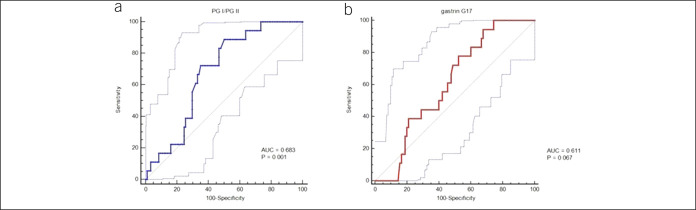
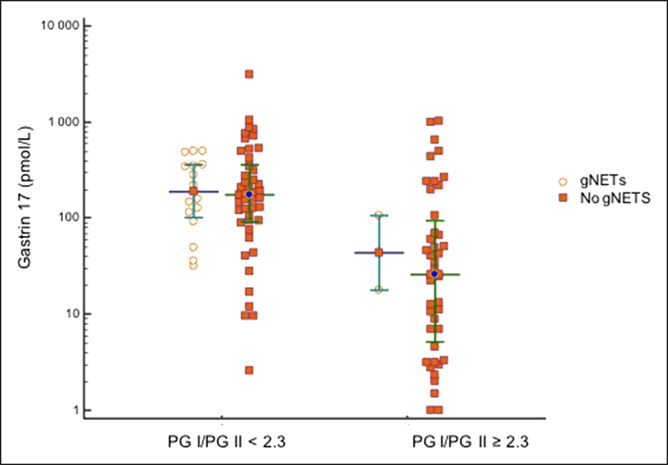
INTRODUCTION: Chronic atrophic autoimmune gastritis (CAAG) can lead to the development of gastric neuroendocrine tumors (gNETs) and can be accompanied by other autoimmune diseases. This study aimed to determine, in CAAG patients, the association of gNET development, the prevalence of autoimmune diseases other than CAAG, the association of autoimmunity, and gNET development with pepsinogen I, II, gastrin-17, and Helicobacter pylori infection analysis. METHODS: We determined the prevalence of gNETs and other autoimmune diseases and analyzed pepsinogen I and II, gastrin-17 serum levels, and H. pylori infection in all patients diagnosed with CAAG at our hospital between 2013 and 2017. RESULTS: A total of 156 patients were studied and in 15.4% was observed concomitant gNET. Approximately 68.6% had at least 1 other autoimmune disease at diagnosis of CAAG. Approximately 60.9% had autoimmune thyroiditis, followed by diabetes (19.9%) and autoimmune polyendocrine syndrome (12.8%). CAAG patients with and without gNET had similar rates of comorbidity with other autoimmune diseases, but the pepsinogen I/II ratio was lower in patients with gNET (1.6 vs 4.5, P = 0.018). Receiver operating characteristic curve analyses identified a pepsinogen I/II ratio <2.3 and gastrin-17 levels >29.6 pmol/L as cutoffs distinguishing CAAG patients with gNET from those without. The combined use of these cutoff correctly identified 16 of the 18 CAAG patients with gNET (P = 0.007). H. pylori infection was observed in 28.7% of cases tested but did not associate with gNET. DISCUSSION: This study suggests that a low pepsinogen I/II ratio and high gastrin-17 levels characterize patients with CAAG and gNET and confirms the frequent coexistence of CAAG with other autoimmune diseases.
Overview
The claims and statistics of this paper haven’t been checked yet.
Free: it reads the open-access text and checks the first 5 claims that cite a source we can check. Create a free account to check every claim.
Integrity signals
Registry
Cites
Statistics
Figures
Verification
Claims the paper makes
The claims and statistics of this paper haven’t been checked yet.
Free: it reads the open-access text and checks the first 5 claims that cite a source we can check. Create a free account to check every claim.
Claims other papers make about this one
Each is checked against this paper’s own text: does it say what the citing paper says it does?
The cited source says what the claim attributes to it.
In the citing paper
“Providers should recognize that there is an established association between AIG and other autoimmune diseases, especially autoimmune thyroid disease, perhaps related to shared genetic susceptibility loci.91–93”
From AGA Clinical Practice Update on the Diagnosis and Management of Atrophic Gastritis: Expert Review (2021) · cites this paper as [93]
Self-check
Percentages, sums and reported differences re-computed from the paper’s own numbers.
The self-check needs the paper’s full text.
Citations
Cites
Classification and Grading of Gastritis: The Updated Sydney System
Dixon, M. F., Genta, R. M., Yardley, J. H., & Correa, P. (1996) · The American Journal of Surgical Pathology · doi:10.1097/00000478-199610000-00001 · Cited by 5,185
The 2019 WHO classification of tumours of the digestive system
Nagtegaal, I. D., Odze, R. D., Klimstra, D., Paradis, V., Rugge, M., Schirmacher, P., Washington, K. M., Carneiro, F., Cree, I. A., & the WHO Classification of Tumours Editorial Board (2020) · Histopathology · doi:10.1111/his.13975 · Cited by 4,192
Samloff, I. M., Varis, K., Ihamäki, T., Siurala, M., & Rotter, J. I. (1982) · PubMed · Cited by 515
Relationships Among Serum Pepsinogen I, Serum Pepsinogen II, and Gastric Mucosal Histology
Samloff, I. M., Varis, K., Ihamaki, T., Siurala, M., & Rotter, J. I. (1982) · Gastroenterology · doi:10.1016/0016-5085(82)90176-7 · Cited by 414
Autoimmune atrophic gastritis—pathogenesis, pathology and management
Neumann, W. L., Coss, E., Rugge, M., & Genta, R. M. (2013) · Nature Reviews Gastroenterology & Hepatology · doi:10.1038/nrgastro.2013.101 · Cited by 406
Fallahi, P., Ferrari, S. M., Ruffilli, I., Elia, G., Biricotti, M., Vita, R., Benvenga, S., & Antonelli, A. (2016) · Autoimmunity Reviews · doi:10.1016/j.autrev.2016.09.009 · Cited by 217
Autoimmune Gastritis in Type 1 Diabetes: A Clinically Oriented Review
De Block, C. E. M., De Leeuw, I. H., & Van Gaal, L. F. (2008) · The Journal of Clinical Endocrinology & Metabolism · doi:10.1210/jc.2007-2134 · Cited by 212
Autoimmune Phenomena in Pernicious Anaemia
Doniach, D., Roitt, I. M., & Taylor, K. B. (1963) · BMJ · doi:10.1136/bmj.1.5342.1374 · Cited by 173
Diagnosis and classification of autoimmune gastritis
Toh, B. (2014) · Autoimmunity Reviews · doi:10.1016/j.autrev.2014.01.048 · Cited by 168
Risk for gastric neoplasias in patients with chronic atrophic gastritis: A critical reappraisal
Vannella, L., Lahner, E., & Annibale, B. (2012) · World Journal of Gastroenterology · doi:10.3748/wjg.v18.i12.1279 · Cited by 167
Cited by
AGA Clinical Practice Update on the Diagnosis and Management of Atrophic Gastritis: Expert Review
Shah, S. C., Piazuelo, M. B., Kuipers, E. J., & Li, D. (2021) · Gastroenterology · doi:10.1053/j.gastro.2021.06.078 · Cited by 560
Diagnostic criteria and endoscopic and histological findings of autoimmune gastritis in Japan
Kamada, T., Watanabe, H., Furuta, T., Terao, S., Maruyama, Y., Kawachi, H., Kushima, R., Chiba, T., & Haruma, K. (2023) · Journal of Gastroenterology · doi:10.1007/s00535-022-01954-9 · Cited by 98
Endoscopic features and clinical importance of autoimmune gastritis
Kamada, T., Maruyama, Y., Monobe, Y., & Haruma, K. (2021) · Digestive Endoscopy · doi:10.1111/den.14175 · Cited by 95
Guidelines for diagnosis and treatment of chronic gastritis in China (2022, Shanghai )
Fang, J.-Y. (2023) · Journal of Digestive Diseases · doi:10.1111/1751-2980.13193 · Cited by 66
“An increasing trend of gastrin-17 in patients with AIG has been reported.(125) Furthermore, studies have demonstrated a positive cor-”
BackgroundHu, H., Li, R., Shao, L., Zhang, Q., Xu, R., & Zhang, S. (2022) · Scandinavian Journal of Gastroenterology · doi:10.1080/00365521.2022.2081061 · Cited by 31
“An Italian study suggested that a low PGI/II ratio may characterize patients with AMAG and g-NETs [3].”
BackgroundUpdate in Molecular Aspects and Diagnosis of Autoimmune Gastritis
Iwamuro, M., Tanaka, T., & Otsuka, M. (2023) · Current Issues in Molecular Biology · doi:10.3390/cimb45070334 · Cited by 30
“6 pmol/L serves as a definitive approach to distinguish autoimmune gastritis patients with gastric neuroendocrine tumors from those without [55].”
BackgroundClinical value of serum pepsinogen in the diagnosis and treatment of gastric diseases
Qin, Y., Geng, J.-X., & Huang, B. (2023) · World Journal of Gastrointestinal Oncology · doi:10.4251/wjgo.v15.i7.1174 · Cited by 29
Autoimmune Gastritis and Hypochlorhydria: Known Concepts from a New Perspective
Vavallo, M., Cingolani, S., Cozza, G., Schiavone, F., Dottori, L., Palumbo, C., & Lahner, E. (2024) · International Journal of Molecular Sciences · doi:10.3390/ijms25136818 · Cited by 30
Update on Serum Biomarkers in Autoimmune Atrophic Gastritis
Dottori, L., Pivetta, G., Annibale, B., & Lahner, E. (2023) · Clinical Chemistry · doi:10.1093/clinchem/hvad082 · Cited by 30
Piezo channels in the intestinal tract
He, H., Zhou, J., Xu, X., Zhou, P., Zhong, H., & Liu, M. (2024) · Frontiers in Physiology · doi:10.3389/fphys.2024.1356317 · Cited by 28
Chapelle, N., Martin, J. P. D., Osmola, M., Hémont, C., Leroy, M., Vibet, M., Tougeron, D., Moussata, D., Lamarque, D., Bigot‐Corbel, E., et al. (2023) · Digestive and Liver Disease · doi:10.1016/j.dld.2023.03.015 · Cited by 25
New Developments in Gastric Neuroendocrine Neoplasms
Exarchou, K., Stephens, N. A., Moore, A. R., Howes, N., & Pritchard, D. M. (2022) · Current Oncology Reports · doi:10.1007/s11912-021-01175-y · Cited by 27
Update understanding on diagnosis and histopathological examination of atrophic gastritis: A review
Ma, X.-Z., Zhou, N., Luo, X., Guo, S.-Q., & Mai, P. (2024) · World Journal of Gastrointestinal Oncology · doi:10.4251/wjgo.v16.i10.4080 · Cited by 23
“Therefore, in CAAG, it appears reasonable to assess plasma G-1 annually, with endoscopy performed, if there is an increase, especially if it is significant (> 100 pg/mL)[45].”
Jove, A. G., Lin, C., Hwang, J. H., Balasubramanian, V., Fernandez‐Becker, N., & Huang, R. J. (2024) · The American Journal of Gastroenterology · doi:10.14309/ajg.0000000000003235 · Cited by 21
“To our knowledge, there are very limited number of studies evaluating gastrin concentrations in autoimmune gastritis, and these studies were mostly based in Europe (9,10).”
Proteomics signature of autoimmune atrophic gastritis: towards a link with gastric cancer
Repetto, O., Re, V. D., Giuffrida, P., Lenti, M. V., Magris, R., Venerito, M., Steffan, A., Sabatino, A. D., & Cannizzaro, R. (2021) · Gastric Cancer · doi:10.1007/s10120-020-01148-3 · Cited by 20
Self-citationLenti, M. V., Vanoli, A., Miceli, E., Arpa, G., Stefano, M. D., Soriano, S., Capuano, F., Gentile, A., Aronico, N., Coppola, L., et al. (2022) · Frontiers in Immunology · doi:10.3389/fimmu.2022.866167 · Cited by 16
“According to a recently published paper, fasting 17-gastrin levels well correlate with the diagnosis of overt AIG and type 1 gastric neuroendocrine tumors (35).”
BackgroundManagement of type 1 gastric neuroendocrine tumors: an 11-year retrospective single-center study
Chen, Y., Guo, W., Shi, Y., Su, F., Yu, F., Chen, R., Wang, C., Liu, J., Luo, J., & Tan, H. (2023) · BMC Gastroenterology · doi:10.1186/s12876-023-03079-6 · Cited by 18
“An analysis showed that approximately two-thirds of AIG patients were diagnosed with at least one other autoimmune disease, the most common being Hashimoto’s thy-roiditis and type 1 diabetes [23, 25].”
BackgroundAhn, S. M., Kim, T., Kushima, R., Lee, J. H., & Kim, K. (2024) · Gut and Liver · doi:10.5009/gnl240223 · Cited by 15
Chen, L., Wang, X., Li, J., Zhang, L., Wu, W., Wei, S., Zou, W., & Zhao, Y. (2025) · Frontiers in Pharmacology · doi:10.3389/fphar.2024.1499753 · Cited by 19
Zhao, J., Tian, W., Zhang, X., Dong, S., Shen, Y., Gao, X., Yang, M., Lv, J., Hu, F., Han, J., et al. (2024) · Biomarkers · doi:10.1080/1354750x.2024.2400927 · Cited by 12
“…to cooperate with epidemiological data investigation. exclusion criteria were: (1) Due to the rare occurrence of the autoimmune type, a distinct subgroup of patients with specific biomarkers gastrin G17 and pepsinogen (Magris et al. 2020), none of the autoimmune type were included in this study.”
Fornasarig, M., Capuano, A., Maiero, S., Pivetta, E., Guarnieri, G., Canzonieri, V., Zucchetto, A., Mongiat, M., Cannizzaro, R., & Spessotto, P. (2021) · Scientific Reports · doi:10.1038/s41598-021-00550-w · Cited by 12
Self-citationZhao, Y., Deng, Z., Ma, Z., Zhang, M., Wang, H., Tuo, B., Li, T., & Liu, X. (2022) · Biomedicine & Pharmacotherapy · doi:10.1016/j.biopha.2022.112660 · Cited by 9
Panozzo, M. P., Antico, A., & Bizzaro, N. (2025) · Journal of Translational Autoimmunity · doi:10.1016/j.jtauto.2025.100273 · Cited by 9
“Although PCAs may precede the appearance of atrophic lesions of the stomach for several years, their diagnostic use, if [81,84] Patients with both A-CAG and gNET have a lower PGI/PGII ratio and higher G17 levels than A-CAG without such tumors Determination of PGI, PGII and G17 may help to identify…”
A Prospective Study on the Detection of Gastric Neoplasms Using Pepsinogen and Gastrin-17 Levels
Lee, S., Moon, H., Ahn, Y. O., Song, J. H., Kim, J. H., & Sung, I. (2025) · Gut and Liver · doi:10.5009/gnl240544 · Cited by 8
“29 In that study, high G-17 levels of > 29.6 pmol/L and low I/II ratios of 2.3 indicated the presence of gastric NET in autoimmune gastritis patients.”
InfluentialLi, Y., Guo, W., Deng, C., Luo, J., Shi, Y., Zhu, D., Wei, Q.-L., Zhang, M.-G., Du, S., & Tan, H. (2025) · World Journal of Gastroenterology · doi:10.3748/wjg.v31.i41.111449 · Cited by 9
“In a previous study, H. pylori infection was detected in 28.7% of AIG cases and was not associated with gNETs[23].”
InfluentialJin, J.-Z., Liang, X., Liu, S.-P., Wang, R., Zhang, Q., Shen, Y., & Li, X. (2024) · World Journal of Gastrointestinal Oncology · doi:10.4251/wjgo.v17.i1.92908 · Cited by 7
Serum exosomal miR-122-5p, GAS, and PGR in the non-invasive diagnosis of CAG
Liu, N., Huang, Y., Liu, F., & Liu, H. (2021) · Open Medicine · doi:10.1515/med-2021-0342 · Cited by 6
“A cross-sectional study highlighted that GAS was upregulated in atrophic gastritis of southwest China, in line with previous studies, they intended to suggest that serum GAS was upregulated in atrophic gastritis patients [14,15].”
BackgroundResultEarly diagnosis of autoimmune gastritis
Ozhiganova, N. V., Владимировна, Б. А., & Кручинина, М. В. (2023) · Экспериментальная и клиническая гастроэнтерология · doi:10.31146/1682-8658-ecg-212-4-12-18 · Cited by 5
Five Autoimmune Gastritis Patients with Positive Findings of Serum Anti-parietal Cell Antibodies
Jeong, J. H., Lee, S., Han, H. S., Kim, J. H., Sung, I., & Park, H. S. (2021) · The Korean Journal of Helicobacter and Upper Gastrointestinal Research · doi:10.7704/kjhugr.2021.0016 · Cited by 6
“(enterochromaffin-like cell, ECL) 세포와 유문부의 G세포가 상대 적으로 활성화되면서 혈청 가스트린(gastrin) 수치가 상승한다.(4)”
Liu, Z., Wang, Y., Hong, J., He, F., Hao, L., Liu, L., & Zhai, H. (2025) · Clinics and Research in Hepatology and Gastroenterology · doi:10.1016/j.clinre.2025.102722 · Cited by 4
Clinicopathological characteristics of autoimmune gastritis: A single-center retrospective study
Wang, X., Lu, C.-J., Li, H., Zhang, J., Zheng, J., Wu, N., Yang, W.-L., Yu, J., & Huang, W.-F. (2023) · Clinics and Research in Hepatology and Gastroenterology · doi:10.1016/j.clinre.2023.102154 · Cited by 4
Autoimmune Gastritis: Unveiling the Mystery
Ahn, Y. H., & Kim, Y. S. (2025) · The Korean Journal of Helicobacter and Upper Gastrointestinal Research · doi:10.7704/kjhugr.2025.0011 · Cited by 3
“69 However, the accuracy of non-invasive markers for early gNEN diagnosis is relatively low, with a sensitivity of approximately 50% and a specificity of approximately 60%.”
An, F., Ge, Y., Ye, W., Ji, L., Chen, K., Wang, Y., Zhang, X., Dong, S., Shen, Y., Zhao, J., et al. (2024) · Cancer Biomarkers · doi:10.3233/cbm-240023 · Cited by 3
Genetic Determinants of Autoimmune Gastritis
Polyakova, V., Бодунова, Н. А., Rumyantsev, K. A., Хатьков, И. Е., Bordin, D. S., Bilyalov, A. I., Sviridov, P. S., & Yanova, T. I. (2023) · BioNanoScience · doi:10.1007/s12668-023-01068-3 · Cited by 3
Pacheco, A., Diedisheim, M., Goulvestre, C., Alexandre‐Heymann, L., Mallone, R., Dubois‐Laforgue, D., & Larger, É. (2025) · Diabetes & Metabolism · doi:10.1016/j.diabet.2025.101640 · Cited by 3
Dell’Unto, E., Panzuto, F., & Annibale, B. (2025) · The American Journal of Gastroenterology · doi:10.14309/ajg.0000000000003519 · Cited by 2
Autoimmune gastritis diagnosed due to recurrent gastric neuroendocrine tumor: a case report
Yang, Q., Jin, X., Lv, X., & Hu, J. (2025) · Frontiers in Medicine · doi:10.3389/fmed.2024.1519819 · Cited by 2
Jin, J., Zhang, H., Ding, S., & Zhang, J. (2026) · Surgical Endoscopy · doi:10.1007/s00464-026-12749-x · Cited by 1
“Studies have shown that patients with autoimmune meta-plastic atrophic gastritis who develop type 1 gNETs have significantly higher serum gastrin levels than those without gNETs [21, 22] [23], also found that gastrin levels can predict the recurrence of type 1 gNETs.”
Autoimmune Diseases of the GI Tract Part II: Emergence of Diagnostic Tools and Treatments
Al-Ruweidi, M. K. A. A., Khater, N., Alkaabi, H. R., Hasan, M., Murtaza, M., & Yalcin, H. C. (2022) · IntechOpen eBooks · doi:10.5772/intechopen.106185 · Cited by 1
Analyzing serological screening of the functional state of gastric mucosa in clinical practice
Владимировна, Б. А., Ozhiganova, N. V., Кручинина, М. В., Polonskaya, Y. V., & Щербакова, Л. В. (2024) · Bulletin of Siberian Medicine · doi:10.20538/1682-0363-2024-2-21-27 · Cited by 1
Biomarkers and OLGIM Stage for Prospective Preneoplastic Risk Stratification
Re, V. D., Vettori, R., & Cannizzaro, R. (2021) · Clinical Gastroenterology and Hepatology · doi:10.1016/j.cgh.2021.02.012
Self-citationCytokine profile in patients with atrophic gastritis in comorbidity with thyroid gland pathology
Mosiychuk, L. М., Tatarchuk, О. М., Konenko, I. S., & Петішко, О. П. (2022) · GASTROENTEROLOGY · doi:10.22141/2308-2097.56.3.2022.502
Jove, A. G., & Huang, R. J. (2025) · The American Journal of Gastroenterology · doi:10.14309/ajg.0000000000003578
Mario, F. D., Franceschi, M., Rodriguez-Castro, K. I., Panozzo, M. P., Russo, M., Ferronato, A., Violi, A., Franzoni, L., Tursi, A., Brandimarte, G., et al. (2025) · Journal of Gastrointestinal and Liver Diseases · doi:10.15403/jgld-6212
“…factor located in the upper area of gastric mucosa leading to CAG of the stomach body [ In AIG, hypo-or achlorhydria, elevated levels of gastrin and low concentration of serum pepsinogen (PG) I are the result of damage of oxyntic glands and the ensuing atrophy of the gastric body mucosa [33-35].”
Chen, Y.-Y., Guo, W., Shi, Y.-F., Su, F., Yu, F.-H., Chen, R.-A., Wang, C., Liu, J.-X., Luo, J., & Tan, H.-Y. (2024) · Figshare · doi:10.6084/m9.figshare.26654044
Chen, C., Meng, F., Shao, L., Zhang, S., Li, P., & Hu, H. (2026) · Journal of Translational Autoimmunity · doi:10.1016/j.jtauto.2026.100377
Xu, X., Qu, C.-K., Bao, L.-L., Zhang, Y., Wang, W.-J., & Ye, Y.-Q. (2026) · World Journal of Gastroenterology · doi:10.3748/wjg.121944
Rossi, R. E., Ferraris, M., Petronio, L., Masoni, B., Stefano, L. D., Bertuzzi, A. F., Fraticelli, S., Lania, A. G., Zerbi, A., Hassan, C., et al. (2026) · Frontiers in Endocrinology · doi:10.3389/fendo.2026.1880679
“In particular, Magris et al. (18) reported that AIG patients with T1gNETs were characterized by lower pepsinogen I/II ratio and higher gastrin-17 levels, whereas Campana et al. (13) identi fi ed CgA >61 U/L, intestinal metaplasia, and male sex as independent risk factors for T1gNETs.”
Influential
Metadata
- Authors
- Magris, R., De Re, V., Maiero, S., Fornasarig, M., Guarnieri, G., Caggiari, L., Mazzon, C., Zanette, G., Steffan, A., Canzonieri, V., & Cannizzaro, R.
- Affiliations
- Centro di Riferimento Oncologico (IT)
- Immunopathology and Cancer Biomarkers, Centro di Riferimento Oncologico di Aviano (CRO) IRCCS, Aviano, Italy;
- Azienda Ospedaliera Santa Maria Degli Angeli (IT)
- University of Trieste (IT)
- Corresponding author
- Cannizzaro, Renato
- ORCID
- Venue
- Clinical and Translational Gastroenterology
- Published
- 2020-09
- Volume
- 11
- Issue
- 9
- Pages
- e00238
- ISSN
- 2155-384X (ISSN-L)
- PMC
- PMC7494140
- OpenAlex
- W3093856850
- Semantic Scholar
- 655eded8381559592c49dfd5055df3be113fe04f
- Cited by
- 46
- References
- 35
- Citations by year
- 2026: 3 · 2025: 10 · 2024: 10 · 2023: 10 · 2022: 6 · 2021: 7
- FWCI
- 4.12
- Type
- journal article
- Language
- en
- Open access
- gold
- doi.org
- Locations
- Clinical and Translational Gastroenterology (publishedVersion, cc-by)
- PubMed Central (publishedVersion, cc-by)
- PubMed (publishedVersion)
- ArTS Archivio della ricerca di Trieste (University of Trieste https://www.units.it/) (submittedVersion, cc-by)
- Topics
- Health Sciences › Medicine › Oncology › Neuroendocrine Tumor Research Advances
- Health Sciences › Medicine › Gastroenterology › Helicobacter pylori-related gastroenterology studies
- Health Sciences › Medicine › Oncology › Gastric Cancer Management and Outcomes
- Keywords
- gastric neuroendocrine tumor, pepsinogen I/II ratio, gastrin-17, Helicobacter pylori infection, autoimmune disease comorbidity, autoimmune thyroiditis, autoimmune polyendocrine syndrome, diabetes mellitus, biomarker cut-off values
- MeSH terms
- Adolescent, Adult, Aged, Autoimmune Diseases, Diagnosis, Differential, Female, Gastrins, Gastritis, Atrophic, Humans, Male, Middle Aged, Retrospective Studies, ROC Curve, Stomach Neoplasms, Biomarkers, Prevalence, Helicobacter pylori, Helicobacter Infections, Neuroendocrine Tumors, Pepsinogen C, Pepsinogen A, Young Adult
About these checks
Registry, retraction, Cites and statistics results are computed, not judged, with one exception: a printed reference that no index lists is read once by a model before it counts as a citation error. Claims are extracted by a model and kept only when their quote appears verbatim in the text; each cited source is then checked, with a model’s help, for whether it says what the claim relies on. Those verdicts can be wrong — read the claim’s quote and the cited source before relying on one.
Statistics and arithmetic are recomputed, not judged.
Confidence bands are shown only for fields calibrated on our annotated test set. None is calibrated yet, so no band is shown.
What counts as a claim ›How we measure confidence ›How we check this ›
Are you an author, or do you see a problem with this page? Request a review
Data sources
Bibliographic data: Semantic Scholar, OpenAlex, Crossref.
Contains information from the Semantic Scholar Academic Graph Datasets, made available under the ODC Attribution License (ODC-BY 1.0).
Semantic Scholar’s data is described in: Kinney, R., et al. (2023). The Semantic Scholar Open Data Platform. arXiv:2301.10140.
